Man Dares to Do My Winter Chores | It's a Lot
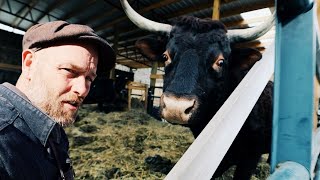
In this 2022 YouTube walkthrough, Victor (Speaker A) guides a guest, Luke, through the full suite of winter farm chores on a mixed‑species homestead. The video is a live, conversational tutorial that covers every step needed to keep the farm running while the owner is away. Victor demonstrates how to locate and use filters, jars, lids, and other small supplies, then moves on to feeding and watering protocols for cows, sheep, pigs, lambs, rabbits, chickens, and cats. He explains how to manage the wood‑burning boiler, load ash, monitor temperature, and stack firewood for morning and afternoon runs. Safety around the electric fence is emphasized, with detailed instructions on grounding, disconnecting, and testing the fence before handling animals. The walkthrough includes hands‑on animal handling: moving livestock, tying cows, milking, using a staff versus alfalfa for herding, and cleaning stalls with manure forks. Victor also shows how to flip hay, distribute wood chips, and manage hay‑flake feeding. Throughout, he stresses the importance of a checklist (food, water, security), redundancy (multiple water sources, spare tools), and automation (automatic waterers, feeders, door openers) to make a farm sitter’s job easier. He offers practical ergonomics tips for wheelbarrow use, knee‑friendly lifting, and proper hand‑washing to avoid zoonotic disease. The video ends with Victor confirming that Luke has successfully completed the tasks, reinforcing confidence and readiness for future solo work.
Chapters
First thing you do, you come in the house. Over here, you might have to get Grandma to help you. She will be here. If these aren't here, she'll have to help you find them. You need to grab filter. There's a ring that's not always there. You could have Grandma help you, but it could be in the dishwasher. It could be in this, uh, in this, and it could be in this, which also goes, which I don't see the lid for. You'll need that filter. Go ahead and grab this whole box because you're going to need that tape and pins later. And actually, Grandma will probably follow up with you on this because might as well show you how to do it in case they don't.
Okay, so they're handling feeding the lamb?
You take our feed? Yep. Lily will feed the lamb. Lily will probably help you milk even. Lily would take care of the rabbits.
Well, I always need a woman to give me some guidance in life.
You take—
I'm gonna let you do it. You take that and push it down in there. Perfect. That's probably the best way to learn, is that you just do.
All right, concur.
And there's—
is there one more?
It just—
it's just those two.
Now let's grab— let's grab— grab them with me. 6 jars. Again, on this one you'll coordinate with Grandma. If you're running out of jars, she'll probably bring you separate or something. Okay, here's the lid.
Okay, and there's one lid total.
Yep, put that inside of that. Got our lids ready for the— when we come back in, we've got our Take Sharpie, mark it. You need to get one more thing. Tumbler is usually right there. Okay, the tumbler is for warm water. Here, you come here, you do it for the cloth. Um, I put it on heat. Here, let you do that, and then spray 10 soaps in there. Kind of keep an eye on it to make sure it doesn't get too hot. We're on a wood boiler and it gets really— it gets 100 60 degrees. Just 10. Put the lid on it.
Um, so don't keep going away.
Let's do it. Let's go to 3/4. The more you put in there, the longer it lasts. There's a mess. You won't be able to get everything— the pig bucket and the milk supplies. Okay.
Uh, so me and Lily have to help.
You could have.
Would you do that? You go get the pig bucket. The cats, I don't know if this food gets stale.
Yeah, they want fresh stuff.
Yeah, so I just give it, I just give it to them. And then we have the food for it in here. If you run out, we'll have a supply inside that I can get Grandma to get for you. Oh, just try to do just a little bit. Notice how I have this bag rolled up in there. There's all these little things we just end up doing every single day. Kind of take it for granted, but we roll this up, get stale, and kind of hold it, put it in this way, put this bucket in such a way that it doesn't unravel.
They're out already, but they will normally not be out, or they will—
cows are out onto the concrete. That's— that'll be normal. Okay, so let's grab our cart. Hey, the wheels are all on. Are they off?
No, they're on.
Last time they weren't, were they? We have a stall of wood. We're gonna fill up that Henry cart pretty good. So it wasn't that cold last night, so there's wood in there. Okay, well, we should have looked and seen how much wood we needed. I was kind of assuming we would need a full Do you—
you don't use this for anything else, or do you?
What do you mean, the, the cart? Our wood?
Because you could leave the wood in it if it's underneath somewhere else, like the cart.
Yeah, we are going to use that cart a lot. Okay, so what we don't use, we'll stack right here so it'll be close for you next time. So you grab this, we try to kick some of these ashes down. There's a, there's an ash catch down here. Can we just stir it a little bit?
Okay.
You can— see the roll of hose?
Hose?
Hose.
Okay, it's like it needs to be open so they can get air.
See that? Yeah, see that? We need to open it up. I guess that's part of the fan system. Both sides.
We get into the intricacies of it.
Kind of— we're paying attention to the weather. Yeah, we'll load it accordingly. And this would have burnt down a little bit more because we wouldn't have loaded it as high. Yeah, we would have been able to clean it a little bit better just then. Okay, yeah, that makes sense. Come over here and pull this handle up. Oh look, you can lift this too. 182, that's really good. Okay, if that's below 140, you're probably running out of wood.
Okay, so this—
lift the handle up.
Yep.
And then you can open it.
Yep.
One here.
Okay.
And then one in the back.
See?
Okay. So there'll be two rows. One row here and then one row in the back. And then how high are you— how high is you gonna go?
Just as high.
Okay.
Whoa!
You know it's not gonna be very hot today?
Right.
So maybe let's not go all the way to the top so we can clean it out this afternoon. Because we'll load it twice.
Papa, can I burn this one?
We'll load it morning chores and afternoon chores. Yeah, go ahead. You can do like stack it on the rack.
Okay.
This is for your— this is for your next time. We're already right there with the cart. Yeah, the cart's empty. The hay's right here. You might as well grab some hay.
So how is it? You could do— was it 3 last time?
3 or 4 flakes, because you could have an inventory over there by the heifers. Okay, they don't need that. They maybe need 2 flakes. Watch out, Mr. Brown.
Don't put it on me.
Too big, too big. Gotta cut down.
Actually, that needs cut. Oh, okay.
Well, here you go.
You got a knife? Yeah.
Okay, good.
You better not get caught on a homestead without a knife, right?
And it'll be tied 3 times.
Of course. Look at me, I'm passing the test.
I did think about it this morning. I was like, you're like I— because I carry it for work normally, but I don't always carry it.
That'd be like showing up without rubber boots on, wouldn't it? Watch out, Mr.
Bramble.
All right, what I want you to do, take the staff. You don't rarely have to use it. It's more just a case you need it. It's not like you have to hit them or anything. You're gonna hurt them in the stall.
Oh, oh man.
Well, we can feed them hay, but the hay thing doesn't really work anymore.
Come on.
Come on.
I don't want to mess it up anyway.
Good. Exactly. Sometimes it's just a patience game. They can go in either stall. It doesn't matter. One can go in one and one can go in the other. Come on, fine, work with it. Just see if they'll go to the other stall. Stay back so she doesn't run out this way. Okay, there you go. So are we—
am I trying to move her either way, or just— will she back up?
There you go, it happened. All right, now you can shut the gate door on them. It's latched open, or otherwise it would shut and they wouldn't be able to go get their water.
Good.
But if we were to fill that up anymore, all the poop would fall out onto the— to the gravel.
You mean like last time?
Yes, exactly.
So do you just disconnect it? Is that how you turn it off? Okay, uh, this button here.
Did you just turn it off? Um, but is it still blinking red and then turned off? It was red.
Well, no, it was blinking green and then—
huh? I touched it. Is this— is this bad or not? It's blinking or not?
Because if I'm gonna touch this fence, I'm gonna go disconnect it.
Well then, go disconnect it. Hey, I don't know about the buttons, but I know it's not connected. Whatever makes you feel comfortable. I don't, I don't blame you. Have some redundancy. You can push the button off and disconnect the fence. Now wait, what'd you disconnect from? The ground?
Oh yeah, I just did the ground, didn't I?
Yeah, which I think you can do, but it could still ground out and still shock you.
So disconnect right here.
Yeah, there we go.
Okay, good.
This is our little makeshift gate. Just set it to the side there. Now you got to go backwards with the wheelbarrow. It's hard to push up a curb, so you have to go backwards. Uh, we need to get a—
I'll go get it.
Go get him a stash, please. Let's park it. Somebody hold this because we have to dump it in there. But how are you going to dump it with that man there?
Yeah.
Do you feel comfortable walking behind him right there? No, I don't either. I'm glad you don't. So walk around, walk around, and we'll herd him out. I'm glad you're, uh, you want to be extra careful.
Yes, Miller's had bigger legs than him.
All right, there he goes. Shut him in. Drag that in there and just pick a low spot to dump it in.
Doesn't matter.
Is this Too close to the— no, great. That looks— I would have said that was the low spot. I would maybe said right where you're on, kind of high right here. Yep. Yeah, good.
That's good.
And you don't try to level it or anything?
You could kick it. You could kick it around if you want. This is pretty lumpy.
It's working it around.
But it'll, it'll level itself. Now since we're here, we might as well get the wood chips and put it on the— we might as well change their diaper. That's kind of— that, that gate wasn't shutting well, so let's kind of harvest this stuff and use it. So grab your manure fork. Your manure fork. Well, I'm kind of letting him do things so he can learn how to do it. Sure, sure, go ahead. Yeah, and we're not completely covering it, we're just sprinkling. Yeah, perfect. I think that's good. You want to put your fork back? They have quite a bit of hay left over. But it helps to flip it. Do you remember flipping it last time?
Yeah.
So they're kind of eating what they want. They're being picky because there's too much— there ends up being a lot more hay in here. You just pile it up to one side. Yeah, you did that. And flipping it won't hurt. Expose more of the stuff they like and they'll eat it down a little bit better. This is a big flake. The littler flakes are that.
Okay, and you wanted two?
I was thinking we do little flakes. I think I did 3 or 4 big flakes yesterday, so maybe we could do 2 big flakes.
This thing's tired.
I kind of roll it up. I will sit in there like that.
Yep.
Heads up, get in, get in. Don't do that, please.
I did not.
You want it to fall on this end or that end? That's fine. Doing that, it's fine.
A whole big tumbler head.
There you go, perfect. Yep, see how it sits and it's not likely to be falling out of the— yeah, their trap, their hole for eating it. That was perfect. Looky here, Luke, I like how much hay is left. Actually, that's so little left, they're probably— they probably ate all they want out of it. And we're gonna use for the sheep, we don't We just haven't been using— haven't had to use wood chips. We've just been using spent hay. Okay. And they don't have pies like cows, you know. They just got these little marbles. So we kind of spread this everywhere.
So is this one big flake or is it one and a half? It's one big.
That's one big one. We could do another.
So he's in here. Is he always in?
He—
because he goes—
he's in, he's in until after milking.
So he goes in at night?
Yeah. Okay, I'll show you that on afternoon.
Taking all the milk at night.
I'll show you that in the afternoon. So before we leave any animal systems, we have to say, are they secure? We'll go that way. You're already doing what I'm about to tell you. So we're about to leave these lambs, but look, Luke, got the chain.
Did we— did it drop down? It did.
I see it right there. And when we ultimately— when we ultimately leave to go inside or go home, we have to think food, water, and security. Okay. In the sense of security, that's fences and gates. Are the fences on? Are the gates shut? That thing. Are they— do they have their shelter? You don't want to use hay and manure for the same wheelbarrow.
This is rotten, rusty.
That's how you know it's the manure.
You do hay first and then manure?
Yeah.
Yeah, you can fluff that. Let's maybe take it out and put it on top. Okay, gonna build that, see how that works. So then let's just fill that.
Hold on, you need flakes? Hey, for the Luke stores, we're really gonna jam it down in there.
Yeah, we did need hay for lute stores, but we ended up using all this. You want to go back and get some? No.
Okay, you guys can.
You're gonna be a supervisor today, huh? Yeah, we just jammed it in there. You jammed it in there nice. We'll do that in the morning and afternoon.
Now let's—
the cows are— the reason we put the cows in the stall, we can get this hay in nice. We can, uh, get the manure up. We're gonna try to get the Kubota and bring you a big old hay bale over here and park it in front of the mower. Okay, okay. Might as well get our waters. You can actually fit— what I do, you can empty that out, kind of pitch it out into the garden there and then hang it back up. And then grab the black one in there. It's just hanging, no carabiner. Let's pitch it out in the garden. Try to get all the way over in the garden if you can. Yeah, then that way you're not stepping through mud.
Did you bathe yesterday?
Set this right here, Luke. And then because it's not frozen today, you can use a hose to fill these up. If it were frozen, you'd have to take these buckets over to the spigot. People need to do what I'm doing right here and hire a farm sitter and pay them good money and put it into their travel budget or, uh, vacation budget. If they do not have money, yeah, then they need to make all the chores super easy. Yeah, so one example would be— well, for you. I made sure the luchador pen is fixed. The farm sitter should not have to do that stuff, right? I mean, I make sure all the hooks are in place, make sure, uh, the hay's— I'm gonna bring hay and put it over here near the shed so it's easy for you faster. But what I'm saying is, if you're just— if you've just got some chickens and a garden, well then go on vacation in a win— in the winter. Yeah, you've got no garden chores.
Well, even out here you almost don't have to water a garden for the most part.
Yeah, you can get away with— no, you could get away with regarding— so, but for chickens, get a big old automatic waterer, a 7-gallon instead of a 5-gallon.
Get a—
get an automatic feeder for your chickens. Don't be doing fermenting and soaking for the farm sitter. Just if that's what you're doing, take a break from that. Yeah, make it easy and just have auto feeders, auto waters, auto door openers and shutters on the coop. Yeah, so try to automate as much as possible, and then give them one heck of a list to follow. And then that's easy for you. Did they follow the list or not? Yeah. And it's no, oh, I think they did a good job, or this and that. No, you can go down the list and say, well, they didn't do this, and right here, it's right here on the list. And you can decide, uh, adequate enough. Nobody's going to be perfect.
So the handle, I got you holding it like that. Yeah, that makes sense.
Putting it this way, the other way.
I don't know, that back is flat so it can lean against the wall.
There you go, look at you switching the carabiner, washing it off for you. He's just gonna watch it for me.
I'm trying to— and so this is now just parking?
Yeah, let's park it. I kind of like that flow that we did. What do you think?
I mean, that's fine.
You ready to walk away?
Makes sense.
No, I would.
The cows are still pinned up. And, but we're not worried about scooping that out, or should we go ahead and scoop it out while the wheelbarrow's—
Let them out and let's look. We could see.
Okay.
If it's real, let's see what it's got. Let them out so you can get in there.
Okay, so I can tell. Look, they're getting out. And okay, yeah, there's our problem.
Hey, hey! Oh, here we go.
Okay, we're gonna get some practice.
All right, just one's good.
What you want?
Okay, no. How's he going to get in? Come on, come on, come on, go back.
All right, let's go ahead and shut that. Here's a real stab. So you would want to find a real stab. Yeah, take your time. Her out is not an emergency.
Well, there's not much traffic.
It's not going to go very far. There's no traffic. You can take your time. You can find you a staff. I don't care if she goes that way or this way. She's in our garden there, but we're converting that to a different garden. It doesn't matter. Let's put that back. There's no rush. So if you're at this point, you're like, I don't feel like I can herd her in, this isn't working, she's not wanting to just go back in, go get your alfalfa. Let's try it. I'm not saying this will work either. But let's take the whole bucket. Let her, let her nose in that. It might not work. Shake it.
This—
if you're going to use alfalfa, you're not going to use the staff, okay? Because if you're using alfalfa, you're leading her, you're not hurting her. Okay, you can put it down. There you go. See, she heard that. Let her get a little taste.
Cool.
Okay, walk a little bit. This is the carrot in front of the mule trick, and then when you get in there, you're going to reward her by taking a scoop and putting it in that wooden trough. Okay. Make sure she sees you do that. Don't worry, that happens. It happens. It happens to me all the time.
Well, and unlike you, forget to shut a gate. Like, for us, we're right by the highway, so if anything breaks out, yeah, we look out and it's just—
now, are you done in there?
Um, See, water. Hey, no, there's the cow still tied up.
So you'll make a habit of, before you leave an area, water, hay. And you did the checklist, I heard you. You said water, hay, and the other one would be security. So worst case, that didn't work. Okay, or it's these guys out. Worst case, I'll show you where the nets are for the fence. Okay, and what's set up here, we would open that fence and then kind of set up a net in the funnel, basically like what we did more open way out here, and it's getting narrower as you get closer. And if you can get them inside this broad open funnel, this, this net, then it's easier to herd them. Got our big straps, divide this evenly in 3 buckets. There's not a whole lot of—
do you have a teaspoon?
You said even, right?
Yeah, you might need like a—
and then let's, uh, no, it's fine. And then let's do 4 pounds of grain in each one. This is bigger. When you run out of this bag, you have another bag. This is a pound. Bring those buckets closer. A pound is about a half an inch from the— from this rim, that inner rim. That's a pound. Okay, half an inch from that inner rim. Okay.
Okay, so 4 pounds in each one because these are the 3 pigs, right?
Yep. A little bit, just enough to guesstimate to get that grain wet. We're going to stir it in a second. All right, let's do one more bucket. Chickens, the whole bucket full for chicken feed. Yep, you remember, just fill the bucket up. You can carry two buckets in each hand and walk out of here. You don't need to take the skin. Okay, let's mix in the skin. We could have maybe done more, more skin. And I'm not saying—
do you want me to grab it?
I mean, I, I guessed, and I guessed I didn't pour enough. You can. So I was saying, to try to make it easy on a farm sitter, if you don't have a budget because then you don't have to pay as much for a farm sitter, or you can get your neighbor to do it. Yeah, if it's easy enough, you can get your neighbor to do it for eggs. We're thawed out this morning, so we can hook up the hose and kind of do a better job washing. Training, training for the farm sitter. You can let him do it, okay? Uh, there's a pink clipboard in there. You can grab it.
You remember what we did here?
We kind of try to figure out how to throw it in there without them knocking it over. Yeah, trick them.
And this is just going to keep popping up, so I don't really need to worry about— or I do need to try to worry too much about—
is it dirty?
No, uh, not especially.
Okay.
I mean, I basically have gone to a system where we run out of feed every night, otherwise the rats will come.
Yeah.
And then there They will tell all their friends.
Lift it up so then it doesn't get dragged in the ground.
Do you move it? You don't have to.
You can leave the pallet. If it's getting gross, you can move it. Okay, so we're right here, so we might as well check for poop in the nesting boxes. I know there's one here. Wow, you touched that. It's dry. I don't know, you want to make sure you wash your hands really good because I got Campylobacter. Yeah, and reactive arthritis, and it's hell on earth. So it's all good. Nice. They are out of water, so you would tell Lily— this is good though. Okay, but make sure these are working. She won't be able to fix A broken water line. Hey, but you, you might be able to. It's her job to fill this up. Yeah, I know, but I like this too because I like redundancy. Yeah, when it comes to water. This is not working. Yeah, he actually knows what he's doing with rabbits. Do you use these waters? We—
yeah, we use something similar. Um, actually, I moved to something like this, but I had— I actually have all my bottles from when we did it because I'll probably use it for a quail eventually. But this, so you don't have to open the door.
Yeah, sure. But all—
so on the outside—
oh, that's how you're supposed to—
it's gonna hang here, so it's never gonna sink.
You can—
that makes a lot more sense. Yeah, it's tied up better through there, sits more secure.
You know, since you've been showing me up all morning—
no, I'm always learning, man. It doesn't matter where, just somewhere where it's not maneuvering. Check this. Oh, we're good on kelp. So this is something as a farmer I would fill up before I go so you wouldn't have to mess with it. But do you— daily you do have to come get some of these bigger rooster teeth out. They're never going to eat that. Okay. And some of the spine stuff isn't even good for rooster teeth. I don't even like to leave the lid on it. Somebody did that. Because if you leave the lid on it and there's water, it just freezes. It's frozen shut.
Do you have soap out here? You want me to wash my hands real fast?
Uh, that's, that's not an awful idea, but I don't have soap out here. Well, I do in the cow bucket. If you grab you a rag and dip it into that, uh, tumbler. The luchadors. Half, half of a little flake.
Okay, oh well, then we'll fit through.
We've been over here, so there's this line. Can you see that line ever fading? Yep. Ah, so you want to try to just stay on the line, otherwise you're getting into where they've been and they don't need to be back on their own poop. You got it. So we did you a handle, we got you no flat tires. This thing, once you get it moving, you'll be able to pull.
Or does it push better?
And that's so good for your knees, the bending, pulling, pulling weight, pulling upwards. So consider this a knee, a knee workout. And if that ends up being a struggle, you can try pushing. If you get in a bind and you just cannot pull it, there's probably something wrong. There'll probably be a wheel jam or a cable wrap. But if that's not the case and you need to, just go get the side-by-side. That's enough. I think you only need— you only need to go one link. Let's get in there and empty their water.
So I climb in, or do you do it from the outside?
Here, do this. Look, okay, if these guys get out, it's very tricky. Yeah, you almost have— you could try Alfalfa, but you're probably gonna have to do a net funnel.
Feed, water, security.
So water's good. Sometimes we've done this.
Yeah, we have the same stuff.
And then this gets pushed open. Sometimes we have left it all the way wide open. And security also includes their shelter which looks fine.
So now we can place all this— we place it in here?
Yeah.
Okay, because that's the bottom of that will be clean, so everything's going to get dirty.
Yep. You would have set all this part up yesterday in the afternoon. Okay, so we're good, right? We've got our cloths, our brush, apple cider vinegar. Our—
did you— you didn't use this the cream last.
Yeah, we're not using it. It just kind of stays in there in case she might have a cut or something. We might use it, so we just keep it in there in case. Perfect. We'll check our water, make sure there's no poop in it. Okay. If it's 18 degrees and they need water— well, if it's 18 degrees, that's the ice. Yeah, but if they need water, there's a hose that we keep in the furnace room.
Okay.
That you'll have to use it when you're done with it. You'll have to put it back in the furnace room.
What'd you say?
That's good enough. You open that gate, stand behind the gate, he'll probably go right in. If he doesn't, you'll have to walk around and just tap his butt, but he's hungry.
Right, nice.
So we have it up here, hold it open. I hang it up on here. I don't like to drop it because it could drop on the manure.
Yeah, and then let's, let's check.
Not that one, that one's the sheet.
So they are two separate, and it makes that way you only have one group get out.
Yeah, yeah. If one chain goes bad and it's to both groups, you've lost both groups. Just redundancy here. Now let's tie up the, the mama. Be mindful of their heads, their horns.
Come on, come on. Okay, so get—
try your best not to hit her head or spill any. Okay, or get horned. All right, now you got her, why don't you go ahead and tie her up? Be aware, be aware that she could pop up her head at any moment. Where's the—
what's the—
that's it, you had your hand on it. This is—
so how does it—
oh, this. Okay, good. Turn it, hook her to that.
It goes like this.
Yep. And always put that quick release in, not the other Like that. So we're good, because then to release her, all you gotta do is that, and she could be pulling against it and you can still undo her. If you were to hook this, you wouldn't be able to. Okay, so she's good. There you go. So he's at— he's asking, you know, how do you manage them? Because, you know, are you physical with them? Not really, because you, you're not gonna— they're—
you can't win.
They're too big.
So, so that's where you use the staff to—
so you could— here, I think as somebody beginning, it probably won't hurt to use the staff. Let's, let's, let's do a training. So they say, hey, I'm not comfortable with this, a little sketchy there, get your pan and get you a scoop out there. Okay. And then come in with your pan.
Okay.
And then they're following you. Watch this, she just wants to— See, no interaction physically. Now I'm being mindful of these, I'm being mindful of that. I know she can come up at any moment. I'm ready to jump back at any moment. Okay, Lily might help you. Let's not count on it for sure. Let's teach you how to do it if you were to do both cows by yourself. Yeah, let's go to the dominant one. You always want to do the dominant one first. It should only take you one scoop to clean, to get it clean. So you've done that, go ahead and brush her Feet off. Always with her, always from the right side.
This side.
Okay, so before you get a pitch, go ahead and give her a little bit more. But you probably don't— you probably— no, I wouldn't give her a whole scoop, just a part. Yeah, we can overdo it with the alfalfa. Let's not milk yet because I think for the sake of time— okay, I'm gonna help. I'm gonna milk one cow and you'll milk one cow. Okay, but you should train in setting her up. Okay, so let's, let's do the same. We actually should have set this— it's my bad—
in the middle, in the middle.
Out.
Okay, go at it. You might have to reposition her legs. You need to reposition her legs. Move the bucket out. Okay. Okay, and then try, try this. Yeah. Wow, she let you do that. That's easy. It's not always that easy.
Yes, knees back.
Good. Still good. Oh, except that—
hold on, I didn't spray the first 5.
It's okay. Best practice. Maybe when you get about a third full, pour it into the reservoir. I can hear the sheep bleating, and I know I've missed a step. We open this up. Let's go ahead and open this and let the sheep out into that because they need to get their minerals. See that mineral feeder? Uh-huh. You won't have to— we would have filled that up for you.
Okay.
They should know the drill. Don't let the cats out because the cats will go to the cows. He even knows the drill.
You can tell they need—
they're going to need water. This water is terrible, so I might actually get this water going while we're wrapping it up. Water's just dirt. It's just gotten filthy. And then you can make turns, true turn. Cool, let's turn on our way there. So let's grab our pans and throw them back over. Let's get this— all this stuff over the fence before we let them out. In the afternoon is when we would do the cleaning of this. Afternoon chores are a lot quicker, but that's when we do the cleaning because the lines would be thawed out.
Yeah.
Okay, so we're good, right? Look at things and say we're not good at So they can't get at each other, right? Uh-huh.
Well, and they can't get to feed. Do, do I need to be herding, or they do— this is all just staying open?
It's fine, you don't have to hurt her. Okay, let's secure this open, otherwise it'll swing shut and somebody can't get the feed or water, you know what I mean?
Yeah.
Now if it was wet and warm, you're gonna not let them in here, and they can only go to the concrete. I'll have that in a minute.
Okay, but they can go on the concrete.
So we're gonna do a checklist. It looks like the sheep could maybe use it. Okay, they ate it down pretty good, right? Yeah, the cows are good, they've got their— their water's clean. We need to take the sheep's water. We put our cloths— there's an open bucket in here for dirty cloths, and there's a bucket in here for clean cloths. We're gonna go ahead and get yesterday— tomorrow going. 6, okay, 6 cloths. And then we forgot to feed our upside down. I like to splash that on floss. This is food. She's the dominant one, the one with the horns. So this is, this is packed. You can set it in there for tomorrow. I, I like to fill this up with alfalfa so that it's ready.
Okay, are these bees in here?
It's a little trick. First of all, you don't open it on this side. You actually open it on the side of the the brown tag. See these tags? What do you want to call that? It doesn't have that on this end. Okay, even though I'm basically opening it from the bottom. Now see how one side has a, a single strand? Do you know this already? Oh, you already know this. Well, I'll teach these people in the camera. And one side has a double strand. You want to open it from the side where the double strand would be on your right. Okay, if you were looking at it. So over here, the double strand would be on my left. Over here, the double string would be on my right. All I got to do is unthread it one length and pull on it. Okay, you can pour that into our bucket. Remember how we spoiled that milk? Let's just pour this into our skim bucket for tomorrow. So now I'll let you pour it.
Let's see.
And this one, you were saying Grandma would go in here and take over from this point? Okay, good chance.
Okay, but you were saying this one, it's heavy enough you have to still touch the bottom?
Yeah. Okay, so you have to be mindful of that left hand and you don't touch like the brim or something. Set it down, go up really fast, and you're going to have to switch it over. Okay, so we want to switch it over like that. I'm going to let you switch the next one.
Okay, okay.
You're going to have to set the bucket down to be able to switch.
See that?
Maybe that's the one you want. Just keep going, it's gonna overflow.
Nope.
You grab the bucket, you put it here, you transfer over. Okay. Okay, so when it gets so full it's hard to pour out without spilling it. Okay, gotcha. No problem, you're doing great. Lily's gonna take it from here, or Grandma. I've told you what to do just in case. I think you can figure it out. You're a smart guy. You did a really good job.
Okay, hope you feel good.
Got my exercise.
Yeah.
All right, thank you. Confident in you, buddy.
More from Justin






If I had to start my Homestead all over again, it could only pick one animal… 




