Man Farms Florida in the Winter and Maine in the Summer | Best of Both Worlds
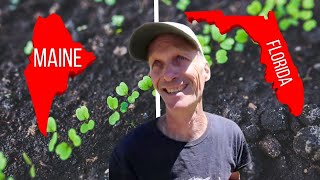
This content was created by Victor Justin Rhodes. This content was uploaded by Victor Justin Rhodes. This is a YouTube video titled "Man Farms Florida in the Winter and Maine in the Summer | Best of Both Worlds" (created 2022-01-10). The excerpt is a filmed, on-site interview/field conversation featuring market gardener Jim Kowalewski and two hosts/interviewers (labeled SPEAKER B and SPEAKER C). They tour Jim's market garden and living setup and discuss practical small-scale farming topics: front-yard/backyard market gardening, seasonal migration (farming in Florida winters and Maine summers), crop varieties (lettuces, potatoes, turnips, squash, garlic, raspberries, etc.), growing and soil techniques (soil blocks, wood-chip mulch, yard-waste compost, hugelkultur, scything), production, yields and income (e.g., roughly 10,000 lb/year, $5,600 gross in a February), marketing/logistics (farmers markets, buyer's clubs, using a truck/RV for transport), and low-cost, land-borrowing arrangements. The transcript is a multi-speaker interview-style piece produced for YouTube.
Chapters
On my own, I'm, you know, the month of February I made $5,600.
And we are at a place, they're a market farm out of backyards. Here's the main man. What's your name?
Jim Kowalewski.
And what are you doing?
I'm packing for my local health food stores. Got an order going this morning.
Okay, well don't let me stop you. Keep doing what you're doing.
It's mostly front yard gardens. Believe it or not. So it's become a, the area's become known as the garden district.
The front yard garden is now the new backyard garden, isn't it?
Yep, yep, yep. People are really getting it.
Yeah, and they're getting it because it's beautiful too. You know, it's crazy how good.
Oh, I know.
Yeah, well you'll see hopefully.
Look at this, I mean just here, and this is just your staging area.
Yeah, this is because it got so shady, I'm not gardening as much here, so I moved down the street. Borrowing land pretty much, which is pretty cool that you don't need to, own the land.
Salatin talks about that a lot.
Yeah, you know, the fact that you can be a portable farmer using other people's land that's not being used.
Good for you.
Yeah. So how much land do you own?
I just own this little place here, which is all shady, you know. Like, I did the pond and everything, and I had more gardens planted here like 8 years ago. I've been doing it almost 10 now.
Good for you.
And then I switched down the street, so as the garden evolved— so let me get my hat.
You just find another yard, huh?
Yeah.
Started, like I say, about 10 years ago. George started this probably 6 years later. I don't know, 5 years later he started farming. He's been going to market too. So this is my neighbor. He got known as Broccoli George because he grows broccoli like crazy good. Um, he's in transition. He's going into the spring garden. I go to Maine, so I don't do much of a spring garden. Yeah, yeah. And you see me every morning walking down the street, you know, in the dark most of the time. My neighbors think it's cool.
They don't care.
They actually approve.
I guess I guess why wouldn't they? Look at this yard.
Right.
I mean, it's rocking in there.
They're like, please come to me next.
Well, I've had the guy offer to lease the one across.
So what do you have to give him? A little bit of veggies?
Well, he was wanting cash. I don't want to deal with cash, so I've kept off that because I can barely maintain this. For one guy, this is about a half acre of land in production. Okay. So I'm busting my butt probably 70 hours a week for maybe 10, 12 weeks. So, you know, by myself. And that's how I've chose to work because I don't work well with others.
You found the job for you, buddy.
Yeah, I'm living the dream just like you are, Justin. Taste awareness for me. So they used to grow this back a long time ago, called it asparagus broccoli, right?
Yeah.
The Chinese call it gai lan. But try that, just try the stem. That's what you want. The stem is the sweet— yeah, it's incredibly good. Mmm. Oh yeah, sweetness.
Never heard of the stem being any good.
Yeah, I mean, that's— so I tell my customers to think about it as asparagus. You know, because the top's good, the leaves are good, but they're sweet, not like broccolini, which is kind of bitter. And there's like— I'm trying like 5 varieties, but it comes— that one's called Suho, and I've got Happy Rich. Those are the 2 I kind of— cool— grooving on. Yeah, so that's fun, you know, introducing people to new crops too. Yeah, growing on good soil, that's where a lot of the flavor comes from too, though. But this is all coming, you know, the fertility stream here is free yard waste from my city. They compost it You know, they take our yard waste, take it somewhere, compost it, and they'll deliver it back to us. So it's a cool circle of life that I'm growing food with my neighbor's yard waste to sell to them at market 3 blocks from here. Wow. It's a really nice tight circle, and you know, I got a little dump truck, so I go get it from them, but I probably put, you know, 50 yards of the free compost across this every year. So that's my fertility stream.
Yeah. I see a lot of wood chips.
Well, see, the thing is, so that's, you know, it's 3/4 finished yard waste.
You know, and I'm liking that better than finished compost. Everybody bows to the finished compost, but I see this as diversity on the top of the soil. It kind of self-organizes. The wood chips stay on the top, the fines go south, you know, or deeper. And that's really a nice thing. I used to sift it, but it tended to dry out more with that, so I like the wood chips.
To anyone who thinks putting in a front yard garden has to be ugly, here you go. Look at this. Isn't this not the most beautiful front yard you've ever seen? The wood chips helps keep the weeds down, helps keep these plants moist, creates organic matter.
Little maintenance, high growth, high performance gardening that I've evolved over years to get real intensive, um, So I'm just picking the outside leaves of these plants so they continue to produce in the same space. And I get a lot of production this way. It's kind of like the French intensive method, you know, that Coleman talks about a lot, that, you know, you can— if you always are maximizing the space, you can produce massive amounts of food on small space if you got the organic matter to support it. And I have it with that Nuparichi compost. And you get a diversity too. I'm growing probably, I don't know, 70 different kinds of lettuce here, you know, all around, all probably 150 different kinds of leafy greens that I go through, do this, mix them in there, right? And then I'll put them in a bin, wash them, spin them, and sell them as a greens mix.
Sweet.
And, you know, organic has gotten a name for, you know, just, um, you know, what you didn't do to the soil. Or what you didn't do to the plants. And what I'm seeing is organic is about what you did do. Because the quality on the nutrient density on this stuff, my customers are always telling me this stuff lasts 2 weeks in the refrigerator. Yeah. You know, whereas some of the stuff they're getting organic from the grocery store, 5 days it's going slimy. And I don't think it's about the freshness as much as the quality of the food coming from the good soil. Man.
Now wait a minute, your potatoes there are jamming.
You know, I'm introducing—
You're not supposed to be able to grow potatoes here, right?
Well, no, I've heard a lot of this stuff about how you can't do any— a lot of things. I told the guy he couldn't grow garlic here, and sure enough, he looks it up on the internet. You just got to put it in the refrigerator. They call it vernalization. So now he's getting hardneck garlic here, which I told people he couldn't do.
What do you mean put it in the refrigerator?
You know, you can grow tulips the same way. So you put it in a cold storage for a certain amount of time, simulating a winter. That makes the bulb produce— I mean, you know, it produces a bulb then. Potatoes, I'm really psyched on the fact that I've grown growing not the yields I get in Maine. I get like 20, 25 to 1 on some of the stuff in Maine. These are about 5 to 1, but it's like a 70-day crop here for new potatoes. I mean, here, come look at this. So these have been in the ground maybe— if I had my tag, I think they were planted like 5 to 10 weeks.
Here's the old potatoes ready to harvest.
So this is a variety called Carola that I'll be taking to a buyer's club. And you know, that's some baby new potatoes.
Potatoes.
No skin, you know. Yeah, you could just, you know, I'm selling these, you know, at a fairly good price, $3 a pound, and people don't blink because again the taste and quality is something like you never got. Nobody these days gets a potato that was dug that morning. No, you know, and then grown out of good soil. Hakurai turnip, that's what the seed packet said, but I found a woman came from Alaska to one of my markets and I asked her if she grew them here and she said, oh yeah, but we call them snow apples.
So wait a minute, you're growing them in Florida, she's growing them in Alaska.
Yep.
And I found out about them in Maine, and I found out about them in Maine. Some guy about this time of the morning, I was at Climbing Ground Country Fair, and Jack Cortez says, oh, you got to try one of these. I don't like turnips, 6 o'clock in the morning, come on. But you know, he gave it to me, and raw too. Raw is the only way, really. It's in—
I mean, all turnips or just this turnip?
That turnip.
And bite a little deeper.
Wow, my kids would like this turnip.
Yeah, as you get to the center, it's so tender and sweet. Mm-hmm. You know, so definitely I always tell people to try them raw before they cook them, because turnips you cook. And then the greens are exceptional. They're much like spinach. Yeah, you know, so just to move this into Florida, I guess they were growing them in, you know, back in the 2000s, but nobody had them when I started growing.
So what are you doing? You're at the market handing out samples?
I've learned to do that, and then people just buy them. Crazy. The baby carrots too, once they try them, it's just like, wow. You know, they think baby carrots are the things they get in bags that are all, you know, whittled down with whatever machine, but you can actually grow baby carrots. Coleman pioneered that.
It has taste. It's actually sweet.
Yeah, who would have thought with a turnip?
Now did I hear you saying you also live in Maine?
I farm in Maine. I'm an itinerant farmer. So, you know, I'm like any—
A snowbird farmer.
Well, let's call it indigenous culture.
They used to do that, right?
Yeah, yeah, you're right.
Kayak up and down the river.
You're right, you got me.
So you follow the climate that produces abundance. Yeah, so I leave here about the 1st of May, get up there, plant my crops, you know, get the potatoes in the ground, start mowing the grass. I was telling you I mow like 7 acres worth of scythe and that feeds the garden.
Nice.
Grow through the season, sell a little at farmers market there, then pack up my old '65 F-350 dump truck that I can make into a minivan.
Or well, like an RV.
I can sleep in the back. Bring back like, I don't know, maybe 4,000 pounds of food that I sell here when I get here. It gets me going until my crops come in at Christmas time.
Good for you, man.
Yeah, it's working out great and it's just slowly evolved. So crops are going north. I'm taking onions north. I used to take citrus before the greening took them out.
And everybody's excited to get that because you grew it and here it is.
Yeah, it is connected. So it's not really local food, but it's connected food.
I think that's what we need to talk about.
You know, local within just certain parameters can be, you know, slow you down a little or limit you. But if you keep connected, you know, people are waiting for those apples I bring back, varieties you've never heard of.
Cool.
You know, so it's a cool lifestyle.
I bet y'all want to know, this is a market garden. He doesn't own this land. He gives them— do you have to pay him some money?
No, no. Well, this is actually my, you know, my mom owns this place. Okay, I'm borrowing her land. My ex-wife owns that one.
Most people got a mom.
Yep.
Well, and ex-wife.
Yeah, most people, half the people have ex-wife.
Yeah, at least.
Yeah, we're good friends, so she lets me garden. She gets free veggies out of it.
Yeah.
You know, and I'm actually doing a buyer's club with her work. She works at the Attorney General's office, and you know, I do a buyer's club there. She takes stuff to them, and you know, I get some cash out of that, and she makes her coworkers happy.
How much pounds of food do you think you get out of here in 12 weeks?
God, over the year?
Well, see, we don't need to just talk 12 weeks because I harvest sweet potatoes away from that, right? So that's a big volume. Let's do a year then. So, God, these days, at least 10,000 pounds.
Okay, and so I bet what people really want to know is how much money can you make doing something like this on my own?
I'm, you know, the month of February I made $5,600 by myself in the month of February. You know, that's crazy.
That's gross, or is that profit?
That's gross, but I have no expenses. You know, I maybe spend in the year $500 in seeds, you know, a little for water.
You're doing all the hand— you're doing this by hand?
By hand.
You're in great shape.
No, I get some exercise doing this, and you get really good at, you know, functioning to make this all get better. And every year I'm increasing production because I'm learning the land better. But I love the fact that the land's taking care of me and I'm participating in taking care of the land. I'm not the manipulator, I'm just a participant. What we got going on over here? I'm getting this ready for market, washing and spinning. Using my expensive method, my $4 salad spinner that I've washed 10,000— well, at least 5,000 bags.
Wow.
You know, and you know, they got that one for Johnny's that cost like $300. That was $4, I think. It's pretty much ready to eat. You know, there'll be a little bit of, you know, like right now the oak catkins, you know. So quality control, because I do small batches when I wash it, allows me to get really good quality control. That's the other thing about that big salad spinner, you know, you're doing this massive amount, you'd really lose a bit of quality control, I think. And it's kind of funny, if you move from the bottom, all anything that was heavy will fall through it. So it's really clean, you know. I'm a little debating about the city water, but I mean, you know, you gotta choose to run that through that RV filter.
Yeah.
And you know, that instead of weighing or anything, again, saving myself time because I'm a one-man show, that that is a bag which fills that, you know. It's, it's usually about a half pound. They go anywhere from 7 to 10 ounces, depends on how generous I am at the time. Like I said, this is probably my bread and butter through the year. You know, if I sell, you know, 2,000 of these, that's, you know, $8,000.
This is his truck, man.
It's all red.
Living the dream.
'65 F-350 with sides that flip up, turned into a kind of like a covered wagon when I travel.
Nice. Yeah, this is your— this is your ride from Maine to Florida twice a year?
7th round trip it'll be this year.
Nice. So, and you just load it full of produce and the Maine people are happy to get all these onions early?
Yep.
But mostly it's the people coming— what I bring south, you know, 2,500 pounds of winter squash, 500 pounds of apples, 200 pounds of garlic. 400 pounds of onions, 400 pounds of potatoes.
And see, that pays for the trip. That pays for the trip.
More than pays for the trip.
Wear and tear.
Because I, you know, this thing, you know, I'm gonna put 2 grand into it every year, but I probably made 8 grand on what I brought back.
So where do you sleep on your way up there?
So it's got sides that flip up.
I've taken them off, but so it's like 3 foot taller. I put a tarp over that and then pack everything in and put a little bed in the back, as far back as I can go. And then I've got my little cook stove in there so I can make breakfast and coffee at the rest stop in the morning. So I don't pay any sleep, you know, stopover charges either. Plus I'm driving my produce.
This is the trick. Then you don't have to make as much money.
It's all about it.
And Salatin talks about that a lot too. Be frugal. Yeah, you know, um, yeah, it's amazing how much, um, wealth can be given from the land by just taking care of it.
Here's the soil block makers. Oh, you guys know this if you're longtime vlog fans. You've seen me do this.
I love it.
You've seen me teach this, no plastic involved.
So, but what's your mix?
Oh, I buy it. I buy the premix. Do you make your own?
I've, you know, again, I've learned to trust, you know, the pioneer was Elliot Coleman. I mean, it was being done before. I mean, the Aztecs did it, I guess.
Yeah.
Um, but Coleman had a mix and I started out with just compost and I wasn't at all happy with it. Um, it didn't work out good, but then I figured, you know, I should follow Coleman's method.
He's got a recipe.
So I started with that and I had incredible results, right?
Wow.
But he, you know, he uses, um, like a third of sand. Um, and my friend up in Maine, George Hope, was all talking about granite sand and the paramagnetic effect of that. Familiar with that at all? Okay, so I substituted the granite sand for Coleman's builder sand, and I did a side-by-side test with the builder sand and the granite sand. And at 3 weeks, the soil blocks, the plants were 3 or a full inch taller. Nice. Cool, you know, I don't need to know the science behind it. Coleman heard about it and he said, oh, there's probably mineral difference. So he was interested because I told him about it.
Um, you just take a base, you had Elliot Coleman as a base, but right, you ain't scared to have an experiment and you tweak it. That's right.
For your trust, what are—
somebody's already developed and then go with it instead of create the wheel again.
Exactly.
So what I usually do is I start the minis, you know, it's a different mix with the minis, but this is the big block mix. But so all you do is these are little 3/4-inch blocks. You pop them out, and then I put a seed or two in each one, and then sprout those out, grow them about— and maybe perfect is about 12 days for me when everything's going good.
Yeah.
And then I move them up to the 2-inch one, which I can't imagine how many blocks I've made with this. It must be— oh, getting on.
It looks like it's well loved.
Yeah.
How old is this? Block maker?
This one is got to be getting on 10 years old. Wow. You know, think about that, that, you know, everybody said I can't afford that $30 tool. Oh, whatever.
I mean, you know, so how much would you have spent in plastic trays by now?
Oh yeah. And then the plants are better. It's not about so much about, you know, the, the savings or whatever. The plants actually perform better, which is cool. So then you can imagine this little sprout in here, and then I just pop it in there You pot up. And then, yeah, and then sometimes within 3 days you'll see roots coming down the sides. It's so, um, it's just, it doesn't disturb the plant at all. It's amazing. So that's where I see it as very valuable.
Yeah, because it can come out of the block instead of getting blocked by a plastic tray and getting wrapped around itself, and then it, and then it has stress when you transplant it.
And I also believe that, again, how a plant grows is— a lot of people say, why don't you just plant right into this? You're saving the step. But what I've seen is these don't dry out as fast. So a young seedling, I think they need that pulse of air and moisture, air and moisture. I think most of the commercial production in those cell trays, they keep them too wet. The plants aren't healthy. So I've seen when this dries out a little, then it gets more air to the roots. And the same thing, then you've got a plant that's producing more root. You put it in here and the same pulse starts happening. Now that's my theory, you know, I ain't no scientist, but that's what I found.
Jim, thank you so much. This was amazing. Your salads look so good. Nice touch with the flowers.
Yeah, it's my signature.
But yeah, great seeing you.
I'm great. I love what you're doing. Keep doing it.
This is the campground of a nomadic farmer. We saw him down in Florida, 1,600 miles away. Now we're in Maine, gonna see what he's up to. Very exciting day on the tour. Do you guys remember Jim, the Florida gardener?
The guy who was doing market garden on borrowed land, on borrowed yards.
Everything you see here that's in grass, or it's more like meadow, but most people, traditionally a lawn is mowed with a scythe. Okay, so there's probably about 2 acres of mixed area here that I mow with a scythe, and I'm mowing 5 times a year here because I want it to be a little more attractive for, you know, being more of a lawn. And think about this, for 8 years I've mown this 4 times a year, 5 times a year, and taking every bit of grass off it. So I ran down the pasture, right? Yeah.
Does it look like it? Well, I mean, look at the lushness of it, right?
So I think I'm mimicking a rotational grazing idea with the side, because as you cut that, right, the grass or the roots decay in the soil. If I let it flush up again, you know, get to the, um, the teenage grass like Salatin talks about, right? And so if I can keep it at that stage, I'm doing what the herd does, and then I'm feeding the grass to the microherd.
So why not a lawnmower?
You know, Pete was in lawn care, I was in lawn care. I fell in love with this tool. This is the best harvesting tool I've ever used. Imagine a tool— if you told somebody that I had this tool that'll mow a 10-foot swath, right, rake and cut at the same time, put it all in a windrow that I can pick up, all running on breakfast, essentially, the machine. There's no mechanic. It runs on oatmeal. You know, I'm all about— you know, it is pretty cool, and it's something I don't have to reinvent. I saw a Coleman video last night, that's why I didn't see you, and he was talking about there's nothing new in agriculture. You gotta go back. And so we're talking back to the future here. I think this is a potential for being the new small-scale organic agriculture because this is grow farm grown fertility.
Can you give us a demonstration of the cyclator?
Yeah, yeah, I got it all set up up there.
Yeah, yeah, we'd love to see that. It also keeps you nice and thin. I mean, you're one of the fittest guys I've ever seen.
It is, but you know, so I'm on Route 1 out here. That's what you guys came in on, right? And I've got the field, Northfield, out there, and I'm mowing there every morning, right? And people are kind of looking at me funny, but they're jogging by. Think about this. Yeah, and they're— that's admirable. The guy that's training for the marathon, it's admirable, right? But they think I'm stupid and they're not really getting anything done.
You're getting exercise and something done.
And I get a meditate at times.
We need to have some sort of scythe event.
Well, they have a league or not, some sort of competition. There is tournaments.
There's Nova Scotia.
There he is.
Okay. Hey, there's Big Red. This is what you drove all the way up here?
Yeah, that's all right.
Is it still set up as your RV or what?
Nope, she's already came down. So these sides flip up, right? And I had a red tarp over the top, had all my gear in it, and I slept in the back all the way down for 4 days. Or all the way up, and then I converted it to a hay wagon yesterday. Now it's full of—
what you got in it?
Last year's hay. Now my haystacks, I'm learning the Europeans got it figured out that when you bust into them, it's like green hay after. So this was uncovered in the field, so you didn't— you don't even need a barn. This is again old technology.
So could you have used this on livestock?
You know, the first year I did it, when I covered just a little bit of the top, because I'm not good at making it, because if you do it right, it's thatched.
Okay, you know, so it's like a thatched roof.
But okay, you know, the Europeans know how to do that. I didn't. So the one year I did cover it, just about— you broke into it and there was still purple vetch flowers in it, so it would have been quality. I've got a friend in Newport that's feeding 4 acres to his ox. Okay, he's putting— yeah, so it can be done.
Nice.
And then, so right now I'm mulching some of my areas that are a little bare. So this one I mulched really thick before I left, so that's really weed-free. But that down there That you'll see the— well, we can go look at it. Um, this whole area looked like that. Whoa, the woods had come in because, you know, Dad had been gone for 7 years, right? And this is the, this is the extreme look. So see the thick woods down there behind that apple tree? Yeah. 2 years ago, I— it was right to here, just like that. Wow, right? See, here's the old stump still.
So how'd you get it up?
Handpower agriculture. It took me about 12 hours with a hatchet and a handsaw, right? Okay, I like keeping fertility where it was grown. So when you cut those off, all the root mass is in the ground, right?
Yeah.
Okay, so there, and it's cut off. Anything that's going to sprout, if I cut it off at the ground, I can mow with the scythe, just like a chop and drop, right?
Yeah.
So anything that kept sprouting— this is only 2 years from the woods, and look at how clean it is. And then look at where the debris is, or so debris.
See it back there?
Yeah, you know, I call that a hugelite.
Jack—
I actually— Jack Cortez called it a hugelite. I've learned that if you plant berries, you know, any kind of cane crop, they like to be tucked up into that. So I planted over there, I've got some that I did like 5 years ago, and they'll actually creep underneath that and come up. So I never had to chip it, do nothing. I just moved it into a windrow and then started planting this. And this is very similar to what the Native Americans did. You know, the New World crops with the squash after they'd burn— slash and burn, right? So I put some New World crop squash and I had some great yields in here. There is a limiting factor of how the trees are here, so it's a little— when they leaf out, the morning sun I don't get, so it limited production. But you know, that first year I probably got, um, I don't know, maybe 800, 900, 1,000 pounds of squash out of here, plus some annual vegetables. But see where the soil life has eaten all the mulch I put down in the fall? Yes. I didn't do it as thick, so now I'm remulching.
Ah.
And right now between what's in the truck and what's there is an acre of grass mown out there.
Okay.
So the idea is fertility concentration. Think about that. I took an acre of grass and put it into something that's more like, what, 2,000 square feet?
Okay.
So that would be similar to like many years out in the field of dying back, right?
Right.
So you've increased fertility here big time. So that's, that's what I'm watching and having great yields.
Is that mound retaining some of the moisture too?
You know, I don't think so. You know, I did a lot with hugelkulturs. Yeah. And I think they're highly overrated for what people want to get out of them.
Okay.
Um, I did one over there that was like, that's probably 7 years ago. Some of the wood has not even rotted yet.
Okay, so that's basically for growing your, uh, looks like you got what, raspberries or something?
That's 2-year-old raspberries. Okay. Which is a high-value crop here. Okay, and then what I did is— what happens is they'll suck her out. Come down and look at this. That's a Baldwin apple tree that her dad planted, a beautiful keeper apple. Um, but so the original stuff I bought from Fedco, right? Yeah, it's a variety called Killarney, right? You can see it's bigger canes there, but the first year it came out, look at how far they're already out.
Wow.
Okay, and now all I got to do is do that and I can spread them, you know, because I paid $35 for 5 plants, right? Yeah, you know, but think about again compound interest. Yeah, I've got about, you know, 50 plants here now that I am selling, and I'm also moving to other areas of the farm. I'm growing 7 varieties now here.
So you're taking advantage of those being viral. They're taking off, they're prolific. Others would consider that a problem. You're harvesting it and selling them.
The problem's the solution. That's one of those permaculture things, you know. I'm not a big permaculture practitioner, but some of the things they talk about are so valuable. Yeah, the idea of composition instead of imposition. If you compose a system working with nature, you don't have to work as hard.
Yeah, let me get this right. All you did was take what you chopped up right here and you piled it up in a mound. You didn't worry about how it was on the contour. You didn't— you just, you just put it right here to create a garden, huge garden bed. And all you did was plant some raspberries. 5 raspberries.
Yep, 5 here. And now they've— last year I moved them, you know, you've moved some up.
So this is the second year.
So the first year they even suckered, and then I moved them up there, and now I'm gonna have to sell a bunch of these, otherwise this is gonna turn into a bramble.
What do you mean suckered? To produce fruit?
Sucker means— that's what these are. People call these suckers.
Oh, okay.
I mean, I might not have the nomenclature right, but that's what I call it.
Did it produce fruit that first year?
Yep, very— not a lot, but they're just starting to.
This is a mid-season, so there's gonna be a huge crop this year. Yeah.
Okay.
You know, and I'm selling them for, um, I think I'm getting $3 a half pint.
And you didn't do anything after you planted except for mulch.
But think about where raspberries grow. Yeah, they grow on the woods edge.
Okay.
Okay, so instead of trying to put them out in the field and bring your mycorrhizal chips out there plant them where the woods were.
Yeah, right, because I chopped this back.
This is a mycorrhizal system.
Permaculturalist at heart, you know.
Well, I mean, it all goes together. It's just nature what it does, right? Um, and yeah, and her dad had planted— there's, um, I don't know if you can see up there, they are, um, hazelnuts. Yeah, there's stuff in here that he planted. Those are all, um, pear trees behind you.
And when you say dad, you're talking about another— you're not related to them? It's not your dad? No, it's a lady that you've known, Bob Johnson. You've asked her if you could— you kind of saw this as an abandoned land. Exactly. But they still own it, they still had a love for it, and you said, hey, can I cultivate it? And they said, cool.
Yeah, and they said, have at it. I said, can I camp out on the ocean and beat back the woods, right, and keep what I grow? And what the thing is, the abundance that happens— at first I think she was a little— saw how much was coming out of here that she was feeling, oh, maybe this ain't a good deal for me. But there's so much abundance now, she's getting all this stuff from this land that I can't sell. Okay, you know, and then the land's being taken care of. It's in much better condition than when I got here, because think about that compared to that or that.
Wow. You said camp out? You're like camping out here in a tent?
Come on, okay, okay. This is home for 8 years.
Wonderful home. I bet it's paid for, Jim.
Yeah, well, it's—
yeah, that's the thing.
Yep, that was paid for.
Nothing. That— I think I bought a new tent last year that was $600.
What? Paid cash. What's your market— what's the mortgage rate on $600?
No, well, I paid cash from what the land produced.
Good for you, buddy.
And then here's kitchen. So I've learned— so I'm a market gardener, right? So I've got a market— these easy-ups are crazy. So I buy a new easy-up every year for market and then retire the other one to be my kitchen.
Check it out.
It's like being a Boy Scout all summer.
Great America Farm Tour Cribs, here we are. He's a Boy Scout all summer.
Yeah, this is all you need.
I mean, yeah, I mean, what do you need?
I mean, you're a single guy.
I call water from the farmhouse drinking water, and there's a little seasonal creek that right now is running, so I can, you know, I do my dishwater on the fire, so I can use that for dishwater.
And what a view! What river is this?
This is actually the mouth of the St. Croix River, which dumps into Cobscook Bay. Okay, Canada is right across.
I watched the sunrise over Canada every Every morning. Wow.
And it rises— you realize how early it's rising here? It's what, 4:45 right now? And so we still got another month. So about 4 o'clock it'll rise. There's— on the longest day. Yeah. So you see this, that's the mountain over there, that double one? Yeah, that's called Chamscook. And over the summer I get to watch— when I get here, it's like on the southern shoulder of that one, and then every day it goes all the way up to the notch, and then it starts going back south. And I get the— it's really a good, you know, calendar for how the season progresses here.
Living room, kitchen, bedroom.
Oh, on the ground. Okay, so I haul all this down and I kind of live out of these bins because they can seal up and carry around.
That's true. What about nor'easters, man? What about a summer storm?
You know, this one's held up really good, and the easy up. It went through two different ones. The true—
one of the hurricanes came over, it was coming out of the south, so this is protected from that.
But the nor'easters You just hunker down. There's some bad weather in Maine. The first year I camped here, 2009, it rained every day in June.
Every day. There were slugs everywhere.
But that's farming.
Is this completely waterproof?
It is, believe it or not. Yeah, the canvas— old canvas tents are good.
This is out of Alaska.
I think it's Alaska Tent and Tarp. And there's your—
what's that for then?
So that's the guest tent.
Oh, okay.
So if you would have come by yourself, I don't think you'd get your whole family in there, but You got any guests right now? I don't, and you know, you know, over the years, maybe in 10 or 9 years I've been here, I've had 6 or 7 guests. But you know, it's kind of cool when somebody shows up and they get to help out and see what's going on here. I got a friend Ian who's actually going to take the bus up and he's going to come visit me from Florida.
Okay, nice.
I don't water. I haven't watered in 7 years here, including transplant day. I don't weed if I keep the grass on the beds, you know, don't let the soil life eat it all. And, um, I don't fertilize, all because of a handheld scythe, right?
Let's, uh, let's show the process. You cut it and then you put it in your truck and haul it, and then you put it on this. So we'll do this later. Okay, we'll come back with the kids. You've got a load, we'll dump it on here as mulch. But let's go see what it would look like to cut it.
So this is my, um, technology for the farming I do. This is what I need. I need a tarp technology here, a hay fork. With hay fork is different, it's only got 3 tines, it's like a manure fork.
Yeah.
And I need a scythe.
So how much, how much did that set you back?
Oh, it must be, you know, probably— well, you know, believe it or not, these are all antiques. Store finds. The hay rake too. So I mean, you're probably looking at $100. Okay, the scythe cost you $200.
Nice.
Can you smell the chlorophyll?
Oh wow, yeah.
Now it's getting dull. I felt the drag. It started— I was having effort.
Is that because you hit the ground a little bit? Because the mound could be a little uneven.
So then you go ahead and— well, know what you— I mean I wear the gloves, so what I'll do is when it's wet, because you got to wipe the grass off, but traditionally it's, uh, you do this to wipe it. But I got sick. I mean, I mow so much, how many bends would that be over the day? Because it's probably every 5 minutes. So I just wipe it with my hand, and I've never cut myself. Knock on wood.
Okay, my turn, Jim.
Okay, nice.
Watch it.
And it's all about how far to step.
Yesterday I thought these were his onions that he brought from Florida. His onions are still in the barn, not ready to plant yet. This is garlic. This is what you did when you left here, you planted garlic.
The last thing I do, like, I leave here usually maybe 3rd or 4th of October, so last 2 days I'm planting 1,800 garlic.
Okay, and then you come back and you have a produce to sell.
Well, so this is actually a crop that I'll pull in probably the end of July. I'll cure it in the barn and take it to Florida. And I planted like 1,800 of them, and that could turn into like $4,000 for me down in Florida.
Nice. Um, and do you bring anything up from Florida that gives you a quick cash crop?
No, what I've done— well, so I— because I brought so many of those onions, I probably grew about 10,000 of those onions. So I've already sold probably, I don't know, maybe 2,000. Okay, I made a couple hundred bucks. You know, my farmer friends are happy to have them.
Okay, cool.
Oh, Red's a dump truck too! I love her. That's a good truck. It's a great truck. I just got this hydraulic cylinder rebuilt.
It's—
the reservoir is integrated in. It's a 20-ton dump, so I could dump, you know, 40,000 pounds with it. I couldn't carry it, but this is an old landscape, um, way we used to move a lot of brush and leaves. So you just take a tarp, which weighs ounces, here's the kind of A bummer when it's really windy.
You see this, guys?
You can help him. You can grab it by hand and put it on his cart.
This is a little moldier than I'd had in the past because I didn't do well in the stacking, but still, you know, it's, it's preserved over the winter without a barn.
Good job, Lily.
And when you were asking about, um, well, how I'd rather use the hay that's cut, the thing about, um, moving stuff is when it's green it weighs more, right? So if I got good drying weather for me, like haymaking weather, I'll let it dry out there because it's easier to move. So somebody grab here, somebody grab right there, right here.
Okay, got it.
Now we're gonna pull this way.
So you guys are not really helping. We don't gotta hold it because all the weight's on the ground. Yeah, so even rough ground, you can go over stuff without having it, um, you know, like wheels bouncing around or anything.
Oh, man down.
Man down, come on.
Be careful with that with your brother's hands in there. Doing it really thick, like I said when I smothered the inside the chicken barn, the witchcraft. What I'll do then is I'll pull the tarp up, full load, full load, and then all I'll do is that, and then it dumps and it's pretty thick, and that's enough to smother stuff. So last year at this time, um, the grass was right here, right?
Okay.
And my big problem, you can see it right now, what happens is the weeds start coming from the outside of the bed, right?
Yep.
Okay, so I'm looking, what happens here usually is the dandelions show up, which is a quick-growing big leaf plant, right? They fill that void. And I went, what else will do that? Potato.
Nice.
Okay, and I learned from Mark that potatoes— Mark Fulford, he's like Victor Justin Rhodes, one of my big-time mentors. He's a soil scientist out of Monroe, Maine, and he also grows amazing organic apples. But he said potatoes like new ground. Even the Swedish will actually plant it right in the sod. They just take a mattock, make a hole, and stuff the potato in. So I kind of modified that. So what I'll do this year is put it right here on the grass edge, right? So I'll make a divot, plant the potato there. Potato will come up. The first mowing, I'll mulch it, right? Because it delivers that windrow right to the potato. Potato grows up, it's keeping the weeds because it's shading them out, right? And next thing you know, I've got a wider bed, right?
Nice.
And it kept the weeds from going in.
Nice.
And I'm starting to call it— I think I'm going to call it pioneering because it's pioneering land. Pioneering perimeter potatoes.
I like it. He's chopped the bark off of that. I said, what are you doing? He's killing it and turning this into a trellis. For hops. Man, Jim's just full of ideas here.
This is a killer apple. It's called Hudson's Golden Gem. I got them about 5 years ago from Mark Fulford. It's this beautiful big russet apple that's so crisp and yellow fleshed. Um, they're huge. And so I got one of these, two of them, from Fedco. So I got that going.
Do you prune or maintain these apple trees in any way? A little.
The Ellen's more— the apple trees that were here from her dad, she prunes them. The pears have been incredible once they started getting So think about now you've got trees in the middle of these lush gardens with the microherd really happy manuring. These are having incredible crops of pears now.
Nice, because that's what the blossoms are you're seeing is pear blossom.
Thank you, Jim, for showing us around. It was so cool to follow the loop, see you in Florida, see you in Maine. Thank you for all that you're doing.
Yeah, I can't believe you guys made it.
I'm—
you know, most people say they'll visit and they don't, so you did. That's awesome.
Here we are. How many miles is this from here to your home in Florida?
About 1800, and I think it's, I think it's, um, 22 degrees in latitude.
Okay.
More from Justin






If I had to start my Homestead all over again, it could only pick one animal… 




