More Abundance with less Work | A Permaculture Homestead
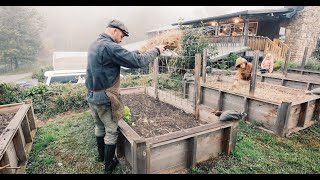
Victor Justin Rhodes and Rebecca Rhodes walk through their permaculture homestead, showing how they use chickens, pigs, sheep, and cows to restore pasture and feed the garden while reducing daily work through strategic zoning, cover crops, and mulching.
Chapters
One of the biggest things permaculture has taught me is to make connections. There we have a garden, there we have chickens, right next to each other. See, I used to have chickens— well, look, let me show you. I put chickens in the back behind the house, and the garden— heck, our first garden was over 100 feet away. Way past the tunnel, not right here. At the time, over 12 years ago, who was putting gardens in their front yard? Two little bonuses to this video here. We're going to talk about proximity, but bonus: bad idea because the chickens would have been behind the house. This is actually south. The sun is going through here, and this— the house is blocking the sun. Yes, what do you need? Um, well, our bucket is out of dirt for it. Okay, let's Let's get them some more grit. All right, that's filled up. Why are you gonna put something 120 feet away, especially something intense that you visit a lot? If you visit the chickens how many times? Well, you let them out, you put them up, that's 2 times a day. That's over 700 visits in a year. One thing permaculture teaches you is to put those things that you visit a lot close to the house. There's some permaculture zoning for you: the house, the garden, and the chickens. Things highly visited are close to the house. Looks like the kids have planted a little feather garden here. Josiah, will you go get the, uh, cover crop seed up off the porch? So anyway, back to proximity. You got garden— what? Always, if you're gonna have chickens and a garden, at least put them next to each other. Why? Well, some kid come harvested lettuce last night and left some about. Yep, that's it. You got it, buddy. We only need one bag though, so just bring one bag. A lot of stuff they didn't get and then what happens there? Chick, chick, chick, chick, chick, chick, chick, chick, chick, chick, chick. They eat that. It's free food for them. But what they don't eat, they scratch in. This is a pile of wood chips just below. You rake the wood chips off just below the surface. Look what's starting to develop.
That's compost.
And where does that go? It goes right there. Well, of course that can go around your lettuce. This year we've timed it right so we don't have to use plastic. We've thrown down cover crop. Our chicks were getting out, they spread it just that way. You come put a little bit more cover crop in one like this. Chickens got out and we end up clipping their wings. Our newest chicks, they keep growing, so they keep growing their feathers. So we got to keep clipping them back. Just make up for it where a little bit where maybe some of those aren't. Anyway, we were having to use silage tarp all winter. We used silage tarp to kill off the remaining weeds. It's great, but now let's plant us some cover crop. I mean, that's another permaculture principle right there— use plants and animals to do the work of the farm. So we're going to use plants, this cover crop, to do the covering. Nature wants to be covered. She's very modest, and if you don't dress her, she will dress herself. So we're going to dress her— dress her with beautiful cover crop that will build the soil, add nitrogen to it, and be a nice cover so it doesn't wash away, dry out throughout the winter. All right, everybody grab some— grab some straw. This is organic straw. It'll be a great temporary mulch. You could use grass clippings that would come from your own farm. We just don't have any grass clippings right now. This is just quicker. And if you can get a hold of organic straw, it seems to be better for a mulch. It's going to dissolve quicker, it's going to let air and light in there a little bit better. And isn't there something about covering it that just Makes you feel better inside. Just, it's just like good. It's just something good about that. So basically the chickens feed the garden, the garden feed the chickens. So you want to have them close to each other. They complement each other. Looky here, staying in this pig net.
Yeah, unless you scare them, they go out of it.
Oh yeah, okay. And if it's not on like it is right now when we're out here, this little tiny pig net is working. I mean, it worked for turkeys. Why wouldn't it work for sea monsters? You just walk right over and deal with the chickens. Plus it's a lot easier to move, isn't it? Yeah. Tomorrow we're gonna do 2 pig nets. Oh, and we got how many out of it? How many days out of this one net? 3 or 4? 3. So how am I using permaculture principles with sea monsters, these crazy hybrid fast-growing meat birds? So, you know, besides 100 birds being 500 pounds of meat in our freezer in just 2 months, we got these guys to work. We got these guys on a job. You'll not believe it, but this pasture used to be one of our worst, and now look at it. Isn't that absolutely beautiful? It's not necessarily beautiful right here, they're on it. They're disturbing it, but they're disturbing it in a wonderful way. So we're having chickens, seed monsters, do the work of our farm by restoring our pastures. They drop manure. Look, they weren't here too long ago. It's still recovering. You still got some manure. That spot, mucho manure. It's gonna be mucho verde. There'll be a lot of green here in no time. Perry, you want out? Yeah, yeah, yeah. Okay. All right, it's on. Well, good morning guys. Actually, a month away, a month away from harvest. What are they doing? What do we have the pigs doing? They're in pasture that will one day be better for the cows because look, they are stirring this up. It was something like that, highly unedible for cows. It was not long ago forest, but we're turning this to a silvo pasture where it's 30% forest and 70% pasture. Look, this is an older paddock that the pigs have left. I get excited over here. I get too excited over here. Look at all this grass, all this food for the cows and sheep. So how's this working for proximity? Well, the pigs are in the cow system. How about that for proximity? They're together. Like, the cows were just here and they were just around this fence. All right, you guys ready to see what I think is my finest example of proximity and animals doing the work of the farm? Boom! Okay, paddock number 1, the cows are in. You can see their little shed there. It's a net paddock. We've set that up, we leave it. Paddock number 2 is the sheep. That's where the cows were yesterday. They went into what we had set up for the cows yesterday. Behind them is an empty paddock. Why? Because this morning we're going to move the chickens over into this paddock. So that was the paddock for the cows, what, 3 days ago? So then what we do is we move the chickens from the very last paddock, the 4th paddock, we put them in the 3rd paddock, we pick up the 4th paddock, it's, it's picked up and it's moved way down and it becomes the cow's next move. So instead of this being all the cows over there, the sheep over there the chickens over there. No, it's one thing. We set up one net, everybody goes through, everybody drinks from the same waterer. We don't have to move that much. The sheep complement the cows, eating what they don't eat, eating their parasites, and vice versa for the cows. The chicken spreading the manure, eating the fly larvae out of the manure. And this is one system. It becomes one chore instead of three. And we've used the same land for 3 different species, maximizing efficiency. Look who's here, hair combed and everything. What's the occasion?
Well, just trying to be more productive in life.
Feeling a little better? Snowball being a little easier on you?
Yeah, just trying to— I read something about you just gotta be motivated. You just gotta tell yourself to do these things. Trying to tell myself to do these things. All right, I got laundry started. What? But I felt good when I woke up, so that helps. That helps a lot that I'm not trudging out of bed.
Come on, stud. Let's go. Fill us in here and get stud through. Come on, come on. We're gonna milk later, okay? Okay, we're gonna milk later. All right, thank you, Jonah. I'll hold her up. No, they need to go that way. Come on, come on, guys, come on, come on. It's amazing how they don't forget you, babe.
They don't.
And they all come up to you. They will not all come up to us.
I spent the most time with them when they first came, I guess.
Yeah, they get the gentleman and just Week, week and a half. Sheep, sheep, sheep, sheep, sheep. Today's milk harvest. You know, Rebecca is responsible for getting us into homesteading, But I'm pretty sure I'm the one who discovered permaculture and took us in that direction. In a second, we're gonna go ask Rebecca's impression of permaculture and give you a perspective of our story there. I'm kind of interested to see what she'd say about me, my idea and all. But look, I found them. She thinks I took these and didn't put them back. She's been fussing at me for 3 days. I found these, I found these in the kids' room. They're in the kids' room. All right, first let's talk to her about permaculture and then let's surprise her. She really likes these. Just for the record, this was all your idea, right? Homesteading. When I, I found permaculture and introduced it— I don't remember how I introduced, if it was conversation or just started doing it. What was your— what was your initial impression?
I don't remember any, any impressions.
You had the— you had the big— the biggest, greatest facial expression. So were you like, this is weird? No, this is cool.
It made sense. I was like, yeah, because it was like get more with less.
Ah.
Less input.
There we have it, the elevator definition of permaculture by Rebecca Rhodes: get more with less, less input. Get more with less input. There you have it. I mean, that's not obviously it, but that's pretty close.
Like, well, I mean, like, I don't know, I think the whole working together was really good. Yeah, I'm trying to think though, were we that far off though?
No, it wasn't a big stretch for us. We had already been gardening like Elliot Coleman. We'd already been moving our animals like Joel Salatin. We were pretty dang close.
Yeah, I mean, I think we had some components to it.
It's a little family dynamics here. So how was it more with sort of me kind of taking the reins at that point, taking the— taking the steering wheel?
I think you had already done that. Because I mean, while this was all my idea, I also had a— not a— it wasn't hard, but I had a— well, I guess the first trip, the first 16 weeks of Josiah's pregnancy were really hard for me. Yeah, way harder.
So I took over the garden.
I didn't have a very hard pregnancy, so I just thought, well, I'm not gonna have like, you know, pregnancy is going to be easy.
Yeah. I took over the garden out of necessity, and it was all right.
And well, and then you had— you did the cows—
was in the rhythm of the homestead. But I will say this, I did not really start enjoying myself until I found permaculture.
Oh really?
And, and then it became this puzzle, this— let's, let's— then it became something very, very exciting. Let's, let's put all these things, make all these things work together. I don't know, there's something special about that.
Yeah, maybe you owned it a little bit more. You know what I mean?
Yeah.
Like, it became your ownership here. I mean, you were— you did the cows. I never did the cows, you know? Like, that was always you. I was more of the garden and stuff.
Before we do this, just one second, okay? Just one Permaculture has blessed me. I want to bless you guys with it. Let's see, once you join my email list, and every week you'll get what we've just— I've just started called Thingy Thursday, where I send out things that have inspired or encouraged in my life and hopefully your life the sustainable food growing lifestyle. So you'll get Thingy Thursday once a week. But joining my email list, I think I'm going to do a special series going into this weekend, and I'll figure out how to get it to you guys even if you sign up after that. But the Homesteaders of America is, is going up this weekend, and I'm doing a talk on permaculture, so you can get way more into what we just talked about, like an hour-long talk. I want to get you maybe the, uh, the booklet that goes with that when you join the email list. What else can I give you? Oh, we're doing a talk on family-friendly homesteading. I can give you some of the, the notes from that, um, and some other things with— I'll put more info on that in the description, so definitely sign up. Oh, and I'll give you exclusive invitation to the Homesteaders of America conference this weekend where you can get access to my talks for a week long or a whole year. Okay, so more info on that down below. Are you done?
Yeah, I'm trying to fill that up. Where'd you find them? Where'd you find them?
Where do you think?
I don't know.
Where do you think this is? You golf clippers!
Where'd you find them?
In the kids' room. Oh my word, on the trim, on the wall. Oh yeah, I think you owe me 3 apologies. One for each day you heckled me.
What happened to— you were the one who, uh—
oh, she ain't giving it up. She ain't giving it up. She says I'm the one who left it in the kids' room.
Well, this is the thing, Justin. Oh, you were the one who asked me. I told you where my precious clippers were.
Yeah, and I put them back, and then some kid
More from Justin






If I had to start my Homestead all over again, it could only pick one animal… 




