My 10 Part Plan to Grow $50,000 of Food this Year
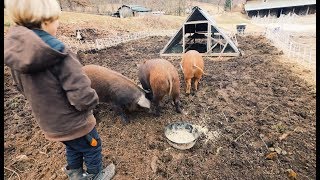
In this vlog Victor Justin Rhodes walks viewers through his farm’s ten‑part strategy to produce at least 75 % of the family’s food this season, targeting roughly $50 000 in value. He tours the property while performing chores, explaining how each enterprise – raised‑bed vegetable gardens, intensive 10 800 sq ft crop garden, chickens, turkeys, pigs, guineas, geese, sheep, and cattle – contributes to food self‑sufficiency and cash savings. For each animal or crop he outlines the planned herd size, feeding regimen, expected yields, and monetary calculations (e.g., $7 / sq ft garden value, $10 / lb pork, $14 / gal milk). He also discusses challenges (mortality, parasites, labor intensity) and mitigation ideas (rotating chickens with pigs, fermented feed, Joel Salatin‑style shelters). The video ends with a call to action for viewers to join his “Do It Yourself Abundance” membership, which offers detailed how‑to videos and discounts.
Chapters
Today I'm going to show you guys our top 10 goals, our food growing goals, to produce so much of our own food, at least 75% of our own food this season. These are ideas that maybe you want to implement as well, so be sure to watch the whole thing. We're going to go on chores. And as we go about chores, I'm going to share with you the top 10 things we're using to grow most of our own food. We're talking about tens of thousands of dollars worth of food, y'all. It's one thing to say we're going to grow 75% of our own food. What does that mean? I mean, by the end of the 100 days of growing food this coming summer, we will actually measure it. We actually look at our plates and say what percentages of this is from our farm. But like Like, how's that helpful? Well, since we're a whole food eating family— meats, veggies, not a lot of processed food, maybe not any processed foods— those are— those, especially organic, tend to be the most expensive. So it's a big deal for us. That's by far— food is by far our biggest expense. So what is actual value of what I estimate from getting from all these, these top 10 enterprises we're going to do this year? Look at this. I got some notes right here, right outside our door. The garden, it tends to be the most profitable, the most productive per square foot. In here, raised beds, 2-ish by 8 foot, 8 of them. So we can put chickens like this here. Good morning, guys. Keep a few of you, just a few chickens to be rotated through the raised beds. Also planting the chickens perhaps over here. It's nice to have chickens and the garden together. It's a really good idea to do that because the chicken and the garden can work together. The garden can feed the chickens and the chickens can feed the garden, so to speak. They're making compost under this deep mulch. That's great for the garden. They've got, they've got manure the garden can use that, and then certainly the garden can feed the chickens. We can be picking off pests. We can— any old produce, look, they totally, you know, we'll bring them in after we're done and they'll totally take down our old kale stalks and whatnot. According to a Mother Earth News article, Edible Landscaping, intensive gardening, you can— and this was old articles, it's probably more than that now, but let's be conservative— $7 per square foot. So if we're doing— I don't know what exactly size our, our raised beds are going to be, let's say 2 foot by 8— that's, that comes to about almost $1,000 worth of food just in our raised beds. As we walk towards the chickens and our small animal chores, look out in that field. Can you see it? Can you see it? Turkeys. That's where we had them before. Enjoy the new grass. See, look how calm and quiet they're gonna— they're gonna check out their new surrounding. Now, they're not the smartest. They do have bird brain, especially this one. Will not— sometimes will not walk out that door. Come on, man, the door's right here. Got some ideas for improvement on the turkeys. They didn't really like their shelter. They didn't go in it automatically. I had I have an idea to do a smaller scale scissor frame, Joel Salatin style turkey shelter, the Turkey Shawl. Of course, it's movable by just one person. We're gonna raise them up. We just want 12. We just want one a month for the entire year. Um, they go to about 12 to 14 pounds. That's 156 pounds. I totally forgot to figure that up before I got out here. But, uh, do you remember what we paid for turkey a pound? If it's like organic chicken, organic pasture chicken, that's, that's $6 a pound. But it's probably more because it's turkey. But let's just go with 6. So 6 times 156. Now they say turkeys are hard to raise. Well We've raised turkeys. We only had a 10% mortality rate using magic water and fermented feed and keeping them inside for 8 weeks. I think we'll do that again. We'll buy extra just in case, uh, but certainly enough turkeys for at least one a month. I found that once you get turkeys past that initial stage, they're really easy. They get a lot off the land and they're really hardy after you get them past that first 8 weeks. Good morning, fellas. Let me get these guys fed, and then I'll explain to you what's going on with these pigs, chickens, and like 10,800 square feet of gardens. Hey, how's it going? Let me take you back here. There you go. You got to be fast with those guys. Top of the morning to you, cage fighters. Chickens, clean out the nesting boxes. Doubt anybody's laid yet. It's still early. If we increase our flock and we're getting younger chickens to replace these older chickens, I said 2 to 4 dozen eggs a day. It's probably going to be more like 4 to 8 dozen a day. Right now we have about 30-ish chickens in there. Chickens and pigs work in this garden area. Look, this is 8 plots down here plus 1 more, 1,200 square foot each, these plots. That one up there is a little bit smaller. Rotating every 2 weeks. We had to use pigs to establish this. It was sod. Hopefully moving forward we can get chickens. So I do plan on getting more chickens in here, probably 50-ish, and doing a mega shaw to accommodate that, an 8-foot by 8-foot. There's been a lot of people mention that they could use an even bigger mobile chicken coop that still one person could move, and I've got some good ideas for that. It actually might even be lighter than our Chick Shaw 2.0. I didn't realize off the top of my head that the egg enterprise would be one of the most valuable monetarily. What's the matter? They got into your chicken stuff?
No, uh, stuff— grain got into my boot.
You need help spreading it?
I got it.
Good morning, Josiah. Will you go turn on our— hook up our hose and turn it on? All right, Jonah, you're gonna have to follow me because I can't hold the camera and feed these guys. They're kind of crazy.
Papa, their pans are inside the coop.
Keep coming, keep coming, honey. Okay, let's give them a little bit right there.
Oh, Papa, be careful. Pig.
Papa, I'm gonna have to put the feed over here until I can get this— these pans out. You don't think they're gonna go in there and trap me, do you?
They might. Oh shoot.
All right, let's get it from back. I'll get it this way. Oh, just that Just reaping cheap, reaping cheap. Not scared of nothing, just goes in there. Pigs. 6 pigs are going to be harvested this year. We've got 2 big pigs that are going to be harvested very soon, 2 guinea hogs that we've raised since last winter harvested very soon. That's 4 pigs. We're gonna buy 2 more feeders this spring, raise them up. That's 6 in total. This is 12 pounds dry weight of pig grower, then soaked. We'll give them another 6 pounds this afternoon if at all possible. Pigs, I've learned, like to eat twice a day, and they like it wet. The fermented should make it go further. As you know from last week, they got out of hand. They were eating like 36 pounds They were— no, they were eating, uh, 13 pounds each a day. Textbook says 1 pound a day per month they've been old. So they're 6 months old, they should be eating 6 pounds. Some folks say feed them all you can. I, I don't know, I couldn't— I, I had to stop. I couldn't feed, uh, I can't feed them that much. 39 pounds a day. Organic. That, that gets really crazy. Jason at Yonder Way, also one of my pig guys, said, hey, you know what, try just 6 pounds each. It's soaked, so I think they're doing okay. Look at how they've gone after that root right there. Excellent till job in here. So one thing we tried say, hey, maybe they're mineral deficient. We put out some salt, they did eat some of that salt, and we put out some kelp, and those look like they might have gotten some of that kelp. So they could be hunting minerals in their feed and overeating.
I can't even get up close to him to ride. You cannot ride these things at all.
I had the live weights on these pigs. Take off 40% of that, and that's what ends up being in your freezer, about 60% of their live weight. Basically, the 4— the grower pigs are going to be about 168 pounds in our freezer. Pigs— pig being about $10 a pound. If you were to buy a whole pig, including the, the premium cuts like bacon, which were more like $16 a pound, and then sausages, which bring that average down. So putting that all together, $10 a pound, that means $7,938. 2 guinea hogs versus these big fast grower guys. We've given the guinea hogs a shot. We really like them, to be honest with you. We're even considering starting a breeding program with guinea hogs. It's got the bucket stuck on his head, so that might be possible. It seems like we're gonna have a lot going on this year, so I don't know if it'll be this year. We'll see. I don't know, I don't know. It's hard to tell the future with all this, by the way. But anyway, that's the plan of right now. He's gonna get stuck in that bucket again. We're gonna try these guys, growers. We're gonna get them smaller in April and then just grow them up to the fall and harvest them. And that's where two of our pigs are coming from. We're harvesting two of these in less than a month. Another one of these is a friend's, and we're having the— harvesting it. Oh, harvesting the guinea hogs at the same time. So that's how we're getting— plan on getting 6 pigs in 2019. We eat a lot of pork. Yeah, so we might even do more than that. I don't know, we'll see.
Let's keep in the other bucket.
No, let's save the other bucket for this, this afternoon. Then there's the crop garden. I mean, intensively, 10,800 square feet times $7 is like— is that over $80,000? That's cray cray. And I'm not going to do it intensively. Like I said, we're going to plant a lot of COVID crops, we're going to plant a few things in there, but it's going to be certainly the most profitable. We're thinking over the 12 months, doing a bit more of this, putting in a cat tunnel, growing more winter crops, we're thinking— I mean, seriously, $1,000 a month worth of produce. That's being very conservative. It's going to be fun to see kind of what it ends up being, given that the crop garden is going to be the most efficient per square feet, guys. And we're talking about if we grew it all out in edibles, we're talking over $10,000 worth of food. It's absolutely crazy. This is my source of overwhelm. I'll be— I'll admit that to you because I understand that the garden is the most productive. I'm going to check the water.
I already got it going.
Oh, okay. Thank you, buddy. The garden is the most productive, but it also takes the most amount of work. It's also the most intensive. The chickens and the pigs help us, but you still have to either start the plants in another place and transplant them and then undersow cover crops to combat your weeds, or you got to keep up with those weeds the first 4 weeks while your plant grows. So it can be pretty intensive. That's my overwhelm. But I also tell myself, hey, if we were in season right now and these guys were moving out, I can plant what I want. If I— if we're hurt or sick or something that week, I could plant one row of whatever, and the rest in edible cover crops for these guys. And when they come back through, they have something to eat. And these are suddenly, um, food systems for our chickens, for our egg operation. Very low-key. So in the worst case, I'm growing my own chicken feed. Before we go to the big animals, the guineas. In a roundabout way, they could be the most valuable element on the farm because of the protection we get against Lyme disease, which is very expensive. We're not necessarily going to harvest them, not certainly not this year. I don't know if— I don't think we're going to eat their eggs. We're going to hopefully let them reproduce. But Lyme disease has cost me tens of thousands of dollars, and if I can prevent that in my family members— guineas could quite possibly be the most financially benefit element on this farm in a sort of roundabout way. I'm thinking those two are female and the one in there is male.
Yeah, yes, we think so.
We've seen him fighting with a rooster, so that's our suspicion that he's a male, right?
We saw the white one fighting with the rooster.
Yeah, I feel like I could do better with guineas. We want them to free-range somehow. We want them to go back to their own coop. I've never had that success, so I'm actually turning to my member area. There's a fella in there, really helpful. Well, you guys met him the other day, Mike. You're up and early this morning. Yep, usually am. Okay, so need a hand? I'm gonna see if I can't make a video with him or have him make a video and share with us how to have success with guineas, because he has done it. They go back to their coop, they still free-range. He has, he has a system where he can get them to go further or bring them back in based on food rations. So he has some tricks. I have some ideas. I think we could use— build that turkey shawl I was talking to you about earlier for the guineas. It's wide open, it doesn't have any walls, it just has a roof. I think they would enjoy that more because they like, um, perching more out in the open. Maybe one of those for the guineas. What do you think? Yeah, I mean, wouldn't that be fun to have 20 or 30 guineas? Roaming around reproducing themselves. Yeah, let's go on to the big animals. Icelandic's here close to home for the winter. You see the goose in there? Where's the goose? The goose— we got females, not just because mainly to guard the flock, but also because they'll lay eggs. Let's say they lay— they can lay 12 to 15 eggs a day is what Mr. Google Pants said. So let's say 12 eggs Also, I saw goose eggs listed for $17.50. That's like $200 worth of eggs. Sheep— given that we lost 4 of 5 to parasites, heavy loads— is probably our biggest mishap, failure of last summer. There's a number of things we learned about that. I actually created a video inside of our member area over 30 minutes long about what we learned and what we're going to do next time. I'll share some of that with you. First of all, we're going to get a humid hardy breed. We're going with the St. Croix. Second of all, we're going to get them from a breeder who has the same practice as us, has never fed them grain, has never gave them vaccine, has never even had treat them for worms. We don't even want to have to treat them for parasites naturally, guys. We want a naturally hardy sheep from a breeder who's done the hard work, who has let the strong survive and breed each other, and it's never bred any weakness. That's what we want to continue and encourage on this farmstead, so that one day these children will have even stronger of a flock when they're grown up. And with their children. Same way with the cows and the chickens. Sustainable breeding programs where the animals don't have to depend on synthetic chemicals or even hard-to-get expensive herbs, but they can thrive on the land. And that's happening in August. Now, we're not going to have any food per se in 2019 from it. I was just so excited to tell I tell you all that because we are— we aren't giving up on sheep. They're delicious. As much meat as we eat, it's so good to have a variety. That's why we're growing chicken, pork, beef, turkey, and lamb. That gives you 5 different options, because having the, you know, 2, 3 meats continually at every meal can get old. Now I want you to see this when they bring Flossie in. This is gonna be the most exciting the soonest because Flossie's due like any day now. In fact, we thought she was in labor yesterday. I even drove the car out there last night with the light to shine to see if she had her baby. I mean, it looked like she was having her baby yesterday afternoon. Hey, come on, Phyllis, let's get in. Let's get in the right way. I'm super nervous about Flossie though. She's still— she's kicking though. She's kicking when I touch her udder. Hopefully that's going to go away after she has her baby. She's probably sore. Doesn't look like they gave you enough, honey. RC Gold for the probiotics. Beef between our steer bear inside there, uh, and maybe getting a steer in the spring, raise him to the fall, just keep up with the grass. I'm estimating 200 to 600 pounds. That would be times $8 a pound, so $1,600 to, uh, $4,800. You know what? Well, I was gonna say let's just leave her out there, but we need to get her in this— we need to keep her in this routine because when she has her baby, it's gonna be even harder to get her in. Why do you say that?
Well, she's not going.
They're saying she had her calf. There's no calf out here. I guess it is possible. She's still swollen back there. Does she look thinner than yesterday? Does she look significantly thinner than yesterday? I don't think— I don't think so. Have you had your baby, honey? And the baby's hiding because you usually do go in. I don't see it, and she seems— she still seems very round. All right, come on, honey. Let's see if I can get her. Come on, come on, come on. come on, come on, come on, come on, come on, come on, come on, come on, come on, come on. There we go, honey. You were doing good. You were doing good. Come on. There you go. She got a lot of mucus coming out. Look at that. See how she putting her tail up? They do that Pretty close to when they're gonna have birth too. So speaking of calf, Aunt Flossie is going to have a calf. I mean, that's how we're gonna get Aunt Flossie in milk. Plus you're gonna have another one, you'll breed. Oh, watch this, watch this. We've pretty much trained her. Get her a little thing. Come on, hey, get her a little thing. That's the problem, we didn't get— we didn't get her feed. She is trained. We've trained her to come out, but now We've disappointed her because we didn't have our feed ready, guys. Can somebody look around and find a feeder?
Yeah, the big one's in there.
The what? The little one. All right, here. There you go, sweetie. She's so used to us now. Not jumpy. And then cows. This is fun. Cows. Flossie, let's say we're gonna milk her for 10 months. Let's say she just gives us a gallon a day on average during that, uh, $14 a gallon is what raw grass-fed milk is going for around here. That's what we'd have to pay for it if we were buying it ourselves. So that's 240 gallons, $3,360 worth of milk. Plus they give us the calf, so there's monetary value there, $2,000 to $4,000 there, guys, on that calf. But I'm not going to count it down, we're just going to try to stick to the food here. And then Phyllis, let's say she's doing, uh, 10 months, she gives a little bit more. Let's say she averages a gallon and a half. That's $5,040. Oh, Jonah, move the bucket quick! Wow, yes! Okay, hey, I'm not even counting the monetary value of all this manure they're giving. Jonah, you're crushing it, man. Good job. $900 for the raised bed, $210 for the goose, which we're getting 2 more geese, by the way, for 2 other flocks for guarding, and they will be females too. But takes them a year to start laying, so we won't count that in there. I'm, I'm doing this a bit off the fly, so let's check the descriptions just to be sure. But by the time it publishes, hopefully this number is going to be in the title. Okay, plus the crop garden, let's say $12,000. And then the turkeys was $1,000. Sea monsters— I didn't even talk about sea monsters. We're going to run meat chickens. This is going to be one of the most profitable enterprises. Why do I not have them on here? Oh, there they are. Sea monsters. We're gonna do 6 batches this year, 100 batches each. Let's say we are able to keep 75. There's a failure, we trade for labor. That's 75 times 6. That's 450 birds. And let's say they're $6 a pound for pounds. So 1,800 pounds times $6 a pound is $10,800. So let's add that to our $56,942. Wow, wow, wow. Hey, did you finish milking her?
No, I thought I heard a calf.
Oh, you think, uh, they thinking she's gonna have that calf in the stall. But most of our cows here have given birth at night for some reason. Let's finish this off for Jonah. You guys see me all right? I mentioned this to let you guys know what to expect in the vlog, give you some of our goals. Hopefully it inspires you to do some or all of these. Now, if you guys are gonna get our adventure along that way, do we make our goals or do we not? You know, we're gonna give it our best to try, and you never know what's gonna happen. You never know what obstacles are gonna come in the way, or how we're gonna adjust, or what different things we're gonna do, or things not mentioned like the asparagus or the blueberries and raspberries and other kinds of Who knows? Maybe even devil eyes. Oh my word, God forbid. Anyway, we're going to take you along with us on the adventure. Now, if you guys are more into doing that yourself, I do want you to consider the, the member area. It's open right now. I have a membership area, it's called Do It Yourself Abundance. It's what it says, it's, it's, you know, it's how to do this kind of stuff yourself. It's instructional videos updated regularly to new videos. Much of the stuff we've already about like chickens, goose, how do you raise a goose for, uh, guarding, uh, family cow. There's an hour documentary style how-to family cow. Um, there's all kinds of stuff in there, and there's all stuff— there's all kinds of stuff coming, like a monthly update on our Animal Garden Miracle and what I've learned from it and how I'm improving and things you can do on your end at that moment to follow along and keep up with it. How to make a raised garden bed— these are going to be some of the new videos. We've got guests coming in. It's open now. That card is open and it's closing Friday. And as of the publication of this, we are giving 10% off until Tuesday at 10 PM. Tuesday— what is today? Today's February 3rd, so you're seeing this February 4th. So Tuesday is Tuesday, February 5th, 10 PM Eastern. And then after that, the cart will still be open, but spots are limited at premium level. And then it all goes away Friday. We're just gonna, you know, promote this, put our effort into that, and then get to focusing on the community, hanging out, creating more do-it-yourself instructional type content. We were doing our morning inside chores, cleaning up after breakfast. Jonah looked out the window window and saw a calf. Look, guys, it's standing up!
Hey, Papa! Papa, they can go in there and see what type and see if it's a girl or a boy.
Not yet. How about let's, let's just make sure she nurses, or he. Sure enough, Flossie had her calf. We spent the last hour, hour and a half tending to that. It's going to be a big piece of content. There's no way I can tuck it in on this video. Let's do that for tomorrow. It'll be really special, really nice. Um, in it, we're gonna make sure that this new calf— of one, is it a boy or a girl? Is it getting its colostrum? The calf has got to nurse within the first hour for optimal gut health, for survival. So, um, it's, it's a good one. Uh, check it out. I think in that one too we'll also, um, bring— we might even be milking. We're gonna find out. So we'll— you'll know all the answers to that in the next video. See you guys then.
More from Justin






If I had to start my Homestead all over again, it could only pick one animal… 




