My 240 Square Foot PIG Farm
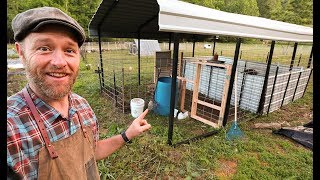
In this weekly vlog, the host (Speaker A) tours and explains the expanded 240 sq ft "pig port" built under a carport, detailing its deep‑bedding, mulched wood‑chip floor, feed pan sanitation, and ventilation. He describes the integration of multiple animal systems on the homestead: pigs, chickens (layers, broody hens, guinea‑keets), geese, and dairy cows, highlighting feeding routines, health supplements (apple cider vinegar, kelp, salt), and pest‑control methods (fly larvae consumption). The video also covers garden work—carrot and tomato cultivation, weed management, use of grass‑clipping mulch as a nitrogen source, and the construction of raised beds. Family members (Jonah, Lily, Gideon) assist with chores such as moving chicks, handling broody hens, and setting up a brooder breaker. The host mentions milking 15 gallons of milk, a pending calf birth, and promotes an upcoming butchering class for the community. Throughout, the tone is instructional, enthusiastic, and conversational, emphasizing practical, low‑cost solutions for small‑scale, diversified farming.
Chapters
The nipple water is still holding strong. No leak. Notice anything different? My pig The pig port just got better. The 240 square foot carport turned pig port just got better. We expanded it from just in here, a deep bedding system where they eat and then they manure. Oh, and let's do it now. And we cover with— wait, how'd that— that got uncovered. Oops, that's supposed to stay covered at night. Anyway, let's get some mulch on that. We got to keep these wood chips dry, got to keep this area dry. That's why we had to fix that leak. You guys want the tour? You want to go inside? We've expanded out into underneath the carport here. A door, just a simple door with cattle panel to keep them in. Just cattle panel rails right there. A little bit of a turn here. We wanted to keep our staging area. This is great for compost thermometer, pitchfork, extra feed, trash can. Now they have this outdoor run where they can come in and out of the mulch as they please. How about Let the pig go where the pig wants to be. They can come out here, catch a breeze, catch a view, uh, catch some rays, or they can come back in here, which is where they still spend a lot of their time. They nap, they nap in there. We feed them in here. Some of this green material gets mixed in with this, is slowly compost. We keep the surface dry with clean wood chips and keeps it nice and cool, keeps it from being warm from this compost, from heating up too much underneath. We don't want the compost to heat up too much underneath this. We want you guys to stay cool. In this system, it's so pleasurable to work with. Sure, it's, it's a little more intense if you had broad acre, if you just put your pigs in a new paddock every week in a forest, uh, but it's so enjoyable. Come out here, give them some of your food scraps. Give them some, uh, throw them some bedding, pet them. It's just nice. I've given them a fresh feed pan. The old one I took out, washed it out, let the sun sanitize it, keep everything sanitized. I dropped them some apple cider vinegar in there to keep them in good health, some salt. I'd add some kelp to that. That's my 240 square foot Micro pig farm, y'all. I think it's gonna open the doors to a lot of people keeping pigs. Welcome to your weekly update where we're gonna go around, do some chores, update you on everything that's going on down here in our fall garden. Things are steady without Ryan. Things kind of stay steady except for this Swiss chard. It jammed. Bonus! Hey, Jonah's idea worked! He said, hey Pop, what if I take out a nesting box and they can get out themselves in the morning? They're still high enough up to ward off a predator. The fences are really hot right now. Because it's so dry. I said, why not? It worked. Some of you bird brains didn't figure it out. Now, right next door, the little chicks, the replacement. Here's the thing about these guys, I put them in a separate pen because I have so much layer food. These guys don't need to eat layer food. I just want to get rid of it, keep them in a separate pen. I have some ideas though. What if we put this in there, fed you guys in the morning, kept you guys up, and come and let you guys up after milking time, after they've eaten all their food, open the door like this, somehow rig it so it only opens that far so only the chicks can get in and out of here and they can get all their food they want. The big chicks can't get in there. I think so. I debated whether I should let these guys out today, if they'll know their coop. I think they will. We just put them in there yesterday. It's so flat to the ground. I'll keep their feed and water in there. I trust this Premier One, shock or not. See, really tight mesh at the bottom. I trust that enough that They don't go back to their coop, they're going to still be protected. They're going to go back. See, this one already got out and he's not wanting to venture too far. But it would make chores so much easier if these flocks could be blended. One net, one Energizer, one system. Because you got to go and mow around the fences and stuff. Looks like nice now, but I worked real hard on it yesterday. Right beside the chicks, pig port. Let's call this the Frosty Garden. We put in tomato stakes last night. That was a really quick fix for staking up these tomatoes. These are— we've had these for a number of years. You just buy them at the store like this. These carrots are coming along nice. We have some up in Arun's garden that we've already eaten. It's hard to resist. It's almost like candy. Homegrown carrots makes it all worth it. You have to weed like crazy at first But they're almost to the stage where they leaf up and block most of the weeds, and we're through the spring, so that weed flush has gone through. We're much more encouraged. We're much more able to keep up with this, just working maybe 4 nights a week, come out and weed something for an hour. 50 plus 50, 100 feet, plus 50, 150 feet of carrots. I think these guys are due any day. We got guinea keets in here. Mama hen's on them. Did I hear something? Do I hear chirping? I think I hear chirping. Maybe that's those. Oh, look, we do! I do, I hear it. They're guinea keets. You guys see the guinea keets? Look, Mama Hen. Mama Hen. Oh, precious. Maybe you guys stand a chance under a mama hen. Oh, she must abandon these. How you— you got something? Oh, you do, you have something. They are good. Don't steal anybody's babies. How about you? You got something? Everybody's got something. Everybody's got something. You know what that means? You got to get out. You're laying eggs anyway. You're ready to get out. And you chicks, you have a new place now anyway. I'm gonna give these, these mama hens and guineas one more day in here, and, uh, then we'll move them. We'll move them into that, shall we? Inspect this garden. Look, every once in a while something peeks up through. That's actually lamb's quarters. Should go feed that to the pigs. So look at these carrots, look how they came up. And now a weed can barely even get light, so they don't grow. Here's something on the edge. You just come through and pull it up. So satisfying because it's going to be one less weed there. Shall we check on the kids? We let them sleep in, try something different since Since they're staying up later because it gets dark later doing chores, maybe letting them sleep in. 7:20. Guess what? The keats have hatched. The guinea keats have hatched. This will do it. Guess what, everybody? Your guinea keets hatched! And they're so cute, so little. And you guys gotta go get Laurel today. Why don't you go put your shoes on while I got these milk? Oh my word, 15 gallons of milk back, I think, if I calculated it right.
Papa?
Yes?
How many guinea hogs?
I don't know. I don't know what you're talking about.
Uh, how many guinea keats?
Guinea keats? I don't know. Let's go see. Mr. Brown, where's your boot?
I think we should put them in the 100 chick brooder that the, the, uh, 100 chicks just left.
That wouldn't be the end of the world. Jonah's idea is to get them out of here. Okay, all right. I don't know if it's gonna work, but there you go, Jonah.
I'll take some pulps.
There's some Keats beside that. Let's pull Pull that out and then we'll put the keets in there with them. Look at the little kids. Yeah, you can put that on top. Open them back again. Gideon, let's handle them when we get over there. Hold that, Lily. Look at that broody hen. Does she have any?
She had one.
I think they get confused.
Okay, I think we should just put these— yeah, let's get that. Big one, and put her in there.
So we still have to hatch those, so let's put her in there. Do separate them. Yeah, you know, this other broody though, we don't even need her. No, we don't.
Look, she's getting in there.
Okay, so grab that other broody. Oh, it is so small.
Yeah.
Hey buddy.
Boy, they're cute when they're this age.
You really are.
That one Guinea nest was abandoned, so we had to leave those eggs. That means we really don't need this extra broody hen, which means we're gonna have to break her of her brood. We gotta break hens of their brood anyway that are out in the flock. So I was setting that up and then Lily's chicks got out. Your raised beds are looking jamming. So how did your chicks get out, Lily? These raised beds totally jamming. You're sprouting something here, babe. Did you plant something? Did you plant beans or something? They're coming up. This has been good soil. Have you liked the— have you liked the grass clippings? Okay, do you want to share about this? We have a lesson learned here. Before you do Shackley, wow, as a bug deterrent, go ask Mr. Google Pants for a recipe.
I got a little crazy. I didn't read the directions well and I misused the product, so it's my fault.
Yeah.
Hey, you're just planting, babe.
I am.
I don't know if we'll get a zucchini off of it though. No, I think we will. You're gonna recover?
It's recovering. I am, um, it— I'm getting rid of all the It's like you're pruning.
Look though, beauty. Everything else, is there any complaints on anything else? Look, look how the grass clippings are working. They die off, they become more of a dry matter, they suppress the weeds. That's a nitrogen source for the soil. How do you like the grass clippings?
I love it.
It's been good. Look at the goose! Look at the goose! This goose is doing much better, Mom. The reason we're doing so many different flocks You got to keep geese separate or they become buddy-buddy with each other and not the chickens, and then they don't guard them. Here's the, uh, grass clippings. Amazing. We have that mulch blade— mulch blades on the mower, so it chops it up really fine, breaks down really fast. So when you're putting a Premier 1 net in mulch, oftentimes the tongs on these are not too long enough. So we're gonna show you a trick. We're gonna take one of these rebar posts, drive it in diagonally, slightly diagonal. Yay! Look at all the string you brought me! Thank you. All right, there we go. We've got it energized, we've got the corner supported. How dare him to get out now! All right, let's get this finished. We got our brooder breaker. Basically, it's just a dog crate, cardboard floor so they don't manure on the main floor, or water and feed. That's it. And give them 2-3 days, they break their brood. All right. Shut the door. Now we have like, what, 4 out in the main flock? We got the Icelandics following the cows again. We took a break because of my hand and because the boys can't move this fence, but we need them on it because the flies are getting crazy. And these guys help, they put their feet on their manure. This is 3 days behind the cows. Fly larva is in there. And they, they get it out and eat it. And that's a lot less flies. On Fridays we try to milk early, 8:30, because we cream separate. We're just about— it's 8:35, but I gotta bandage my hand before I milk. See, those layer chicks are— chickens are already done with their feed. I could have totally let these guys out now if they were together. You enjoying the free range? Everybody's staying in. It's all working good now. You're gonna be able to do 15 gallons of milk.
I got this.
You got this. Feeling good?
Yeah.
Hey, you got a nice haircut.
Yes, thank you.
Looks good.
I had it cut yesterday, or trimmed. It's more trimmed than cut. I wanted to make sure that, um, I could still use that ponytail.
So you're gonna let that heat up to 100 while you bandage my hand? Yeah. We got bandaged. That didn't take long. But look, how'd the goose get out? Jonah, will you turn us off? How'd this goose get out? Oh look, it's way up over there. Is it off? All right, get us a tent stake, Jonah. Come here. It's way off the ground right here, Jonah. So you— will you drive us a tent stake in on that right there, please? You need And then turn it back on. Thank you, Miss Thing. She has slowed down a bit, maybe a gallon right there. She's getting closer to drying off before she has another calf, guys. Another calf. I think that calf's due in September-ish. I didn't get to show you guys these this morning, ran out of time, but this afternoon— the sea monster!
Whoa, Papa, feed them out in that— all that briars. Look, they trample it. Feed them out in the briars.
Ah, what'd you do? I just cut myself in the briars. Here. Wow, our most successful batch of sea monsters. Cornish cross. So happy about these guys. Donald, give it up to Donald. Clapping my hand here. I'm clapping my hand. Give us a clap, Jonah. Yay, Donald! Right, good job, guys. Okay, this is almost over though. They're graduating Wednesday. As soon as these— huge! As soon as these guys graduate on Wednesday, butchering day. Got a butchering class, by the way, and there's some spots still available. Come hang out with us, learn from us how to butcher. Jason from So the Land's going to be here. It's going to be fun. We'll bring those chicks. We got chicks to replace these guys. The day we move these guys out, we move the new chicks in, and that way Donald always has somebody.
That means like at 6:00 we have to get up and move all these guys to the butcher.
Yes, we're gonna get up early on Wednesday. Okay, okay. Hopefully start butchering at 7:00. Class starts at 8:00.
More from Justin






If I had to start my Homestead all over again, it could only pick one animal… 




