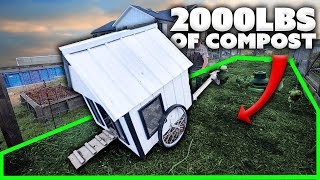
In this instructional video, Victor Justin Rhodes demonstrates a permanent, floor‑less chicken run and coop that eliminates the need to manually handle manure. By elevating feeders and water, using deep wood‑chip bedding (≈8 inches) on a cedar‑framed, cattle‑panel enclosure, chicken droppings fall through the bedding and mix with the carbon material to become compost. The system is placed near the house and garden for convenience, requires about 3 sq ft per bird (he uses ~20 sq ft per bird), and yields roughly 10–12 wheelbarrow loads (over 2,000 lb) of compost annually. Rhodes explains sourcing free or low‑cost wood chips, maintaining the bedding to control odor, and offers design plans via homesteadbuilds.com and an upcoming book. The video’s key messages are: a no‑poop coop is feasible, it provides a sustainable fertilizer source, and it simplifies chicken management.
Chapters
Notice I have the water cooler and the snack machine. Both of them are elevated. When the chickens scratch in the mulch, we don't want to get the mulch in that. I also have it separated. That's so we spread the chicken squat love. Because people loiter around these things, you're gonna get a concentration of manure there. Well, concentration of spilled feed too, in this case. So just Move it every once in a while. How's that? They're congregating and manuring over here. Chickens poop a pound and a half per chicken every single week, and I never handle a single bit of it. Well, mostly never. This is the rare exception. Sometimes some hay falls out of the nesting box and it prevents manure from following through falling through, and I do have to handle some. Otherwise, there are loads and loads of chicken squats I didn't have to touch. For most chicken tenders, chicken doo-doo amasses over time, and it's disgusting and unfortunately common problem. But it doesn't have to be that way. So instead of handling evil chicken poo, give them a carbonaceous diaper, as Joel Salatin would say— wood chips where the manure can sit on and mix with. Give them a floorless coop where said manure can just fall right through and you never have to clean this thing. Over time, that manure mixes with this wood chips and becomes compost to feed your garden, preferably right next door. In this video, I'm going to show you exactly how I take something— evil chicken poo— and we automatically turn it into compost. Sanitization for the chickens, they're going to work for you making compost. And then at the end, you've turned that evil chicken poo into holy chicken squat. Here's how. Working on the homestead house. We're not going to stop them. Just remember, you have to handle chicken manure and it's misdirected, that's evil chicken poo. But when you put it to use, you turn it into holy chicken squat and you've got more from your chickens than just meat and eggs. 3 keys to the no poop chicken coop and run. Let's talk about the run. Where do you put it? Well, you want it as close to the house as socially acceptable. In my case, I have it in the very front yard. I also have it right next to the garden. If you're gonna have a permanent chicken run, it's a good idea to have it next to the garden because, well, you can pick weeds, extra produce, you can throw it to your chickens. Weeding has never been so much fun. You need at least 3 square foot per chicken. Now that's not much, and that can be a good thing. And the more chickens you have, the more easier it is quicker it is to break down the compost. The more manure they get, the nitrogen that feeds that— the chickens are on wood chips in this case, we'll talk about that in a minute— that mixes. So the more concentration you have, the better. You actually don't want to spread them too much. You don't have too many chickens. I would say, what do I got here, about 20, 20-ish square foot per bird. Quick tour of what I call the compost corner. Corner because this whole system automatically generates compost. This is a permanent run. We have a design for this in Homestead Builds. This is cedar structure, rot resistant. Since made this over 52 inches tall. You can see where we first did this and the chickens would still jump over it. Cattle panel snugged in onto the inside, and that's just for structure for the poultry wire that keeps them in and predators out. Last but not least, some sort of material. In this case, it's a cedar 1x. This keeps the bedding in. You can see the bedding has built up. People could use tin, people could use any kind of lumber. The cedar is rot resistant, non-toxic, and so therefore lasts a little while and doesn't contaminate the soil. Plans for that particular coop at homesteadbuilds.com, my new book that is coming out. Don't necessarily say hurry up and and build a permanent run. I would say start— and you don't have to have a permanent— I would say, I would say start with a Premier 1 electric poultry net. For years, that's all we had in this yard, and we did our deep bedding in there. I mean, yeah, the mulch hits up against the net over time, but you just go around maybe once or twice a week and just lift it up and reestablish it. Second key to a poop-free coop and run is wood chips or some sort of carbon material. You could use leaves, you could use dry leaves, you could use straw, something like— I find that wood chips are the best. Oftentimes you can get wood chips for free talking to your local power company or local landscape company. Sometimes they're happy to drop there, but sometimes they're not. And that's okay, because even if you have to buy a load of wood chips, which is like a dump truckload of wood chips, it's $200. And from that, you're gonna get thousands and thousands of pounds of compost. You'll see in a minute in here, you just— this, this 600-square-foot system is gonna yield 10, 12 wheelbarrow loads of compost a year easy. And that's over 2,000 pounds of compost. That's a ton of compost, literally. What you do is start off with at least 8 inches of wood chips, then bring in the chickens and let them have at it. And what they do is they do their thing, they peck, they scratch, and manure. That one's scratching right there. What happens there to make compost, you need nitrogen, which is manure, carbon, which is the wood chips, air, which is them turning it, and then water, which naturally comes from the sky. And then over time, what you have here— look what they've uncovered right here underneath those wood chips. It's just incredibly insane useful soil. Bringing up some greens. Yeah, after you've had your initial dump of compost, if you ever have any stink, definitely sprinkle some more down, bring in another load, do what you got to do to keep the stink down. You want to have that right ratio, and you definitely need more carbon than you do manure. We generally bring in a load probably 2, 3 times a year. You don't really have to worry about spreading it out because, as I've said it before, chickens don't have internet and