No Bugs, No Weeds Garden Solution ~ How to Grow Veggies All Winter
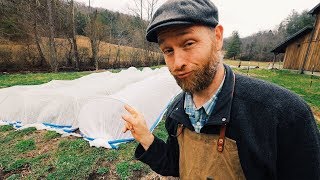
Casey Oswitch and the host show how to grow vegetables all winter with almost no weeds or bugs. They use low tunnels made from 10-foot conduit arches and Agribon fabric, direct-seed hardy crops like kale and spinach, and let them sit dormant under protection until spring.
Chapters
Today's February 27th and I've still got a bunch of fresh vegetables growing. Let's get this back up. This has come undone. This is going to be the backdrop, so we want this to look— we want to look good for this video. Okay, we've got 2 and 3/4 up. Let's get this one other one up. Wow. In this video, I'm going to show you some things I did to manage to have fresh veggies all year long. Okay, you guys want to hoe? We got little hoes out.
Yeah.
Okay, let's do it. We're gonna need to hoe. It's raining, it's raining, but the work's got to go on. Let's hoe it before it gets muddy. Winter gardening is actually one of the easiest forms of gardening, I think, because Well, you know, when everybody's kind of putting it away, putting in the last effort, it's still hot out, you plant your crop, you let that grow up, that grows to a point of harvest, you then cover it as the cold weather comes, and you protect it, and it sits dormant all winter long. You come and harvest it. The good thing about that, what makes it so easy, is guess, guess what's not around in the winter? Weeds, bugs. So if you cultivate it well, it's growing up, it's fine, it will do great all winter long. You just come and get it, there's no bug pressure on it. I think winter gardening is like the— it's a, it's a hidden secret for sure. Trying to not get burnt out at the end of the season, give it a little bit of, um, at the end and you'll get so much more throughout the entire cold months. This row, for some reason, was the most difficult, hardest to keep the Agribon on. It's totally shredded right here. It's totally ripped in half. I just gave up. So this is actually the worst shape. There's not much left in here. So we got a wheelbarrow load of weeds, some soil. Let's not waste that. Let's put it in the chickens. You got my gate, Jonah? You know, in the future though, I'm gonna have the chickens do this job. It's just we didn't time it right. My friend Casey Oswitch is coming today, and he also wants to plant today. I'm thinking we could plant some other stuff too, like onions and spinach. Another bonus to this style of farming is the spring head start. A lot of people are jumping the game, starting seeds indoors or in a greenhouse, and that's great and that's fine, and we do that too. But with a winter harvest garden, you come out and, you know, we haven't visited in a while. There are some weeds growing up because it is starting to get warmer. But for example, the kale—
look what's under here.
We're going to— this is how you revive a garden in the spring. This is why I'm not rushing to plant my seeds in the spring, because we already have kale that has been protected all winter, harvested all winter, and it's coming back. You see that green? That's new growth. It's coming back. They're weeds. They're weeds. Let's get these weeds up, Jonah, and we'll have a jump start on spring. It's there. It's wanting to come back. You can see some new growth on it. Just coming in and just cultivating it a little bit gives it this breath of fresh air, and you're so far ahead of the game. No starting seeds indoors, no transplanting them out to the greenhouse, no monitoring, watering them in the greenhouse. They're already in the ground ready to go. Boom! I'd say that's easier than starting these seeds way ahead of time These have just been here sitting sort of dormant all winter long, and I just hoed around these and it's like they have a breath of fresh air. You guys can breathe now. You can breathe and grow now. We'll be eating you guys in just a couple of weeks. It's crazy. It's February, Jonah. It's February. It's the end of February. You showing them a little love? I kid you not, 30 minutes later they've almost finished their second breakfast. Well guys, we have a third breakfast for you. Let's do it. That would be good. Let's set you guys up on a time lapse. We'll see how they decimate this in such a short amount of time. Boom! Just like that. An hour-ish, hour and a half. Explosion. Okay, see, you arrived and I have to milk now.
That's fine.
I did want to work with you. I did, I promise.
That's all right.
So look, this is what we did. Got you a cloth there. I'm gonna have Jonah help you. Is this what was up here? It just, it just got ripped to shreds. No, I didn't. I'm not that organized. Not anywhere close. Yeah, no, that got the one, the one Look, you don't have a trick for not getting this stuff ripped. Look, it's just terrible. See that? There's just— look, look at that far one. Well, there's— I mean, there's no way they're gonna last more than one season. Is that normal?
They can, but you also have to realize that we had two hurricanes. Yeah, snow, like two windstorms.
Never stops raining.
Yeah, I know, it's rained record rain this year.
Okay, so did I do a good job hoeing this, or are you crazy and you like to get every single weed out of there? I've uprooted it. Yeah, so it should die right there. Yeah, it should. Okay, so you— we'll get you a rake.
I brought some tools.
Oh, okay. Yeah. All right, well, tell everybody who you are and who you're with.
Uh, Casey, and my wife and I are starting Honey Tree Farm. We do have a YouTube, you can check it out, there's like 10 videos or so. And then Honey Tree Farm NC Instagram, Facebook. Yeah. And yeah, we've been doing this, this is our second season, but I've been working with plants and trees half my life.
Yep.
So that's what we want to do.
So it's fair to say you're homesteader gone pro?
Nah, not pro yet.
Come on, you get paid, right? You get paid something.
Well, I finally sold enough product to be considered an actual farm legally.
Then you're pro. Pro means you get paid. Doesn't mean how much. You're not doing it full-time yet, that's what you're saying. Uh, you and Tori are not, yeah, living off the land yet? No. Okay.
No, we're getting there, but it's only been 6 months, so.
Okay, so here's what I did to make this happen. One, we prepped it. We used chickens and pigs ahead of time to come in where the pigs and the chickens have prepped this land, but it's like ready. It's ready to be planted. It's bare. Mother— Mother Nature does not like to be uncovered. We also put down compost in here. Chickens and pigs help to stir that. You know, I'm gonna put a hair grain on this and then I'm gonna bury it. I'm gonna pile it up and see if that doesn't encourage them to scratch it even more. After we moved out the chickens and pigs, we spread that all out, we put it up into rows, and we direct seeded. We, we could have seed started if we were ahead of the game. We weren't. We direct seeded, then cultivated it for the first, I don't know, month, 6 weeks. Do just one side, but I think— let me see if it's made to do both sides. It looks like you do both sides. Yeah, bring it on. Why are you cultivating so much? Well, you want to stay on it, otherwise the weeds will get over— will grow over our crops and take over. How's it working, Jonah? Hey, good morning! You wanna— are you coming to work? Do I need a tool? Yeah, here, take this tool so you can do this. Okay, get these big roots out. Or would you rather hoe? Maybe you'd be a better hoer. Oh, okay. So we want to weed this and thin this, and then we want to cover this. It's gonna be a lot of work. Yeah, but it's good work. This is not— this is not it. That's not it. I would just swipe that. See, I did— I did a lot of weeding in between the rows yesterday. Yeah, so necessarily— no, I didn't get close to the plants yet, so it's going to take some tender loving care, like with your hand. Let's get this big bad boy up and get this set before it's too big. That didn't help. Well, I'm not getting this very good. Take these weeds, turn them into a solution. Take the problem, turn into solution. Have it be the mulch for the path. Now we have the little stuff. So close. We don't have a little hook. Casey and Tori told us about a little That's an old hook, and that gets around close to the plants. So for now, I'm just going to show it mega love. Right here is going to be a perfect opportunity to transfer some of this bunch to right here. We got 3 of the 4 rows done. You guys want to see what it looks like? Check it. We did around the lettuce and little plants. It's looking good. And basically the winter had come, the cold weather had come, the first frost Frost was coming, we put down these row covers. For the poles, for the ribs of these low tunnels, it's a 10-foot conduit, half-inch. We got a pole bender from Johnny Seeds and we bent these into an arch, and then we put them in every 4 or 5 feet, I forget which now, and then put this Agribon over them. It's called Agribon. It's like a light material. Rain and moisture could still get through, but it protects the plants from frost. Now when it did snow, we came out and we put plastic on it. We did it, Jonah! That looks legit. You know, while normal people are rushing to the grocery store to get eggs, milk, and bread— I guess they're making French toast— they're running to get their French toast. We're running to cover our greens. And look, we're fine. I'll pick some. Come here, Jonah, can you help me get this— some of this lettuce? I picked some lunch here. And we got a greenhouse plastic again from Johnny Seeds, 10-foot wide, and you can get it in 50-foot pieces. I think this is 36 feet, but next time we'll do 50 feet. But it doesn't matter if you have a little extra, it worked out fine. We put this up yesterday. This is the perfect width, 10 feet wide, perfect length, 100 feet. You got to cut it in half for our 50-foot rows. Wow, it just really started to pick up. Anyway, that's 36 feet, but in the future we're doing 50-foot rows because everything comes in 50-foot— hoses, greenhouse plastic, everything. So we're going to streamline it, streamline it like that.
Josiah!
I cut my first one, Jonah. That was pretty easy. Listen, let's straighten up the low tunnels now. They're a little untidy. We need to pull the Agribond tight. Let's straighten that before we put these— this plastic on. I was surprisingly thrilled. It was pretty easy to put up. We just put it up over the Agribon, and thank goodness we did. While other people were rushing to the store to get their French toast, milk, eggs, and bread, we're rushing to cover our greens. Yeah, this was a good bet. This was a good bet. These bigger ones up— this bigger ones up here. These low tunnels, some parts of them are crushed, but they're certainly not defeated. I doubt the food's even ruined under there. We'll just wait till it's thawed out, lift it back up, see. Let's see if the kids are ready. Doesn't sound like they're my kind of ready. Oh my, uh-oh, it's time to eat and there's still stuff. And then to weigh it down, we actually used fire hose, sealed it off on one end, filled it up with water, not quite full because we wanted to be able to freeze and not break our, our line, and then sealed it off on the other end to weigh it down. We, we also ran out of that, and so we did use some sandbags to weigh the rest of it down. We ended up going a little longer than I think we imagined we would. But it is nice to wrap it around and use the hose as opposed to sandbags and a hose. See, as we were cultivating and stuff, it's the heat of the summer. We did water this. We would water it if it didn't rain. We make sure to get about 1 to 3 inches a week. Did I miss anything? Uh, two things you could put in there is, uh, you're growing cold hardy. Here, let me get a shot at you just saying this. Oh, that's a good point.
Okay, over the winter you want to do cold hardy crops. Oh yes. And also, so in the fall, depending on where you are in the States, the farther north you are, the quicker you lose 10 hours of sunlight a day. The farther south you are, either you don't lose 10 hours of sunlight a day, or your period of less than 10 hours of sunlight a day is shorter. On this area, because we're about the same latitude, November 28th to January 14th were less than 10 hours of sunlight a day. So what that does for your cold-hardy crops, it's not enough sunlight for them to actively be growing. So they really don't do anything during that time. And it's almost like— well, it is clockwork because it's the sun, but once that 10 hours comes back, everything really starts growing again. It's a huge difference. If you grow spinach, you'll see that right away.
That's a good point. So it doesn't grow less than 10 hours, and it's not like I planted tomatoes and cucumbers. Forget it. Yeah, I'm gonna be able to grow that or have that under there. That's gonna get just demolished under there. But stuff like kale, spinach, lettuce, Swiss chard, and beets and carrots—
what, what you really, what you really want to focus on is how long it takes that crop to get to a harvestable stage. So whether that's 2 months or 120 days, just add some extra time because it's a shoulder season and it's getting colder, the days are getting shorter, and then start those vegetables earlier in the year so that when you have them covered in the winter, you're coming out to a harvestable stage of your plant and you, you have a lot of resiliency there with either leaving it because it's not going to grow or overharvesting it because it's not going to grow but it's going to come back. Uh, no, in 2 months, 3 months, or whatnot.
Nice. Well, that's all we got out of Aunt Flossie. You know, she hasn't, she hasn't even moved in the stanchion. She's been a fabulous milker. She stepped around today and once in the bucket, so that's all we got. How's it going down there, Casey? John is envious of your seeder there. You got to use it. Oh good, you get to use it, buddy. We got a little less than a quart, but I guess that's one reason why we have two cows. It's a bit of a fail-safe. Okay, Phyllis, the pressure is on. Look, evidence of all the Spilt milk, man. And when they step in it, man, it spills. You can't even salvage it for the animals. Okay, well, that's why we have two cows. We're still in milk. Boom! Look at that, man. He knows how to— he knows how to put this together. Casey's low tunnel. We got a new cover, of course. Casey's low tunnel. Milo's tunnel. This is his. Looking nice. Spinach, carrots, onions, beets. Casey's also going to square our animal crop garden, but we need to go in and eat breakfast. I'd say 10:38. It's a good time for that. You hungry, Casey? Boom! Fresh eggs, cabbage, and look what's hidden in this cabbage. The Gap sack gets better and better to me now that we can have spices now. Look what I'm gonna eat. Sausage. Sausage. Sausage. Sausage. That means bacon's gonna come into roast soon. Now I think bacon's on full gas, but we'll be on full gas in like a couple weeks. Rebecca is not here, she had to go to a doctor's appointment, but everything's good with her. But Casey and I are gonna eat a little bit and then we got to— we're gonna square the garden outside. Another thing, Casey, about these low tunnels, I had to I did my rows wrong. That's why I had to set the, the bars sideways so that we could actually have a path. What is the ideal row width?
Uh, well, the width of your row ideally is gonna be like— I would benefit from a bigger row. We do 18-inch. Yeah, I would benefit because I'm 6 foot tall, but Um, he doesn't— you know, some people like, uh, Steadfast Farm in Arizona, he does 12 inches, but his land constraint, I think it gives him like 12 more beds or something. So, oh, that's pretty awesome.
We're talking about the pathway there.
Oh, you're talking about the bed?
Yeah, but about the bed. Sorry, row 12 inches.
Yeah, well, if you get into the market gardening stuff, everything's pretty much based around 30-inch beds. So the tools like your broad fork, most of them are going to be 28 inches.
Yeah.
And the BCS, which is used for most of stuff, the attachments are 30 inches.
Um, okay.
Just a lot of fabric and stuff can—
is—
will fit around 30.
I think this— am I wrong— but this, this is probably should have been two 30-inch beds under there.
Yeah, you could probably fit two 30-inch beds in there.
Yeah. And I wouldn't put them right now. I would still have a path in between them, a foot in between them.
The path in between, if you covered two beds at once, is like where you would go in and harvest in the winter.
Ah, you crawl in and then you don't have to lift up along the side.
You got to be down.
Okay. Anyways, all right.
But yeah, that's— most of the tools are made for 30-inch. That's really from Elliot Coleman mostly.
Yeah.
And okay, where market gardening came from. Um, like in Paris they had 30-inch beds, and it's also like you can't, you can't like straddle this. No, and work comfortably.
Quite too much to straddle, but you can straddle a 30-inch bed.
Yeah, or if you're right here, like you can't— a 30-inch bed you can reach halfway across, and it's just easier for people to—
yeah, to work. Okay, what did you plant in there, Casey, and where?
The left two is spinach, left two rows of spinach all the way down. Yep, and then 2 rows of beets, 1 row of kale, and 3 rows of lettuce mix.
More from Justin






If I had to start my Homestead all over again, it could only pick one animal… 




