No More Chicken Chores: Never Freezes + Always Clean (Everflow 3.0)
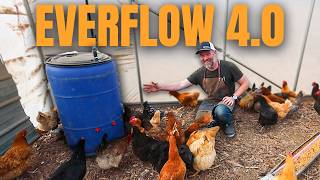
In this 30‑minute homestead vlog, Victor (Speaker A) leads his family through the design, construction, and testing of an Everflow 3.0 chicken waterer. The system is a gravity‑fed, electricity‑free water delivery network that draws water from a pond 35‑50 ft above the coop, runs ~400 ft of 1‑inch poly pipe through a culvert, and ends in a large trough with nipples for the chickens. The video is structured into five stages: (1) installing a pond intake filter, (2) laying the main water line, (3) tapping the line with a hose to feed the waterer, (4) assembling the waterer trough, and (5) commissioning the system. Throughout, the family members (children Lily, Josiah, Gideon, Jonah, and others) participate, learning hands‑on skills while the narrator shares his permaculture philosophy—using gravity and continuous flow to keep water from freezing. The host recounts three previous Everflow prototypes, explains why they failed (insufficient fall, clogging, need for a drain), and shows how the current design solves those issues with a larger fall, a drain valve, and a poly‑face cage to keep debris out. Detailed tool and part usage (saws, zip ties, hose clamps, union adapters, ball valves, drill guides, washers) are demonstrated, along with on‑site problem solving (leaks, missing washers, stuck grate). The final test shows water flowing continuously to the coop, confirming the system’s benefits: no freezing, no electricity, no daily cleaning, and scalability to other livestock. The video blends instructional DIY with family‑building narrative and a broader educational message about raising productive, self‑reliant children.
Chapters
Happy day! In this video, we are building an Everflow chicken water. Never freezes, always clean, never needs servicing, no electricity. Let's go! Let me be free. Go! Are you gonna wear those gloves?
Those are mine.
Can he have those? They're his. You have the saw, remember? Let him get something at Lowe's. Thankfully, I talked him out of the trucks. You want me to get the Ergo and carry you? There he is. Here, you have the saw. If you want to take your kids with you, it's gonna be A long time. That could very well be the project today. We're not installing an Everflow waterer. We're working with our children installing an Everflow waterer. Does that make sense?
How about, did you know that blind people can play soccer?
I didn't. In the Olympics. I did not know that. If you want to go get our— all the 1-inch poly pipe we've got over there behind the Bastion. I'll get all the tools. Because you want to be a man, right? You're a boy right now, but if you want to become a man, you gotta be with the men. Okay? Our philosophy summed up right there. Hopefully I'm not negotiating with terrorists. Hopefully I'm training men. Give me patience and wisdom. Did y'all figure this out? You know how you get patience, right? You know how the Lord gives you patience? He gives you trials. Don't be a wimpy. Exercise in patience. Had to get a new torch yesterday.
Oh yeah.
We're in business. Every day is bring your kid to work day on the homestead. Our child-raising homeschool philosophy is I want them to be productive citizens, give more than they take when they grow up. People— the boys who grow up to be men, the girls who grow up to be women. So that means they need to be around what men and women and what they do all day. I got all the stuff ready. Me yesterday so you guys don't have to be bored to death me going around finding— you'll see what this does. Need your saw. You got your saw? Okay. Is your love tank empty? Do you need a hug? If you're cold, let's go get in the sun. Come on. Pond's still frozen. Even when this pond was absolutely froze over, still had A little bit of movement right here, the water emptying. As permaculturalists, we look to nature to see how we might solve a problem. So how do animals in nature keep their water unfrozen? Two things: gravity and flow. It's always moving. We're gonna adapt that right now to our situation. It's all coming in handy, huh? Yeah. Let's break this project up into setting up the intake, stage 1. Stage 2: running the line. We're here, we're up here at the pond. It's going to be our source. How high do you think we're up here? We're not quite 50 feet vertical, we're probably 35. Water will flow down through there. That'll be the sec— second stage, getting the water line all the way to the creek. Third stage, tapping that water line with an attachment hose to fill up our Everflow waterer, and then the fourth stage would be doing our Everflow waterer, and then fifth stage getting it going. How long you think this is going to take, buddy? An hour. Whoa, I like it, aiming for the impossible. I think we'll be lucky if we get it in 2 hours, but that would be really cream on the top if we get this done by lunch. Let's stop talking, let's start doing. That's what he said 30 minutes ago.
How are we gonna get to it?
You're gonna get out there with the boat? I didn't think that through. What are you trying? I'm just gonna tie it, zip tie it right here. That's fine. Oh yeah, like that. That's not bad. We don't have any zip ties up here. Do you want me to get zip ties or do you want to use a string? You put this on your end of your pipe. That's it. All right, besides saying we need more holes. Okay, this was already a pre-made thing for a spring catchment, so let's just dig more real quick. Get in, come over here and get this stick out of here. Stage 1 complete. I think our filter intake is going to work great. Stage 2: unwinding 400 feet of poly pipe, plus going through a culvert under the road. That's the tricky part, but I've got a plan. Kids are pretty determined to get the project done, then have free time. You gotta unroll it, you can't unwind it. The things you learn just over time and experience. One of the major problems here is we're on a dead-end road. This is a public street. We can't put the pipe over this, it'll get run over, the DOT will get mad at us. Hey, Lily. Yeah, I guess— well, wait. I guess she unwinds it. I think I have an idea. I don't know if the kids will go for it. Let's do 90s through the culvert. It'd be really clean if you came up to it, did a 90, and then a 90 at the bottom, and then shot out. What do you think? No necesito? You up for it? I can go in the tunnel. You can go in for us? We're gonna need that. Just keep on rolling it. So good to have all the kids out here. Jonah's the only one missing. He's gone to work as a grader today. Trying this out. Prepared yesterday for a day project today. I'm liking it. 2, 3.
Wow.
1, 2, 3. Wow. Oh no, that's stuck. Cannot get this grate off, so there's no going in it from here. Could we ever get that grate off? You could probably break it off. So let's, um, you want to crawl through the pipe?
I'll crawl through it.
Okay, Billy wants to. We need the littlest person that we think can attach a pipe. Okay, you got this?
Yes.
All right, you got this. And while she crawls through, flashback in time. Many years ago— it's been early vlogs, so 10 years— I had the idea to do an Everflow waterer. It came down the mountain from the pond and went into a trough, and the idea was it would fill the trough and drain out the other side. But what happened to that is It would fill up the trough, but it would, it would drain out the other side-ish, but it also wouldn't. It would if any little thing got in it, and you know the chickens getting at it, something would get in it. It wasn't enough. It was a lot of flow because you have 50 feet of gravity from the pond down to the where the chickens were, but then you're trying to catch flow again from the trough to the creek, and there just wasn't— that just wasn't enough fall. So the downside of the waterer wasn't drawing nearly as fast as the upper side, and that was a problem. It took us 3 times before we nailed this. The second time I'll tell you about in a second. Our second attempt to overflow water, which was pretty doable most of the winter, but it wasn't quite right. I'll tell you about that in a second. She coming? You're almost there, I can hear you.
There you are.
All right, hand that up through to Josiah, and he's got it. Good job, Lily, MVP today. Uh-oh, the hose clamps are getting too small. I thought these were bigger.
These are bigger.
These are bigger, right? Yeah. Only a 75% chance I indeed get it. Did get everything I need at Lowe's yesterday. The hope is to not have to go to the hardware store today to be able to get this done. We're at that point in our story where the kids basically want to take over. They don't want to assist. I like it. I'm the assistant now. Why do you like to take over? Because it gets done faster. We're gonna go along the garden. Can't dig down here because septic tank drain field. Stage 2 is complete, and I cannot believe it. This 400-foot water line came to right here. We don't have to make a cut. It's just long enough. We don't have to add an extension. It came right here and it'll, it'll come down through here and drain into our creek. So that's where the water would have went. We got to keep the water flowing, so we're pulling water from up there. It's going to flow through, it's going to— it's going to the creek anyway, so we want to put it back there. The water we don't use— I can't wait to show you how this is going to work. Stay tuned for stage 3. On the down end, a tee with a —what would you call that—a faucet attachment for attaching our hose. That hose will meander in there and feed our Everflow waterer. Josiah is now putting the shutoff, which is key because you want to shut off the water below, below this, so that water will be forced to come into this and to the Everflow waterer. While he's doing that and Lily's calling me, let's do history lesson number 2. Second Everflow waterer. I thought it needs to keep going. We need to have the water flowing and not trap it in a little trough. We came up with this wild PVC operation and this thing was like a creek. The water was literally flowing through and the chickens would drink of it from like a creek. Austin, show a good bit of footage of us building that and showing that how it works. So the PVC pipe goes here, trough goes in there, this on the other side.
This is how you disconnect it, and then you move your trough to a different connection. Here it comes. Woo! That's going to be full of water.
It's going to be a lot of pressure on that down. Okay. You can undo it now. Still, that worked better than our first one. Just keeping the water flow helped, helped with our downward pressure problem. We worked it so we could have a filter in there, but even so, we built a polyface— we eventually built a polyface design type cage around this thing, and that helped it stay even more freed up. But still, you know, you had to kind of maintain it. You kind of had to clean it out once a day or whatnot, and that's beside the point. We don't want to do water chores. Let's go finish up stage 3, and then I'll tell you about The system I landed upon that was better than all the rest, and it's the one we're building upon now for chickens. Stage 3. Do you need to heat it up some more? Heck yeah, buddy. I don't know about you guys, but I'm having fun. I can't wait for this next one, actually putting together the Everflow system. It's different. So with our chicken— current chicken waterer, it's a big tub It's got chicken nipples on it. It's got a connection so that you can feed it with a water hose, and that works great. That can work great all summer so long as it doesn't freeze, but it does take electricity because you have to put a trough heater in there to keep it from freezing. There's a better way without electricity, and there's a better way without having to even hook it up to the, the house water because, uh, this is gravity. This is gravity-fed, dude, from water off the farm. It's not even having to be pumped out of our well. Zero electricity. Power goes out, it doesn't matter. This is still going. Power goes out, this doesn't matter. This is still unfrozen. Yeah. All right, he didn't get excited about it like I do. Big huge tub. The chickens need that much? No, but you'll see why we're going to use such a big one. It'll make perfect sense. But first, the history lesson. I first had this idea when I got these big water troughs for collecting waters on top of the mountain. They had these tubes in them and it fills up, and then when it calls upon water, water falls down these tubes. And I thought, well, that could work. And we tried it with our pigs. I thought if we could get water to come into a trough— if water comes in off the mountain and fills up, and then there's a pipe in there that drains it down to here, that's fall. That's a lot of— that's a lot more fall than if it were here. Do you get it? That's 3 feet more fall. Water coming in, water going out. A lot more fast this time on the downhill. Pig waterer, of course it has nipples, but because the water was just— yeah, on real cold days we have to come warm up the nipples, but the water kept flowing. Even in the freezing. Josiah was saying we don't need our drain line right through here that we just put in. This is an inch, this line, and it might get full of an inch of water. This hose is only 3/4 of an inch, so it can't take it all. That means water will build up in this and won't be moving that much. It will freeze. We crank this open a little bit to keep water moving, not all the way. Enough to where water will still come through here, some will come through here, not stopping us out. Does that make sense? Yeah, it's a little tricky to teach with people flopping around in this— sorry, this stage. We're gonna install a drain too so that we don't have to tip this over to get the water out to move it. I got these union adapters, so there it goes like this. Don't glue anything yet too, we're gonna make sure it works. So then you'll cut this right there. You get it?
Yeah, good. There.
Hopefully that's big enough. It might just not gonna be. It's plastic. How is that gonna stop water from leaking through? Uh, there's one on this side. This rubber. Oh, this one's probably it right here. That's too big. Here we go. There it is. Oh, the bit's broken on the end of it. Replaceable? It might be. Josiah was able to get that drill bit out. Are you able to put another one in? There's none that we have the right size. If we had the right size, you'd be able to do it? Probably. Okay, that one's too small and this one's too big. Try it in this barrel without it. That drill helps you keep it straight because if it gets all cattywonk and the rubber washer doesn't cover it, it'll of course leak. All right, that worked. Is it too big, the hole? No, it isn't. It's perfect. Yeah, you sure? It could be a little smaller, but it's fine. Oh gosh, oh gosh. Did need that guide. That drill guide slipped around a lot. Hopefully that doesn't, you know, open things up to where the washer can't protect it. Well, do we put the washer on the inside? You don't have to go on the outside. I never seem to remember this. Does the rubber washer go on this? There's a rubber washer on one side, a plastic washer on the other side. Does the rubber washer go on the inside? I'm asking Groc. The rubber washer gasket ring and union fitting goes on the inside. Now is that lined up good? Get in. Yeah, you got the, the wrench. Okay, one down, one to go. And we're missing our washer. Hold on, here it is. Now attach the ball valve. We have to measure it for draining it, or you could do that. Gideon, how excited are you for this? I don't— you end up doing the water chores, don't you, on the chickens? I guess. No, I guess, I guess that's why I'm the most excited, because I do the water chores on the chickens. You want to do this cows in the field next? How are we going to do that? Well, we don't have to do any water chores out there if we set one up. Where's the saw? The trough's already set up. Jonah does them. Did you guys catch that? I said, you want to do the cows in the field next? He's— Joe, that's Jonas. I see how you are. Hey, while he's sawing this, Austin, you might as well show the cows Everflow waterer that we figured out. Just so you're gonna have to ask that question again because I bet the audience is thinking it too. Why didn't we want to run this hose straight to this? Good question. I was gonna rig a hose, a poly pipe straight into this. But what I found when I did with the pigs, if we have a system that connects a flexible water hose like this— guess what, Josiah? If this is what connects us to our source, okay, it's flexible, and then we can go to move this. That means we can move this around to different places inside of here. Somebody kind of cut that crooked. Does that matter? No. Is that the glue? It's the primer. You see what's happening? Water fills up and it doesn't drain until it comes to the top of this. Now let's do the lid pipe and then a male to male. You put this on there, PVC, and then we have a female to female. We're gonna put this lid on it. It gets so dusty and dirty in there. Plus the chickens might jump up on it. We will keep this open so keep getting air, otherwise it'll create a vacuum and the water won't flow through. I don't think— put some sort of cage over this though. We already lose that bit. I put it in here. I feel like I saw Gideon running around with it. This is all we got left of the 1-inch. Hopefully, uh, this is enough for the greenhouse and make it all the way down to the creek.
Yeah, I'll make it. You think? Yeah.
Okay, step on it. I feel like we're catching some breaks. That was plenty to the creek. We need to snake that drain line over here, tap into our culvert. We got a culvert running right where I'm standing. We ought to dig it up and drill a hole and put these 1-inch pipes into it, and then they're going to be run over when we go out through here to the pigs. Put our drain on and We're going. I don't know if we'll be able to turn this on before lunch, but it's going to be close. Just drill straight in. If we screw up on this, we're having to build a whole nother barrel. Wait, I was thinking below it. What do you think? Yeah, is it screwing down tight? Probably. Is it getting harder? Heck yeah. You're going in the stanchion just for fun now. Yeah, just for fun. She's been going in the stanchion great lately. Another wonderful question. Ask it again, Josiah. Why didn't we make it ever flow into that little barrel? Why didn't we? That might have worked, and I think maybe one day we should try it because this is a lot. But the reason is I got— I get more fall out of this one. I'm gonna have a taller drain line and get more fall. We're gonna do this. Yeah, kind of wish we would have done this first. How many? 3? Yep, just 3. We built this We built this, we built this. If these nipples go bad, we're starting all over again. This has taken 2 hours to build, but it is literally gonna save me hours upon hours upon hours upon hours, countless hours of water chores. I gotta set this down for this dance. You are welcome, future self. Oh no, what happened? Nothing. We're too close to the lip? No, it's not gonna go all the way on, but okay, it's gonna be fine. Dude, it's not working. Is the washer on that one? There's no washer. What? Why isn't there a washer? I don't know. Don't get too far though, there's no washer on it. I had the perfect drill bit for this. It's not a washer on any of these, Papa. There's none. It's one washer. Are you serious? How did we lose washers? We can't leave that one on after all. We need it. It's the last one we got that's got a washer on it. Go get it out of the barrel. This may be the biggest chicken water you've ever seen, but it's the hardest working one. Okay, Lily has called us for lunch. We are done with stage— what stage are we on, Austin? Ding it right there. Next stage You don't want to miss this. It's going to be very exciting. We are going to hook water up to that and then get water going down our line, man. We are literally 20 minutes of work to get this flowing, and by the end of the day, chickens will be drinking water from gravity-fed water off the farm. Okay, we got to get you excited. If we get done with the chicken waterer, I'll give you a bonus. What do you want? You get to play an hour of Call of Duty on a weekday. You like that? That gets you excited? Or were you gonna sneak and do that anyway? Uh, yeah. Lily, what'd you cook us, birdie? Chicken salad and baked beans. We're back at it. Kenny, get that chicken out of there! I never see a chicken get in a fence. If you can grab it, that's a bonus. I'll give you a dollar bill if you grab it and we clip those wings. He's trying. Oh, oh, it gave you a second chance. Here comes Josiah. $2 if you get that chicken. Attach that. Is that good? We are moments away. We are in the final stage. We've already set that in the water, and Josiah said, well, why isn't it flowing? It's in the water. Well, you gotta— you gotta get it sucking. You gotta get it flowing. And the best way to do that is to fill this hose up with water and then disconnect it. And because there's water in it, it starts the gravity flow and it just creates a suck, starts pulling all the water out. You got a female to female? Garden hose to garden hose, you can tell by the threads. All right, fill it up. How do we know when it's full? Well, we could go up there and see it coming out the other end, or we could just wait. Let's see if it's not leaking too, huh? It's a climb. I think our pump will do it. What do you think? It should. If that doesn't work, we have to shut it off at the bottom, run a hose up to here, and fill it from the top. Do I hear it bubbling? Look, when that quits bubbling, water has come through. All we got to do now is disconnect the hose filling it up and turn this on. Let's go! Uh-oh, uh-oh, we got a leak! Why? It's what? It's not screwed on tight. Okay, hopefully that's it because we have threaded and everything. A little bit of leak right there. Where? Oh no, maybe that's residual water right here. No, it was— that should be going through. Hear it flowing pretty good. What? We can slow it down by opening up our, our main water line. Which is maybe what we'll do once it fills up. That's amazing. Water off the farm. That's how nature keeps its water clean too, not just unfrozen, but just the movement just helps keep— keeps it clean, keeps it unfrozen. Why don't we water down these wood chips while we wait? We've got to see if the nipples leak, and we've got to see if the drain works. In the meantime, let's get rid of some of this dust. They're just gonna turn it. I think I hear it. It's draining, but we can slow it down a little bit. We slow it down, all the water is being— for— it's going 1 inch to 3/4, so that's a lot of pressure. We can let off some of that pressure by opening this a little ways. Okay, is it still coming? Yeah. Is that enough? There it comes. There it comes out down into our creek. It's a success. No more water chores for me. No more frozen water. No more hauling water. No more cleaning waterers. The Everflow waterer is back. Link down below to a Google Doc to all these parts. La la la la la, let me be free.
More from Justin






If I had to start my Homestead all over again, it could only pick one animal… 




