Our Next Milking Cow
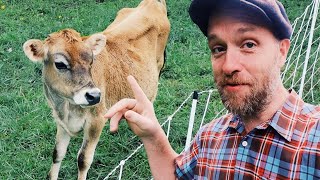
The video is a candid, vlog‑style walk‑through of a day on a small diversified farm. The host (Speaker A) and a helper/child (Speaker B) move through a series of tasks: checking on pigs, turkeys, chickens, sheep, and cows; addressing feed shortages and accidental contamination of pig scraps; digging grass to control rats; inspecting and moving turkey coops and discussing grit needs; observing pasture regeneration after using pigs to clear forest, noting the balance between disturbance and weeds; evaluating cow health, especially a senior milker named Phyllis with declining teats and a younger cow Maple, and planning replacement strategies; designing a mobile milking station inspired by Joel Salatin, including ideas for stanchion placement and cross‑bracing; making yogurt, measuring milk, and dealing with a hand injury; building a children’s earthen play fort and a retaining wall, highlighting family involvement and improvisation. Throughout, the tone is informal, observational, and pragmatic, with moments of concern (feed low, animal health) and optimism (pasture recovery, successful milking).
Chapters
Oh my word, call the Inquirer. The boys started the dishwasher without being asked. Uh, I'm not hurting as bad this morning. It's currently most in my big toe. You can kind of see it's red, swollen. I'm kind of crossing my fingers that I'm gonna be able to put on— I kind of feel like I'm missing something, probably because I cannot find my apron. I just saw the boys way out there. Boy, they're feeling good today. Oh, there they are. They're playing down in the tree. Hey, what have you guys done this morning?
All of the little animals.
Really? Check the pig water. You gonna eat that while we drive?
Yeah.
We accidentally threw some non-edible stuff into the pig scraps, so we had to throw out all the pig scraps. So what'd you feed them this morning? Grain and arun scraps. How are we doing on pig grain? I think we're getting low, aren't we? Are we getting dangerously low? Because it takes at least a week to get here.
Yeah, you better order some. Okay, why don't we dig up this grass next? It's only from here to here. There's another hole here.
Why would you dig it up?
To get rid of the rats.
Okay. Josiah loves to dig. Hey, we'll have to show them your— hey, you guys need to take them up to— will you take the vloggers up to your— that would be the happy ending today. You want to take the vloggers up to your pit? Can I drive all the way up there?
Yeah, we just gotta move a thing that— a tree that fell on the road.
All right, all right, let's go check the other jobs. Well, I haven't been out here in a while. The fat chicks, they're jamming.
Are they getting big?
You guys have moved them good? They're not— that's not nasty in there? It looks though that they need more feed, so it's good to get more feed. And their coop needs to be moved up. Well, we got this stuff for, for grit. Guys, they went through this whole bucket in like a month.
Yeah.
Okay, I guess that's how important grit is, especially with turkeys. They're like voracious grit eaters. Is this where y'all like to get grit?
Yep, we're going through the jungle.
It's a pretty place. Imagine like a day down here, just creek sand with these little tiny rocks sticking out, the big rocks, and the little stuff going through it.
Look what I found in a pretty place. You gotta show them all that.
Oh my word, that's smooth. Are you sure you found that in there?
Yes.
Maybe that's one of y'all's play.
No, it isn't.
That's crazy smooth.
That's a real rock. Maybe it fell out of someone's pocket, but I found it in the pretty place.
All right, y'all go help hold it in your pocket. I'd hang on to that one. Look at this, these guys are looking great. They've all made— what, what, how many we lost? 1, 2? Yeah, so this has been a good round, especially since we lost half the first round, and then I guess we lost all of them on the third round to the rat. This is encouraging. They're going tomorrow, guys. So who's gonna pull out the feed this afternoon, evening? Thank you, Jonah, for volunteering to do that. I should show you guys how big of a difference this has made. This is a 30-degree slope, and I didn't know if this would work this steep, but this is one of our worst pastures, so we wanted to— I'll show you, I'll show you what we wanted to do. You always want to run the Sea Monsters in your worst pasture. I'll show you why. Give me a second, we'll drive over there. I think you can see it pretty good from here. There's the chicken, so it's worn out right behind them, but it soon starts jamming. Yeah, see how much greener it is right there? It's really not capturing good on camera, but it's so much greener where they were. See, they were up on that top strip. Green, not so green. See that? It's because we've been going across. Let's check Dixie. She's right up there with everybody. Claire, our sheep mentor, uh, saw the video and said she thinks think that Claire might just be depressed from the weaning. She's eating. She's not faking it. She's actually eating. She'll come out here and fake. She'll just hang her head down, act like she's eating, probably so a predator doesn't pick on that she's weak. So that's encouraging. She basically kicked this on her own. Claire didn't think it was mastitis, so that's good. She'll— because she'll kick a depression. She was the most prolific mother, so I can see her having the most hard time, the most difficult time. I just love this particular pasture. Yellow flowers, white flowers, everybody's happy in there. Isn't that nice? That right there, down there, used to be thick forest. We used pigs right up in here to help us clear this forest and bring up grass. You guys can thank the pigs. This used to be total forest. Now look at it, wonderful grasses. It's not perfect. One rule of thumb I learned from Joel Salatin himself is with pig disturbance, if you disturb it too much, you're going to get weeds, and if you disturb it not enough, you're going to get brambles. This is a good milking spot because I found that when the cows are standing uphill, their legs go backward and then their udder goes level. Yes, it's like a perfect setup, isn't it? I start measuring my recovery by my ability to milk. Joel had some ideas for our mobile milking station, which— this was his idea. See this crossbar going there? He said, he said, well, if you could raise that to the above the cow level and then put some cross braces like that from down. The cows could get through there and they could lounge right there. Right now they can't lounge there or on the skids or on the back. Well, we can't do that because then— because you have your stanchion here and it has to be that low so they can go over it. But what if we put the stanchion there? There's no rule that has to be this way directional. Yeah. So if the stanchion were there, then we could put this brace higher and that wouldn't catch on logs. Remember guys, that is caught on logs. That would free up one side for lounging. What if we took the mineral and put it on that side too? Well, maybe we should put it on the opposite and we open up this side. Then two sides would be open for lounging. He thought that this could be 12 foot by 16. It's probably 16, but the roof could be wider, which I agree. I feel like, I feel like we could have more of a lip. People ask me if I have the plans for this thing. Well, it's a big prototype until, um, until we perfect it enough to put out the plans. But I need to be thinking about it and trying to make, maybe make some of these changes to see if that works. Nice, guys, that was quick. They're in a good mood today, man. They're knocking it out. I know. Let's measure my healing in my left hand. Wow, she's really Wow. Yeah, and I don't know if I can do that yet.
No, maybe don't.
I see another rubber ball. Yeah, if you do rubber ball, it's also help you just, uh, take your stress away. It's pretty good, like, exercise for Teddy.
Bring you some strength.
That's probably what I'm gonna have to do. Let her out. Phyllis is ready. They know the drill. It's something. It's crazy. Oh, they're getting the routine. Hi, little one. He doesn't care to be with Phyllis. He's probably got a full belly. He's still nursing 24/7. We'll do that until we come out here in the morning and there's no milk. He'll start keeping up with her milk, and then we'll be like, okay, now it's the time. And we'll separate him at night. He'll go in with the little lambs and the calves. I'm just really happy to watch them graze and eat. It just seems so pretty and peaceful to me this morning. I'm just realizing this is slowing me down. Time is now taken up with observation, which has been nice. Something I don't take enough time to do, probably. That one I think we're gonna let go dry, Jonah.
Yeah, I think there's—
she'll have two dry teats. It's hard. Yeah, that one was a dud last time. Towards the end we had just had to milk out and there's just snotty stuff, so I think it's closing off. She's older, she's 10— what, 10, 11 years old?
She's lost both teats on this side.
So she's got 2 teats left still. She'll probably give us 2 or 3 gallons at her height once her milk really starts to come in. It's time to think about replacing Phyllis as she's getting older, down to 2 teats, before she gets down to 1 or 0. We've gone back and forth with some different plans. One would be to buy a replacement. That'd be immediate, except replacements aren't really available. It's kind of hard to get livestock right now. We've been hanging on to this one, Maple. I love Maple's build. She's got this potbelly, she's got these short legs. I said to Josh, why did you sell us her? Like, what's wrong? Was this a call? You know, she's a little— she's little. So you're what, 2 months older, Polly? I mean, look at that build, uh, and she is small. Which is good. I mean, Dennis at Full Circle Farm liked small cows. Greg Judy likes small cows. I said, Josh, what's wrong with her? Basically I said, what'd you— what'd you get her? He said she actually comes from a great mom, she actually comes from a great dad. It's— they needed the milk, so they'll cull their calves early so that they can get 100% of the milk because they're dairy. So that kind of made me happy, Maple, because Flossie adopted you. Remember that? She's not gonna just surrender. Are you a little old thing?
This is a really nerve-wracking experience, I think.
Keep fighting, honey. Keep fighting. Keep fighting. Okay, I'm gonna get back there and hold the bag.
Look, look, she got on!
She got on despite— yeah, I mean, well, she Yesterday it took getting in the stanchion, but maybe if we've got her on alfalfa— yes, yes, keep trying, keep trying. Okay, keep trying, keep trying. We're already keeping this heifer away from stud because we're raising her for meat. Polly, so we might as well keep you too. We're keeping one cow away from stud, might as well keep two. She won't be ready for— we don't want to breed her yet. She needs to grow up to be, what, 20 months old? I like you. I have a special connection with you. You're cute. Isn't that kind of cool? She's adopted. Flossie raised her. She's not related at all to Stud. She's grown up on our farm her entire life. It just kind of makes sense to keep her. Now that means we are going to have to do another run with Philis and kind of cross our fingers that all will go well in her older age. Because if that calf is, say, let's say it's, I don't know, 8 months old, you got to wait 12 months to get it to 20 months old to breed, and then you got to wait 9 to have your baby. So it could be, uh 12 plus 9, so 21. Almost 2 years. Patience. Homesteading is— oh, we're gonna make yogurt today. I give it my best shot. This is crazy. I could bang this jar lid. But I don't want to do that because it just needs a little more oomph. You need, you need me to open jars for you?
This is hard on me.
She got a joke.
Hold on one second.
Uh-huh.
You, he has—
It's always a joke.
He's kidded me for practically our whole marriage.
So dark.
That I can't open my own jars, which I can open most, but I can't open all.
I can open all my own jars. Till now. I guess it's come to— come to get me. Look at this. Look at this. Look at this.
Holding a baby.
Holding a baby open in a jar.
It was hard.
It was hard.
My hands hurt a little bit.
You had to gird up your loins a little bit. We had what we got this morning, although we did spill a lot. Trying not to cry over spilled milk. I would say that's a quart. Third cup for every half gallon, so 2/3 cup. And then plus we'll do— then we'll do a half of a third. So let's go ahead and do that. Mr. Brown's going to help me ladle. I was doing it fine with my left hand and I'm like, he's just going to make a mess. Then I'm like, well, if I move the jar over here, it won't matter as much if he makes a mess. It was like right here. And then nobody gets all up. Well, this was first attempt.
Milk on the floor.
Now he's doing that, and I can go get the lid. I've made my way into the woods, and we're gonna see this kid's fort. Oh, you got a little walkway right there. Where does that go? The toilet? Where's the toilet?
It's just a quicker path.
Is that the toilet?
No, no, no, look at this. Papa, it's so good. You can come in here.
That's crazy.
You can come in here.
Look how clay it is up here. Very red clay.
Come in here.
Whoa, you've got branches and mud roof.
We're gonna fix this. It's leaning to one side.
This is an earthen structure right here. I bet it's nice and cool.
Yeah, come inside.
I will, I will. So you've dug that— you've dug all this out?
Yeah. Yes.
Oh my word, boy, they put energy into something when they Want it, don't they, Beck? Look at this retaining wall. Becky's teasing me, telling me I look like walking around like my dad, which I guess is true. It's how he walks around at 86. He's like an 86-year-old man. Wow, that's over 6 feet tall.
We had to build this wall from right here all the way to here, and it rained too, so it must have worked.
It didn't get a puddle in here.
It didn't turn. Well, that got washed out.
Boy, y'all dug a hole. Yeah.
More from Justin






If I had to start my Homestead all over again, it could only pick one animal… 




