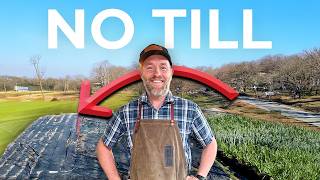
In this 8‑minute vlog, Victor Justin Rhodes (Speaker A) walks viewers through his large‑scale, no‑till weed‑control system for an 8,400 sq ft garden. He introduces UV‑treated silage tarps—borrowed from Canadian farmer JM Fortier—as a durable, UV‑resistant mulch that smothers weeds, boosts soil microbial activity, improves moisture retention, and makes the soil easier to work after removal. Rhodes explains why regular tarps are unsuitable (they fray, leach plastics) and shares his personal shift from skepticism to advocacy after observing thriving earthworms and moist, supple soil beneath the tarp. He then details three weighting solutions he has tried to keep the tarp in place during windy, rainy conditions: (1) standard sandbags purchased from Uline, (2) water‑filled 2‑inch discharge hoses (similar to fire‑hose) that provide even distributed weight, and (3) Farmer’s Friend sandbags that are camouflaged and long‑lasting. For each method he notes pros, cons, sourcing tips, and practical installation steps (spacing every 5–8 ft, handling caps, storage considerations). Throughout, Rhodes emphasizes the low‑labor, reusable, and versatile nature of the system—using the tarp as a winter cover, cover‑crop terminator, or seasonal mulch that can be shifted or folded as needed. He frames the approach within a permaculture ethic: avoiding tillage, reducing herbicide use, and decreasing the carbon footprint by growing food locally. The video ends with a successful demonstration of the tarp secured with his preferred Farmer’s Friend sandbags and a call‑to‑action with links in the description.
Chapters
Happy day! In this vlog, I'm going to show you how we keep our 8,400 square feet garden weed-free and put to bed all winter. But as you can see, it's not looking so good. We're going to talk about these things— Silent Start, the magic— hopefully solve the very common problem. I'm going to show you 3 different ways I've done it of them blowing up. And away. These are useless when blown away. We've had a crazy windy fall and it's been hard to keep these silage tarps on here. And when you do that, the rain washes it out, the sun bleaches it, the dogs scratch and— oh look, bury the bones in it— the chickens scratch, the cats come in and go ahead and put the Band-Aid back on. But I'm sick of Band-Aids, so I'll put the Band-Aid on right now. Maybe it'll fix it. Come help me. All right, this black tarp is called UV-treated silage tarp. We first got this idea from JM Fortier, Classic Market Farmer, the new Elliot Coleman so to speak, up in Canada when we went to his farm on the Great American Farm Tour. Just killed things that were there. Cool. So once this is dead, and it's almost dead, another week, then we just use another tool called a harrow, which is about an inch, and we just recreate a new seed bed and we plant right back in. Okay. Do not, do not use a regular tarp. A regular tarp, well, I know it's cheap, but— and less expensive, but it frays, and all that plastic will surely be leached into your soil, whereas this is UV treated. It can withstand the heat of the sun. There are 7 major benefits to the Silastart besides keeping out the cat and the dog poop. One, it smothers weeds and kills any kind of seed germination that there may be. Two, it improves the soil microbe activity, earthworms, and quickly— or quick breaks down the organic matter quicker, makes it more available to the soil. When I first did silage tarp, I admit it, I was skeptical. It's plastic. I'm a permaculturalist. I understand, you know, I want to work with nature, not against it. I understand plastic is going to be with us for 450 years, but plastic is going to be— plastic is going to be with us for 450 years, so this will last. But when I took this up after experimenting with the first time, I opened this up and the soil was wet it, and it was just littered with, uh, worm vermicomposting, which is worm— worms are aerating, worms are manuring, basically tilling. It's a haven for them. And I was sold, and I've been doing it ever since. Third one, already spoke to it a little bit, is moisture retention. Did you guys see that when we did this? Come here, Lily. Lily, the camera man. Okay, did you see this? Do you see this? Do you see how wet the soil is? And it is dry. It is dry out here, but it's retaining this moisture. So if you're feeling saucy, you'll do the silage tarp after— after— just excuse the rooster— after the rain, or you'll water it down and then put the silage tarp on it. It's just good. It's just good for the soil to stay moist. The next— I forgot what number we're on. What, Austin, what number? Flash it up there. I think we're on 4. Well, the last one we did was 3. The soil, I just grabbed that up with my hand. It's supple. It's going to be easy to work. When we pull this off, it's not going to be hard from the baking in the sun. It's not going to be washed out from the rain. It's going to be supple and easy to work with. And it just gets easier and easier every year. We add more compost, it just gets easier and easier. Less labor than other methods. And so and even more natural. Let me explain. Um, less laborious than tilling, and tilling would kill and destroy those microbes. So in permaculture, we don't till, we just do layers. And yes, we're using plastic as our mulch here, but we're covering Mother Nature. We're doing as she wants to do, and she covers herself. She's modest. May not be harder to use herbicides, but it's definitely more toxic, and we definitely don't want to do that. And this keeps us from doing that, and this keeps us— sure, we've got plastic But we're also not counting on the grocery store for our food, and so our eco footprint is much less sourcing our food locally as possible— our backyard. Furthermore, it's reusable for multi-seasons. And lastly, it's versatile. Right now we're using it as a winter cover, but you can use it to terminate cover crops, to maybe to go from— you could also use it from the spring to fall to eliminate the the residue leftover of the spring garden and flip it over for the fall. So you can use it for all different kinds of things. You can— you see over here we have the— we peeled some up to plant the garlic. And so it's also flexible like that. I could move 5, 10 feet of this up. I could uncover one row. I could fold it on itself. I could lift half of it up. So it's very versatile. Next we'll talk about weights. We'll go from our first to our best. How about that? Our first, again, UV treated. These are sandbags. You get them at Uline. Yeah, it's an office supply type of place, but that's the only place I know where to get them. Now the plastic holds up unless of course the animals get loose and get on it, but Farmer's Friends does make a repair kit, which is nice. These sandbags work. You could buy sand if you needed to, buy a dump truck load. You open these up, we put creek sand in it, and then you can tie this. And I think this is maybe a, uh, what is that, Lily? Is that a 12-inch? 12-inch, maybe. Supposed to lay them every 8 feet. We don't have them every 8 feet right now, and that's why our tarp— I mean, sorry, 8 feet, 5 feet. And that's why I believe our tarp has blown up. Do we have more sandbag supplies? Yes. We're gonna get to our new go-to sandbag. Should we show them a fire hydrant though? One, we got our Band-Aid on, it's covered. It just feels so right. Mother Nature is modest, she likes to be covered, and if you don't cover her, she'll cover herself and she could dress as crazy. This next idea I first picked up on the Great American Farm Tour. A fellow farmer in New Mexico would cover his low tunnels with these things.
We tried sandbags and clips and we get some really high sometimes brief but very high winds in the spring, and any little opening under the COVID and it'll let air in and out and try to lift the fabric. So we'd like to get the tunnel sealed up as best possible. So this is 2-inch discharge hose. It's flexible. It's full of water, so it's heavy-ish.
What is discharge hose?
Oh, it's just a low-pressure hose. It's used from coming out of a pump.
And, and, okay, and you get that at— can you get that at a hardware store?
Yeah, yeah, this is pretty common material. Fire hose is similar. That might work if it would handle the UV.
I thought this was an ingenious idea. We've used them for a while. They seem to lose water over time. But the idea is to put water down these hoses and then have these caps that you can fill up, put in the end. Maybe we'll try to fill it up. You can't fill them too tight because if they freeze, they'll expand and you don't want to bust the end. But it can certainly be higher than this. And this is my other problem. I guess that's not that bad though, is storing these things. You'd really want a storage shed. Or something nearby. I guess you could just lay them on the ground and tarp them when not in use. I must have— either I dragged a hole in it. Yeah, probably from going down the road, or there was a hole in it. Or they might be why it's leaking. I don't think this is my future because I don't know. It's just trickier to, to haul, to store. No, it won't work, Jonah, with it cut. Can you haul it to the dumpster? Use it up, wear it out, make it do or do without. The idea is though that gives an even distribution of weight. I think for a low tunnel I'd probably still be a fan, but for silo tarp, I don't know. Kind of hard to get these on, these caps. It's really hard to get them off. You pretty much have to cut Cut it off. I've landed on these. They're long, unlike the little sandbags that only put out a little weight, but they're not 50 feet long like the hoses. It has a handle. It's green. It's not ugly. It doesn't stand out. I really like these. All right, 2 strings. He's calling. Wrap it around it. Hold on, I guess I could tie a knot in on it, couldn't I? I don't ever get to empty it. Okay, all right, load them up. How heavy you reckon those are? 10 pounds? They're pretty heavy. I bet they're more than 10 pounds. One is— that might be 10 pounds. 12 pounds, 15. All right, spread them out. Keep it every 5 feet. Start with the edges first. We did it! That's a good feeling to have our garden covered. UV-treated silage tarp, the Farmer's Friend sandbags. They're kind of camo compared to these ugly white bags or this blue fragile fire hydrant hose. I've had some of these sandbags last literally since we've been gardening hardcore. Looks good, feels good. We're covered till spring, ready to go. Happy day. Links in the description to some of this stuff I use. Get in, get the closing shot.