Planting Fruit Trees (before it’s too late)
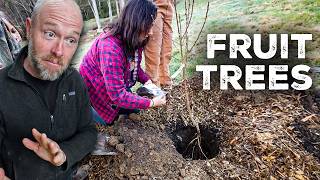
Victor Justin Rhodes and Allison Wade of The Farm Connection plant bare-root fruit and nut trees on his homestead. Wade shares five practical tips: dig wide holes and loosen soil, use starter amendments with worm castings and mycorrhizal fungi, protect young trees with Agribond, mulch with cardboard, and avoid over-handling roots. They discuss species like peaches, hazelnuts, and chestnuts, and why diversity protects against cold snaps.
Chapters
It's March Madness here on the farm. We're getting as much as we can get done before it's too late, like plant some replacement trees. I'd say we're more cowboys than plant ladies, so we're gonna need some help. Thankfully, we have Allison coming with some trees and at least 5 different tips for us and you on how to plant trees. And thankfully, it's not too late. Happy day. 10 till 8. 2 days after time change. This is our approach. Go to bed on the new time, get up on the old time, and hopefully get up closer and closer to the new time every day, but give ourselves some grace.
I always wake up automatically at 6:40, and I keep waking up at 6:40, except now it's 7:40.
Yeah, yeah. When I was a teenager, like any teenager, I liked to sleep in. By the way, why do we sit They slept like a baby, meaning they slept— what do you mean? You woke up every few hours screaming and crying? No, you slept like a teenager. My dream for when I grew up was to have a job where I could sleep in. And at 14, I became an entrepreneur. I always wanted— I always had wanted St. Bernards, and so I said, let's turn this into a business, and I've been doing that ever since. Turning my passion into a business. Next it was mountain boarding, and then eventually ministry where we trained young teenagers into missions. And then it was helping the young people of North Carolina through foster care. And then it was market farming. I'm realizing there was a stint there in mountain boarding. That was the glorious days in sleeping in. I used to work online. I had a mountain board shop online. Took 2, 3 in the morning, would sleep till 10, ride, repeat. And then we had kids and they wake up with the sun. So for years upon years getting up with this, I guess, getting up the sun. Rascals in. And then I followed my passion of teaching this wonderful thing that is this regenerative homesteading. And here we are, 10 years later, of immersion learning. Through this vlog. I don't know why I brought up that whole history lesson to say this. Hope you enjoyed it. To say this, because of kids and the long time farming, anything past 7 feels like sleeping in. And really just feel guilty. And if we're being honest, I felt guilty back when I was mountain boarding and sleeping in until 10. They say you should do with guilt one of two things. Let it go or change? When time gets changed an hour, that's a little bit difficult. Sudden change that fast. I'm not sure it's healthy. And it's not like we were staying up partying. So how do you let go? How do you let it go of the guilt? Maybe you shouldn't have. Growing up, my dad was constantly, you're burning daylight, get up, let's go. Always had to be doing. In fact, when he waned at the end, it was almost a relief to see him actually sit and watch TV. I never saw the man sit and watch TV my entire life. Of course That's how he went from that 600 square feet house, no running water, no electricity, to a successful businessman himself, acquiring more land 3 miles from here, building a nice house on it for us to grow up in. You don't just get that by sleeping in. It's a balance— honoring the body, making sure you get enough rest, but also making sure you get the work done. We have a 9 o'clock here on a farm. We have a lady coming a local plant lady to help us replace the fruit trees we lost. Just texted, she's running a little bit late. We're all having a hard time getting on this new time change, and I'm okay with that too because I'm running a little bit late. We gotta plant trees. Can you think of a more important work besides acquiring animals or rotating animals? There's not much more of important work than planting trees. Henry, why are you wearing those gloves? All right, we got a few minutes before the plant lady arrives. This is the 2-ish acres kind of in a nook that we cleared during the 100 Days of Building a Homestead. And now though, we want to tidy it up and make it to where it's a little bit more easily used. Let's assess. We got a brush pile there. Hopefully this is a March Madness project. Yes, this road could be smoothed out. We need to get our water coming smoothly off the mountain. Any water lines prepared? This ravine— well, the sheep have four-wheel drive. I want to use the sheep to get more in my nooks this year. We have a burn pile here. We have a burn barrier here, a burn barrier with that ravine. It's not on a hill, so that will be our master burn pile. We'll mow this for safety. This is a safe place for a burn pile. Get those rotten logs up. Are they rotten? Yeah, put them on the burn pile then. And you say you got some trees need to come down? Yeah, it's kind of thick around this Rich Mullins, isn't it? Yeah, you're gonna clean some of those? I could. Okay, phase 1. A few more trees need to be cleared there. The small brush pile needs to be consolidated into the bigger one. All right, along the way Allison shares some useful tips, at least 5. Some I know, some I don't know, some will be beneficial to all of us. Hey, good morning!
How are you today? You tell me, but I brought trees to plant.
Yep. Let's, let's put them in the truck and let's go. And everybody squeeze in.
I don't want to squeeze in on that because it's wet.
Everybody's working today. Is there another most more important job than planting trees?
No, because it takes forever for it all to come to fruition.
This is about the most— if they don't die, especially if you're using the trees to complement your cows and sheep. Okay, tree number 1. All right, you should introduce yourself to everybody. Who are you and what you doing?
My name is Allison Wade. I'm here from The Farm Connection. It's a little nursery that we started about 7 years ago, and we specialize in edible, medicinal, and native plants. And so we brought some fruit trees today.
Hey, you brought fruit trees and some nuts?
Yeah. Okay, yeah, these would be like more food foresty type plants here.
We'll look for a place for them.
Do animals rotate through this area?
Yes, but They— we wrap those trees with our electric net when we come through.
Nice.
And their daily paddock.
So Ian wrapped up these trees together, so we'll have to unwrap them now.
Every now and again, sure, somebody gets out and they don't— they go after the tree. But yeah, for the most part, we keep everybody in. And they do get out, but for the— they tend to wander and enjoy other things before they enjoy the tree. But surely if you put them in a paddock with the tree, they're going to decimate it. Yeah, it's gone. It usually takes about 6 years before we don't have to protect the tree anymore.
Yeah.
Number 1, you don't want to just dig deep enough, you need to dig wide enough for your trees. And by the way, we got what you call bare root trees, which I think are better because you're planting them in your soil, so the tree adjusts to your soil quicker than if it came in a pot and it's in that and then it has to assimilate to the other soil. Yeah, bare root trees is where it's at. All right, is this deep enough? Teach us, Allison. We're more cowboys than plant ladies.
You guys are doing great. Yeah, I'd probably pull the mulch away a little bit like you were talking about. Yeah, and, um, we should dig this hole a little bit wider because we want to loosen the soil around the tree. The root system on this one is fairly big.
Yeah.
So we probably want to, um, this looks like good soil though.
Henry, are you helping too? Dig down in there, buddy. You guys got to go far. Look how far you got to go.
It's so cool. It's in the family.
Are we in trouble? This is already starting to bud.
Well, nectarines are pretty early. Um, we'll just have to cover it, right? Well, so the way I kind of view the prunus, right, like nectarines, peaches, apricots, is you're kind of taking a risk.
Yeah.
And you want to diversify so that like when you're— when you're cold— when your late cold snap comes through, you might get your nectarine that year, but you're going to miss your peaches. So we diversify plums, peaches, apricots, nectarines, so that if the plums get hit this year, maybe the peaches don't. Okay.
Which we are going to have 29 degrees Thursday.
I know. Well, um, so what we were thinking to just wrap it with some Agribond for the frost and then unwrap it during the day. I think that, I think that this year it's not gonna be a problem because you probably won't expect fruit off of this. Um, anyway, we want to try to get it as deep as we can and the roots are straight. It would be ideal if our hole is not as big as the root system that we would probably trim these instead of circle them or kind of split them in. Okay, about the right depth, but we might want to just go a little bit wider so that some of these— so that's not too bent and wound up. Well, if we can go a little bit wider, I think that would be good. This one's probably fine going to, you know, anyway, the bigger the hole, I think the, the better it's gonna be.
Next time we'll put the dirt on this, or we'll never have enough dirt, especially with these bare root plantings.
Yeah, I think that looks pretty good. None of these really look too—
okay, do we need the Felcos?
I think that— well, I'll try to use the—
yeah, I'll try to use these.
I would say it would be a good idea instead of curling that one to just cut it. That made a nice clean cut. I think that's okay.
All right, we have our wire cutters up here of all things.
I think for the most part these look good though.
Okay. All right, let's put it back, boys. Try not to get any of that wood chips in there. That's why we're gonna have to use that cardboard. That was a neat trick to— if your root— and I never knew about this— if you don't want a big— if you don't want to dig a hole that big and you just got to get it done and you've got too long of a root, snip it off. There we go. And don't get it, you know, the roots swirling around in the bottom of your hole, so to speak.
This is our tree planting fertilizer. Yeah, it's got worm castings, uh, just like a general all-purpose fertilizer, some minerals with the azomite, and 18 different species of mycorrhizal fungi so that we can try to, you know, get these roots established really quickly with all the good soil biology.
Nice. I think you sell those.
Yes, we do ship those. Yes, we sell and ship them. Yes. Um, so I think here, some— sometimes what we do is we have a bucket and we just kind of mix it into the soil that came out of the hole. But I think in this case we can just do something like this. And so as we're putting the soil back in, it'll just be kind of mixed in with it. I don't want to get a whole lot of it right on the roots, but probably just sprinkling some of it down in the hole too. All right, you're on.
Now try not to get the wood chips in there. That's why we'll use cardboard the next time. Yeah, you guys are eager to get— either eager to go on tree number 1. Are you guys going to be this eager tree number 10?
I brought 9 fruit trees.
Okay, 9.
And then we just want to make sure we don't get the—
we don't want the wood chips on the bark.
We don't want the wood chips on the tree. We've got this.
Yeah, do that.
Okay, great.
Yeah, helper just died.
Strong enough?
No, it's, it's funky.
It's like—
there, there you go. It's, it's not that, it's a trick.
It's not stretching as hard as I can.
It's like, it's a trick, not a string. Okay, now you can put heavy mulch around it. You're gonna drive along and I'm gonna test these. I don't know, we have 80-something-odd trees. To lose 10 of them Not bad, especially under— especially under sheer utter— what is it— sheer utter total neglect. The strong survive, and we just replace the dead ones early on, and eventually we'll have all strong ones, and they'll be so low maintenance. Is this dead? I think this one's dead. No, it's not dead. Just scrape the bark in the winter, and if it's green, it's alive. Another thing, I've been testing my tree too hard. Just ever so gently, ever so little bit, just scrape the bark. What do you guys think? It's sickly if it's not dead. Um, I peeled it right back here. You got another trick besides peeling it?
Oh, I probably wouldn't peel it that far.
Okay.
Um, yeah, I'm gonna check some of these up here. Just a gentle scratch right under and there's green.
Oh, okay.
So I think it's alive.
Okay. Yeah, it's green up here.
Yeah.
So what is it? Just more dead barky stuff here at the back of it? Yeah, look, maybe that's where I scraped it before and it healed back. It's alive despite me trying to kill it.
Yeah. Yeah, I mean, it's, it's just getting older and it's a different kind of tree and it's got Bargain stuff? I think you keep that one.
It's persimmon.
Yeah.
Besides, there's one down there we can do it. Okay, great. So I've noticed our trees do good from this line, that tree line, over to that tree line. I mean, look, good tree, good tree, good tree, good tree, good tree, good tree. And there's so many, and only one is dead. Tree number 2. I know it's alive because I can see a bud on the bottom of it.
I think that hole looks good.
And wait, just wait, get in. She's gonna mix in her starter.
Yeah, let's get it. Rosie, you want to dump one of those on there?
Yeah, and then let's pull this closer. There we go. Wait, you already burn out after one tree? Yep. Oh, these are our fruit trees. Anytime during the growing season, there's gonna be all the fruit you could ever want to eat. That smile, that was classic.
I would eat all the fruit.
You would love it. You gotta play that back, Austin. All the fruit you could ever want to eat. For starter kit, did you catch that? She sells the starter kit, but it's a, it's a more, um, I don't know if I filmed it or not. It's not a real I guess strong. It's more neutral. I forget the word she used for it, but you don't want to use heavy fertilizer on your fruit trees, and you don't want to use a whole lot of amendments anyway. And just mix in a little bit. It's got vermicomposting in it, which is worm poop, so it's gonna, I guess, leach into it a little more slowly and naturally. So we sprinkled some of that in, and that felt real good. That felt right.
It's alive above the graft, so whatever variety it was, it still is.
Is it worth replacing?
I think it would be a good idea to replace it, especially since I'm here with some bigger live trees. We could do a nut, couldn't we? We could do the nuts.
Yeah, what kind of nuts did you bring?
I brought some hazelnuts and some chestnuts. So the thing to remember about— do you, do you already have hazelnuts or chestnuts? Either. So they are wind, wind pollinated, and so you really kind of want to have them close together. So when we, when we plant them, I think it'd be a good idea to put 3 of them kind of close together.
That feels good. 3 down, 6 to go. We're gonna do a little divide and conquer. Ladies versus men. What happened? Just like, we got a lot like these. These are cherries, but I didn't ask for any cherries, did I? Okay, that one's for sure. Sad. It's almost 11. It feels like almost 10. It's a trip. I would say this one needed to be replaced, wouldn't you? Animals, no delayed gratification. All right, there we go. Hey, you want a natural dopamine hit? Plant a tree. That's how it comes. Earned, earned. Not from scrolling, earned with you, with your bare hands. No, it didn't I'm sure we learned more as we went along there, but the, the fifth thing I want to point out is you want to plant into the native soil. I asked her what is the most important thing she could communicate to somebody planting their first tree, and she said don't care for it too much, or don't take too much care for it. You don't have to baby these trees, and we've, we've adopted that method here. We've, we, we've planted our trees, we've put some mulch around them, we put some comfrey around them, But that's it. Every year, early on— we're in the early on stages— we're just replacing the ones that don't make it. And that way, when they finally all do make it, those are going to be really— they're going to be the ones that want to grow and the ones that want to grow here. And it's going to be no fuss and a wonderful gift for our grandchildren. All right, what are we thinking here?
We're gonna plant some chestnuts here.
All right, this is just a wooded edge. We'll never graze Gideon, let him have the hatchet, bro. All right, go dig, Josiah. Right there is fine, right? Screech! She asked me if we have pigs. Of course we have pigs. Pigs for everybody. We're moving this to where we're gonna run the pig land, and we're gonna put this on the edge, edge of the pig land. So if we forsake harvesting these, the pigs will get them. We didn't waste our time starting these holes. We're gonna plant Aronia berries, which are blueberries.
They're the same size and shape and color as blueberries. They taste pretty similar too. They're really nice and sweet, but they're really fibrous, so, um, adults have a hard time eating them, but children love them. They're really great for smoothies and for baking with. All right, and they're the highest antioxidant value native North American fruit. Wow, they're super healthy too.
All right, we're gonna mulch with some rocks. Just throw these, eliminate some of the competition, and we'll be able to identify where they are. There we go. And now it looks like we can identify it and string trim around it. Josie? Yes, pig time! I love this concept, for if we forsake harvesting them ourselves, the pigs will end up getting be running the pigs up through here. Trees can be along the edge. Okay, you ready? And you said they could be pretty close. Martini tree. Uh, is it?
Yeah, the last one. Is that what that means?
In filmmaking, they call it the martini shot. Oh, the last shot. Okay, so we'll call it the martini tree.
I've learned something.
All right, you taking your pot?
Yeah, well, unless you want it.
Uh, no, you— it's your pot. That's probably a $5 pot.
They're like $13.
Whoa, I forgot we're in the 20s now. We're no longer in the 90s. Thank you, Allison, and for bringing Rosa.
Rosalie.
Rosalie. Okay, tell us again, where, where can people— you, you ship these bare root plants?
Yeah, we ship the bare root plants, um, to all lower 48.
States.
Wow. Um, and the starter kit and the tree planting kits. Yep. Yeah, good, good add-on for those. Um, we also ship plants with soil to, um, the East— the East Coast.
Okay.
So there's all kinds of stuff on our website. We also have, um, cover crop seeds.
What's your cash cow? What's your most popular thing everybody should be getting?
Yeah, yeah, bare root trees right now. They'll find everything else on my website.
Everybody needs to get the bare root tree. What, what, what, what tree are they not planting that they should be planting?
Uh, there's a lot of apple trees right now. I think apple trees are a really great first fruit tree for a homestead. They can be—
what kind of apple tree? Because everybody wants to be cool and plant the Honeycrisp or whatever.
I think the most— I think the most important thing to remember about the apple trees is that you just need good cross-pollination. Okay, so get some varieties that you're interested in eating. Okay, you know, I recommend throwing in some good self- self-fertile varieties like Granny Smith is a great one. And then that's good for homesteads too because that's the one that you use for making applesauce and pies and things, and it's self-fertile, so it provides a lot of pollination power to your entire orchard. So, um, just a good mix of 3 or 4 trees, you can almost never go wrong with cross-pollination in that case.
All right, all right. What's the cool tree that people are planting and maybe shouldn't?
Um, I think it's so difficult Well, um, I mean, I personally love all of those extra things that I brought you, the native fruits and nuts and the forest farming things. So that's a lot of what we carry and we like to promote out in the world too, is those serviceberries and the aronia berries, elderberries. Those things are really easy. They're native, so you don't have to fuss with their hole and a bunch of crazy planting techniques, no pruning techniques. You just throw them in there and then they start making fruit.
Okay, cool. Thank you. All right, tell the website again. I'll also link it.
Um, it's The Farm Connection. You can find us at tfcnursery.com.
Yeah, and we're gonna put a special link in the show notes. Are we gonna do a coupon code too?
Yeah, we can.
We're gonna do—
yeah, okay. What's your code you like to use?
You could do Rhodes10, something like that.
Okay, great. Rhodes.
All right, down in the description. Oh no, this afternoon You gotta make soil blocks. No. Yeah, 3 bags. I don't know about that. Gotta do that since you're making that video tomorrow. You gotta do this right now. Right now? Yes, 5 o'clock. Hey, we're not— we're fasting tonight. We're fasting. This keeps getting worse.
Soil blocks instead.
Yeah, in the evening when it's cool. Yeah, sure. It's really funny.
It's hilarious.
Thanks, Allison, for helping us get those trees in the ground. Guys, those trees are the ultimate passive income, work in your sleep kind of deal. Those trees are going to be growing and producing for us while we sleep. Now, Allison was so kind to come out of her day. Let's bomb her! Let's explode her website. I left a link down in the description. Go blow it up and tell her I sent you. Hard-working family right there. You'll get a lot. You can get that starter kit there. You can get trees, all kinds of good stuff there.
Check it out.
More from Justin






If I had to start my Homestead all over again, it could only pick one animal… 




