Quarantine In the Country | Farm + House Tour
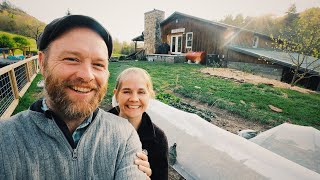
In this 2020 vlog, Justin, Rebecca, Jonah, and an older family member give a comprehensive tour of their homestead during COVID‑19 quarantine. The video walks viewers through the front porch, European‑style barn‑house, livestock facilities (cows, sheep, pigs, chickens, geese, rams), rotational grazing and silvopasture, a large composting system that links chicken manure to garden soil, a greenhouse, extensive raised‑bed gardens, a hand‑milking station, cream‑separating and dairy‑product processing (yogurt, cultured cream, butter, ice‑cream), a kitchen redesign, a cool‑room/freezer area, a solar‑powered battery charging station, a fully organized workshop and tool storage, and the interior of the house (living room, dining room, bedrooms, bathroom, sauna). Historical anecdotes trace the farm back to Grandpa Henry’s 1932 purchase, the 1994 “white‑elephant” horse barn, and the evolution of the property. Throughout, the hosts emphasize the self‑sufficient, home‑based lifestyle—working, schooling, and entertaining from home—while highlighting how quarantine has given them extra time to improve infrastructure, expand food production, and remodel the house. The narrative interweaves practical demonstrations (rotational grazing, compost turning, milking, dairy processing) with personal reflections on family history, the challenges of farm life, and the joy of continual improvement.
Chapters
That is my milking station. Right above it, my house. Good morning, Miss Thang. Right here, the cow. We milk her there. We'll milk her later. Bedrooms right there. A European-style house where the farm is actually underneath the living quarters. But how did that come to be? Well, we'll talk about that. But this is our life in the country. Mega house, barn house, mega barn house. And farm tour. Let's get going. This is where we start a lot of the vlogs. To give you guys perspective today, this is our front porch. This is my Sturge Brothers apron. We're going to start here on the porch and go in the farm. We'll give you guys some history of the place, but also you guys have been asking and asking and asking. We are going to give you a complete house tour later on, but first this porch. We hung the swing. It's a wonderful view. Look at the view of our farm. I try to give you guys perspective today, okay? Our parking lot, but then we have our luchadores, our ram and wither, out on pasture. We have some chickens on pasture out there. We call this Violet's pasture after one of our late cows. And then out there is where the main cow herd is across the street. Here, sometimes it's nice to take meals here. The kids particularly love it. We got some plants ready to go in. What do we got here? Lavender. Uh, this table, not a single nail. Look at how it's built. Isn't this neat? Kind of a European style. This is super sturdy, real wood. Look at this style. Rebecca's grandpa built this, and that is built to last. Probably one of my favorite features. We got a backup generator right here.
These are nails.
Nope, they're pegs. He would have drilled, probably with a hand drill, and then put pegs in there. It's a style. We have a shoe nook for all our shoes, save Mr. Brown's shoes. They're never in there. We're always looking for Mr. Brown's shoes. Cat house. You get— good morning, guys. Feed and water for them. So let's take you from the porch. Swinging out is our front yard. You want your high-intensity stuff close to the house. We have raised beds. Rebecca has planted peas. That's one thing about this, this quarantine and living in the country is it's really not that much different for us because we are such homebodies. If you're going to be a successful homesteader or farmer, you really need to be home. So we work from home, we school from home, we shop from home. What else do we do? We, we do everything from home. So Rebecca's got some peas, they're coming up this nice trellis. This is early in the season, so we don't have anything going in here, but soon this will be completely jamming of produce. Right next to the raised beds, it's always smart to have chickens at least next to your garden if they're not doing the gardening for you. We are building a nice fence, permanent fence. We've been using Premier 1 poultry net. It's nice, but if you've kept the chickens in an area longer than 3 years, you can go ahead and build a permanent fence. So, but they will still work for us. We will put deep bedding down, we'll put down wood chips to keep their run dry and absorb the manure. And then look, look what happens underneath. It develops compost. That's a good thing right here. Because look what happens. You can get the manure, the chicken's manure and scratch, and it ends up being compost. We feed the garden the compost, and it's right here, so it's easy. We're gonna have a gate right here to bring it out. We have a gate down there for hauling in big wood chips and stuff. Right in the middle, you got a grumpy spring male goose right there, guys. So the the compost— the chickens feed the garden with that compost, but then you have extra, or you weed, then you throw it right over to the chickens. Now remember, this is right in our front yard. We're those people. We're not even backyard chicken people, we're front yard chicken people. Right beside the chicken, we have a nice rock sidewalk here with grass growing in between. I like that feature. We did find this amazing huge rock on farm right there at the entrance, and we really like it. This gate is easy open, you know, it kind of gives the open feel, but it also gives clarity of where our yard is and where it isn't. We have swinging gates. You want to show them how this works? Because what if we— one of the favorite features about this barn, look, we're going to talk to it more, but we live in a— like, we converted a loft. Like, this barn used to be— was built for a loft. Half of it was to be a hayloft, the other house for a rancher's quarter. Yeah, look how that worked. He pulled that open and you lifted the brace out. Randolph, our carpenter, designed this. He's got a chute for the pen. Go ahead and show them that. And then that way we could drive in there and unload on the dock. We can unload heavy furniture, we can unload groceries, anything like that. You can just go like this. Yeah, look. So if you just need to maybe get Sally the side-by-side through, you just open one. If you need to get a car through, you open both. Thank you, Jonah, for that demo. Trash bin, recycle cover there, and trash. So what happened? Why do we have a horse barn? My dad would call it his white elephant of 1994. He built this to be a horse ranch barn. He and my brother were going to go into business, uh, running a horse ranch. In a minute you're going to see like the— what we have, Jonah? 40 stalls? 40-ish? 30-ish? 37 stalls, something like that. Downstairs he calls it his white elephant of '94 because for whatever reason it never happened. But it did. Now look what we're doing here. We're turning, we're going down from our porch We're going downstairs. You see this a lot, you see this, uh, pawpaw tree. I think it's a— no, not pawpaw, persimmon. Persimmon tree here. South is that way, so it's, it's not going to shade the gardens. And we got a little bit of strawberries growing around it, and this is a nice little area. But it's still alive, look, it's blooming. So, um, the white elephant— the business never happened. But now instead of a horse ranch barn, it's turned into an EIEIO barn. All kinds of animals. We park our Sally side by side right downstairs, guys. Right downstairs. Look, that's the porch I came from, okay? This is where we parked the car. That's the greenhouse. We'll get to that in a second. But look, we can store up to— gosh, how many thousands of pounds of feed do we have in here right now, Jonah? 2, 3, 3-ish thousand.
We can start 2 more and then we could do through here too.
Yeah, and this is— you're right, and it's super convenient because it's a concrete floor, so if we spill feed, it's easy to pick up. We have 2 cats that do a fabulous job keeping mice out of this. We could not keep these here like this.
So much grain on the ground and it was like all there, and I just went— there's a leaf blower, blew it all out.
Yeah, Reedy Fork Organic Farm, order from them once a month. And we order in bulk and saves a lot of money. There's some bags here because we ordered some pig feed. We don't need a lot of pig feed, but this, this is, uh, like grain, uh, chick starter feed that we feed everybody. And then alfalfa for our cows. Some organization ideas in here: we have our mineral programs over here and our 5-gallon buckets. You can see the labels. These goes to the cows, these goes to the sheep. T-S-T-M-O-M-S. We have some spares up there, some extra. We have these milk buckets that only are for skim milk that we feed to the pigs. The reason we don't want to use milk buckets for other things is milk clabbers, whatever, on the side, and you just don't want to like get water or feed that. You just want to always use it for milk. So you can take her those. She's probably going to need 2 more because we have 19 gallons of milk to cream separate, plus whatever we harvest today. It's a cream separating day. Also in the garage are natural treatments for, uh, sickness. These are supplements, vitamin C for the animals at all times, charcoal if somebody were to get sick, nozzle stuff, uh, our Synergy animal product program. Thank you, Jonah, for that light. This can help with mastitis or any cow sickness, uh, utter rub. And then this is our battery charging station. We have solar-powered energizers and we keep batteries charged for them because the, the energizers run off a battery at night or when there's no sun. We always keep some charged for if the battery goes dead, and then that way we can go out and replace them. Coming out of the garage We have the milking area. We're going to get to that. But look, there's the lofts. What do we do with the lofts? Well, we had hay. We stored hay in here. We store loose hay in here now that we can use for the chicken bedding in these big bags. We put down pallets so we can store hay in here. But look how much storage you can get in here. This is like 150 square bales in that room. And so you've seen these stalls before. We'll get to it more when we're milking, but 2 stalls for holding the cows when they're not milking. One stall, one cow in the stanchion. She's fine, we've got her a little bit of a snack. They don't mind being there for a little bit. We have a hardening off table outside the greenhouse. You grow your plants inside the greenhouse, and like this week we need to start setting these guys out. They're being babied, they haven't had the direct sun, they haven't had direct wind, they're getting watered real good. They need to start transitioning to outdoor environments. So little bit by little bit, we'll put them out here on this hardening off table and get them used to the big world. Right next to the greenhouse and in between the cow area, this is beautiful. We have an asparagus and strawberry system mulched, so it's low maintenance. Those crops grow, they don't have to replant them again and again. We'll have food for decades here. But what's nice is we have our water station here. We have a 4-way hose connector, one going to each thing. One goes to the greenhouse, one goes to the washing station, one goes to the field, and one— that's right— and one is for washing things. And we have a cage here to catch grass and hay before it goes down into our gravel, which is a French drain, which drains way over there. Below the greenhouse. See, close. But you don't want to get hay or grass in there because it gets turned into our, you know, slime eventually and will clog up our drain. So we put this down, we clean our buckets here, and when our buckets are— we sift it, we run it through this to get out any food scraps that we could reuse, and we put our water there and we water. Then we put our water in our watering cans and water the, the garden. Okay, here I am. Water's coming out of that from what we just— we just ran it. There's your perspective there, guys. Spigot's right there behind the greenhouse, comes down through here and out here. So we got the milking area, we have a trail here to get the cows in, we have mulch, wood chips getting ready to go in. Our raspberry and blueberry patch, deeply mulched. We're gonna grow grass in between the rows. It's a nice little area for them. So walking down the raspberry and blueberries, come here a little further, and we've got garlic. We've got some volunteer garlic from last year. We guarded off from the cows. This is a cow pasture. They're not here now, they've moved on. They were here a little bit ago. There's our bedroom. That's the kids' bedroom. There's our bedroom. There's the cow stanchion. We have a pile of wood chips there. We're gonna do a shed, a shed right there, and that way we can use wood chips in our bedding inside our cow stalls to absorb manure and urine when they're in there. Right there's our perspective, our house. Violet's pasture. So cows graze on this side. We have some chickens down there, and we have a ram system, a ram and a wither that move around in a mobile cage. Here, here, let's go. We got to move them, right? Let's go move them. They move around in this field. They started here, moving them twice a day. This land gets over 60 days rest before we come back. That's important for breaking off the parasite cycle. That's important for letting grass recover before you mow it again. And this field just keeps getting better and better because of that rotational grazing system. And the rams are safe, and they can't get out of this cage and get to the ewes who are currently over there. Because if a ram can see a ewe, you got to have a pretty good fence so they don't get to them. Because we want to time our breeding. We don't want them to breed until October, so then we have spring babies and we don't have winter babies. These chickens are out on pasture restoring, building up some of the poor parts of our pastures. You want to improve pastures, put animals on it. That's what we're doing with our chickens right there. All right, there's the rams. We are in a lane. We get our cows out to pasture through a double-line lane, and we get our sheep cross-farm in this too, so You can run cows or sheep out through here and then open it up to where you want them in pasture and move them around every day. People have asked us, your life hasn't changed much for this quarantine, has it? And we're like, not really. We're real homebodies. But you know, one thing that's maybe different is we're not having as many guests. We're like some of the most socialized homebodies on the planet, and we miss that. But maybe because that's not happening have a little bit more time, and so we've ended up probably growing more food than maybe we would have. I don't know. I think it's important to stay busy, do something positive, and that's what's cool about living in the country and on a homestead is there's always something to do. So we were just out in the field, we're back at the greenhouse. Hopefully I'm giving you guys some perspective watching the vlogs. You see a lot of these scenes, but you don't necessarily connect them together. The Holler Farm sign, that was the name of our farm when we used to market farm.
Just like our main— I guess we always meet up here. It's always like packed with somebody at least.
This is, this is. So there's the garage. Isn't that neat? You can open the door and go into the garage.
In wintertime you can have your garage door shut, it's a little warmer.
Yeah, you wouldn't even have to go outside. This was a brilliant idea from Rebecca in the hallway. Why not hang our tools in the hallway? That way they're close to the door and they're not taking up any space. And we have a kind of a wide hallway here, so this has worked out really good. Got these hooks from Lowe's. This has got to be one of my favorite features. Look at this. This is a huge basement. There's our house, guys. Insulated. One stall we've used for Hey, one stall we have for a tack room. Another, like, that's where our furnace is. You know, if we wanted to soak feed in the winter and it not freeze, we could put it in there. This is more tables for growing plants outside and tool room. Concrete floor, all kinds of cool— from great light, great light. A lot of Papaw's tool he's passed down to us. Here, backtracking a little bit to show you Grandpa's scythe. We're gonna get to the history in a little bit. Hang on, guys. Okay, there's Grandpa's old scythe. Back down here to the basement, we have our fencing stall in there, all our fencing supplies. We have our low tunnel supplies in here. We have a stall for the kid, but look, these are horse— horse barn— horse stalls, but they work great for different things. We have our shop here, okay, a table saw, chop saw, This weekend we've built many things in here. We've built our chick shawls in here this weekend. We built our sheep shawl in here this weekend. We're gonna build a pig shawl in here. It's gonna be real nice because we're gonna have our tools right there. This is wide enough. This is wide enough to put an 8 by 8 foot shawl in here.
Yeah, the ceilings are 10 foot, so you can build like a mini house in here.
Yeah, it's good lighting. The tools are here. There's power right there. This has got to be one of my favorite features. You can open this garage door to get the thing in and out. Let's show them where we are here. So you open, you open this garage door and there's that pasture with the garlic in it. There's our pile of wood chips for, uh, using as bedding. The cows are around the corner. There's the bedrooms again. There's the shop. There's an animal stall. We're gonna get to that. Let's get to that in a second. Okay, Jonah? The secret door. Oh, so you don't even want to go outside to go down to the barn? Well, you don't have to. And some of you may recognize this. You see this? This is our loft. This is where we keep our freezers. Somebody said, how much does it cost to run all these freezers? Guys, we have— what do you have in there? We have our chicken, we have our beef, we have— you want to show them our chicken? A lot of our chicken. We have our pork, guys. We're growing 100% of our meat and we eat meat every single day. It's kind of a mess in here. It's an ever-going battle. Some extra chairs. But look inside here, a cool room. This is custom built. Hired my buddy to build this for me. Jason sold the land and he built this. And we bought this door, insulated door. It's really nice. It doesn't lock behind you, but we keep our milk in there. We keep our milk coolers for cooling off our milk after we milk. We keep vegetables in there. We've hung meat in there. This is a multi-purpose area. This is great. This cool room is one of the best things we've ever done. We're over halfway done with the farm tour. We're gonna then milk and then we'll show you guys inside the house. Back downstairs, we even have a water source down here. We have a water spigot. So look, there's our milk bucket full of skim. We just came out that door. Let's go out the other end of our house. Again, hanging more tools, maybe more gardening style tools, because our garden— our crop gardens are over here. Also over here, look, more outdoor stalls. What do we use them for here? Let's show them. Can you open that one stall door? This is a hint. We store our wood splitter here. Oh, firewood! Firewood inside and downstairs. Super convenient. More firewood, some kids' toys in there. Wood chips. Wood chip storage in pallet walls. And inside, are they in here? Hey, the pigs are actually in here. We have a deep bedding stall. Hey guys, right below our bedroom. That's our bed. That's my bedroom right there. And it's super convenient for training, like little pigs. We trained our lambs here. They're on deep bedding, so this, this wood chips absorbs their manure and urine. Here's fresh ones. Put— add some fresh ones every day, and eventually this turns into compost. So it keeps them clean and we get compost out of it. And we have a little run here for them. They're now training to follow a bucket. They're training to an electric fence. Well, here they go.
Yeah, they were like going for Josiah.
Yeah, they're going into our backyard. They can munch on some grass, get some water. Our house, our backyard piglets. Our crop gardens. Looks like, Jonah, we gotta put up— pull our tarp back. Sometimes our tarps blow off. These tarps are for keeping the weeds from growing, encouraging worms until we're ready to plant. So crop gardens, instant chicken garden demonstration. Chickens and a tractor. 3 chickens, moved them out, what, 3 weeks ago. We built a garden In about a week, we'll plant a garden. So we're demonstrating the miracle that is working chickens in your garden. So you come— well, some of our potatoes have come up. Yeah, he didn't— he said our potatoes didn't come up. Some came up. Right next to our gardens, chickens, compost corner. These chickens are working this area. We have compost. Where's this compost come from? This is bedding from our cow stalls and chickens. After we pile it up, we get it heated up, we pile it in these pallets, they heat it up, then we open it up, chickens help spread it, and we've got compost. Look, this is the perspective. Then we can haul compost from there just to right here to feed our gardens. So having these close to each other makes sense. Chickens feed the garden, the garden can feed the chickens. Inside the chicken coop, we've tried this mineral feeder. Jonah's raised it up because they were perching in it. Well, good morning to you too. And it seems to be working. I don't think they're getting in it now, Jonah. Okay. There's our chicken compost corner. There's our market gardens. There's our home— not market gardens, crop gardens. A pasture for the cows. Another pasture for the cows. Well, he's happy to say good morning this morning, isn't he? Coming back down towards the house from the crop gardens, back to our yard. And we have a crop garden in our front yard where those were those people, were those crazy food-growing people. Got cabbage under a bug net, 50-foot rows, 1, 2, 3, 4 of them, so it's 14 feet across, 50 feet down. Lily's tended the chickens in the front yard. We're back to the front yard, but I want to just show you quick across the street. This is when we get into the history. We've got an old Barn, my house, old barn. The old kids have built some swings. This is the old corn crib. This is an old grill that just needs to be repaired or taken to the— my dad's tractor is where we parked that. We have some of our machines in here we like to store. There's our meat shop for raising meat chickens. There's our turkey shop for raising that. Uh, some of our equipment, trailer. In the back. Somebody asked in our member area, where do you store off-seasonal stuff that you don't use all the time? Well, here's our chicken processing stuff stored in the old barn, staying out of the sun and the elements. Food-grade barrels for, you know, we have a barrel there for chilling the birds after they've been harvested, uh, also scalding the pigs. 100-gallon stainless steel barrel. It's just food-safe barrels just for various uses around the farm. Corn crib. This is where my dad would have stored corn that they would have fed to the animals and themselves. My grandpa acquired this place in '32, 1932, and he had a dream of building an office over this stall. Well, my son did it. Jonah did it. Grandpa Henry would really enjoy— would really enjoy that. So more pasture up there. We have fruit trees planted in among our pasture. One thing I'm really proud of in this old barn is that Grandpa built that by hand. I mean, there were no power tools or anything like that for him. Wood off the land. And what's exciting is that we are thinking about— there's a flat area there and we could use a shed for some of our equipment, maybe for hay, for wood chips, just all-around use. I thought about getting one of those metal, uh, they come and assemble it type of thing, but that barn is nearly 100 years old and we're still finding great joy and satisfaction from it. So I'm thinking if we do that shed, we ought to do it ourselves, and we'd do it in Grandpa Henry style. Wood off the land, gonna last, could be repairable from the land if something went wrong. Okay, our house, the pastures we've talked about where the rams are, the chickens are right now, but over here, just across the street, the original, the original, the old farmhouse where my dad grew up. Grandpa Henry would have bought that. Fortunately, I interviewed my dad. My dad is now no longer with us, but I interviewed him in 2017 when we were taking a break from the Great American Farm Tour. He tells you a bit. How about some history from him about this old house?
I mentioned the house had a porch that pretty much went all the way around, though it wasn't finished completely. And my Uncle Ossie built the house, and he used used lumber to build it. And the ceilings were 10 feet high. When my dad and mom bought it, I'd say around 1930-ish, somewhere in there, They lowered the ceilings to 8 feet and they used material out of Good Luck School. Wasn't open very many years, but I've got a list of the people that attended there. And actually, my brother Ralph started there and it was 7 grades all met in one classroom. And he was a little underage, so he just got to go a couple of weeks. They decided it's too much for him. But anyway, we lived on other farms for my dad to earn, where he could earn a salary. And his objective was always to buy something so he could end up here and be independent. In fact, he bought this place for $500 initially. The initial 60 acres and was making $50 a month and paid $25 a month till he paid for it. When you think about that and what you have to pay for a house today, is a tremendous bargain even though he's paying half of what he made. But it didn't take him long to pay off $500.
Yeah, the way I figured, if somebody makes $50,000 a year now, 2 years paying half their wage, that'd be like getting this for $50,000. $10,000.
There's no way. Yeah. And, uh, now because we didn't live here all the time initially, we would rent the house. And my mother told me that at least one tenant paid $4 a month for it, and he was a barber down in Fletcher. And another tenant was here about 9 years, and he had a bunch of little kids and nothing hardly, and so he didn't pay anything.
That was in the '30s?
No, that was much later.
Oh, okay.
I should fill that in, but the one that didn't pay anything was after I bought the place and moved to California.
Oh, okay.
My mother was looking after it for me, and so she let this person live there for nothing.
So you guys grew up here a little bit in the '30s or '40s?
I'd say the '40s. I actually left here in '55. 50, the end of '52, to go into the Navy. But as we were growing up, the house was not underpinned, was not insulated.
Wow.
And the wind blew. We didn't have a basement. Actually, water would accumulate in a hole we dug down under there to bury our potatoes to keep them for the winter. So we constantly fought that water under the house. And we had an outside toilet. We didn't have electricity until either '47 or '48. I believe it might have been '47. And at that time, the minimum bill was $2. If you didn't use $2 worth, you still had to pay $2. And the fellow that was the barber, he apparently did pretty good. And after they moved and we moved in here permanently, this field right here in front of the house, we used it as a potato patch, the upper part here, and the bottom for corn, what have you. And off to the left, that grew real good hay. I remember we had soybeans that were really good. We stacked big stacks of soybeans right out along the road. And Justin, you saw in one of your vlogs where a guy used a scythe. And that's what they'd cut the soybeans with. But it had a cradle, scythe with a cradle, and to catch it and, you know, have it gather together nicely, and then we'd stack it. Same thing when we just had regular hay. We would cut it. My dad had a horse-drawn little mowing machine. And then we would windrow it and rake it up and stack it in a big stack with a pole up the middle and some slats and things beneath it to keep it from rotting.
And you would just leave it out in the weather?
Yeah.
You could stack it in such a way to protect the interior of it?
Right. And only a few inches would get damaged, actually.
Who knew how to stack it that way?
Well, my dad knew how and he taught us how. You just throw it to the middle of the stack and somebody get up there and walk around the pole and keep tramping it down to make it stick and stay. And I guess that's— you've heard of looking for a needle in a haystack. That makes you realize how hard it'd be to find. The next little field out here where your house is now, Justin, that was also a little less than an acre of land. Went almost to the creek. Well, it did go to the creek at the time, but the creek was over this way a little from the flood of 1916. But my dad grew potatoes there, and boy did they make good potatoes. And one year, as a 4-H club member, I had an experimental crop of corn to try to grow 100 bushels per acre. At that time, North Carolina only averaged about 37 bushels an acre on corn. Well, I made 87.
Wow.
And that was a real accomplishment for me.
So we're passing my dad's old house, the original farmhouse. More pasture. This is what we call our north field. Uh, it's not really a north, it's just facing north, and I guess that's why we call it that. It's not that great because it doesn't get a whole lot of sun, but it has improved dramatically just running the animals on it and going behind the animals. We're back, it's milking time. We were gonna head out there, show you the pastures, but we'll do that when we take the pigs' feed. We'll show you where the lambs currently are and the cows and what the kids are doing. First, let's milk this cow and get Mom the milk for the cream separating. Grandpa bought the bar— the farm in 1932. My dad ended up buying it from him, and now we're buying it from the estate. And I'm milking by hand with my daughter. My dad, when they were here, sustenance farm— if you did not grow it, you did not eat. Of course they had a family cow. Everybody had a family cow back then. And my dad milked by hand. My grandpa milked by hand. He milked 15 cows a day by hand twice. My granny did 10. My dad had a family cow, one or two. And now I've got one and she's milking by hand. That's 4 generations to hand milk on this farm in this family. That's pretty special. Just milk, Flossie. 2 gallons. What's nice about this is stanchion. It's under our shed here. It's south-facing, so, uh, this— the pad will be sanitized a little bit later today. It'll get some sun. This one— oh, I should show you our gate. Look, if you want a big gate, we have that. Okay, and this is such a way that cows can't get out, but we could get out. See? Wait, hold on, shut it, shut it so we can show them. So if this gate's shut, it's a people's— people's gate. But if you have a handful of milk, or if you want to haul your alfalfa pail in, or whatever, haul something through here, you just, you swing the door open. That's pretty nice. We just walk up these stairs and up into the house. Hey, good morning! Good morning! Okay, we are back downstairs. When the boys brought the cows in— we have 2 cows You put the dominant cow in first in the stanchion. She walks right in. Takes some time to train them to do that, but then they just do it. You just herd them in there, run them through chutes, whatever you got to do to get them in there. And then over time, it becomes a habit. They just walk right in. This one's in here. Phyllis, you ready? You ready? So since they're way out in the pasture, we can't just put them out in the pasture yet. They got to go together. We'll open this stall. Guys, this is all happening underneath my house. I love it. We love living under a barn. If we can have it to do over again, we might make the barn adjacent to our house, like walk right under a pavilion or something. Maybe not necessarily under because sometimes noise, you know, cows banging the stall, or pigs banging the door, or whatever. Not really smell, because you shouldn't have bad smell on a farm. Bad smell on a farm is just mismanagement. If you have bad smell, you just need to either move the animals or add deep bedding. That's it. That's all there's to it. So she's backing out. She's being a good girl this morning, going right into her holding stall. Wood chips on the floor. Catching the manure. We got a pile of manure and wood chips here that will go towards making our next compost pile for the gardens. We've shut her in. Come on, Miss Thing. Next, come on, Miss Thing. We got our, uh, 30-gallon food-grade barrel here with alfalfa. Organic alfalfa. It's a little treat for them, a protein boost. It's very high in protein and it helps keep them keep dropping that milk. That's a grain-free treat that helps drop their milk and overall health boost. RC Gold, half a tablespoon. That's a probiotic. And I guess apple cider vinegar is also probiotic, but it's overall health boost. As well. I'm gonna milk her and then I'll show you guys the cream separating process, the kitchen in action. Skim is piling up, cream separating right here. Look, a whole quart of cream already. Pouring the milk in, out here in cream. Oh, you know, all our eggs right there.
2 quarts.
Oh yeah, this is, uh, where I've been pouring the milk this morning. Got some more right here. You ready for it, Grandma?
Oh my, more milk going in, Grandma.
Yes, over 20 gallons, man. It's happening. Rebecca's making ice cream, and in our ice cream maker, this is the cream stacking up. She's got cultured cream. From last week that you turned into butter. And this is a happening kitchen right now. People want to know what we do with our milk. Well, here it all is. We first drink it, and then we make yogurt, put it in a, uh, a dehydrator here at 100 degrees for 24 hours. You can put cream in there for 24 hours, 100 degrees, and make cultured cream. This is last year. And then we make butter out of our cultured cream. And there's the stick, Wren. Yeah, nice. Good to get it all done at once. We'll probably run the dishwasher 3, 4 times today. 4 or 5 times, she said. All right guys, good job. They're inside skimming. I do want to show you guys this something. I turned on the sprinkler. Oh, I should show you our little raspberry patch right next to the house. Another, uh, persimmon tree. Our vegetables, guys, our spring crop is coming in nice. We have lettuce ready to go, ready to put on our plate. Spinach ready to put on our plate. It's nice to grow the spring and fall crops in our yard because they're intensive. You have to cover them when there's frost coming and uncover them during the day. Oh, I'm getting sprayed. So it's a lot easier easier to do if it's right in your front yard. It's also easier to harvest. Like, you don't have to harvest salad and kale and Swiss chard and spinach all at once. You do that when you want to eat it. Just come right out and grab it, go back inside, eat it. All right, let's show you where the cows and ewes are right now. You sheep and the pigs. The farm's behind us. Here are the sheep and the cows. Home sheep. No, that's not where they always are. In fact, they'll move there tomorrow and they're going to go around the farm relatively quick in the spring because grass is growing so fast. 15 to 30 days, they'll uncover the entire farm. In the summer, it slows down. We get down to 60. In the winter, 120 days it takes them to get across the farm. You're any warm? Sheep, sheep, sheep, sheep, sheep. Nice water for you. The sheep, the cows, and then we're going to travel further north through the silvo pasture and up to where the pigs are helping us clear for more silvo pasture. And at the outermost of our property access road around the edge, our pigs clearing more of that, turning that— helping us turn that into that. All right, if you guys still don't get a perspective, let's try Let's try aerial perspective from the drone. First shot is of our house panning up to the north side. So back behind me, back to the crop gardens, the compost, chickens, and the back pasture. Now let's switch to the south side. So next shot is of our house panning up to the south side. So that's our greenhouse, that's our strawberry asparagus patch, that's Violet's pasture, the rams, and where the ewes and the cows currently are, and finally the silvopasture pigs. The next shot is Panning up from the house west, so across the public road to my dad's old barn, Grandpa's old barn, the past— more pasture and orchard. The final shot here is taking off from the house, just going up as far as the drone could go to give you some perspective of where everything is outside. One more thing, the house over there— we've come down the house, across the creek. Rebecca's sister's building them a treehouse. Epic treehouse. This is what we call our pretty place. Can you see why? Look how pretty this is. It's in the nook of creek, enough of the creek, corner of the creek. This is where we're doing our polar plunges. The, the rams are right out there, the ram, uh, the cows are way out there, and our house is back over there, the old farmhouse. How's the water this morning? This is one of the last cold days. Finally, the long-awaited— you guys are gonna get a house tour. Spent all day cleaning, haven't we, Rebecca?
Well, that's been my theme lately. Quarantine has boosted, yeah, my desire to get this in order.
So taking advantage of the opportunity, making a problem into a solution.
That's right.
Let's start with the kitchen, the heart of the farm. This is what it's all about, eating.
Yeah, so this is the kitchen where all the cooking happens and and we recently redid the kitchen. Well, not recently, last year, but I just love how bright it is. I love that I finally have a tile backsplash, open shelving, and we switched some things around, which was awesome, and we gained all of this cabinet space. So it makes me very happy.
We used to not have that.
Yes, this used to be the fridge.
I think this is notable right here, the view.
Yes.
Uh, right outside the window is the farm.
Yes.
So it's kind of nice.
I can see my greenhouse plants from here. And yeah, it is—
you can see if the animals are getting out or anything like that.
Also of great note is the gigantic kitchen sink.
Yeah, game changer.
Huge. I love it. Fit 3— well, not 3, 2 5-gallon pots in here. Yeah, if needed. And I love it, love it, love it.
Cool. Yes, you know, we bring— we put our eggs in and process them there. These are baskets we put our eggs in the, the containers there. All right, a mobile cart. Oh, maybe all our milking. This is after milking, uh, cream separating day, so we have all our jars.
So all jars, they're all available. There's just a couple of ones, probably not even in the fridge anymore. We probably drank all the milk.
You should speak to this. What do you have in there? Culturing?
This is my cultured cream going. We also use this for yogurt, and we also soak and dehydrate nuts.
Okay.
For digestibility, and this gets used 4, 5 times a week.
That's our, uh, nothing supplies but what you you have there?
This is what I use as my rinse aid. So I, um, as we eat oranges or lemons, I go ahead and stick them in vinegar, and then I will filter it out and I put it in a jar underneath the sink. And so then when my dishwasher says it needs rinse aid, I use that.
Cool.
And it works great.
Let's go to the living room.
Okay.
Shoes for everybody. I'm I'm sure they've seen that plenty.
Yeah.
Trying to find Mr. Brown's shoes.
This is wonderful to have. So living room is a work in progress. It's not complete as to what I want. I want to get a new light fixture, a new couch. I love the wood stove.
Mm-hmm.
It is a centerpiece of the living room.
70,000 BTU for all the guys out there.
Or, um, it is, it is just lovely because you can see the fire and it is just a very cozy warmth. This was a fireplace when Justin and I moved in here. Will it be 20 years this year? No, 19. 19 years it'll be. And so we had a fireplace here and when we decided to put in the wood stove, I was like, as long as I can see a fire, you can do what you want. Yeah.
So.
We have the glass in the front. That was always a must for me. And you can see it. Yes.
So, you know, we stack the wood right out on the porch from the basement. Oh look, you can see out the window here too. And can you see the boys out playing on the wood chips? So it's kind of fun to be able to see what's going on.
Yeah.
Uh, my favorite feature in here, Rebecca, is the bookshelves. Just shows what we're all about.
Yes, you built these for me. Oh, I wonder if Lily was a baby. Yeah, so yeah, we've had these bookshelves for a while.
That's because this used to be a wall, and so this used to be a loft out here.
Yeah, that was a garage door, the loft door. Now we're going into the dining room. Yeah, this is the dining room. This was just unfinished loft. And we have turned it into our dining room and done some additions. Again, still work in progress, got some things to do in here. But, um, my favorite part of this room, I think, is the sun that comes in from these doors in the morning. About 9 AM, you can kind of— you need to wear sunglasses. But once it gets up, it's, it's amazing. It's, um, it's really nice to be able to— you can see the garden, you can see, you know, the chickens. You, you get kind of a good feel for the outside, which is nice.
You know, our house is placed very nice because you can pretty much see the entire farm from— yeah, some window. Yes.
I mean, I have big plans one day to knock down all of the walls these 3 rooms and to open it up into the loft area. We'll move all our freezers into the room that the cool room is in, um, and we'll move the kitchen over there. Completely new kitchen, um, and that will actually become the office. The kitchen will become the office. Right now Justin's office is here in the dining room.
I don't mind, which is nice. Yeah.
Which it's nice to have him back in the living space because even though he's working, he's got his earmuffins on, he's still very much a part of it. And all I have to do is scream a little bit louder for him to hear over the ear protection.
They'll tell you if you work at home to get yourself an office, but just— it's not how we do. No, like, we— it took us a while to get to grip with that because that's not normal. But yeah, we— that's why we work at home. That's why we school at home. The kids could do their math books here.
The kids can listen to their audiobooks here, table, or in the living room, or on the floor, or outside. We don't have desks. We're very, um, unconventional in that, that we don't sit at desks.
They listen to a lot of audiobooks. Lily, what do y'all listen to now? And then what do you listen to at night?
Star Wars.
People are saying That map is my favorite. Where did you get that map?
So this map came from IKEA in like 2011, I want to say.
Yeah.
Um, was the first time we came to IKEA. Actually, I'm going to take this map and put it up on the ceiling, and we're going to get a new light fixture in here. It's going to be more central to the table, and eventually we'll get a new table. And here I wanted to do a big gallery wall of just photos of our family and, you know, from when Justin and I were kids and the babies and the whole nine yards. So that's a work in progress, something that— all right, we're gonna do. Through those doors, I know everybody wants to know, are the freezers and the fridges.
I showed it this morning, but show the connection again, like right outside these doors. Again, guys, we don't really have to show it again, it's embarrassing, but everybody's got a room like this, right, Rebecca?
Well, this is unfinished going This is, this is being given away. I have a, I have a, I have a taker already for it, and I just, there's still some. Yeah, you know, we're still deep in quarantine clean.
That's everybody's got unfinished messy room.
Yes, this is another.
People love this when they come over.
Um, so I just bought these baskets on Amazon. You can probably buy them at any home store. Um, and then these are like, what are these? Called? They're electrical conduit things stripped. I don't know what you call them. Anyways, you— I just screwed those in, and here is all of our produce. And I like it because it, um, the kids can get to it easily, and it's beautiful. I mean, look at all the wonderful colors, and it's just fun.
Yeah, I think you should give them a sample of our— of what's inside our cabinets. Just basically dehydrated nuts.
Yeah, I mean, these are so dehydrated, so they're called Crispy Nuts by Weston A. Price. And then Justin has a serious peanut butter addiction. Um, we've added some things into our life from coconut sweetened. So Hugh has— it's coconut sugar, it's not, um, it doesn't have maple sugar in it.
Rebecca has a serious dried mango addiction.
They're so good.
Is that an Azure Standard order?
This is Azure Standard, and, um, yeah, so we do that. Let me see what's over here.
Wait, you might want to see what's in the fridge.
Oh, okay.
That's fun.
What's in the fridge?
Kombuchas, eggs that we've washed.
Kombuchas, eggs that we washed, egg whites from— I made ice cream today. This is maple syrup from a local— not a local, but a New York organic Maple syrup farm. That was like, this syrup was made like a month or two ago.
Yeah.
And it's sitting, we're almost done with this unfortunately.
This is like, there's our raw milk and yogurt. This is a homemade—
cultured cream, cream.
Uh, ketchup and mayonnaise and sauces. So that's good.
Yeah.
Good. All stored in glass.
Yes, I ditched the plastic and went to glass.
Okay.
Our hallway is actually really wide. It's 6 feet wide. It was made, um, to have closets running along this wall. So if you can see, the lights are positioned on this side.
Yeah.
Because it was made for that. The closets never got built because there actually aren't— there is no like coat closet or anything. So this has become our coat closet. that you can see our coats hanging. This is also another quarantine project that has not happened yet. This is new. I just put this together from IKEA. It's solid wood.
Show them the camera equipment in there.
He's got all his— I put all his camera equipment in here and he's got all of it organized. Got our printer. This is moving over there.
Let's see you do a pull-up.
I can't do one.
Teddy's toys.
Teddy's toys are here.
Catch the bathroom while you're there. The original bathroom.
This is, this is our original bathroom that is, um, that is actually going to get redone as soon as all of this quarantine stops and we can get back to normal and get Randolph in. We can get Randolph in the house. Um, so she accidentally knocked that over. So basically what the plan is, is we're gonna take the washer and dryer and we're gonna flip them over here to where the bathtub is. The bathtub is obviously leaving.
What's wrong with it?
It is a clawfoot and it's not deep enough or big enough, and I just, I want, and it's not, um, what's the word I'm looking for? It's, it's too much. Like, we have a separate shower and a— we can combine the two.
Better space.
Better use of your space. So what's gonna happen with this space, there'll be a wall. The wall will extend all the way here with a sliding door in there. Um, and then this will become a big closet with a laundry sink in it for me. And so then this will be laundry room, and then this will be bathroom in here. We're going to take out the shower, and this will be the vanity. Toilet will stay where it is. And over here, because the wall is going to come over, we're going to have space here for a bathtub shower combo. So that is how this will turn out. I— it's going to be amazing. I can't wait. I have some fun stuff picked out to kind of give it some space or some spice, and I think it's going it's gonna turn out really nice.
How many loads of laundry do you do a day?
Oh, 2 at least. If I'm not doing 2 a day, we're getting backed up.
Yep. So summarize the, the, the amazing book collection here. Okay, so we are crazy readers.
We love to read, and so we have all sorts of different books here. Um, these are all of our like homestead. Well, not all of them. This is some of them.
Farming or homesteading.
Farming, homesteading. I think the other ones are over here. Yeah, we have some on this side as well. And my business book, business books up here. Then just some storage. I'm not— again, we're still in clean mode. Um, crafts, art supplies. I've got some office stuff there. Lots of kid books. We've got puzzles. These are my health books.
And, uh, youth, young readers. Like, we just read them The Call of the Wild.
These are, these are our books up here.
That's our non-fiction section.
I guess we could put them up here.
So what was the— you got your latest? Point to a book. How much you liked it?
Um, this one, loved. Oh yeah, Where the Crow Dogs Sing, loved it. Um, I liked the— this series recently, but it's, um, it starts with Windmills of Windmills and War. Yeah, I mean, I've just finished— I just finished The Alice Network and it was a good book.
How many days it takes you to read a thick book like that?
A week maybe.
She's a crazy fast reader.
I love to read.
Let's back up and go in there.
I love to read.
You're gonna let us in here? I'm gonna look. Guys, she cleaned it up. We can come in here.
I worked, I worked all day. Well, I had help because one of the children had desire to get their toys in here. So this room is getting a complete redo as well to make better use of our space. And got my office desk over there. I've got kids' toys here so far, and then, um, we got our piano— pianos in here to start doing that again. And yeah, so this is our guest room that is going to be double as a playroom office. So we're gonna keep the bed, but we're built that. Well, this is actually—
we just sanded and painted a barn door.
Yeah, so this is one of the barn doors from upstairs. I'm not sure which one it was. It might have been the one to our bedroom. No, because we had that one. It might have been the one— anyways, it was an extra barn door and we painted it, but it's gonna leave. It's leaving. Yeah, because we have big plans.
Remember the days, back in the days when we were just scraping by, we put this room on Airbnb.
Yep, we rented out our spare room on Airbnb because we paid the rent, didn't it? We couldn't pay our bills, so we did that, and it was a lot of fun. We met a lot of fun people.
We did.
So yeah, it's good times in this room.
All right, let's move on. Yeah, to the kids' room.
Kids' room.
Well, these little nooks are interesting. These little— yeah, for gloves.
And I'm, I'm actually going to be redoing this. They were all low because our children were all really young, so now we can kind of put them up a little bit.
Service hooks to hang— they serve us, but also nooks for like gloves and toboggans.
Yes, gloves. All right, hats. All right, so this is the kids' room and Teddy's room. This is where Teddy sleeps in here, and it's pretty basic. I want to get all toys out of the bedroom. I just want it to be clothes and sleeping, that's it.
Yeah.
Oh, don't put that there. Go put that in the dining room, please. And here is the presidential suite. So that's what we used to call it when we we first got this. So when Justin and I moved in here, it was just a 2-bedroom, 1-bath home. And, um, when I was pregnant with Lily, we, we wanted to make some adjustments. And Justin's dad said, hey, let's put that master suite in that we've always talked about. And Justin and I were kind of like, okay, if you want to do that. And so he did. And he— we— I said, there's 2 things that I want. I'm I want a bathtub and I want lots of windows. Those were the two things. Everything else I was like, I don't care. I just want those two things.
Lots of windows.
I got the lots of windows and the bathtub. He obliged me. Justin actually made this bed for me.
Like, not like put the covers together. I made this wooden bed. No, he made this.
And a white plant. He did this bed. He made it. And with his own two hands. It was my birthday present the year we moved into this room, which was 2011. So we have done that. This is one of my favorite spots to sit and look out. You can see the dogwood tree, the creek. I love to have the creek, um, I love to have the creek, uh, mowed, weeded. So that we can see it. And actually, I can see it from my bed, like laying in the bed, which is nice. I really, really love that. And yeah, so we're just keeping on. Got my— we got our closet, got a bathroom, all my natural remedies, herbs and stuff like that. Okay, over here we have our sauna. It's a sunlight and sauna, and we've had it— I don't even know how long.
It's probably been a year. It's just, it's, it's for self-care.
Yes. So for both of us, with my Hashimoto's, with Lyme disease, one of the things I kept reading about was a sauna, a sauna, a sauna. So we saved our pennies and we got this on sale. And so it has been one of the best things that we have done. It's super relaxing and it's just so good for your health.
Um, this is how we get so much reading done. Yes, we sit in there 40 minutes every night and read. It's nice to relax, unwind, get away from screens, uh, unwind the brain, think about something else, and then get in the bed. Yes, it's a precursor to sleep.
Yes, we love it. I actually— one of the things that I would love to do is to take this window and make a porch out here, make a door with porch to go out here.
Yeah, let's show them the view out here.
I'd love—
see, we could see the back.
I would love to sit back here and drink tea and just hear the creek.
Yeah, I can see— uh-oh, so you can identify problems from inside the house. The tarp has come up.
The tarp has come up and it needs to be put back, but that's not—
yes, you did like yesterday. It's not—
it's not work.
The work never ends here.
No, it doesn't. So here we have our bathroom. It's pretty basic.
We have 2 sinks, but we don't use this one.
Yes, we never actually use it. So one day when we eventually remodel this one, which it doesn't really need it, um, but one day it will, and we will do do some shifting of things and get rid of that sink because we don't need it. Yeah, but I love this bathroom. Um, it's super nice to have a window that opens. That's one thing I want to do in that bathroom when we remodel it is put in a window that's bigger because, um, we don't really have anyone in danger of looking in our windows. Yeah, so I, I just I just love it because like when I blow dry my hair, I can open the window and the nice cool breeze comes in, keeps me nice and cool while I'm blow drying my hair when that happens.
Well, I hope you guys enjoyed that video of the quarantine in the country. Yeah, our farm tour and home overall. It's kind of nice because we're normally home anyway, right? And we have had a little bit more time because maybe we're not having as many guests and some of our events have been canceled that we were going to go to and stuff like that.
So, and I probably would have gone out a little bit more than I've, I've been like, it's been a— I'm a homebody. Yeah, it's felt a little hard. Yeah, having the same— I can't imagine if you went from a very full life to having to do this, it would maybe make you a little bit crazy.
I can see that being in the country and on a homestead, there's always something to do. Yes, there's always something Very positive stuff to do. It's good in a way to be quarantined right now, to be focused on the homestead and the farm, because what you do now in this time of the year, the spring, you end up harvesting and reaping the benefits of that later. Yeah, so it's a good time. It is a really good time in the country.
More from Justin






If I had to start my Homestead all over again, it could only pick one animal… 




