Raising Pigs | What Happened the 1st Two Years
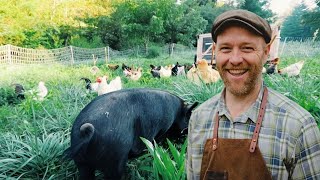
In this two‑year farm vlog, Victor Justin Rhodes documents the full lifecycle of raising a small herd of pigs on a 240‑sq‑ft farm, from receiving piglets to processing the meat. He applies Joel Salatin’s deep‑bedding system, rotating pigs every 12 days and using a foot of mulch to rest paddocks for up to 80 days. The pigs are used to clear underbrush in a forested pasture, working alongside cows and chickens in a multi‑species permaculture design. The video details feeding experiments with wood chips, charred branches, kelp, salt, fresh manure, and garden waste, as well as enrichment items like balls and limbs. Wood‑chip moisture is managed with shelters and tarps. The crew builds a simple “pig port” and uses the pigs to till soil, encouraging grass seed banks to sprout. As the pigs mature, the family prepares for humane slaughter, receiving NRA‑certified gun‑safety instruction, practicing unloaded shots, and discussing ethical shooting angles. The actual harvest includes evisceration, skinning, and meat processing, with family members learning the skills. Rhodes compares meat from traditional American Guinea hogs to fast‑growing lean breeds, noting fat content and flavor. Throughout, he reflects on the emotional responsibility of raising and killing the animals, the challenges of farm infrastructure (leaking carport, water runoff), and the satisfaction of turning waste into food. The video serves as a practical, experiential guide to small‑scale, regenerative pig farming.
Chapters
This is my entire feature-length film, Permaculture Pigs. It's our first 2-year adventure with pigs from piglet to the plate, but also putting those pigs to work in the garden, in the forest, also demonstrating what if you don't have much space. We raised 2 pigs all the way to harvest in 120 square foot under a carport. You're going to enjoy it. If you go away from this feeling like, oh, I want to do this, I can Well, guess what? You can. I've got now a— I've now released Permaculture Pigs, the course, into Abundance Plus. So you want to check that out at abundanceplus.com or link down in the description. How does it make you feel to be getting pigs on the farm?
Uh, a little— to get little pigs.
What are you gonna do when we get our pigs?
Ride them.
You're gonna ride them. First thing we had to do is get ready, locate feed pans. Will you go get our feed pan, Jonah? All right, go wash it out, please, with that scrub brush. Thank you, buddy. Here's another one. We might do our automatic waterer. I have no idea how to water a pig. I don't know, they're probably too short to get out of that yellow bucket or pink bucket. We take this too just in case we use that. The owners will know what we do for water. Thank you, Jonah, those look good. Okay guys, I think we're ready. We have feed pans, potential waterers, we have our soaked feed, we have our stall ready.
I'm not getting them right now.
They're coming. The people are gonna deliver them. I'm gonna dump it out in the middle and everybody can spread it evenly. The pigs are here in a minivan. That's a good sign if they came in a minivan. They're carrying 2 pigs in a minivan. That probably means we're gonna be— it's gonna be easy to put them in the stall. Hi.
Say hi. Hey, Janae.
Justin. Nice to meet you. Nice to meet you. That's what they do when they get stressed out, just go to sleep. Pretty much. They slept most of the way. Yeah, they seem like they're pretty laid back until you try to catch them. You like to pet them? There they come. So they're used to— they're used to kids. Yeah, if we stand over here, maybe they'll come out. You could tip it up, Jonah, if you want. Slow Slowly though. There they go. There they are. You guys are going to till this up, stir it up for us, aren't you? Soaked feed.
This is a—
Okay, you got some feed? Okay, I've got some feed, Mama's got the water.
I fed them grass.
Oh good, did they eat it? Okay, go. It helps if you find your rice nut. Okay, well, they're eating right by the door for one.
Oh, because they brought them.
Yeah, after getting them in, I feel like so relaxed. They're so laid back. Look, look, I can, I can pet them. They said forget the grass. Oh, they'll, they'll chow down on it. They'll probably eat all we would give them. And these guys are so chill. They're so small.
Grab the water and pour it.
I will. Look, Lily, they let you pet them.
They're a lot calmer than the sheep. It takes a while to get them to be able to do this.
Okay, they love that. They're gonna about to eat all that grain. Then we got them some grass. We got them some apple cider vinegar and some water.
I want to pick up pigs.
Good, you want to? Come on, she'll help you. Come here, pet them.
The handkerchief leg. There you go.
Yeah, I gotcha. I believe we could catch them and carry them if we absolutely had to. So this is totally non-intimidating first-time pig experience so far. Very happy about that. Look behind you guys. I love you guys. You guys are awesome.
They're turning the feed into jowl bacon and bacon and sausage and head cheese.
Oh, I like it, I like it. Time bye.
Bye.
Put your tester on there, just make sure it has juice.
80.
Okay, that was hard. Watch, watch. everybody just be patient.
Will Henness ate it.
No, they're gonna just be curious and touch that fence.
That's one trained.
That's one way to get the water over here.
Putting a fence up for the pigs.
Yes. We got to see one of them get shocked.
One of them got up and screamed like a lady.
Let me tell you, that one will never touch that fence on purpose again. You guys ready? You've been trained on your electric fence? I think so. Look how lucky we got Jonah. The post ended up being right there exactly where we wanted. That's crazy. You're making those go down? That's good, that's handy. Go do that over on the— go do it on that one. There you go. Oh look, Josiah got it down. Oh, he took it off the top of the pole.
Yeah, boy.
Just— I don't think you're gonna have a problem getting them out. They're charging the gate right now. Oh, they found them a friend. They found— they missed— somehow missed the avocado last night. All right, just, uh, get their attention. Go, go show it to him. Show it to him. Show it to him. Hey, don't scare him, Jonah. Don't scare him. Put it right there, Josiah. Put it right there. Wow, I thought they'd come right to your feet. Things were going all good, and then the pigs got out. What?
Pigs out!
Quick, get some grain!
Oh, I already had the jean scraps.
Did they come to that?
They like it.
Okay, hold on, I'll help you.
It dug under there.
How do you know? Oh my, apparently it's dug under the fence. There he is. Okay, see if you can't follow your bucket. Okay, here, get his attention with the food scrap bucket. We want to get his attention real good before this other one gets out. Come on! Oh my gosh, you rascals! Why didn't that pop him? This fence is not on. The fence wasn't on. Hey, Josiah, you know the fence wasn't on. That'll do it. Bring it in here. What you want to do, let's pour about— pour about half of it in this. Just listen to me. Pour about half of it in this. Oh, okay, I see. Okay, pour about half of it, not all of it. Okay, that's enough. Uh, you just poured all of it in there. Okay, here we go, here we go. Here we go. Look, look, look, get— come over, come over, Josiah, come over. Well, that was easy. Go get your string trimmer. Let's reinforce this pig. It's hard. There you go. Look at that tail job though. You guys don't play. We string trim just to make sure this is real hot. We lowered the fence. You guys ready? Most importantly, we're turning it back on. All right, see how they mucked this up? They've got it, they've got it, uh, good and tilled. Smelling like a pigsty. We got to get them out. Ready? Let's move this fence. Wow, that was relatively easy. The pigs were out. We just encompassed them where they're supposed to be. Are you happy? Are you happy? Look how good you did tilling. On to the next job. And isn't there just something so right about getting animals on fresh grass? Aren't you guys just happy as can be roaming this grass, huh? Are you happy as can be? Huh? See over there? See over there, the bare spot? See that bare spot, kids, where these pigs were? That's our mission today— plant a garden there. Y'all ready? We're gonna plant the Three Sisters. That's what you wanted there? Corn, beans. Do we have runner beans?
Yeah, Mama's got them.
And squash. And so you got the plates? You've got pitchforks for your wood. Yeah, so take the— take everything over there and then, and then go. That's some hard workers. Good job, guys. You filled one wheelbarrow. One left.
I need help on balancing.
You want to do it? Go ahead.
Somebody's got to hang on to it while I fill this.
You're going to balance it?
No, you got to balance it.
Got it. Donna, can you carry the wheelbarrow that full? All right, well, Jonah, you know what we're gonna do? Let's go. I think traditionally you're supposed to create mounds. Create, I guess, just as many mounds as you can. Okay, buddy, maybe 3 or 4 feet apart. You having a hard time with that? Try again. That's not bad. That's not so bad.
You got it.
How about I'll make the mounds and you plant them? Look, Johnny, here. Here's your seeds. I'm gonna put— I'm gonna build a mound so you can put a plate on top of it.
Hey, you gonna help me?
Oh good, the water's clean.
Very weird that the water is clean, right, Papa?
It is, it's weird since they're pigs, but they keep the water clean. Here we are, one of my favorite elements in the farm. Why? The pig. Rich manure. Till fast, eat anything. Did I tell you I love you? Oh, don't jump, don't jump. Oh, he's looking at me. He might take me down. You don't like a head scratch? There you go, that's better. Come on, come on. You guys are growing fast. What? Nothing's growing over here. Give us some time. We planted it by seed. It's got to germinate and grow. We'll see. We don't have much to lose there. Oh yes, something is growing. Some of your cover crops are sprouting. The pigs are over there. This is our crop garden chickens. You know, we're not going to plant in June. We're taking a little break. Gonna start planting again in July in the greenhouse. Those plants grow up, then we need to transfer. So they've got 2 months. I don't know if they're going to get that down in 2 months. I'm thinking real hard about blending the chickens and the pigs to speed up that process. Why have them on two jobs if I don't have to? If we're gonna— I know there's some difficulties to work out, but, uh, you know, we've got to keep the chicken's feet elevated. I think these chickens are big enough, the pigs are small enough that the pigs aren't going to eat them. I think it would be cool. It would definitely cut our chores down some if we could blend them. Today we got to get the pigs out of where they are. See, we are overdue for a move. Josiah, how's your automatic water working out? Looks like it's working out good. You know, Josiah's trying to make his chores easier. I'm all for that. He actually asked me to go to Tractor Supply one day so he could get some things to make his chores easier. But, but not the thing we haven't built a shelter yet, so we're still dependent on the stall. We're gonna need to make a lane from the stall out to here and then another square garden area like that. So Josiah, let's use this for our lane. We'll set up another fence right here. It's hard figuring it out sometimes. Yeah, okay, I think I got it. This is what we're gonna do. We're gonna take one of these extra pig fences, we're going to start one right here, and then we're going to start one end of it right there, and then the other end of it right there. That leaves an opening. We'll, we'll, uh, drape it around as big as we need to. If we have some extra, we'll loop it back on itself. Can we get our post too?
I can get them in the stall. Okay, good. I'll get them in.
Well, hold on, hold on. You think that would be the method to do? Yeah, just get them in the stall and go distract them. That's not a terrible idea. Wait, take the food in there for them.
Uh-oh, Papa, what do I do now? You run, run into the cave.
Don't lay down. Jonah, you got to come get your food. Wait, don't you want to feed them?
No, not yet, Papa. That's how we're going to kill them.
No, they're not getting it. Hey, if, if you guys lure them into the stall with food, they can eat. Hey, hey, hey, if you lure them to the stall with food, they can eat. And then when we get this set up, they can just come out on their own.
Okay, Papa, they come to me, they know me.
And okay, but I want to feed them. They're hungry, it's getting late.
Go get their tricks.
And how are we going to get them into the They'll come out the chute when they want to and then go into the other paddock. They will. Here's what we got going on up here. Basically, we started with one fence on either side. See, we did that fence that ends at the— that ends at the stall, and then it comes all the way out and around as far as it'll go in that paddock. And then we did the other fence on the other side of the stall. It came all the way out around. They met each other, they crossed each over each other. Hey, I'll climb off the roof.
Thanks, Dad.
I think I trust getting off this roof more than I trust that widowmaker ladder. Put the energizer on the lower one. You got it.
And flip it around.
Okay, you got it. You got it ground in. Yeah, flip it around towards the sun.
Okay, buddy, let's go release the hounds, Papa.
Actually, we should put this over there because the sun's gonna be behind this building real soon. The theory is they're gonna walk down this chute and into our new garden area. See, look what they've left behind. We got cover crop, we got our Three Sisters coming up. Have y'all made it out? Our goal is to plant this today. They made it out, no problem. I know because the grass is already wearing out. They've made a circle right there. Oh, it doesn't take them long. And is it— and then their daughters— no, maybe they haven't made it out. I think they've made it out. Well, they have now. So as you can see, pigs can really tear up the place. So we began to discover though and used our permaculture principles, which is what? Turn a problem into solution. Wait, pigs tear up the place. That's good. We need some tilling done on the gardens. Could we blend our pigs with our chickens who are already doing the gardening? I think we can, but we're going to need a shelter for the pigs. They can't live in our coop. So I kind of just slapped together an idea for a shelter, you know, where maybe the roof would face the sun and be a place for them to get out of the sun and the rain. And eventually maybe even the frost and the snow. Let's measure this and see if 6 feet will do. I'm hoping 6 feet will do. It's heavy. I don't want it to be so heavy we can't drag this thing, but I want it to be adequate. Yesterday we went to Lowe's, we got all our supplies. I don't think it's too crazy. I have this kind of— I idea for kind of like a lean-to type shelter. That's a very rough draft of what we're building that will face towards the sun to give them max protection. We're gonna have a 6-foot shade structure. Let's make 7-foot skids. I'm excited to get started today. I'm excited about this kind of work. We're gonna put 2 together for one skid, one on each side. Now let's do our angle cuts. Whether it's working on some sort of shelter or coop or creating a video or planting something in the garden— that's just the skids. That doesn't look too big. It's gonna be a foot shorter than that. There's something so satisfactory about that kind of work. I think I know what it is. Make an angle cut so that it will pull easier. When you work with your hands, your imagination, to create, build, or grow something, you then have something to show for all that effort. This part is for you, buddy. We got our skids. Now we just gotta screw them together.
Papa, can I take those splinters off?
It doesn't— maybe, sure, but let's do that on your own free time, okay? He's gonna take the edges down with his Dremel. At the beginning of the process, you have nothing. Well, you do have something. You have an idea, something in your head, and by the end of it, you have something that you can touch, watch, see, smell, taste. Look, John, I could use a couple more screws right there. There's a gap. That's what makes this kind of work so enjoyable. There's our skids. It's gonna be a slanted roof. Gotta figure out where I want it to start. I don't want to put it all the way down. Ventilation coming through. Go! Okay, this is very manageable. This is even lighter than the mineral sled.
Yeah, yeah, we made it!
What's going on? Get off of it! But we're gonna get them used to this so then we can move them anywhere we want and we're not limited to the shed. Nice, we got you a hangout. Okay, we got you a hangout. Time to move the pigs. We're moving the pigs in with the chickens, kind of. We'll have an idea. We have a perimeter fence around this garden area. But the chickens aren't tilling this fast enough. We're gonna need to plant here in 3 weeks, so they need a little help. We're gonna give them a little help with the pigs. So Jonah, I'm kind of going to go off your idea. Your idea was to run a poultry net through the middle, through the middle of this, and put pigs on side one side and chickens on the other, right?
Let's do that.
But let's take it a step further and let's put a pig net down the middle. Yes, yes, I was thinking because that's less heavy duty, and if the chickens want, they can maybe get through that pig net. It would be on their terms, and they could get to the pigs, and they could maybe sort of get used to each other. What do you think? And then maybe one day we can blend them. We're gonna run our pig netting right through the middle, and we're gonna put the pigs on this side because it needs more assistance. We've got our pig net up, and Josiah had a good idea. I was just kind of going to go back and forth. I mean, the pig net is 100 feet long, not 25 feet long or whatever this is, so it would just be going back and forth on itself. Josiah had the idea to go around the exterior. I like that idea because if you go back and forth on this, the chickens can't get through.
I—
like I said, I, I don't mind. I sort of want them to get through if they want. They're probably— they're not— it's not like they're going to be barging through. That's going to be a pretty good barrier. I like this combo thing, even if they're just next to each other. You only have to use one Energizer, so that frees up an Energizer for us that we could go put on the sheep since they're getting further and further away. The waters and the feed will be near each other, although maybe they're not in the same pen, it'll still be near. Hey guys, you ready to move? You ready to move? Huh, huh, huh, guys? I like you, I like you a lot. You ready, Josiah? All right, let's move them. You got those posts queued up? Hey, y'all hungry? That's the trick to moving pigs. A lot of animals do it in the morning after they've had that small fast. They're gonna follow us anywhere. Come on, pigs! They're the easiest animal to move. Oh my gosh. Oh, oh, can you— oh boy, pull my line down, Josiah. Pull the wrong one. Yeah, pull it right through. Keep going. There you go. Now you should unravel it and then just drop it before they figure out this fence is off and learn to charge an electric fence. We're gonna have to make a corner right here, okay, before we put their corner up. Quickly, before they eat all their food. Let's go get the, uh, shade shelter. Josiah, let's move this shelter real quick. We can come get our pig fence later. But we gotta hurry while they're eating. Thank you. Now we can put up the fence. Now that we have the shelter in here, we can bring our water later. Let them out. You got new neighbors. Stress-free introduction to pigs right here. This is my least favorite stage in the animal garden miracle, where the pigs and the chickens have prepped this land, but it's like ready. It's ready to be planted. It's bare mother Mother Nature does not like to be, uh, uncovered. She likes to be covered. We're gonna move you guys. Fresh green grass, okay? And then we're gonna cover this with fall cover crops to prepare this for next year's garden. We're going to remove all these support posts, then we're going to open this fence up, move the pigs over there. This is the risky part here, Jonah. You want to get their feed and get them a trough. Get them a trough. Here, we'll let them through. I don't think we're gonna have a problem. I think if they get done, we'll just lure them back in with a bucket. Lift it up. I see that. All right, while they're eating and pigging out, we hurry up and move this fin. All right, time's ticking.
I got it, never mind. But let's just get that big girl out though.
Boy, they're done.
Here baby, here baby. Here baby, baby, baby.
What'd you feed them? Is there anything in there? Okay. And then we'll move everything out. Okay, you're gonna put that down, I'll drive over it if the pigs don't get out first. Hold on, you gotta help me with the fence. You ready? Just get it up. Wow, beautiful. Start flipping it. You going to—
with the other pallet, you going to put it right here?
Really? You found your limit, huh? Oh look, they found some right here. Some fell for you.
Look at how Nice and like clean they are. All that rain did them good.
It's a new partnership, guys. The pigs are all up in it. Chickens are standing by for a new unveiling of food. Look, amazing! I just want to give that pig a hug. He's digging it up. The chickens are getting at it. He's eating something out of there. What are you eating out of there? Because you're just standing by, you don't have to do any work anymore. Yes, I'm looking around and seeing what needs to be done. They're definitely done in here. There comes a stage when they begin to stop fluffing it and they begin to start compacting it. So we're gonna definitely get these guys out of here. They're overdue. Remember, I hope that this would just pop and be unrecognizable when we came back. Look at that chard. Boom, boom, boom. Oh, show me where the pig went in the house.
It was raining bad, so we decided to put it inside so their grain wouldn't get drenched.
Oh yeah, look, it looks rich. Do you think the sagging was from the pigs?
Or no, there was someone— this may go down. Or is there a heavy load?
So Jonah, do you think the pig got in here and too much weight and ripped that up?
Oh, I saw him walking out of here.
Okay, we'll see. He's pulled there, so he must have laid down. Oh, Papa, we got to do a whole new cross piece of this middle section.
Papa, he must have thought it was a back scratch and rolled on it. Then I came back and the Pigs walked out of the chick shawl. One pig. I don't know if the other one was in there and just got up.
All right, well, let's not put the feed in here anymore even if it's raining. Yeah, that was not—
I see where you're coming from on that, but sorry, I didn't know that was gonna happen.
I know.
Um, let's fix it tomorrow.
I didn't know either. I wouldn't have thought.
How does that look? It looks fluffy too.
It looks good, man. It looks freshly weeded. By the end of that first season, we got the gardening system down. This right next door looked like this 2 weeks ago, so that's going to take them 2 weeks, and 2 weeks 2 weeks, we've got this. We're— in a minute, we're gonna rake this smooth, pull out any major sod. 2 weeks before that, they were in here. They did this area. We planted this in cover crop, put some hay over it. Look, the COVID crop is coming up just below the surface there. Can you see it? And before that garden bed, they were in here. And look how well the COVID crop is coming up in here. By the way, this is a cold-hardy cover crop, germinates down to 45 degrees, grows down to 25 degrees. And where were they before this? This is where they were. We have these low tunnels on because it's winter, we're protecting them from frost. Here's a patch that was planted in cover crop. Isn't that beautiful? Isn't that beautiful? Now for the best part, the surprise. What's under these tunnel. You know what's under this tunnel? Unbelievable abundance. Look at these lettuces. Oh my word, how beautiful. Oh my, and it just goes on for like ever. We're gonna be harvesting salad out of there all winter long. We got bigger, more traditional, fast-growing pigs compared to the American guinea hogs, which are a slower, more traditional pig. We got these guys and thought our life would be easier if we blended them. Here we go. So far so good, guys. Come on, come on. And then the leading failed. It was not working. Good boy. Not good. Here, come here, come here, come here. And thankfully there was lots of people behind him. Come on, come on. Yeah, they're not responding to me.
Not good. Come here.
At one point, they— the 3 pigs were scattering pretty crazy, and I said, oh boy, okay, all right. And I was about to go get some nets so we could keep them somewhat, hopefully, corralled, but somehow All those folks put their brains together and, and just were able to somehow herd those pigs.
Come on, come on, come on, come on.
You get them in here, we sort of have a wall. This was too risky. They are not following this bucket. Open it wide. Come on, come on. Somebody cut off this path. Brett, go around and cut off this path. There you go. Good. There you go. Hey, we got one almost in. Oh my gosh, I'm glad we did this with all these people because they were not going in. Yay! Wow, you can herd pigs! Let's see how they're gonna do with each other. Look how much bigger that fence is. Not on, but they're scared of it. Look. And then they pretty much ignored the guinea hogs, but then as they began to kind of approach them, I noticed the guinea hog was standing its ground. It was kind of funny. They don't care about the pigs. You're just going right, you're going right for the feed. You don't care, care about trying to claim your— that one's the boss sitting there. Look, look, you're holding your ground. Look at this. He's like, this is my house. You know, it kept going from there. I mean, I thought they would maybe quickly establish who's boss, and the guinea hog tried to stand its ground, but these bigger pigs were just able to easily just like, rah, and get them to give in. One male and two females. The male just kept chasing the guinea hog, and we thought they'll settle down and You know, we were out there talking and like, we need to get out of here with Laurel, we need to get out here with our people, maybe they'll settle down. Well, I checked on them every once in a while and they seem to have been settling down. Maybe a little bit of ruckus. That one's got a bone to pick with that one. That didn't work, so we separated them out at the end of season 1. It was interesting because we could sort of compare the small, slow-growing traditional breeds to the more fast industry-style traditional breeds. And this is what I had discovered. Can I tell you something else about the guinea hogs, the American guinea hogs? Well, first of all, they follow food better than the traditional hogs. Here. Yeah, you guys, this is gonna count because they're not really following my food. Hey, Josiah! Can you come lead with the food? I'll help herd. Come on, come on. Yeah, they're not responding to me. They eat absolutely anything without hesitation, including weeds. 3, they don't get terribly big. They don't have an ounce of aggression. And 3, they didn't hesitate to eat chickens. Or any other dead thing that happened to be on the farm. Fish, mouse, just ate it right up. Made super— we're super efficient with everything. Well, they're probably not gonna eat that lemon peel, but they eat, uh, watermelon rinds, banana peels, broccoli stems, things that chickens maybe would eventually eat before it rots. Kind of not really. And the other thing, as much as they'll eat a dead chicken, which is great because if a chicken dies, it's sad, but there's some redemption when that chicken— when you can turn that chicken into bacon. But one day, actually the other day, during that crazy wind. We had some crazy wind. It actually blew up the pig shelter and tilted this up on them. Willie, I don't know if we had a kickstand or not. A chicken died. A chicken got squashed and died, and then the pigs ate it. But yet they don't eat these guys. Now, I don't know if it's I don't know if it's because it's the American guinea hog or their particular nature, but they've lived very well with these chickens. I might be a little bit nervous with those traditional hogs. That's my take on, uh, guinea hogs. And did I say they would follow you anywhere? They would follow a bucket. They'll follow a bucket. And in Jim and Renda's experience They don't even need to follow a bucket. They will follow you anywhere. I mean, I had them like 200 yards away. They followed me all the way home, and I had no food with me. Just seeing me was enough to get them to come along. So they're attached. So going into season 2, we opted for the faster growing, bigger pork because we needed to get some stuff done fast. We wanted to grow up fast. We just wanted that food fast. So we went out to Tennessee to already a mentor of mine, Cliff Davis. We had met him on the Great American Farm Tour. He's doing some amazing things, and we went to get some piglets from him, but we also went there for some inspiration and advice, mainly his pigs clearing forest systems. Here's an example of a place that, that when I first bought pigs, okay, they cleared this area out, and now there's pecans in there, chestnut, apples, cranberry, cherries. This over here looks more cleared and actually has productive fruit. Yep. Trees that you desire. And this is what it looked like. That's right. They go in there, they hit it really hard. Okay. And then I go in, I can walk— like, I can't even hardly walk in there. No. So then I can walk in there, and then I start chopping and dropping. Okay. And, um, and then making biochar. Okay. Yeah, taking stuff out that might be useful, leaving stuff that I want to keep. Is that cover crop in there, or is that native grass? That's both, rye and vetch. Okay. There's probably some clover in there, chickweed. So what kind of maintenance goes on in here then? Not much. Do you— when the grass gets high, I put up a fence and I bring them in. Well, it's happening. Our car broke down here, 311 miles Tennessee from North Carolina, to pick up pigs. 5 pigs. 5 pigs in the back of our minivan. Rebecca thought of this amazing idea to rent a U-Haul and a flat trailer so the pigs are level. Seriously, this is our rig home. The cages for them is in the van. It's one reason why we wanted the trailer dolly so the van will be sitting flat. Yeah, because you can't put pigs in the box trailer. There's no ventilation. All right, Justin. How's it feeling? It's, it's a bit different than yesterday. Whoa, I know, right? We gotta lift them, right? Okay, so this comes down. Yep. You don't think they'll jump over that board, do you? Oh my gosh, there's no lid. That'd be interesting. You think they might climb out? Uh, we couldn't get the lid on because we had to— yeah, you have it sideways. We had to collapse it together get in here. That would be crazy if one got out and we weren't in here to know it. Well, then you can just make it into a pig house when you get home. A mobile pig house. Because it will drive a little bit. Put it in the field. There's two things I'm concerned about. One is the top, and then one is those little sides. That they might fit through that? Yeah. We're looking at maybe a pallet. I don't know if it's Yeah, it's hard. That's why I couldn't get the roof in there. Yeah, because it just got— it's that one corner. It arches. It's tough. This metal scrap here? Yep. What if we put both of those on there and zip tie? You got some zip ties? That'll work. Oh yeah, you could get— you could make it to the— yeah, to the board. You might even make it to the— you're actually going to make it to the frame. It was like it was made for this. There you go. That's crazy how perfect those fit. No, he's worried that they might get out the side. What do you think? 2 is too small, probably. What about this? Oh, there you go. What about that? You sure you don't need that? It's just— no, it's just laying around. What? Just almost perfect. Is this crazy or what, dude? It couldn't be any better. That's crazy. That metal wire— there you are, I see you. Pig moving. So these all four got together? Yes, this one jumped over here when that one started squealing.
Get in there.
Oh, now they're all together. All right, they'll move. Five pigs inside of a minivan on a trailer behind a U-Haul truck, 15-foot U-Haul truck. I went away from that with an amazing inspiration to use pigs on our farm to help us create more pasture. See, we have mostly forest here, but we have a lot of ruminant animals, and we sure could use more pasture. And because we have a lot of forest, that just happens to be what pigs like. So I went away with Amazing inspiration from Cliff. Thank you, Cliff. Oh shoot, oh shoot. Oh, reclaim— the forest is reclaiming the pasture, and we, we want to partner. We want to partner. We don't want to get rid of the forest. We want to, as Joel Salatin says, pasture our forests and forest our pastures. So clear some of these trees. So grass will grow in there. Be a nice habitat for pigs, nice habitat for cows. Out in the full— out in the pastures, we'll plant trees. This is crazy. Look how crazy dense this is. Kind of hard to see the vision down here because there's so many trees. So let me take you to a spot that is closer to where we want to be. We are at the top of the pasture. Look at this beautiful view. Wouldn't it be nice to see this right there? Pasture, but over here, forest. Oh, or is it a pastured forest? This is what I'm talking about, guys. Sure, the briars are up. The pigs are gonna help us with that. But look, amongst the trees, grass. Look how nice. Doesn't this feel just right? This feels amazing. You made it.
Made it.
Do you want to clean that up or go and do what you just did there on the strips? I'd say use this to do the strips.
It's a lot easier with all those vines.
Oh yeah, then we can go back. Okay. Oh yeah. Once was not a trail is a trail. Wrapping up the day, pretty happy. Got a perimeter trail established. Got cross lines established. Yes! Yes! There's a cross line example. That way we can run a cross fence through here, a cross fence down there, and browse this middle stuff. We want to build— I've got a carport. It arrived yesterday. That's my best idea to showcase how you guys with little land can keep pigs. And there's our cattle panels, that's going to be our walls. And I'm taking this tin, would be our sides, and it's holding in mulch. Okay, we're going to start off with a foot of, of wood chips, right? And we're just going to add mulch, wood chips, as we go, as the pigs age, as the pigs manure on it. Okay, and start with a foot, hope hopefully not get much higher than this by September. 10 foot by 12, 2 pigs. And then just holding this back with T-posts, putting in T-posts every 2 feet. That'd be a— I think that'd be more simpler. Just do the zip ties. I'm trying to make— Jason, let's make this as simple as possible. Mine and your brain together, yeah, yeah, we can make this. I just want other people to be able to do this, okay? Or at least be inspired by this. They say, oh, I have a shed I could, I could get some tin and some cattle panels like super cheap, right? Or if I don't, I could go buy a carport. Basically cattle panels and zip ties. Yeah, and then this will last for years. We're turning one garden plot into the compost corner. We're gonna have the pig shed in here and then chickens too, and chickens will be making compost and the pigs will be too. And this is either on site for gardens next year, or we can easily— this is uphill, notice— we can easily wheelbarrow our material down to the other gardens. Just putting in those screws, dude, is going to take all day. Oh yeah, that's, that's serious, dude. This is going to be firm enough to be the corner wall. I did good. It's not a flimsy— swallowed a gnat. Gah! Okay, now I gotta swallow a fly to get the gnat. Dude, this is looking legit. Yeah, this is sturdy. 2, 3. While we were setting up the forest system and the pig port, the pigs had to be somewhere, so we let them out of our physical holding into this run, which ended up proving to be a possible solution for somebody who has more than 240 square feet. Maybe they have 700, 800 square feet. This compost corner system for pigs. Real quick look at the system. Premier One electric pig net. Simple, easy to set up in an outdoor run. They could come out and get the sunshine. They have a shed. This could be off of a barn, this could be a carport. A simple 50-gallon waterer, 2 feed pans, a compost bin right in the midst of it. And this is the key right here if you're going to keep pigs in a small area: deep mulch. This is wood chips. They tend to poop and manure— look— on the wood chips. What to do with it to keep it clean in a small space, keep it sanitary in here? That's where the compost bin comes in. It's 4 walls to keep them out of it. This fills up, it starts to heat up, breaks down the bacteria, fries it, anything else that might be in it. And then we remove the walls and the pigs help us turn. Notice how we have the pallet as far as we could get away from the fence. This ramp just above the fence so that we can get other materials and here. That's one system, but I wanted to showcase more— the pig port. Morning. Come here and check this out. Jason back for some more. Jason, you're going to be my left-hand man today. Sounds good. Doing some things I cannot do. Like you need some help? Yes. Look at this, we got the material in, bro. Okay, I can see it now. You can see it now? Doesn't it look nice? Yeah. And I noticed yesterday— hey dude, we were able to haul material in with the tractor too. Oh, you were right through there and you didn't have to take this down? No. Okay, I didn't take it down. The tractor bucket could fit right through there. We put a layer of logs and then we put a layer, probably about 3 cubic yards of compost that was already hot, and then maybe about a half a yard of wood chips on top. Don't you see it now? I see it. Doesn't this look like a nice habitat? Yeah, it does for a couple of pigs. Now it's time to move the pigs.
Go drive over to the pigs.
Okay, you want me to hold this?
Okay.
Okay, that's what you're gonna try. Oh good. Yeah, you're a man's man, aren't you?
Huh?
You just go over there, grab that pig by the back legs. Was that easy?
Yeah.
If you can do it, we can do it, huh? Yeah, I think we can do it. We always, we always figure out a way, don't we? This sheep fence is a little— well, it is big overkill for pigs. Unfortunately, you have to electrify every single strand, so it's going to take more power. The reason we're doing this though is, look, our house is there, the forest here, protecting from the coyotes and Sasquatches, y'all. The forest project begins. Maybe, maybe this is smoking hot. Personally, I think it needs to be maxed out. Moment of truth. Oh, 6K. Just clear as spot for it right there. I think they're gonna be happy up under that pine tree. Probably we're gonna spend their time, but we're just gonna give them this just in case. Are you pulling that through?
I'll guide you.
All right, fellas, take one of those pans and let's lure the pigs into the stall. I think they're always hungry for skim. Like, that was easy. I just don't know if I could lead them across the entire farm. We got our barrel out here next to our water source. Gonna get a hose, gonna fill it up. Got to get over the nipple water and then a little bit more, enough for a day, which should be about right there. And hopefully we can shimmy that off at the end. And it is here. They're gonna fill that water up. We're gonna check and see if— I don't think the dog crate's gonna fit in that. What do you think, Jason? I don't know, I haven't seen the dog crate. Try not to grab him by the hooves, just above the hooves, and lift him up.
Because should we grab above the knee right here?
No, no, we were grabbing on the shin. Okay, right here, lifting them up, and then Anna will grab one side. Come on in.
Okay, let's shoot these guys out.
There he is.
Just commit. There you go.
Grab the other leg. Good job, good job, good job. There we go.
Hey.
We just lifted him, what, a month ago? Not even, okay, 3 weeks. Yeah, just one person. Come over here. I know, there's like 3, 4 people. Pig number 2, is that not a lot easier? Can we let that down? Yeah. Well, he's looking at it, man. He's a lot smaller. Okay, there they are. 3, 3 pigs. I think they'll be happier together. That's just a short ride to the forest. You guys, your life just got so much better. There you go. Thankfully, they're trained to the electric fence. I don't think he's gonna try it. It's not on. Look, he's coming out on his own. Shady. Oh look, is he gonna eat the balm of Gilead? Please eat the balm of Gilead. I think he's just seeking shelter. Good. I want to see you eat something. He says, I'm done, I'm over it, it's where I'm supposed to be, see y'all later. That's a good sign, Jason. Not too stressed to eat. One thing about moving those pigs I'd do different is I probably would have just opened up the side of that in the first place. I would have made sure I trained the pigs to a bucket. I would have got pig boards, uh, that I learned about those at Joel Salatin's. They're like these— I got some now, but they're these plastic light boards and it's great for herding pigs. So it had a few people maybe herding them in the back and maybe somebody in the front leading them with a bucket. Sure, put more dry right there. A little wet over there, a little moist manure here. So yeah, see, see our wood chips will be over it. That's good. We want to cover this with our wood chips. This is a bit of an experimental system. There are people who have done pigs on deep bedding— Joe Salatin, namely, Richard Perkins— with great success. And so we're trying to bring it down to the homestead level. Gonna try different things, experiment throughout this, the summer, and then at the end teach you what worked and what didn't. Just covering it up with with that wood chips. Took maybe 5 minutes. It seems nice, like a nice place to live. How you guys doing this morning after the wild move yesterday, huh? You happy? Eat all your food?
I need to open this, please.
Okay, why do you need it open? You're gonna put the other feed pan? We'll have 2 feed pans. Okay, one right there. Oh, there's one here. Let's save that one for water. You're going in? Yeah, I'm not really going in, but you can go in if you like. Jump over. The cool thing about pigs is they're clean animals. They poop in one side of the area, usually furthest away from their feet. They're pooping over there. We're just going to simply cover that up, keep the flies off them, keep it breaking down, mixing it with this carbon material. I didn't see much animal protein in there, so I'm going to give you some. Okay. Yeah. So what if you're a healthy conscience family, you couldn't source quality pork in the grocery store? Maybe you could find some at the market, maybe some non-GMO, but then it's terribly expensive. What if you didn't have much room, like you lived in a neighborhood? Well, what if you had a carport? 12 by 20. What if you put half of it into a pig pen with simple— what'd you say, buddy? They won't bite you, just stay right there. What if you had a— and then what if you got together some cattle panels, T-posts to help support them, zip ties to attach tin as a retaining wall Just what if, just what if, what if you, you partnered with your local town or power company to be a place to drop off wood chips? You could totally— what'd you say?
Is that the power company?
Yeah, the one on the, on the left. This one's from the power company, this one's from our local town. Oftentimes they have to chip I have the room, so I put it there on the bank next to the road. You could totally put it under this side. That's why I call this a 240-square-foot farm, because this is a total— I mean, you are full of questions this morning, aren't you?
How did you dump that?
They dumped it with dump trucks. 2 pigs, 200 pounds of pork out of each of these guys. Buy them when they're 2 months old, raise them until they're 7 months old, keeping them only for 5 months. On this deep bedding. Look, he's happy in there. You, as you saw, they manure over there. Jonah has put the wood chips in, thank you very much.
He's foraging from that mulch.
Good. He's probably gonna find some stuff in it. Yeah, this is good. When they lay down to eat, they're burning no calories, very little calories. They're gaining weight. All right, that's plenty of food for them today. So the first thing you want to think about with your— let's call this the— let's, let's do it. Let's call this the pig port. Huh, get it? I see that pigs inside there, inside a carport. Pig port also kind of speaks to its mobility. This is not a permanent situation, but think about when you're placing this, how can the pigs benefit the farm if you've got more farm? And how can the farm benefit the pigs? Well, the pigs are right here next to the garden, so we can harvest what we don't use, throw it in there.
Carrot?
No, but it looks like a carrot. And then when we're done with this, it'll break down while they're on it, after they leave, and then this is a future garden bed. And if it's not, we just wheelbarrow it from here down slope to our other garden beds. I interrupt this show. Hopefully you're having a great time. I won't keep you long here, but just one— just, just a quick reminder. If you guys want to know how to set up a pig fence, what pig breed to get, how to do this in small places, uh, if you want to learn the practicals of what I'm doing and learning myself in this film, I end up teaching it in a course, Permaculture Pigs, and we released it We just now dropped it on Abundance Plus. You can get in on this permaculture pigs course and all the other goodies in Abundance Plus at abundanceplus.com. Link in the description. They're here. No disturbance in here. Hey, do we have any in— hey, look, we have some disturbance over here in their little shelter. Hey, let's continue to encourage them to disturb. Throw it right in there. Just side. They have this— this some disturbance where they hid last night. Yay! Have you guys come over here? I think there's a little bit right here under the pine tree. Oh yeah, look at here, looky here! This is probably nice because it's under that pine tree. Okay, so we have some disturbance. Now let's direct their disturbance by putting it— putting feed where we want them to work. So we put their feet in there. They're not used to this yet. They've been fed in pans. You guys have to work a little harder for it.
Papa, let's see how much.
No, these are the happiest pigs on the planet right here. So later on, that second season— like, the second— the first season was like crash course, and the second season is like, let's get it down, let's get some guides, let's do this. So later in that summer, we got up with one of my longtime mentors via books, Joel Salatin, but we lined him up to coach us on pigs.
A covered shelter with deep bedding is better than a moonscape yard if it's not rotated. In a micro scale, I'm a big believer in a shelter with deep bedding is actually better than a moonscape dirt yard. For example, in a homestead situation where maybe you're bringing them some garden weeds and you're, you know, you're just going out and I mean, I mean, if you go out If you go out here with a, you know, with a, with a just any kind of thing and you, you know, you spend a few minutes.
Yeah, and this could be your garden.
Absolutely, absolutely. It could be your garden. You put that in there, you know, and, and it attracts those pigs. Yeah, and they, when people say, oh, pigs don't eat grass. Oh, they eat a lot of forage. They love it. They're drawn to it.
Even though they have all they can eat grain.
Yes, yes, because pigs don't watch TV. So that's the trick.
Don't put a TV out there.
Yeah, don't put a TV out there. No flat screen here. But yeah, the whole— the pigs know what they need, you know, and so they have plenty of instinctual you know, desire to eat stuff.
While at Joel's, I definitely had to ask about this system, the pig port, because he's part of the original inspiration of raising pigs in small spaces with deep bedding. He does that with his pigs during the winter. He raises his piglets that way. So what does he actually think about this as a full-time, whole-time somebody, just family of 4, 6 Not much space, something in the backyard. Here's what he thought. What's your initial thoughts on that for somebody, just a family of 4 in suburbia?
I think it's great. And the key is you gotta feed it carbon. I mean, that's what, again, if it, you know, what keeps the odors correct and keeps the pigs healthy is you gotta keep feeding carbon to the system. And let it get deep. Don't worry about it getting 2 or 3 feet deep. That's not a problem.
Is a 12 by 10 area enough for 2 pigs to grow up to weight?
Absolutely. Yeah, 12 by 10, 120 square feet. Yeah, that's enough room. Again, remember, if they have a good composting bedding, they have a lot to do. I mean, you look at these little pigs here, they're over here, they're digging. I mean, there's, uh, part of the deep bedding aspect is that they have a lot to do, and pigs are easily bored. You know, that's why, you know, you can put a— throw a ball in there, a couple branches that they can, you know, shove around, any of that kind of stuff to give them something to do and bleed off energy.
While visiting Joe, he gave me some insight on the forest Turning Forest into Pasture, particularly on how to get the till just right to get grass to come up and not weeds, not bramble. So let's say you want to turn this into a silvopasture. Yeah, yeah, you want to graze cows in here. Yeah, yeah, yeah, pasture. Yeah, you want to use the pigs, right? How would you maybe do it different?
I'd leave them longer and, and make them— and make the impact harder.
Okay, so either leave them longer or make the paddock smaller.
Make the paddock smaller.
Either way.
Yeah, either way.
Or more pigs.
The point is you need more disturbance. Yeah, you need a little more disturbance.
So is this ideal disturbance for then going behind and encouraging pasture? This right here?
Yes, yes, uh-huh, absolutely.
Okay, so they're in a paddock here. It's going to be, just to review, no longer than 12 days. Are you aiming for 12 days, or do you give and take? It's going to be 10?
Uh, yeah, yeah, anywhere, anywhere from 5 to 12. If you don't disturb it enough it tends toward brambles. If you disturb it too much, it tends toward weeds.
Okay.
So, there's a sweet spot of, of what you're trying to do to create the vegetation that you're looking for.
You guys have got to see this. It's almost, as Joel would say, almost a moonscape. A lot of rocks, no grass, some disturbance. This is where they've been. This is where they're going. But they've been here before. They've done this to that before. This is why this looks like it does. Hey, are you doing a good job? This is one of the most beautiful pastures I've ever seen. Look at that. Good job, guys. Got back from Joel's and we began to apply what we learned the very next day. This morning for the pigs— see that, Ben? You know, that got— we had talked about that. It got moldy because it was sitting up against the water, and that's when our drain was leaking and we got all this water on the wood. But this is good. I learned at Joel Salatin's that in the deep bedding system, to encourage it to get warm, to combat the— all the wood chips every fourth time they put spent hay in there. No kidding. So that's perfect. The pigs eat some of that, and this, this breaks down better than wood chips, and so it, it'll inoculate— it'll get this pile going a little bit better. Yeah. Good morning, gentlemen. How are you guys? Look at you, just getting petted and rubbed and not afraid at all. But I learned at Joel's, this That's another thing. I don't want to keep— you don't want to keep a pig in the same area more than 12 days. Let me feed these guys. Okay, I'm sorry, I'm sorry, I'll feed you. You guys are fine, you guys are fine. Here, here you go. What I was saying is, there, we can't keep— not supposed to keep a pig in an area longer than 12 days without doing deep bedding. So I would have to fill this area up with a foot of mulch. It's not impossible, and I may still do that, um, if I'm going to keep them in there, or give this 80 days rest. 80 days rest, that's a lot of little paddocks to set up around this area, and I'm trying to achieve a 240-square-foot farm for you guys with not much space. Joel thought this 10 by 12 area is just plenty enough for these guys. So we're keeping them— we're feeding them twice a day. One reason is just to keep them something to do. Joel suggested a ball or a limb. We got some limbs or something we can put in here for them to push around. Oh, you know what might be good? Hey, listen, I know it would be good. I'm gonna get it next. Some of those— if there's any branches in the burn pile They would get charcoal off of that. I kind of missed just being able to walk right up and do this. Should I give you guys another one? Should I give you another thing I learned? These wood chips, they need to— Joel said you could cover them up with a tarp, but it is labor-intensive and it does keep moisture in at the top, and I've noticed that. So it's better to keep wood chips under a shelter. Her. So I'm thinking we're getting rid of this and we're gonna actually store wood chips. Jonah found us plenty of branches to take down to them to be occupied. What I'm wondering though is if we can't have a little double bonus. These— this is— these branches have been charred. There's some charcoal in there, buddy. I think this will keep them. Put kelp in there. We're gonna put the charcoal in there. We're gonna see what they eat. And we got salt out there. We're back and you guys are fat. I like it when they, they get so full they can't even sit up to eat. Just check that burnt board in there. They've gotten— they get minerals composting, bro. Yep. So that's why this is amazing and safe, because look, look where they're pooping. It's going to be 100 degrees Dude, and so that's eating the pathogens and breaking that manure down. And yes, warm to the touch out here. It's working. They're gnawing on the branch. I'm telling you, Joel is just a genius. Throw a branch in there, they'll nudge it around. They're nudging it around. They're gonna get some of that charcoal. Look, they're eating that hay. You happy? You're so happy. This is a ridiculously fun system. I never knew how much fun I thought I would have with the system. I thought it would just be an extra chore, but this is fun. We get to interact with the pigs every day. Hmm, we get to throw you our garden, our garden waste. Good girl, good girl. They're gonna be the happy campers. Honey. Hey, is this a fresh manure right here, Ben? Uh, yes. That's like this morning? No, that was yesterday. I wonder if that's fresh enough for pigs. Pigs will eat poop if it's fresh. Ew. I bet that's what everybody else is saying in the comments. No, uh, it's like 30% undigested. It's got amino acids in it that they create with their amazing digestive system that pigs don't, and it's good for them. Special treat there for you. Oh, let's see what happens, see if it's nudged by tomorrow. Fresh poop, Ben! Oh yay, fresh poop! Get the pigs over here, come on! Thank you, Flossie. For our experiment. It's not going to get any fresher than this. 24-hour poop versus a 2-minute poop. Oh shoot, he was right. Don't eat it fresh. Holy smokes, holy smokes! Are you like a kid in a candy store? Oh my gosh, are you serious? As for the other stuff, looks like maybe they've— did you eat it too? You won't eat all of it. Whoa, you ate your charcoal! Holy smokes! And you ate all your salt! Wow, I didn't— I'm not scripting this. This is just an hour and a half-ish later. Look, they ate that too. 24-hour-old, you ate what you're gonna get, I think. Look, they're eating it now. So that's the 24-hour-old poop. That's the 2-minute-old poop. All right, you don't know how unbelievably I am encouraged by this. We've just 10x our situation in there. And the green material, giving them cow manure, uh, giving them charcoal that they've already eaten. Man, does it smell?
Not at all.
That's what I was just thinking. I'm like, there was— nobody would even know in the neighborhood that you have pigs. Do you see a crazy amount of flies? No, I don't see any flies. Yay! Thank you. Our bolted Swiss chard, half of their ration right now. They're not too crazy about vegetables. They'll eat them, but you know what they're crazy about? Curds. And probably not too crazy about apple cider vinegar, but it's a little bit of maintenance, healthy The one thing the pigs aren't going to do for us is— sure, they're clear the way, they'll open it up for us, but we still have to saw down trees that we don't want. And that became a big part of our chores throughout that season. I'm coming for you. This pasture forest, we've used the pigs to help us underbrush. Now We're gonna come in and get this brush, get these trees, get these stumps up and pile them in a brush pile. This is going to be mowed today. That's the goal anyway. But first, chores. How are y'all? Oh, Josiah, I love that one. Okay, they've, uh, they've left some cow manure. No problem, we got some wood shavings right here. I don't want to— I want to cut— I don't— it's going to attract the flies, so let's keep it covered. Now the mix of this carbon and nitrogen will help this pile start breaking down a little bit better. We got the brush clear. Really, I kind of wish I would have just— why, why did I take the pile up there? I should have just put the pile right here. So from here on, Jonah, let's put her— hey, we're just gonna try to get this section. We have 30 minutes, that'll be half of it. Maybe we'll get the other half this afternoon or tomorrow. I think we can get this half. We just gotta come in and get these stumps up and every branch that we missed that the mower can't get. All right, Jonah, what do you think? Wow, now that's pasture. There's no forested pasture here. There was no savable trees. But look, this is like 6 cow days a year probably right here, and I don't see why the cows won't be in here next time.
Yeah, I won't be surprised if they are.
Grass will start coming up instead of this forest. This is what I'm excited about. Hope we hit it tomorrow. I was hoping to hit it today, maybe tomorrow. These pigs were in here. We use them to strategically underbrush. Whoa, till! Look, new grass is already coming up.
Look at all this grass!
Look at all this grass! Grass that was not there before. This was a forest. Now we've kept beneficials like locusts. There's a pine there for shade. We are turning this into— we are pasturing our forest. In doing that, we create shade yet grass still grows, ends up being a much better habitat for pretty much any animal. Place it in here so they'll underbrush this. See that wild bush? That wild bush See this bushy area? Yeah, that's what this used to look like too. But now after they're out of here, you can get in here and cut these less desirable. So this is what this looked like. We're gonna clear it up even more.
Blade trimmer.
Okay, you think that'll do good on some of these?
Yeah.
Okay, let's, let's get it done. First, let's pull out the brush that's already cut. Very soon we're going to be walking through our very first forested pasture? Pastured forest? Oh my word, it's like I'm in a sauna, literally. I am soaking wet. You see it on my eyebrows? Holy smokes. We went past our time, but we got to, we got to, we got to just mow this. So this is your before, and now a forested pasture. Look, Josiah, you're half in the sun, half in the shade. How's it feel?
Good.
This is nice. This is so nice right in here. So much cooler than just right here. Does that not look nice?
Yeah.
What? It looks so good. From this to this. Partnering with pigs to make this a better place for all the animals to come through. In the future.
How's it gonna like it?
Oh, cows love it. Look at this, look at this cow, fat and happy. Do you realize where she is, guys? You realize where she is? This is where we first put the pigs. This was week 2-ish, week 3-ish. That was week 1, and they came there, and now here she is. You gotta say thanks to those pigs. They brought up this, this grass you're eating right now. Wasn't there. It was not here. It wasn't here. And now look how fat you are right now. You're a fat cow. Look, this is perfect disturbance, fellas. Guarantee grass is gonna grow right there. Good job, guys. A little apple cider vinegar, health maintenance. So it rained last night. The question is, did our wood chips under the shed stay dry? Well, we still have a leak. We still have a leak. We tried to lower this carport so rain would run off better. It's cocked It's still leaking. Why? Why? Okay, it used to leak there, and it's only on the side. It's only on the side here, which the gutter will help. It's good to get you a taste. Now you'll follow me anywhere I want to go.
So easy.
All right, Jonah, can you come hold the camera for a second? How about let's start up in the corner? And work our way that way. My little foresters, where they were, where they're gonna be now. Grass. There's actually a seed bank of grass in the soil that they're going to encourage to come up. But look at what they did for us, Jonah. That's incredible. We can actually get in there now. And get at these trees. Good job, piggies!
This is what they would have done to the whole thing. Okay, but it's good that we moved them out.
It's true, we should have made this about half the size. Yeah, this is where the pigs were just last. This is what we're clearing today. We, we gave them too much space. If you want to see how fast it can happen, these pigs were in here— what, Jonah? 3, 4 days ago. You see that new grass? Yeah. Okay, there you go. Let's do this. So I'll do some cutting over here, let you pull some out, and then I'll go cut over there. Just switch back and forth, keep everybody safe. All right, how much did we get done, Daniel? Whoa, we cleared a lot of that, buddy. Chainsaw got hung up. Chain got too loose. Okay, what do we like, guys? Can we get the rest in 15 minutes, Daniel? We got a tough mudder here. I think we can do it. The pigs did a lot of work. We did a lot of work. But we also made time to have a little fun with them, especially these guys in the pig port who could benefit from a little bit of exercise. You want to see if the pigs want to go on a walk, Becky?
Yeah, let's see.
If they're crazy hungry, I'm gonna take them on a walk out there, see if they want some grass on stem. Yeah. Is the sun and it shines, does it open? Yeah, your heart is the sun and it shines, does it open? Your heart is the sun and it shines, does it open? Yeah, they need a little bit of exercise. All the earth, and they sing with the mountains. All the earth, and they sing with the mountains. All the earth, and they sing with the mountains. Why would you look outside yourself when you have all of the world inside? Why would you look Why would you look outside yourself when you have all of the world inside? Why would you look outside yourself when you have all of the world inside? He's just faking it. He's saying it now. Or your mind. One thing I should note is we didn't just use the pigs. We figured out that we could use cows to help us clear forest. First, the cows, they're bigger. They also graze— what wouldn't be graze, it would be browse. They would also browse some of the bigger stuff, knock stuff down, clear it a little bit for the pigs. Then we'd bring the pigs in, then we humans would come in. It was a beautiful combination. Today we're moving the cows out of where they've been, and we're moving the pigs in where those cows have been. How'd you guys do, huh? You did fabulous. Wow. Let's get the cows in here. They'll eat this, uh, they'll eat this poplar for sure. Poison ivy. And poplar. Maybe they'll knock down some of these sticks for us. Why are we doing that? Well, ultimately we're turning our forests into pastures and eventually our pastures into forests to make it more productive to where we get more food from the exact same amount of land. So let's get this unelectrified. Let's clear We need to run a pig fence, let's say, down to here. I hit it about the right size, so let's mimic that. Let's kind of look for a break, an opening. Oh, right through here. See this, Jonah? Right through here. Okay. You guys are just following me around. What do you want? Oh, brush trimmer, Jonah. That might be more peaceful. Get me my scythe. I actually wish they'd leave us alone. They keep following us around. I could string trim it, but some of those things— most of those things are good for a string trimmer. I could cut through it with some. Some things are thicker. I'm thinking the scythe brush blade would be better. Give me some space. Give me some space, guys. Get the water over.
Remember, we shouldn't move them because they're gonna mud wallow.
Uh, you're supposed to do your water last, aren't you? Well, I think because it's so hilly, the water will run right off. Okay, Jonah, you're gonna grab the hose. You grab the hose. Josiah, will you grab the lid for it? I'm gonna do Josiah's suggestion and get these cows in the lane and out of our way. No herding. They're going. They're saying see you later. Get the grain out of the way, guys. Come on, let's go. Get out of our way. All right, that's good. They're in the lane.
They go all the way back.
You think?
Get out!
Yeah, okay, they stopped. Good. Let's hurry, let's hurry, and maybe we'll beat them back. You guys ready for a move? This is the pig's job. So this is where they were before, this is where they were this week. You guys got a great job. You guys did a great job. Maneuvered, tilled. We got to come in behind it. We're kind of getting behind on clearing up behind them. We still got that brush. To get up. Jonah, they're heading out, buddy. There you go. But look at this, where they were. Absolutely amazing. This is a perfect till job right here. Perfect. The cows then have cleared for you guys, and you're going to be even more efficient. Pigs will eat this carcass raw, but I have found that they do a little bit better job, eat more of it hence like it more if you cook it. How are you? How are you guys? You ready to be moved? How have you guys been? I missed you. You didn't miss me too bad, I see. It is a romantic idea to have your animals do the work of the farm, but it's not easy. It's not easy. Extremely satisfying and exciting. It's not easy. See the vision though, right? After animals, after humans. Look how beautiful. Grass coming in, trees. A little surprise for you guys. Somewhat of a snack, but definitely a wallow. Oh, oh yeah.
You're loving it.
Good little wallow for you. Whoa, don't shake that on me. You're getting you some too now, huh? Oh yeah, poop bath! Everybody say poop bath! Jonah went to get some Whoppers. He forgot to leave the plumbing stuff behind, so I'm kind of at a standstill. Look, I was looking for him and look, you're not where you're supposed supposed to be, buddy. I think that just happened cuz he came walking right by here. Jonah's got the feed too, so it's hopeless getting him back in. I'm not too worried about it since there's two still in. Maybe he got out right there. The fence on? It's on. Is it hitting? Hitting hard. You coming back? Come on back, pig. He is wandering way down to that pine tree. I feel so hopeless— helpless. I feel helpless because I don't have a pig board, I don't have any feed. Here he comes. Just stay calm, as Cliff Davis would say. Pigs get out, just stay calm. And would you look at that, he's coming back. We're getting it. We probably shouldn't have been up here. So long without feeding. Probably got excited. All right, Jonah's back. We got the feed. Come on, come on. Just hopefully he'll— Jonah's kind of bringing up the rear. Let's turn off the fence over here, Jonah, and then we'll feed the other two, and then we'll lift up the fence for him. Okay, these guys. That's easy. This is probably it right here. Maybe knock these branches onto the fence. It's been so fun working with these guys as we come near to the end. This has been an absolutely amazing setup. Being that I have acreage, it would have made sense to put— just put these guys with the forest, help the guys clear the forest. But I want to show everyone that even you have a small space, you could raise pigs. 10 by 12 area, manuring in here, covered up every day with wood chips. Such a great situation then. Still certainly better than store-bought. Well, if you want to do organic, it's almost impossible to find. So this has been a great system. And in your situation, you could get rid of your vegetable— what's So they partner, they get rid of your vegetable waste. If a chicken dies or something like that, this is a great garbage disposal, or nature's greatest miracle— trash into bacon and sausage. Pigs for everyone! Pigs for everyone! Can we say that? Pigs for everyone! This has been a great demonstration this year, and I hope you enjoyed watching the process. So overall, we had a wonderful experience in these 2 years raising pigs. And now I should talk about the more difficult part. I mean, it's exciting because it's harvest time, but it's also difficult because we have a few pigs and they are alive and, and we've somewhat become attached to them. And guess what, guys? This was going to be the very first time I'm actually the one pulling the trigger on this size of an animal. So I was totally nervous, but I made sure I got lots and lots of practice. I've never shot a pig, and I'm gonna have to in about 2 weeks. So I thought, I need— I know how to do it, it's in my head. So today I thought I would go out and just practice. I'm not going to pull the trigger. I'm— it's not— the gun's not loaded. It's on safety. I'm just gonna go and act like I'm about to do this and see what it's like. Someone from our fan base actually reached out to us. They're an NRA-certified gun safety instructor. He reached out and offered us gun training lessons, ourselves and the Hollers. So two families gonna get gun safety lessons, and I didn't think that could hurt.
So isolate them out into to the, uh, the area in which you want them. Then I'm going to look at the actual individual animal, such as the back— this larger pig in the back. If you look at his eye set versus the other two, these other two have a narrower eye set, so I'm going to shoot him a little differently than I would these two here. I'm gonna find that cross point, you know, at the eyes. I want the angle to go down and try to intersect from that, that point in the brain, okay, to the bottom of almost the jugular or the trachea is where I'm aiming in an line of going through. Like, if I was going to shoot this—
do it.
If I was gonna— if I was gonna shoot this pig, I would—
come here.
So I'm gonna walk over while he's here and he's done. I'm gonna come in right above the eyes.
Bam! Wait, you just did it? I just did it. Bam! Okay, do it again. All right, so we're here.
I'm ready.
So this kind of movement is unloaded. It's safe gun.
This is just mocking. That's where I would be at that angle down.
That's a pretty sharp angle down.
When I'm at that angle down, I'm going to shoot right in this area. Okay, at about this angle. If you look at the gun, I'm not shooting like this, I'm shooting at an angle. But with the way that they are, that's steeper than 45.
Yeah, I'm gonna come in, do it again on him. Okay, boom.
You could go to a kneeling position where you— is this on?
No. Okay.
So you could go into a kneeling position to get a little better.
I like that.
Boom.
That first one seems so steep, like almost up towards the jaw. Well, that was trying to come over if you were over here. Okay.
If I have him out here where he's there, I like that. You know, I can't— now you don't want to, you don't want to come in here and be shooting this way. I see I'm going into the fish's head.
Then you're going to the neck.
But I want to come in and aim for that point. Right there. Do you see how I was like on this pig here?
Yeah, do it again.
Like, see, I'm aiming for that point there.
Okay. All right, you tell me if I would have killed this pig or knocked him out. Sideways is not a good idea. Yeah, just remember you got all the time in the world. Boom, down, dead pig. Because the problem is, well, if you miss with a bullet and you don't knock them out or kill them really good, they, they're going to run around and squeal. They're going to get stressed out. It's inhumane. It can ruin the meat. All the stresses the amino acids going through, it's just not good. So I had to make sure I got it right. No, that's good. And then we can see if I hit in between the eyes. I'm gonna get as close as I can. I'm gonna to practice kneeling down.
Hey, all right.
Okay, so there's one. I was a little to the left and this guy wasn't moving. A little to the right. So would I— would I have knocked him out? There's no chance. He's done. That's what counts. Here, hand me them.
Okay.
So that first season when I successfully shot all 5 with no incident the second season when I successfully nailed all 5 pigs. I don't know if it matters how many I've done. Each and every time it's exciting and satisfying that that was that pig's worst day of their life. They had a wonderful life, wonderful, but they'll never remember that day. They'll never even know it happen. That's completely satisfying, and it's important that I do it. It may sound strange, you know, you're attached to them. I don't want anybody else doing that. We had workshops, we had volunteers and friends, we had staff come in to help. Nobody else was gonna dispatch those pigs. I felt like that responsibility of taking a life— if I'm gonna eat meat, I need to feel the weight of what just happened. Okay, it's a race to scrape while he's still warm. I think that was our best— it's cold yet. What do you think, man?
Yeah, that was a good one.
They're a little easier to get off. What'd you think about that, Ben? This— which part? The scrape. That was an excellent scrape. Did it in 15 minutes. We got into a rhythm where we put Ben on eviscerating, and we went and harvested the pigs. And it was Ben's first time eviscerating, and he did great. Next thing we know, you're going to be shooting the pigs. Are you guys saying goodbye? We are. We're thanking him. This is the last one. We do. Thank you, buddy.
Open the door. Open it.
Last one. Go, Jonah, go for it. We're back up here with this pig. We're going to scald him.
Ben's eviscerating. And it's a long day.
We've done this whole process, this last one, as a family. It's family affair. It's 6:30. We scraped the last one. Wasn't as smooth as that one before last. If that went as smooth as that other one been, it would be like— it's so much better. So this one was like we could scrape the skin part off, but the hair stayed. It was weird. It was weird. So he's burning it now. We can scrape. And then with the last one, Ben said, you want to do it? And I said, sure. Sure means like, yeah, uh, it'd be faster if Ben did it because he's already got one under his belt. I've seen it, but I've never done it myself. But I thought, I gotta learn how to do this. And you never really learn until you actually do it. I've seen it plenty of times. Well, Jonas, you and I on this one. Now listen, I've done a sheep, seen a pig done before, but I've never done it myself. It's easy. Thankfully, you know, it was like the Boy Scouts. You know, once, once a Boy Scout learns how to set up a tent, once somebody tells him, he's got to teach the other one how to do it. That's what Ben was for me, and it felt great because if Ben wasn't there, I'd be cutting into the urinal tract. I would have not remembered how difficult it was to get the intestines out of the track, and that would have probably took me twice as long as it did without Ben. So thank you, Ben. Our last one right here. 7:45. 2, 3.
I'll help you guys. Can you hold this?
Wow. So we finished just at dark, and Ben decided to stay even further on and help us clean up after dark, just going way beyond what we ever imagined. And it just felt great. It felt great. Art came and helped, then Ben. It just— we couldn't have done it without them. And it was amazing to work hard, feel like we weren't going to get it done, and then get it done. At a somewhat reasonable time. I did get to bed like by 10:30, y'all. That's not too bad, but we did start at like 5:30, so it was a huge day. But felt great to have it done. Feels so good to have them in our cooler and ready to go to the butcher. Look inside this cool room. I think it's paying off right now, Rebecca, huh? We got a pig in each barrel. Bear is on on the ground in plastic bags. The school room's paying off right now. No, no, it's made today possible. The butcher would be closed. Yeah, I know, he'd be closed. Now before I end this, I will say, in comparing the meat of the traditional guinea hogs, really fatty, to the other more fast-growing, leaner hogs, you got to be careful with the fat on those pork chops. We found out the hard way. Oh my. Oh gosh, I'm gonna put it out. Oh shoot, pull the girl away. I'm gonna burn the house down.
Oh gosh, did you turn it off?
Yes.
Yeah, I can't, you're gonna burn.
Oh my gosh.
It's off. Yes, we had a grill fire, so since then we've learned that you need to cut the pork chops, cut the extra fat off, cut into chunks, cook it with eggs or something. It's delicious. So now comes the fun part, the eating. Yes, it feels so good to raise an animal on your own land. Put that animal to work throughout its life doing what it wants to do. Pigs, as Joel would say, they don't have TV. They want to do what a pig wants to do. They want to go around and till and walk around and putz around and get stuff done from dawn til dusk. And we did that, and we've eaten it. We have food in our freezers for a year, and I get to feed myself and my family wonderful, amazing food. Pigs, pigs, they're amazing. And now I hope you see that there's different systems. Pigs don't have to smell. Pigs don't have to tear up the place. Or if they do, you can you'll put them to— you can put that to work in helping you establish a pasture in a forest, or helping you establish gardens, or giving it enough rest and it just comes back how it was, even better because it's been fertilized. So pigs for everyone! Can you guys say it with me? Pigs for everyone! And oh, and what if you have a small space? How about the pigport, guys? 240 square feet, they're living in one half. Your wood chips are living in the other. Now, if you guys are inspired and excited to do this yourself, hopefully you learned something in this movie. Hopefully you've laughed. Hopefully you have been inspired. Hopefully that's the takeaway, that you would be inspired to grow pigs yourself. Just start with 2 pigs. Start with getting feeders, buying pigs that are 2 months old. The Livestock Conservancy is a great source for for pigs. Just get going. Premier One makes amazing fences for this. Premier One also makes feed pans for your water. I mean, you can get the water, the 55-gallon water barrel, or just pans. Guys, we started off with water in pans and feed in pans. It's so easy. Now I'm going to help you if you want to take this further. I'm going to help you. This This is the documentary, what you saw. I've got a course which is more straight to the point. How-to, you know, 10 things pigs can do for you, uh, how to get started with pigs. Just like a 12-minute, 15-minute crash course telling you exactly how to get started. And we go through the gamut of our experience. It's an entire course, many different levels. I encourage you to check that out. I'll leave info for that down below. Goodbye, love you guys, hope you enjoyed it. Pigs for everyone! I hope you enjoyed that film. Thank you, you're still here, that means you're serious, that means you want pigs forever. If you want to learn, if you want to get more info and find out how to actually do these processes step by step, please check Again, check out abundanceplus.com. We just dropped our permaculture pigs course so that you too can raise piglets from hatching to the plate.
More from Justin






If I had to start my Homestead all over again, it could only pick one animal… 




