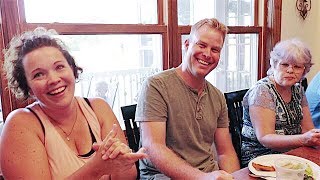
In this vlog episode, host Victor Justin Rhodes visits a family‑run homestead in Gibbon, Nebraska, where former urbanites Anne, Ryan, Jonathan, Catherine and a 70‑year‑old intern share their first‑time experience raising ten Cornish‑Cross meat chickens. The conversation weaves together daily farm chores—tilling with a shallow‑damage power tiller, composting, seed‑starting in a sunroom, and equipment troubleshooting—with the specific steps of acquiring, brooding, and processing the chickens, including the use of a borrowed plucker and the emotional moment of gutting the birds. The family discusses why they left city life to reconnect with land and food, the role of interns and children in learning hands‑on skills, and how they preserve the harvest through canning, dehydrating, and fermenting. They reflect on challenges such as equipment failures, the need for backup power, and the surprise of the birds’ rapid growth, while offering advice for older beginners and expressing enthusiasm for expanding future flocks. The episode ends with a communal dinner featuring the harvested chickens and a showcase of garden produce, highlighting the collaborative, educational, and joyful aspects of small‑scale homesteading.
Chapters
But what I want to do here for you guys is figure out what was it like to grow your first 10 meat birds.
Let's find out.
Good morning, kiddos. Here he is. Somebody's got to work. I got you some coffee, buddy.
Sweet. I haven't had enough.
This? Yeah, pour yourself some in a cup.
Awesome.
Your wife— for your wife too, you got to split it.
Okay.
Okay, Jonathan, where are the interns?
They're outside working.
Okay, I gotta get a shot of that before they come.
Yeah, why don't you go grab them and, uh, catch up after?
Okay.
Good morning. Morning. What you doing?
Getting the tilter ready so I can tilt these beds so we can plant some new seeds in these beds over here.
Power drill powered tiller. Yes, which that does a very shallow till, very minimal damage to the soil. Up and at them this morning. Yeah, what do they have you doing?
Oh, we're composting to improve the soil, getting ready to plant some new stuff in here.
Cool, what are you planting?
I think squash. That's the way that works.
This is—
it keeps falling off.
Yeah, you learn all kinds of trades around here when you're doing farming. You gotta learn how to fix things and everything else. Farmers are jack of all trades. Yeah, yep, yep. Okay, now pull that and see if that'll help control it better.
Okay.
Teamwork makes the dream work.
Excuse me. Is that on?
Working?
Well, yeah, if we can keep it.
It was.
No!
Let me screw it on there for you.
Come on, man. Because I will spend 15 minutes trying to set it up.
You got it?
All right, try it now.
Working now.
Don't let go until you're done. Oh, that's cool. So the rope goes around the trigger.
Yeah, that's cool.
And it goes all the way up to your handle so that you can control it.
Yep.
You bought this?
Uh, he did.
Or did you build this?
Okay, cool. The, the tilters are built.
It's a Johnny Seed.
Working now, guys.
Cool. Thank you.
Why did you intern here?
Why did I intern? Ever since I was a young girl, I've wanted to be on a farm. I never had the opportunity, and so when it came up, it was just like, yes, I want to do it.
Is this your first time opportunity?
Yes.
How old were you when you started this?
70.
Wow.
I just turned 70 in April.
Beautiful.
And just enjoying every minute of it. It's hard work, and there's days when I feel like I might pass out, but I'm healthier and happier, and it's been one of the best summers of my life.
There are many people in your situation actually who email me a lot saying, I'm 70, or I'm 80, or I'm 60, and I want to get started. What would you tell someone in your situation? What one piece of advice for someone who wants to get started at a later time in life?
Don't hesitate, just do what you want to do. Live your life according to the way you want to live it. You know, it's, it's worth every minute of it.
A ton of garlic. Drying their garlic. Hey Jonathan, I was wondering if you had any garlic.
Yeah, a little bit. You guys want some garlic?
Could you come and tell me— Catherine, good morning.
Good morning.
You made a beautiful pot of oatmeal, thank you very much.
None of it's from the farm, but okay.
You didn't grow oats? What are you talking about? So besides working in the kitchen, what else do you do here?
Oh, I start things and I finish things. The alpha and the omega.
And he's the middleman. That makes you the middleman.
No, I say I love starting— I'm sorry, where do I look when you're talking? I love the springtime when it starts. I have the renewed energy after winter, so I'm really excited to get going in the spring, starting all the seeds. We have our sunroom that we start seeds in. You know, we mix our own seed starting mix and start all of our seeds indoors, which then get transplanted outside. So I kind of am the maintainer of that. The kids are helping me with that as they get older, which is great. We incubate all of our own birds here— our ducks, chickens, turkeys, and geese. And so I'm in charge of incubating those and taking care of them inside until they move out to where they're supposed to go. And then I do the maintenance of the house and people during the summer. And then I'm really involved in the tail end, so post-harvest. What do we do with all this food when we're done? We work with the interns and teach volunteers how to can, dehydrate, ferment, whatever, cook food on the tail end. So when it's done, because I love to eat, I love to share the food with people, and it's really fun for me.
Shh!
They're having class now. They not only get hands-on experience, they get some classroom time.
Shea butter or whatever.
And it's just easy to make.
You make it in a pot and then you dilute it with water and Yeah.
Uh, and then backups, you know, like having backup. So the storm came through, right?
Yeah.
And wiped us out. If we didn't have a generator, can you imagine with all that meat and everything? So having backups, but having backups for your backups because your backups fail.
It's that time, guys. Look at all these people we got to say goodbye to.
We'll miss you. Yeah, I know.
Thank you, guys.
You boys have fun.
Good.
Bye-bye, buddy.
Give you a hug now. Bye-bye there, Mr. Brown.
Mr. Brown, you got a hug from him. You win.
Hey, it's awesome to hang out with you guys.
Thank you guys so much. Give hugs, Mr. Brown.
Give hugs.
Oh, he's trying to give her— bye-bye.
Bye-bye.
We've arrived to our destination. We're still in Nebraska on our way to Colorado. It's been great being here. A lot of conventional ag, a lot of soybeans, a lot of corn. So it's refreshing when we get to a place like this. This is that. This is normal people. These folks are vlog fans. When I first get to a place, I try to figure out what's the story that I want to tell. Yes, Lily?
Yeah.
After talking with them, they are urbanites, or were urbanites, who have moved out of the city to the country to be more connected with their food, be more connected with the land, to do something real with their hands. But they just raised 10 Cornish Cross meat birds for themselves. They are feeding us 2 of them tonight. Guys, that's 20% of their harvest.
My name is Anne and I'm from Gibbon, Nebraska.
My name is Ryan and I'm from Gibbon, Nebraska.
Were you guys always from Gibbon, Nebraska?
No.
No. He says that with some passion. No. Okay, well then where are you from?
We moved out here from Denver, Colorado.
Okay.
Hey kids, come here. Heavenly Father, thank you for this food. Thank you, Father, for Good friends and for family, for the place we have here. Look at this plate, guys. Look at this dinner. We're gonna dig deeper into this dinner. You're not gonna believe it. This is a huge collaboration here. Okay, who grew this corn?
Friends.
Friends? Are they here? No, they didn't even get invited. We're eating their corn and they're not even here.
Oh my gosh.
Who grew that sweet potato? My father-in-law. Okay, nice. He's not here either. Oh my goodness. Cucumbers?
Carson's.
Yeah. Cantaloupe?
Mercer's.
Kale? The kale salad. That's you?
Yes.
What a nice collaboration. Now as everybody eats, everybody feel free to eat, we're gonna get the story. We're eating chickens Did y'all name them?
No, not these.
You don't name your meat chickens. Whose idea was it to get the chickens?
It was my idea. We had decided that we wanted to try raising our own meat, and chickens were the easiest way to do that.
We watched a lot of YouTube videos.
Yeah, watched Justin and learned a lot and went and got 10 Cornish Cross, put them in with our regular chickens. So it worked great. They're amazing. Delicious.
Once you guys decided to get meat chickens, where in the world did you get them?
Farm store.
You bought 10. Did you end up with 10?
Yes, sir. Wow, they all did great.
Rookie run. Pretty good. He's laughing. He's laughing. Oh yeah, you know, that's, that's pretty good, right? Yeah. What was your biggest problem?
Um, mostly they're— well, and they're pretty dirty, I guess, so you had to clean the coop a lot, move the coop around. Yeah, yeah. Um, but they were not a problem. Like, I had heard that they were mean or that they were, um, nothing like that. They were great.
Were there any surprises?
The harvesting.
And how big they got. Yeah, how quickly they grew. They were 5 times faster than—
yeah, we had some— the, the, uh, piñas helped us harvest the chickens because we had no idea what we were doing. We're just city folk that moved to the country, and so they let us borrow their chicken plucker, and it was an adventure.
Were you there at the processing with them?
Yes.
How'd they do?
They did great, honestly. They dug right in.
So what in the world was it like to get your hands in those guts for the first time?
Honestly, I felt we felt pretty good about it because—
We had a lot of big time frustration.
Put the hands in there. Get the frustration out.
I think I felt like if I was gonna do this, I wanted to do it right.
I think from beginning to end.
Our kids were traumatized for a while.
Really?
Well, some of them. Some of them were way too into it.
Yeah, that's true.
Way too into it.
But it was fun, you know, getting the kids in there too. And, you know, showing the kids this is where your food comes from. Because, you know, being city kids, they had just never experienced that. They go to the store, they buy chicken off, off the shelf, you know, in the freezer section. And so to see where this comes from, and, and, uh, you know, it was really fun experience.
So let's see if they— let's see, let's see if they pass the test. Where does chicken come from? Either of you. Is that— okay, where'd it come from?
An egg.
An egg. Okay, okay, fair enough, fair enough.
A farm.
He's just looking at me like I'm crazy, like, no duh, right? A farm. No duh, a farm. Good job, Mom and Dad. Good job, Mom and Dad. The final question. Are you gonna do it again? Yes, absolutely. How many are you gonna get next time?
How many should we do?
You should do more than 10.
More than 10?
As many as we can fit in your tractor.
So yeah, you're a family of what? Oh, my tractor, yeah. We're outside now in the garden. This is your— how many, how many years you've been doing this gardening?
2 years.
2. This is pretty good for your second year. Look at this, look at this abundance. This is where we got our cucumbers from for tonight's dinner.
Yep.
The chickens are out. Chicken's supposed to be out. Oh yes, free-range chickens. So after the chicks were in a brooder, they went into this thing.
Yes.
Is that right?
Yeah.
Until they're how old?
Uh, well, I can't remember how old they were, but you know, big enough to fend for themselves against the big chickens.
And then they, uh, went in there like everybody else.
Yep, then they just joined the fray.
Okay, check out their backyard. A pond, a beach. The kids are gonna bring in the evening having a lot of fun out here.