Record-Breaking Abundance (SUMMER FARM TOUR)
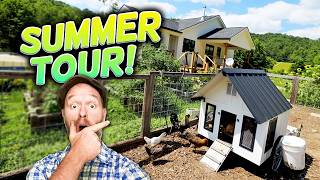
This content was created by Victor Justin Rhodes. This content was uploaded by Victor Justin Rhodes. This is a YouTube summer farm tour vlog titled "Record-Breaking Abundance (SUMMER FARM TOUR)" (created 2024-07-20). The excerpt is a single-speaker, first-person homestead tour in which the host walks through their property and describes crops, livestock, storage and processing systems, and ongoing homestead builds. Topics include greenhouse/high-tunnel production (tomatoes, onions, beans, pumpkins, winter/fall planting), brooding systems and poults (chickens and turkeys), deep-bedded pig and composting systems, cattle/sheep management, root cellar and freezers, canning/processing plans, tools and design ideas (ChickShaw, pig port, turkey shaw, "pretty shawl" coop, homesteadbuilds products), and practical husbandry and garden tips (drip irrigation, trellising, temporary fences, swales). The host references family members (e.g., "Beautiful One," children), gives product/book launch and sale information (Homestead Builds, Book 1 and upcoming Book 2, sales starting July 22), and offers hands-on how‑to and promotional commentary throughout.
Chapters
Absolute abundance this high summer day in Western North Carolina. Welcome to the summer tour edition. This is our biggest year yet in abundance. We sought to quit the grocery store, big goals, and I've learned aiming for the impossible, extraordinary things happen. There's been no exception this year. Sunflowers galore. You know what, I'm gonna get to this chicken coop, raised beds, a little bit of the home— new homestead build in just a second. I have a very special place I think we should start. Should we start there? I mean, that wouldn't be a horrible place to start. The greenhouse? I'll start here, then we'll go to the very special place because I don't want to forget. Oh, I don't want to forget either too. We just some new arrivals, which is unlike us to have new poultry in July. But anyway, I'll explain, show you that in a second. We planted an excess of corn. The neighbors are gonna get a bunch. Pumpkins, I will show you in a minute. We have this amazing plan for pumpkins this year. This was a little ambitious. We've ended up scaling back since then. I like to fill a lot I like to fail small. So Beautiful One has this idea for this amazing pumpkin trellis, and she was going to do all 50 feet of a garden bed row. And then one day she was like, well, should we do all 50 feet and just— or should just do a little? I'm like, yeah, we should just do a little bit. We've got the onions coming on in the spring. We saw it on Instagram the other day, uh, behind every woman's dream for her beautiful garden space is a very tired family. A beautiful one, totally deserves it, uh, has a vision that we all love and appreciate. But anyway, what I was saying here is same things you, you would plant in the spring, you can plant now. The winter harvest garden, the fall garden crop, you plant now. July and August is one of the most underrated gardens because yeah, we protect it a little bit, we get it, you know, the bugs off of it now, But once it gets in the ground, you know, come Thanksgiving, nothing's growing anymore, but it stays fresh. We just cover it with Agribond, and you can harvest it throughout the cold months. And there's no weeds, there's no bugs. It's really an underrated garden. Everybody else is quitting and calling it a go, you know, calling it a season. You, you could just get started, so it's not too late. We just got some excess flowers. I don't think anything's gonna happen to them. We'll have a ceremony when we throw those to the chicken. Beautiful, love plants so much. I wouldn't be surprised if She started having ceremonies for some of these excess things we need to throw out. Some of the stuff we just didn't get around to it, didn't need to it. This is extra. Hey, you want to show them the turkey poults? He's got new chickens, 2 or 3 batches a year since the day he was born. It's not always the most exciting thing to us. Oh, we got turkey poults! We got turkey poults! Because unbeknownst to us, out in the field, a hawk were getting some of our turkeys. We're down to 10. We had 120, so we started again with another batch of 20. They sent 21, 2 died, so we're already down to 19 again, but we have 10 healthy ones out in the field. We'll go, we'll make sure we go see those. So turkeys on a deep-bedded brooder situation, their bedding has filled up pretty much 18 inches. This is going to be putting off some heat because of the carbon and then the nitrogen from the last batch. It's going to be warm. It's gonna keep them warm. We have them in the hover brooder back there. They've got water, feed. This is our catch— this is our feed catch. People jump up on that, dirt, dust falls through to the ground, and it keeps their water and feed clean. Guys, we have plans for that and brooders. Most people aren't going to have a stall. They're going to need to convert because we do like 100 batches at a time. We have developed trough systems, toe or trough systems, whether you want to do 25 chicks or up to 100. And then we've got custom covers that you can build and put over those troughs. And the cool thing about using totes or troughs— yes, oh, don't let them drop! Boy, those turkeys are adventurous. The cool thing about totes or troughs is after you use them from a brooder, take that tote or trough, clean it out, turn it into a kiddie pool. I mean, you're only using it for a brooder for a little while. You know, multi-purpose everything. They're doing very well. That's a good sign. Okay, shut the door. Let's go. Dirt Trap and Brooders coming. Homestead Builds sale going on July 22nd through the 27th. Digital version is done, print is coming, but you got to get in now if you want yours by Christmas. This is where I wanted to start. Perhaps I could have stayed down here, had this shot, but the kids need to clean up the shop quick. Don't look, don't look at that. Anyway, this will do. Wanted to start here because chest freezer, upright freezer, this is where a lot of the abundance is underneath some of that boughten tallow supplement to add fat to some of our beef harvest is chicken. We got probably 100 chickens in there. I don't think we've had to buy chicken since 2018. 6 years. Where? At the grocery store. When? Yeah, when we're— yeah, okay, come on now, fact-checker. When we're traveling. Okay, yeah, we just harvested 3 steers between the last tour and this tour. Let's show them. Let's hope it's not gotten unplugged. It has not because I checked it. Okay, we test it a couple of days. This is just one steer, guys. We had 3 of them. We got burgers, we got steaks, we got roasts, we got bones. Look at that, bones. We got lots of burgers, burgers, burgers, more bones. We have 3 more freezers. I'll spare you up at Big Daddy's. We will have pigs at the end of season, and yes, a couple more steers. Let's go in our house. I'll give you a little bit of a tour of the house. We'll save the house tour for another video. We're almost done. We're in the home stretch of this thing. We have this freezer room, so pretty soon— well, there's going to be a freezer. Stop touching everything. Get in. It's gonna be a freezer right there. 1, 2, 3 freezers there, and an ice machine for cooling off chickens and a butchering, things like that. Stop, stop touching everything. Stop touching everything. This is relevant. This is, uh, our farm kitchen, garden kitchen, whatever you call it. Come on, Gideon, we're coming this way. We're not going up. We've got a step. We'll have a cook stove there. We already got our sink in. You can see it's not gonna be as fancy. We just had a custom 2x4 frame built, but we do have a big sink. We do have a nice faucet for washing veggies, canning, processing, prepping things for freezer. All kinds. Farm washer, dryer, and sink. Oh my gosh, that's going to come in clutch. We think we're growing a lot this year. Wait till next year and we're established in this house, then I do think we'll quit the grocery store. So why did we not quit the grocery store? I mean, we almost have. I mean, right now we're just buying sweet fruits for the kids. One reason is our local co-op, which is like a grocery store, doesn't spray a peel on the produce, doesn't use the Clorox and the veggie spray water, and sources local and seasonal. That's a great supplement for us during the stress of, of this build and living in a 700-square-foot house during this time, not having a lot of room to process things. We just took our pressures off ourselves. But I'm glad we aimed to quit the grocery store because we've done so much as a result because we've got so serious storage up above there. I'm really excited about this because, yeah, you can use it from in here, but watch out. Look, you could have just walked right in, never had to take his shoes off. Not that he ever wears any shoes. Uh, you can just come in and go to the bathroom. Don't even have to get out in the weather to go into this root cellar. Double layered, so one layer of cool here. Bring that camera again. I'm excited to show you. We have 100 pounds potatoes, 200, 300, 400 pounds of potato, and a little bit— some extra seeds, pasture seeds. We store our bulk maple syrup here, just empty cans ready to be used for canning. I imagine next year we're gonna get big time into— well, this year we're gonna have to can You're gonna have to see what we're gonna have to deal with with our tomatoes. Just like we haven't bought chicken in like 7 years, we didn't really know when that first moment was. Same thing with like milk cows. We have 2. We, we've had milk every single day for like 5 years, raw milk. I think we're gonna have that moment with tomatoes this year where we're gonna look back to 2024 and say We've never had to buy tomato sauce. Not that we're gonna have enough tomato sauce this year for the rest of our lives, but we got our system down and we'll be replenishing it every year for the rest of our lives. The onions you saw in the last tour, the garlic is on our produce curing rack. It's also available in Homestead Builds. This started out as a— this was just a screen door. Hey, let's put some legs on a screen door, two screen doors. And call it a drying rack. It worked. And so we said, okay, let's make a nice 2x4 version. Super simple drying on 1/2-inch mesh. This is probably one of our most simple builds. Is there a bee's nest on this already? A little one. Goodness. These are curing nicely. We'll braid them and put them up. We're gonna have more than enough onions and garlic. We're gonna get us a freeze dryer sometime. I'm gonna— soon. And we're gonna start making our own garlic powder, onion powder. We're planting more garlic. Oh, that— those onions that you saw in the greenhouse are going to be for the fall garden, and they're— they are storage onions. These are— we need to eat them kind of before the fall kind of onions. Got a little pole bending project for our pumpkin trellis. We'll get to that in a second. That's— that's brand new, one of the things we're trying this year. I'm very excited about it, by the way. You're seeing this on Saturday. I'm actually filming this on Thursday. I'm gonna be doing a vlog on finishing that on Friday, so this is gonna be a little meta, you know. You might, you might see that unfinished in this tour video which comes out on Saturday, but you might see us working in it on a vlog on Friday. So you might be seeing it get finished on Friday and then you're seeing it unfinished in this vlog on Saturday. It's gonna be a little meta, but you'll be all right. We have nailed our system in here, okay? We have nailed it. I mean, look at these tomatoes. Proof is in the pudding, okay? We're gonna go through, and this is gonna be our fourth batch of hard— look— of harvesting green beans in here from these bush beans. Like, how many are they gonna give us? I guess more, because here's flowers. They're gonna give even more. What we did in this high tunnel, we had wind, we had chickens on it all winter on wood chips, and so they manured that, stirred that in, and compost naturally settled to the bottom. And what we did different this year was in the spring, instead of just leaving it there and using that, the top part that was still wood chips as mulch, it didn't really work out that great. It's hard to hoe, weeds still grow up. We took the machine and you could do this by hand on a smaller scale. We took the wood chips off and we put them to be composted, and it left the supple compost material that we built into beds. And then we brought in some more compost to add to the beds, which I don't know if we needed to do, but we did it. I'm glad we did it. It's maybe some, some security. We got tomatoes there. I'll walk a little further over here so you can You can see our peppers. We did drip irrigation because tomato plants do not like their leaves to get wet. That, that's when they can get the, the blight and things like that. So we're watering from below. Beautiful One's kept them trellises. Beautiful One has kept them pruned, and we're just gonna have gallons upon hundreds of gallons of tomato. Sauce. And I just used tomato sauce today in a taco chili, and we use it in spaghetti. Get this mega weed out of here. We use tomato sauce a lot, you know. It helps us enjoy our meats, our ground meats, especially the older ones like Stud Muffin. Older— we got a lot of ground meat from him. Getting— you want to throw this to chickens when I get there? That's the high tunnel. I feel like we've perfected it. We're going to repeat that exact same process next year. Crop garden number 4, we have corn growing, sweet potatoes, and cucumbers— no, um, cantaloupes. We have our trellis, and I'll talk about it in case you're coming for the tour and you didn't see the vlog. I've actually used the pig port— we'll talk about that in a minute— to create 3 more garden beds here. There's 2 garden beds there, and then there's 2 there, and we have a nice row between. Supposedly Sally, our side-by-side, is narrower than 6 feet, so we could still get a side-by-side through there. We'll see. We're gonna build beds after the pigs. All we're gonna do is broadfork where the bread is— bed is going to go after they've tilled for us. All we're going to do is broadfork, which is a deeper aeration, um, without flipping the soil, so it's not tilling. Then we'll add compost to build our beds. We'll show you in a minute how we're building our compost, how this kind of compost— I think it's gonna be super easy. And then pumpkins, pumpkins galore. Cattle panels going over this. Forgive me if you saw this yesterday in a vlog. Be planting gardens there. Tarp is keeping it covered and weed-free right now. The idea is that pumpkins grow over into this romantic shade. We'll get this vertical space too, which means instead of planting pumpkins every 5 foot in a row, maybe we'll be able to plant them every foot or two because they'll sprawl vertically. We'll take advantage of the unlimited vertical space. But I'm really excited about this. I've taken the pig port, which will be in Homestead Builds Book 2. Yes, there will be 2 books. Book 1 is available now. But we're going right to work on book 2. Not only could you park this and just give them deep bedding and build compost with pigs, you could actually move them around and then till the garden for you. Look, they've tilled all this garden. Takes them a few days. Wet it down to speed them up on it. Look, that one's eating the grass. That one's getting a rub. Move this along every few days. I keep it tarped. It makes it even more supple. Worms start to work it, keeps weeds from growing and establishing again until the whole thing's done. And then we'll be able to build the beds all at once. It just so happens it's a perfect size for 3 30-inch market size beds with a foot path between them, 1 foot in between. They're gonna go there next. They're gonna just park there next to the gardens, and we'll put them— we'll put them on wood chips in there, add wood chips every day, and we'll feed them our garden waste and they'll help us build compost right next to the garden. Look, we've used the pile of compost that they left us in the last pig port situation. Look here, I'll show you. We've put it on our bed. It looks like our squash is suffering because of the heat right now. I think some of these weren't pushed in all the way good, and they're, they're in blocks, and so they're drying out. Crop garden over there, that's the high tunnel bedroom there. This is our backyard. Papa Pig here on deep bedding, always deep bedding. Animals need to be either moving regularly, or if they're still, they need to be on deep bedding. Wood chips are great, they absorb their manure, they absorb their urine. Mama Pig, we've weaned her piglets, sold most of them. The other 3 we kept are doing their job, tilling us a garden bed. I don't think there's too much to say about them that I didn't say in the spring. Right next door to them, chickens not doing much. It's very hot out here right now. It was cloudy and nice, that's why I started this tour, and now it's like, oh my God, why did I start this tour? Case in point for the 26-inch tires on the ChickShaws. Don't be cheap there. Too many people being cheap there and getting 20-inch wheels. Don't do that. Why? They are all underneath getting out of the heat. They don't like to be in the coop, they like to be underneath, and the 26-inch wheels affords them that luxury. Affording them that luxury is going to cost you money, but it's worth in the long run. Husbandry 101: keep the animals happy. And they want to be in the shade. 20-inch tire is too small for them to get under, and then there's more ventilation, so they're not like under a blanket. But anyway, they're making compost. This is fine. We're already using that, uh, it's already pretty much finished. So that's what we'll use to make our new beds. That's what we'll use out in the field on some of the poor pastures. We're going to take bedding from the pigs, build up a pile, and the chickens are going to have work to do again making compost right next to the To the grain-dependent animals, we have our grain barns. Do you really see a barn around here? No, not really. Barns are overrated big time on the homestead. Lean-to off the house. I'd put it in the garage if the beautiful one will let me. She wants to finally park her car in the garage. I can't blame her. Right here, zone zero. You're coming out of the house, you're going downstairs, and then you— this is your central place, and you, you go off over there and go off over there. No sense in coming out of the house way over yonder to a barn and then that being your central— you're going to wear yourself out. No wonder we're burning out. Put the barn in, in a shed by the house. We have covered this drain for when the animals accidentally get out. They can't get in here and get the grain or the alfalfa. We've also put a fence up and around the crop garden in case the animals get out. Another big mistake homesteaders make: oh, gotta build a barn. No, you don't. Just get a— but just, just start in your garage. Start with a carport where you think you would have a barn. We'll start with a shed right off the side of your house. If that stays there for 3 years, then maybe build something permanent. Same thing with fences. Besides perimeter fences that are protecting you from a major road or neighbors, put a fence temporary. 3 years, it hasn't moved, then you could start thinking about a more permanent situation. I guess give me a ride to the, uh, to the livestock. Okay, you got those? Yeah, the big, big animals. Oh, you can drop me right here. I almost forgot. How could I forget our Zone 1 garden? I was supposed to come upstairs from the basement and out. All right, so pretend I've come upstairs. I did want to show you this before we got out. We've put in a hearth. Doesn't that look good? All right, so let's go out. Brand new ceramic doors. Cannot wait. This is, this is already cool on this back porch. Out of the sun. We're gonna spend a lot of dinners out here, summer dinners here. We got a fan, we got a nice view of the garden, crop garden out back. And wait till you see this view of the front garden. I'm sorry, the hair is not cut, it's a little, it's a little bushy. But boom, our raised bed gardens. I feel like I've covered them a lot. We got some Beautiful one loves her sunflowers. They're raising up nice. We could just talk about what has come in. Harvested a lot of zucchini off of this. We've got some onions ready. The idea of the kitchen garden is just come out, pick a little something for lunch. We've got some spices, peppers, cherry tomatoes coming in. We got some bush beans. Yep, just pick a little something. They're ready. I need to let her know that. It's funny though, because we're living across the street, but our front yard is over here. It's a really weird situation right now. More herbs for the kitchen, more squash and zucchini. I learned you cannot prune squash. I saw some of these leaves dying and I cut them, and now the whole plant's dying. Whoops. If you have permanent gardens, it's not a bad idea to put permanent chickens next to them, throw the— this now dying plant into the chickens on deep bedding. What they don't eat will compost. We'll eventually get— harvest the compost out of there, feed the chickens with it. Oh, I gotta definitely show you the pretty shawl. So pretty. You guys can stay, I won't hurt you. I'm not gonna eat you yet. This pretty shawl Beautiful enough for the front yard, beautiful for the HOA. Matches the house— black roof, white trim. I love it. It is in Homestead Builds. It's one of the last ones. Was it the last one? I think it was the last one of 12 designs available now at Homestead Builds. Well, July 22nd, but all you Kickstarter backers should already be in your inbox. So thank you, thank you guys for backing that project. Yeah, it too is on wheels. Even though it's in a static run, you can move it around every day, and that's how I clean out the coop. Poop falls through the floor right onto this material, and I rarely ever have to clean out a coop. The pretty Shaw everyone, with proper ventilation. I'm noticing people are inside this one, so maybe it's a little cooler than the chick Shaws. Back at our temp house, the original farmhouse. We have turkeys in the yard. They're big enough to not get got by the hawk now. Chicken tractor has come in clutch because we could just close them in there and they've been completely safe. That's our staple build, one of the most versatile chicken coops available. They're ready for the turkey shaw. Turkey shaw. Turkeys do not need a solid roof, so they just have a shade cloth. They do not need walls. This is modeled after Joel Salatin's Gobbley Go, which will hold like 600 turkeys. I modified it down to basically a 4-foot cube that will hold 20-24 turkeys. Okay, go ahead. You don't have a chicken tractor. You can keep the turkeys in the brooder until they're old enough to stay in a poultry net. All right, what do you think, guys? You could put them out in this, in a net, just as soon as you think they'll stay in the net. I don't know, about 6— 4 to 6 weeks. 6 weeks be better for avoiding hawks. One of these days we'll just take out the coop when we get around to it. They'll probably start preferring to sleep out here, uh, it's cooler, they can perch higher. Turkey Shawl available July 22nd, homesteadbuilds.com. Heart of the homestead. We happen to right be next to the road. Following the cows with the sheep. Some of these littler sheep continue to have some problems getting away from some of the bigger cows, so we're making it a habit of just running the cows— or the sheep behind the cows. The thought was, well, we'll let the mom and the youth— we'll let the mama and their babies in here. They're nursing, they'll get a little more choice grass, but it's not working out, so we'll just keep the sheep behind the cows. Fortunately, nobody else has gotten hurt, but we have had somebody get limp, but they're on the mend. Looks like Lily just fed Blaze. Cows ahead of the sheep, getting their more choice grass. They're our centerpiece. Everything on this farm revolves around the cow. You can see the future here. See how they're getting around that locust tree, how they love it? Yeah, that's what we've planted throughout the pastures everywhere with our fruit trees. And then down here lower, our locust and maple trees here in the frost pockets. Eventually it'll be all that. It'll be a savanna through here and we won't need the milk sled, we'll just need a mineral sled, and the animals will have their shade no matter what paddock they're in. I'm excited. This didn't seem to be too affected when our steers went up and over and ate this. Kind of came back even better. In a paddock, we come in with the electric net and we go around this and protect it even better. But this peach tree is thriving. It did not kill it. The cows getting to it. I'm gonna hike, y'all. House way back there. Fruit trees up here above the Frost Pocket all survived the cow attack last fall. We dug out these pathways to serve as swales, to serve as pathways to be able to get out here on the steep 30-degree slope. Ask anyone who comes here, they're like, this is a lot steeper than the filmmaker— this is a wide-angle lens and it just doesn't capture the steepness. Quite like real life. Hear my breath. I'm going to show you the 2 acres that we cleared this winter. We're gonna see how it's doing. Of course, the upper side is a little more weak. We've been protecting it, haven't let them graze it. We wanted to go to seed and maturity and kind of build up and reestablish itself. And it is— here we are, all new. It's all new grass. It's coming to seed. That's more seed for the grass. People are wondering, hey, when you're gonna hit this? I was wanting it to get to maturity. We're gonna skip it. Actually, I think it might have gone to maturity. Don't want to hit it too soon, could damage it. I think it would benefit from a graze. So we graze this, maybe hay bomb in some places. I think it could do us good to get some cow hooves on it and some manure. We skipped it the first round, and I think skipping it once has been enough. But look at this, all this was forest over the winter and we cleared it. We're gonna pasture our forests and forest our pastures. Absolute abundance this high summer day. I couldn't do it without those bits. Some of the builds— the sheep shawl over there, that needs to actually go down to the sheep. I think they're out of the woods now and need their shelter. The sheep shawl is the meat shawl now, which is in book 1. Uh, just to turn into a sheep shawl, you just add minerals to the axle. All these builds available June 22nd. Waitlist at humpdubbuilds.com.
More from Justin






If I had to start my Homestead all over again, it could only pick one animal… 




