Rescuing Sea Turtles (From Trash)
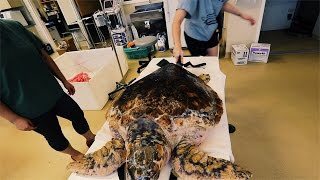
Victor Justin Rhodes visits the Loggerhead Marine Life Center in Florida to tour the sea turtle hospital. The video shows injured turtles like Waffle and Burt Reynolds recovering from boat strikes and fishing line, then follows the group to a neighborhood picnic where they reflect on growing up in West Palm Beach.
Chapters
It's another beautiful day in Florida. Well, kind of beautiful.
It feels amazing.
For the Sunshine State, we are missing some sunshine right now.
Lots of cloud cover.
It's not gonna stop us from seeing some things. What are we gonna do today?
We are going to Loggerhead. We are going there to see turtles, and it's like a refuge, I think, for turtles. I don't know. I've just heard from lots of people that we should go there, so I mentioned it to Kristen. She's like, oh yeah, it'd be great. So that's where we're headed.
Say hi, Galaxy!
Can't wait to get in the water!
They've rescued these turtles from any number of things. Some of them have gotten tangled in rope, some of them have swallowed fishing line, others have been attacked by sharks, others have been ran over by boats. They heal them, they give them a place to rest. They've got a little hospital in there. They heal them and then release them.
Get in. You see the turtle?
Oh, he just woke up.
He got confused when I told him that the turtle's name was Lily.
He was like, "That's 75 pounds!" That was all wrapped around this turtle they're calling Burt Reynolds. Is Burt Reynolds gonna be okay?
I think he will be okay.
How long is he gonna take?
It could take him anywhere from maybe 4 months to a year.
How will you know when he's ready?
The veterinary group here put him through tests, medical tests, checking his blood work to make sure he's healthy inside. And then most likely they will put him in that large tank, the deepest tank we have over there where Squash is now. And they put real food in there to see how quickly he can catch food and react in natural behaviors.
Why'd you call him Burt Reynolds?
Because Burt Reynolds is beloved in this area. He is a longtime Jupiter resident. Oh, he's done tons for the community.
Oh good. Do you have his autograph here for this turtle?
He He actually knew that we had a turtle named for him, and he came after closing one night and wanted to see the other Burt Reynolds.
Yes.
Yay!
The hospital where all the action goes down is in there, but they don't let people in there, so I'm trying to see if I can't get some permission. That one was hit by a boat. Just got permission to go in here. I just gotta wait on the host. Yes! We get to go in there!
Right now they are measuring Waffle.
Okay, 67.8.
Depending on the turtle, there are different steps and treatments that they do every day. Waffle has a skin infection that they're working to remedy right now. Treat the skin infection and— Sick or injured sea turtles is what we rehabilitate. So some could come in with boat strikes, some could come in with monofilament line inside since we've seen a lot of plastic pollution and plastic problems in our hospital, which is not just our hospital, unfortunately. Single-use plastics and all sorts of plastic pollution have become a real problem in our oceans and for our ecosystems. And that is why we are working to educate our guests about that and the importance of reducing your use of single plastics, you know, bringing a reusable bag with you wherever you go, eliminating water bottles, plastic water bottles, from your daily routine and just taking a, you know, a can with you or some sort of reusable water bottle.
How'd she get so dirty?
They have very shallow tanks out there, so the algae grows pretty quickly.
How would they clean themselves in the wild?
Well, in the wild, you gotta think they're in the deep ocean, so they're not towards the top of the water as much where the sunlight can reach to have the algae grow. And also, they're constantly moving out in the ocean.
So we are in Loggerhead Marine Life Center's sea turtle hospital. Hospital right now, and as you just saw, we were scrubbing down Waffle, one of our rehabilitating sea turtles. This is another tank where we sometimes will keep small juvenile green sea turtles if all of our capacity, all of our tanks are filled out there. We also sometimes have post-hatchlings in here or hatchlings that are rehabilitating that washed back because they weren't strong enough or they were disoriented and couldn't make it out over the waves during nesting season once they had hatched. This is where we conduct our blood research, our blood research laboratory, our pharmacy. So always medications, which might look like your medicine cabinet a little bit. This is where we conduct surgeries if we need to. For example, if there's a turtle that has accidentally swallowed a fishing hook that's lodged in the esophagus and is stuck and the turtle can't pass it on its own, surgery may be needed, so this is where that would be conducted. We're right here in front of our high-definition digital X-ray room. We're able to find out, like I said, more about what's really going on underneath the carapace inside the turtle. If there is a need for surgery, we're able to really see where, say, monofilament line or a hook or a balloon, some piece of plastic— again, if they can't pass it on their own, maybe we would, we would administer surgery. We have a shelf here that shows just some of the sea turtle patients that we had had here at our center with different items that were found inside of the sea turtle. So this hook, you can get a good look there, that was found inside Elsie, a subadult loggerhead sea turtle, and this fishing hook was removed from the esophagus. We're working really hard here at Loggerhead Marine Life Center to ensure that people know the damage that can be done, but even more important, what can they do to reduce that damage and what they can do to help. That's what we're doing here at Loggerhead, helping turtles like Waffle and just teaching people about the importance of these animals in our ocean ecosystems.
This one has suffered from a shark bite. You can see that it's missing its fin. Will this one make it back out to the wild?
Yeah, besides the fact that the turtle is missing the right front flipper, the turtle should be able to survive. And once it's medically cleared— by the way, this turtle's name is Scallywag because obviously kind of like a pirate missing a, missing a hand, if you will. This turtle, once it's medically cleared, should be all good to go.
What a great tour. What a great thing they're doing here. This place actually has a free admission. They see 300,000 people in here every year. You can come see a turtle release. You can come and see this. I'll leave links for all this stuff down in the description. Now to find the family. We're supposed to be eating lunch around here somewhere, having a picnic. Oh, I found them on the playground. We just had a great lunch. Walking back to the car through this little nature trail thing. We're about to go to where the beautiful one grew up just west of here in West Palm Beach and see her old house.
This used to be all— palm trees. Wow. Now it's developed. Krista lived down that road. That's the road that Krista lived down.
And you said this used to be just a two-lane road.
This was a two-lane road.
Now it's—
It's crazy how built up it is. So developed.
Horseshoe Acres.
Horseshoe Acres.
I should have gone closer. When we lived here, there was no passcode. It was just— you just drove into our neighborhood. I don't think we had light posts though. I think it was just— I had some friends that lived down that street. The houses look almost exactly the same as when we lived there.
Why'd they call it Horseshoe Horseshoe Acres. Why do you think they call it Horseshoe Acres?
They called it Horseshoe Acres because it was a horse community. There were people here who had horses. That was primarily.
Look at that huge house going there.
Oh my gosh.
Is that your old house?
No. That thing is massive. All the houses were like this small. Like, they weren't like these massive houses.
How many buses could we fit in that mansion?
So this is our house right here. This is the house.
Slow down. That's it. Yeah.
So this is our house, but we had—
the trees have grown up a lot.
They have, they're huge. But we had a fence surrounding all this because we had horses, and so it was pasture, but all the fence is gone.
Wow.
They had a huge—
look, babe, coconut. Oh yeah.
Wow, nobody has horses here. It's so strange to think that. There weren't like everybody have horses, but a lot of people had horses.
Does that bring back good memories for you?
Yeah, I had a really great childhood. Childhood, and I, I had a great life in that house. So yeah, it was good.
More from Justin






If I had to start my Homestead all over again, it could only pick one animal… 




