See the Greenhouse that Saves Us Thousands in Garden Plants
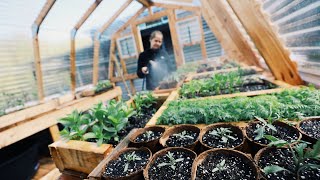
This content was created by Victor Justin Rhodes. This content was uploaded by Victor Justin Rhodes. This is a YouTube video titled "See the Greenhouse that Saves Us Thousands in Garden Plants" (created 2020-05-03). The clip is an interview-style greenhouse tour featuring Rebecca (the primary gardener) and a host/interviewer labeled as "Speaker A." They discuss why the greenhouse is used, construction and modification details (modified Anna White plans, cedar interior, vents/solar openers, possible concrete floor, shade cloth), seed-starting workflows and equipment (soil blockers, biodegradable trays, heat mats, potting mix), a detailed inventory of seedlings and varieties (lettuce, tomatoes, peppers, sunflowers, zinnias, marigolds, pumpkins, cucumbers, watermelons, herbs, beans, squashes, etc.), germination issues, and cost/savings estimates (greenhouse ~ $3,000; plant-value savings estimated at $1,000–$2,000+). The tone is practical and instructional, focused on small-scale market/garden planning and hands-on tips.
Chapters
Tell us, the beautiful one. Yes, about your greenhouse. Give us the full mega tour. First, why a greenhouse, or what are you using your greenhouse for?
So mainly I'm using this greenhouse to start plants to transplant out into for, for us to then garden.
What's the advantage of that?
Um, well, it's a central location to start all your seeds and have everything that you need for that. And you don't have to be, um, like starting them indoors and— or a smaller greenhouse, I guess.
You get a head start on the season because they can be growing in here and it's frosting outside right now, right, when they couldn't be growing outside.
And they get the right amount of light. Yeah. So it's overall the right—
Okay.
Um, climate, temperature, sunlight for them to get what they need, and you don't have to really fuss a whole lot. I mean, you have to do some things, but it's not like intensive as if you are using grow lights. Yeah. That's a little bit more intensive.
So we're going to talk about the stuff that you're growing in here, but, but first, just to get it out of the way, people are wanting to know where did you get these plants?
Okay, so I found these plans online at Anna White. Um, if you just Google Anna White—
we can leave the links in the show notes too.
Yes, we'll leave the links in the show notes. Okay, so we modified the plans though, so we made it longer. It would— it would— I think it would have stopped it here, so we made it, um, a couple feet longer. Yeah, we added in vents I got the vents and the solar openers at Charlie's Greenhouse. You can get different sizes, and actually that's something I need to do. I need to order 2 more vents for right there. I haven't done that yet.
Yeah, the problem is it gets too hot.
Yeah, so in the summer— so in the summer, yeah, it gets too, um, it gets too warm in here to start your fall crops. So, um, so you need to do that in July, correct?
It's like 180 degrees in here.
Very hot in here. So um, we, we have those plants. And then I also bought a, um, a shade cloth that reflects the sun, but it lets light— it lets light in, it reflects the heat. Sorry. Um, and so that's actually— I got an email that that is on its way.
Oh good, because it was custom.
So yeah, so it was, it was a custom.
Okay, so, so, um, what is these plants?
Yeah, so, well, I should say this. We used cedar on the inside. Yeah, because it is rot resistant and there is a lot of water in here. Eventually I think I do want to hook up some sort of misting system too so that they get automatically misted. That's like years away, but it's something that I would like to do. And then these tables are all cedar, and eventually maybe one day too we'll like rig up some sort of shelf up here. If I need it. Justin's like, no, no more!
It's stacking up in here, isn't it?
It is.
There is a problem. We do have some weeds coming up through the gravel.
We do, and um—
And I think I realized yesterday what for sure we did wrong.
The weed cloth, the weed barrier.
Yeah, we used a Jerry weed barrier.
Yeah, the weed barrier wasn't a strong enough weed barrier.
We've recently found a much nicer one.
I think what I want to do in here, which it's gonna be like a lot of work, but I think overall it will be really nice when it's done. And I need to talk to my parents about it because my dad used to do this, but I want to put concrete on the floor. And I think that would be good too because it would hold the heat in.
You're really grinding it into me, aren't you? You're really just—
My dad did concrete. That was his, that was his like specialty.
Next thing you know, we're gonna have heat and cool in here.
No, no, but eventually I want to concrete this. I want to put some concrete in some other places too. Maybe our driveway, things like that. First I'm gonna talk about the trays and how what, how we grow, what we grow in them. So this year I experimented with these. They're compostable, um, trays that you just put soil in and then the seeds. I found that I don't really like them. I definitely prefer the other way that we've been doing it, which is soil blocks. So this is a— you can get in there.
Why do you not like them?
They fall apart and They're just— It's just harder when like, I didn't have great germination in this one, and then I'm like, I feel like this is all the waste. Okay. Because it didn't, the seeds didn't germinate for whatever reason.
Okay, so—
It just, I just, and they don't fit as well in our trays that we already have.
So just explain then, you don't have to show, but just You have your soil blocker?
Yeah, so I have a soil blocker. I have—
it's one piece of metal.
Um, our soil— this is our soil bin. Yeah, you go in and you, you moisten that. Yeah, it's kind of— yes, this is the potting mix, store-bought. There's that. Okay, it looks like— and then here, I'll just do it right here. And then—
yeah, good. You fill these up. These are wooden trays that you've built to just accommodate it perfectly.
Yes, I built them.
Yeah, I said you.
No, I didn't build them. You built them. That's why I'm laughing.
Oh, I built them?
Yeah.
So, okay, thanks for the credit.
You're welcome. They fit, um, 36 blocks per tray, and then I just use masking tape to mark what it is, and I kind of tell, like this one, this is lettuce, Cimarron romaine in 3 rows, and then it's buttercrunch in 3 rows, and it's Jericho lettuce in 3 rows. So then that just kind of tells me what I need to know. I have, um, obviously different degreeing levels of plants in here. This, this is straw flower, um, this is flowers. We got straw flower, cosmos, and snapdragons. They're all ready to transplant out. We're just kind of waiting on the weather to get a little bit better. Spring just trying to hold on for as long as possible. Um, these are tomatoes, and let's see, I marked each one of these.
You did put those in the biodegradable?
So I did. I up-potted these to the biodegradable because it's a little bit easier with tomatoes, um, and peppers. I pot up the ones that maybe need a little bit longer in the greenhouse, like tomatoes and peppers. Um, or, um, like if a zucchini gets too big, or I— or like it was kind of, um, some pumpkins that I, I planted, really big pumpkins, they were outgrowing the, the plants around them because they got so big so fast. So those I kind of— I did that with. But here I didn't have good germination with my sunflowers this year. This is the first year I haven't had good germination. Um, so I have velvet Velvet Queen on this side and Lemon Queen on this side. I only got one Lemon Queen and I only got three Velvet Queens. Um, oh, it looks like I might be getting another one of the Velvet Queen, so I don't know what happened here. I up-potted my peppers, so I have four Big Reds and then the rest were Orange King. I— Orange King really came through for me. And this is another Big Red I need to put over here that I— that came up. Sunflowers. This is the teddy bear sunflower, so they're kind of small, and again, I didn't have good germination rate. I only got like 6. Sad. Marigolds. These 2 trays are full of marigolds. I love marigolds. I just love— they're super easy to grow, although I didn't have great germination rate either on this tray for whatever reason, but my lemon gems— smells so good. Can you smell that from there?
Mm-hmm.
You just move it, and it's so nice to walk through the garden in the summer and just smell that. You kind of walk past it, and if you brush it or the wind is blowing, you can— it smells actively. So it's just a really fun— actually, I planted some more of those. Um, this is zinnias. This is what I already transplant a part of this tray, um, out next to the chickens, and I'm gonna plant more of these soon. I'm gonna plant these soon. Um, let's see. These are tomatoes that I up-potted. I had some, I got 4 Arkansas Travelers and 6 Giant Bunch of Grapes, which I'm extremely impressed with these seeds. These seeds are from like 2015 and they all germinated.
Next table.
Okay, so these ones I just actually seeded not too long ago. This whole tray is zinnias because I didn't have good germination in my other zinnias that I planted. And then here I planted parsley. I need more parsley in my life. Um, I planted daisies and then more marigolds. So this is Aztec marigolds and this is daisy flowers, and then one little line of parsleys. Okay, so these zinnias are coming up, which I'm very excited about. I already got some good germination going on in here. Yes, I love zinnias in the garden. There's just something about the beauty. I just love flowers and vegetables mixed together. There's just something about it. And I feel like it doesn't take that much extra to plant flowers in with your vegetables, and it just adds joy. And then you can cut them all summer long, and it's just beautiful. So this is calendula. This obviously I didn't have good germination rate, but what I did have good germination rate is, is already in my herb garden where keep them. While I didn't have good germination rate here, um, I had— I've planted calendulas for several years now and they have reseeded themselves in the garden bed that I always plant them in. So it's okay that I didn't have great germination rate here because I've already got a ton of plants growing, um, at this, at this level. Actually, this isn't— these, these two aren't even I had some weed seeds in my, um, my potting soil mix, so I've been having to weed in there and get— so I only have, let's see, those 3 aren't, so I only have 1, 2, 3, 4, 5 calendulas that came up in that one. Okay, so I'm retrying my hand at some more sunflowers. So I've got Mammoth Gray Stripe on this side and Lemon Queen on this side, and we're gonna see what happens. I have a little— I have a couple coming up of the Mammoth Gray Sunflower. I love to plant those along my fence line and they get really tall and they're just beautiful. This is the tray that I had up-potted some from already, so I had, um, peppers here and all the ones germinated, um, so I already up-potted those. And then I had planted the Atlantic Giant pumpkin, which is actually right here, um, I am hoping to grow me a big pumpkin this year. We're gonna milk feed it just like, uh, Little House on the Prairie Farmer Boy book, and we're gonna see what we get. I'm pretty excited about it. Um, and then in the other part of the tray, I have a slicing cucumber. It's called— it's the Muncher variety. So I'm going to, um, as soon as I can get them out, um, I have some fun stuff to do with them. I'm gonna have— I'm experimenting with some things there. And then here, the big Atlantic giant pumpkin, which again, I'm impressed with these seeds. The seeds were from like 2015, and I got at least 3 germinate, and there's a 4th one right there trying to germinate. So that's, that's good. This, this is some watermelons, and that's a cantaloupe. This is the only one out of the entire tray that germinated of the pack of seeds. So I did a tray that looked like this, and I only had one plant come up. So yeah, there it is. And then, um, I've got— this is Moon and Stars, and then this one's Crimson Sweet watermelons. This is a new variety. I've never planted these flowers before. This is lupine and then daisies. I only got 2 of each, so we're gonna see what happens there when they flower and what they look like and all that. We've just never done it. So more calendulas. This one germinated a little bit better than my last one. Again, I'm not sure if it's the germination because of these trays or, or what. I just the, the pots. I, I just didn't have good germination rates in those pots. I don't know if it's the seeds or the pots, I have no idea. Here's my zinnias, um, California Giants mix and the State Fair. Again, I didn't have good germination rate. Um, these— a lot of these are weeds actually in here. This is weed and weed. I got maybe like 4 plants out of here. Um, It's, it's dry cuz I haven't actually watered it this morning. Um, but yeah, I didn't get many, but I've got more zinnias growing down there, and so we'll be just fine. This is my Mammoth Gray Stripes. Again, not good germination rate. Um, and these are the Sunspot Dwarf Sunflowers. They're like really cute and little, and they're just— I love to— I love sunflowers. They're one of my favorite flowers. So here I've got some different things going on. I've got, um, some pole beans for the kids to make a teepee. I have the bamboo, um, stakes over there that I just got, and so we're trying to— we're going to start some and we'll put that up when these germinate. Then I've got parsley, cilantro, oregano, and radicchio, um, growing in this one. So radicchio is like a salad lettuce, and then oregano, cilantro, and parsley. Everybody knows, uh, this I have— I, I'm not having great germination rate in my squashes. I've got spaghetti squash, butternut, and acorn squash, um, and we'll see. I actually replaced the acorn squashes because none of them were coming up. At least my butternut and spaghetti are starting to germinate. Um, I've got spaghetti squash there, and these are butternut that are starting. I've got my yellow Well, I guess we'll talk about this one. So this is dill, um, dill, a tulsi, and a zucchini. And I already got the zucchini out and planted it in my garden. Um, I only got 1 out of 8 to germinate, and then, um, the tulsi. So this is why it's kind of looking rough, because I've had to get the zucchini out of there. This is where I've got my yellow squash germinating, hoping we get 1 plant out of 4 blocks. And then, um, I've got Connecticut Field Pumpkins, Wildwood Pumpkins, and Jack Be Little Pumpkins. So we can— I just love— that's another thing, I love to grow flowers and pumpkins. Um, obviously pumpkins, you can eat them, but they're also a decoration. And so I just love having A— We've got a visitor. I love having just beautiful things around the farm. More flowers. Hollyhocks. I've got a couple of them coming up and then a birdhouse gourd, which those seeds are really old. So I didn't— I actually did get one to come up. Wow, look at that. So we're gonna see what happens there. And then this is Lemon Gem. Marigolds over here, um, coming up. And I do have some germinating out of here, so that's good. More of my favorite marigolds. This one I started basil, and then I got 2 more rows of cucumbers because you can never have enough cucumbers. And then this is beans. Um, these are Blue Lake bush beans, one of my favorite beans. I just love their flavor. Okay, so I bought some plants at the garden store the other day, and this is one jalapeño. We don't eat a lot of spice in our family. We're— we like a more mild flavor, and so we're just going with one. We've actually never grown jalapeños before. This is the first time, and we're gonna see how it goes. And I think one plant will do us just fine. And then I ended up getting some Sungold. So these three are Sungold tomatoes, one Tomatillo. Here I had tried to grow— I had tried to germinate jalapeños, but again, my seeds are really old, so I'm thinking that that was probably my problem there. And then I have one row of Stupas tomatoes, um, two rows of Cherry Sweetie, two rows of Chadwick Terry tomatoes, which I did get one to germinate because for some reason None. Um, I planted cherry tomatoes with that group and none of them germinated. It's so strange. Um, and they were new seeds, so it's not like, um, they were old. So, and even old seeds germinate because I have some that germinated just fine. So, um, and then I did a Marconi red sweet pepper and then Dohill pepper. Those seeds were really old and I was just kind of experimenting to see if they would even germinate because I'm gonna toss them if they don't. Um, but I thought why not? My kids love, um, bell peppers, so it's nice when they start fruiting and the kids are hungry and you say go in the garden and get you a snack.
You had no problem germinating lettuce?
No, so this lettuce is called Muir. It is actually a summer lettuce. It does really well in the summer in the heat. I got those seeds at Johnny Seeds. Casey from Honey Tree Farm is the one who told me about that lettuce. So this is my first year growing that lettuce, so I'm hoping to do some more succession planting of that lettuce so that we can have lettuce all summer long.
Um, it's normally in the heat it bolts and gets bitter.
When the— in the heat of summer, it just doesn't— lettuce is very difficult in the heat. But that's also one of my experiments that I have going. I'm going to plant some lettuce underneath a trellis of cucumbers, and we're gonna hopefully see if that— the shade keeps, keeps it from bolting. I've got more dill because you just can never have enough dill in your life. And then 2 rows of pumpkins, and I don't remember what variety of pumpkin that is, but we'll see. I think it might be the Small Pumpkin Pie. I normally write the variety, but apparently I didn't on this one. All right, so here are cucumbers. So this variety is called Homemade cucumbers, and I really, really like them because they, um, are perfect for fermenting. And they, um, we, we grew several different varieties of cucumbers last year to kind of give a, give a test, and I liked the way that the homemade cucumbers fermented the best. And so I'm gonna grow exclusively homemade cucumbers, and we're gonna ferment them all into pickles. So then I have some more herbs in this one. I have sage growing here, thyme, and basil. And here I have more watermelon because we didn't have— this is this is all completely new packet, but for whatever reason I'm just having a hard time germinating them. I'm wondering if they're better direct seeded, which I'll probably direct seed some watermelons to see if we get some to come up that way. And then, um, Mammoth, Mammoth Gray Stripe sunflowers. Again, you can never have too many sunflowers. And then here is lettuce, and that— this lettuce is for my experiment underneath the cucumbers, and we're gonna to see if we can keep lettuce growing all year round.
Yeah.
So that is all that I have right now growing, um, in the greenhouse.
Yeah.
And I look forward to getting it out into the raised beds and the crop gardens in the coming weeks.
Also a bit of storage information in here. You know, you got some trellises for beans, we got more trays We got some biochar and some soil blocking. This is from a local source. This is just Coco Loco. That's pretty much national. You saw her tray there, more storage. We have a 4-inch soil blocker if you want to pot up to just a soil blocker.
There's also a, um, there's also a mini soil blocker that is that size.
It's even more efficient right there. The moisture. Yes, but you know, we don't have time for that necessarily, so we'll take some less efficiency just to pot up to the 2-inch blocker. You got some more biodegradable stuff, you got some watering cans, larger ones that I think I'll keep buying.
The smaller ones I think I'll, I'll not buy.
And you have a heat mat if you wanted to germinate your tomatoes on a, on a heat mat, you can do that. It is 45 degrees in here.
No, I think that's wrong.
Is it? It feels like 45 degrees in here. It's kind of chilly.
I only think it's 45 degrees outside.
Maybe it's colder.
It was the wind. No, it was, I think, a little bit warmer. It was the wind that was causing the problem.
So Rebecca, I gotta give you a big old hug because each one of these plants— well, how much did you pay for that?
It was $3.
$3. So each one of these plants is $3. You estimate how many right now. Estimate how many plants are in here. Are there easily over 350? I think there's over 350 plants. How many are in each tray?
36 in each tray of the soil block.
So 10 trays would be 360. So how many trays we got in here? Well, I know you don't have all germination, and because we're just making an estimate, these are—
this is single plant because you can get a 4-pack of like basil.
All right, well, we're just gonna make a rough estimate of how much money is saved in here. Back. So yeah, we had 36, 10, 10, 10 things. 1, 2, 3, can't count them all because they're not all germinating. 4, 5, 6. I mean, there's, there's, I don't know, there's 20, 30 trays in here, honey. This is well over $1,000 saved, if not $2,000.
Yeah, and I mean, it's a lot of work, but in this, these work.
You'll grow in July, you'll grow again in July. You had more in here earlier.
Um, yeah, because we already transplanted all the kale, collards, lettuce, spinach, cabbage, broccoli, cauliflower. Yeah, I mean, we've already, we've already transplanted quite a bit.
What I'm getting out here is what this— this greenhouse is nice. Cost what, $2,000?
I think $3,000.
$3,000?
Yeah.
Okay, well, you are— you have $1,000 worth of veggie plants right here just this year. So I dare to say we probably— well, and that's paid for this thing in year one.
But no, so that's— these are mainly just summer crops, but like, what are about the spring crops that I already did in the fall? Because so like, yeah, you pay for it pretty big.
$3,000 easily saved in one year.
And then, I mean, like this, you know, like it costs to build all these trays, but we've been using some of these trays for like 12 years.
Yeah, and you gotta buy the soil for it, but it's marginal. Yeah. You gotta buy the seeds, but gosh, you can buy hundreds of seeds for $3.
Yeah, so it's definitely, it's definitely, it's a definite upfront cost that you have to, you know, put your money into, but then from then on out you save, um, you save all this money. I know because I couldn't go to the plant sales and buy everything that I wanted to grow. So having a greenhouse, whether it's just like a hoop house or whether it's something more like this, yeah, is definitely worth the time and effort.
It allows you to put more in the ground because you get a head start on the season, and you can grow things for the fall while you have still stuff out in the garden.
Yeah, I'm really excited this year. I feel like we've— like every year we get a little bit more established, and it makes a little bit easier every single year. Like last year we were getting the raised beds— I don't even think we had raised beds in our— maybe we had them in our yard by this time, but they weren't filled. And but like this year is so easy because like we just had to put a little bit of extra soil in them and then go for it. So it's just like every year you get a little bit more established, it makes it a little bit easier. And I can see how in 10 years it's not going to be that difficult to, to do this.
More from Justin






If I had to start my Homestead all over again, it could only pick one animal… 




