Spend $1,000 on Chickens, Get 100s of Pounds of Meat
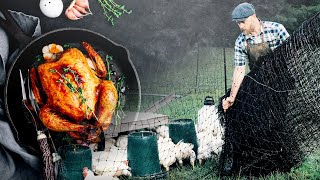
Raise 100 meat chickens on pasture for $1,000-$1,300 upfront and $1,380-$1,600 annually, yielding 350 pounds of meat. A smaller 20-bird model costs $250 yearly and produces 70 pounds. Sell one batch per year to cover costs and keep the other for yourself.
Chapters
You want to grow more of your own chicken? Put it in your freezer. Convenience. Food stability. Say you got $1,000 some way or the other. How much chicken, or what can you do for $1,000? How much chicken can you grow? What kind of value can you add? We're gonna answer that. Let's first do the 100 chicken model. Say you want 2 chickens a week for a year. You're gonna need a 4x6 brooding area for the first 3 weeks of their life. So say you can just scrap together something in the garage. You have some parts, maybe you have to buy a little, I don't know. Let's pretend you have the parts. You're gonna need a waterer. Well, you're gonna need a couple of gallon waterers for that many chickens for 3 weeks. A couple gallon waterers are gonna run you about $16. You're gonna need a couple of feeders. You're gonna need 4 of these things. They're gonna be about $16, I think. I'm gonna leave notes for this down in the description. So you can see where I'm coming up from all this. You're gonna have to keep those chicks warm. Yeah, you could use heat lamps. They're going to be cheaper. You get— you do what you can, but if you can afford it, get these. Um, these are hovers. It's more like mom, so— and there's no, like, there's a lot less danger of fire. So you plug these in, they warm the chick up. You get 2 of these for 100— for 100 birds, and that's going to run about $250 with tax and shipping. So your total brooder costs are— hey, I need my chalkboard, don't I? All right. $282. Or depreciated over 10 years, I don't know, $28.20. Because it'll last 10 years or more. I mean, you be careful with it, it'll last 20 years. In the field, you're gonna need my meat shawl, $427 for parts to build that thing. You're gonna need 1 or 2 shocker knot fences to be able to keep those little chicks in when you set them out at 3 weeks old. You're gonna raise them then to 8 weeks old, so they're gonna be 5 weeks on pasture. But when they're 3 weeks old going out, they're small and they can get through the regular poultry fences. So you need shocker knot fence. It's what, $400 with shipping and tax? That's from Premier One Supplies. You're going to want to get an energizer to make that fence electric, protect them from predators, keep them in. $280 from Premier One with shipping and tax. You don't have to, but it's good to get support posts to help stand up this fence, but they're not that much— $25 more. You're going gonna need 2 5-gallon waterers, $50 apiece, $100. So what are we at? Well, shoot, the field costs $1,232, but if you broke that down over 10 years, being conservative, $123.20. Okay, so, so far over 10 years we're spending about, what, $150 every year we're spending on supplies. What's it cost per batch? 100 chickens gonna cost about $280 at McMurray Hatchery. Feed, organic Reedy Fork Farm feed, shavings, bags, every individual thing to get the chicken into here, these stickers, gonna cost about $11 per bird. One bird will eat a quarter bag of feed. A bag of feed is 50 pounds, and a bag of feed at about $34, yeah, that's where I'm getting the about $11-ish per bird. Uh-oh, uh-oh, total of $1,100. We're getting up there in startup costs. Hang on, hang on, there's hope, there's hope. And it does cost that each and every time you raise 100, so there's no depreciation there. Now you've got to process them. If you're going to be processing 100 birds every year, I would definitely recommend getting a scolder, plucker, and a turkey fryer. Not to fry turkeys, but to— it's a method we use to vacuum seal the bags, make the bags really tight like this. The plucker is going to help you take off the feathers much easier. The scolder is $750 with tax and shipping. The plucker takes the feathers off. The scalding makes it easy to take the feathers off. The plucker takes the feathers off. That's gonna be $800 with tax and shipping. It's the EZ plucker. E-Z plucker. The fryer for the bagging, about $82. So another— guys, you're putting some money into this. $1,332. Now wait, how can I afford that? That's That's— I mean, but you can depreciate that, so that's $133.20 a year. Point 20 year, boy, that's not very good handwriting. So what is that total? What's the total depreciation cost? We can depreciate these items. That's only $284 a year. You could cut that number in half if you let your items last 20 years, which you could. But what's your total? 4,226. Oh my gosh. So here we go. So now with an appreciation cost of 284 plus a one-round cost, uh, guys, I just realized I made a mistake. I should have included the chick cost in here, which would be 280. So that'd make that 380. Okay, sorry about that. That's your direct cost every year. So that you can't get away from. So you have $1,380 plus this. That's your cost, direct cost every year. That's the depreciated cost. What are you looking at, $1,500, $1,600? Yeah, something like that. Because when you have that $1,500, $1,600-ish bucks— I don't know the exact number right here, but I did calculate this. This guy is like 4.5 pounds, but let's say you have an average of 3.5 pounds. And guys, organic pastured— I don't even know if you can find that, but organic pastured around here— what's not organic, it's not non-GMO— $6 a pound. So let's just go with that. So $6 a pound, 350 pounds per bird, that's 350 pounds, guys. That value is— oh look, here we got some good news. Is $2,100. You, you raised $2,100 in value. You directly spent $1,380. That's $435. What does that number mean? That means if you would have bought it at $6 a pound versus growing it, you would have— you'll save $435. So if you're spending— you, you're going to spend— you're going to spend your $1,000 plus some. That first year. Some ways that you could balance out this big initial number is can you grow 2 batches and sell one? And if you're selling them at, uh, $6 a pound and it's costing you, say, $3-ish a pound, then you've paid for your year operation. So you've grown 100 chicks for $3 you ate them, then grow 100 and sell them for $6, but they only cost you $3, so you're profiting $3. You see what's happening? You're taking that profit from that second batch and you're applying it to the cost of the first, and essentially you've raised your 100 chickens for whatever your initial investment was, whatever your yearly depreciation was. So basically, for $1,000, $1,300, you can grow 350 pounds of chicken. But what if you don't need 100 chickens? What if you don't need 2 chickens a year? What if you don't have much space? What about my chicken tractor? We talked about it for laying eggs. You could raise 20 meat chickens in that. Now guys, remember, it only takes— they're only in this for 5 weeks and you're moving it every day. You could do 2 or 3 batches, guys. So 20, say you do just one batch, you get 20 chickens, you just want to eat the chicken every other week, 2 chickens a month. Remember my tractor cost and my brooder cost, you're looking at about $300 or $30 a year because you depreciate that over 10 years. With chicks being $3 each, and then feed, let's go a little higher on the feed because you're not buying it in bulk, you're buying it smaller, say, so let's say $15 each in direct raising them up cost. And the good thing about 20 chickens is you don't need the plucker and the scalder. Guys, you can scald on your stove, a camp stove. You might want to get the turkey fryer, but let's just say you're just making do or do without in this situation. You're tying the chickens up with a string, you're just getting a knife, you've got a pot to scald them in, you just pluck them by hand, you get some friends You don't have to spend anything on that. For 20 chickens, you're looking at about a $250 with direct and depreciated costs. $250. But 20 chickens at 3.5 pounds each is 70 pounds. 70 pounds at $6 value is $420. So you've spent $250, you got $420. So in this case, guys, you could do this for 4 years, grow 20 chickens. 80 total chickens and not run out of 1,000 bugs. It's all paying, guys. I've talked about the garden, I've talked about layers, I've talked about meat chickens. It's paying. This is a good investment, and you don't have to pay taxes on this because you're saving money. You're not making— earning money, so you don't have to pay taxes on that value. So if you want to actually learn how to do this process I've got a lot of resources inside my member area. I encourage you to check that out. Mucho resources on this, including how to raise a year's worth of chickens in 58 days. You get everything you need for this, the links to all these supplies, the what you do day by day, what you do week by week to get you through those 58 days, guys. Just 2 months and you can have 20 or 100 meat birds in your freezer.
More from Justin






If I had to start my Homestead all over again, it could only pick one animal… 




