Survival Homestead Tour
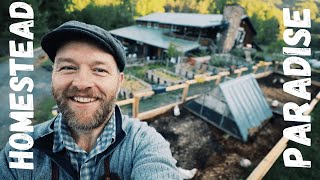
In this walkthrough, the presenter tours a working homestead, explaining how each zone is organized for maximum efficiency, sustainability, and productivity. Starting at the front door (Zone 1), they detail chicken housing built with non‑toxic cedar, deep bedding, and layered wire mesh to protect chicks. They showcase container gardens, raised beds, and trellises for vegetables and herbs, emphasizing ease of maintenance and soil health. The greenhouse, an Anna White design modified with solar‑vented rods and a custom shade‑cloth, is highlighted for year‑round production and heat management. The speaker discusses the use of silage tarps, UV‑treated black plastic mulch, and water recycling from livestock runoff. They outline how to measure and manage slope, size garden plots, and set up permanent stakes for rapid re‑layout. Pasture management is covered through mob/rotational grazing, with detailed paddock sizing, grazing intervals, and the complementary role of cows and sheep. Livestock handling includes chicken breeding for larger roosters, cow‑calf nursing practices, A2/A1 milk genetics, and sheep netting for herd control. Throughout, the presenter weaves permaculture principles, references to market‑farmer mentors, and practical tips for building, maintaining, and scaling a resilient homestead.
Chapters
Here we are in zone 1, right outside the door. So you want to put the things that you're going to visit the most right outside your door if you can. Socially acceptable chickens. So we have our chickens here, they're on deep bedding. You guys notice to keep— you know, this kind of looks good. We actually saw this at the Biltmore House, the cattle panel, or maybe this is a hog panel with framed out cedar. So cedar is non-toxic. So if you put pressure-treated lumber here, it might last longer, but the toxins in it would seep off down into the compost, down into the chickens, ends up in your food system. So we opt out of that. We put a, a poultry wire here just to keep the— there's little chicks in here. Well, some of our big chickens will jump through this, but it keeps the little chickens from jumping through. Ultimately, we buried that side We have a half-inch wire mesh we buried 6 inches down because the little chicks were getting under. So that's this system. Notice this. I mean, this is new for us this year, container garden. It was kind of more a demo, more beauty demonstration for us. We had this here, and really guys, you could knock this out. You could have a container garden everywhere, and you could put flowers or food in it. And then we have our raised beds, and these onions some herbs there, some flowers, some peas. This trellis is another way to make space. Like, you can't plant green beans here, but you could come under here and pick some. Raised beds are good if you— I don't know, they look good. They're good if you want something super easy. They've been really easy. Like, I was kind of like, I don't know, and Beauty was like, yeah, let's do it. But these have been super easy. You just come out here, you barely bend over, rake it, and, uh, you're done. So, so you can come in here and maybe this is no good— Rebecca just weeded that recently— and you can throw your stuff into the chickens. Am I fertilizing and hatching them? No, I'm, I'm not personally. We got our chick or our chicks this year. I've done that in the past and there's nothing wrong with that, but we're just finding it easier with all the things we have going. We're just buying our chicks. We actually We're getting a big fat rooster and we'll breed them to our fat hens and we'll hopefully breed chickens that stay in our sheep fences. We want a— you can't buy that from the hatchery, right? So we're getting— we bought the fattest breeds possible and, and we'll maybe next year or the next go into breeding. Yeah, so am I constantly adjusting the nest boxes in the chickshaw because his nest box are constantly falling out. I might— because I'm moving it every day, I might have to pick up the— it kind of— it will fall down. The nest— the box doesn't fall completely out, and that might happen every 1 out of every 3 days. But what I think the fix for that is— it sounds like you might need to be in a hurry because it's happening more to you. The box sits there, and then there it sits on this wood, right? These wood— this wood frame. I'm going to put a 1-inch wire mesh underneath that wood frame so dirt can still fall through the nest boxes. But if the nest boxes come loose and want to fall through, they won't. I'm going to try that. Right here we have the greenhouse. You want to put your greenhouse close to the house. This is an Anna White design. You can just find that online, just ask Mr. Google Pants for Anna White greenhouse. The one thing we did change is we had our carpenter Jason from Southernlands install, um, Solar vents. You could just ask Mr. Google Pants for solar vents, right? Yep, yep. And, uh, the— so the sun heats up this rod and it opens the vent automatically. That was not enough. I guess Anna White is in Alaska, she didn't have this ventilated, but you're going to need to ventilate, especially if you— we wouldn't need to ventilate it in the spring when we do our spring planting, but when we want to plant our fall planting, and we planted almost a month ago, it's hot. Like, it's hot out here right now. We found— we got lucky. All we had to do was unscrew this right here, and we can curl this up. And this is a game changer up top. If you need one of these, just come to me and I'll give you the link. That's a shade cloth that blocks the heat but not the sun. Don't ask me how that happens, but it actually works. These plants are not too hot. It's only a few degrees warmer in there. What's cool about that is hundreds of plants are in here growing, and what? Out there, the stuff is still growing and maturing if you harvest and then transfer these out right away. And you've got 4 weeks ahead. You're 4 weeks ahead of the weeds. We have our tarp down right now. Maybe we should go up there and look at the tarp. Anybody want to see a silage tarp? Yeah, so we'll go back and go up to the crop gardens. But you just pull that tarp up, plant these, and you're 4 weeks ahead of the weeds. So right behind the greenhouse is the asparagus and strawberry plants. Justin, why are you putting asparagus and strawberries, zone 2-ish and a half-ish, 3, right there at primo, right here in zone 1, south-facing? Why are you gonna put strawberries and asparagus in there? Why are you gonna do that? Break the permaculture rules? Anybody know? The beautiful one. Social dynamics. That's your number one thing to consider. Relationship first. Rebecca wants strawberries and asparagus there. Let's put strawberries and asparagus there. But it actually worked out because that area constantly gets neglected, you know, it's kind of behind the greenhouse. But what is also noticed, we're cleaning our buckets here. Well, we can come over here and put water on that. Our cow— we washing our cow stanchion off, we're getting nutrient-rich water coming off of here, feeding that. So I told you the truth. I told you really what I could have said. Oh yeah, you know, smart permaculture stuff. The, the mineral water, the manure water coming off, right? The waste— oh, look at me recycling wastewater, gray water going on there. No, relationship first. All right, remember what I was saying earlier, you know, you look at slope. Ideally, if you can, if you can plant a garden as close to the house as possible, 5% grade or less. How do you know 5% grade? Do you guys know that? Well, you ask Mr. Google Pants, how do you measure grade, and he'll tell you. If this is the grade I want to measure, I'll put one post here, one post there, 100 inches away, take a string, the bottom of this one, put it to this one, get a level on it, and however many inches that is up is— that's how you grade slope. So just ask Mr. Google Pants if you can't remember that and you want to measure slope. So this is our flattest spot. It's closed, it's out and exposed to the sun. We have 1, 2, 3, 4 garden plots here. They are 21 by 24 feet, or 21 by 50 feet long. So you want to make— if you're going to garden this way in a night, a high-intensity market farm-style garden, that's a good measurement because you can fit— I forget, I think there's 6 or 7 30-inch beds in there with 1 foot, very minimal pathway, 1 foot in between. And being that it's 50 feet long, everything comes in 100 foot. So if you buy greenhouse plastic or your silage tarps come 100 foot, so you get to cut it in half. It usually comes in about 24 foot wide, which is also pretty nice. We keep our tarps at 24 foot and just fold them up a little bit or just put them over a little more We have our permanent stakes here. This was a big game changer because to reshape our beds, we just take our twine and mark, you know, go along these posts and we can see our square corner. And we can measure 30 inches. Oh, this is where I need to build my path. Measure another foot and I'm going along this line. And then I, you know, I rebuild my beds. And another good thing about being 50 feet long but 24, 21 feet wide, that's the perfect size to wrap a 164-foot chicken fence around. So when this is done, put the chickens in here for a couple weeks, let them clean it up after me, move them back out and reshape the beds, compost it, amend it, uh, broadfork it, whatever I need to do. Cover it with tarp, all while the, the produce is growing in another place— in a greenhouse, in your basement, or just outside on a table out near your house. You know, you're not worried about frost this time of year. So that's that. We're weighing it down with sandbags. We've got our, our compost nearby. The truck can dump it right offside the road. You got to think about that. You got to think about how you can bring materials in. I have a real problem here. We're all standing somewhere and here is the drain fill for the septic tank. The one man who knew there where that was is no longer with us. That was my dad. And there's all these questions. He died in November. There's all these questions. Oh, that was like one of them. Oh, where's that drain fill? So we gotta be careful driving around in here. You don't wanna bring big compost trucks in here. It gets wet. How are we gonna get in here? So you gotta think about that too when you place your garden. How you going to get compost into it? How you going to go get— how you going to get mulch into it? How you going to harvest it? Accessing it. We left a big path so we can come down through here. Uh, it won't hurt Sally driving over this. It won't hurt the occasional tractor coming over this. I learned this from JM Fortier, Market Farmer, up in Canada. Curtis Stone uses it. Casey Auswitsch uses it. This is UV treated so it doesn't leach. I can tell you that if you use regular plastic that plastic can leach out into the, the material. But I was leery of this, and you know, being that it's plastic and it's going to be with us for 450 years, it's kind of like, I don't know, you know. It was— that's one of those things that we personally struggled with, and we tried it. And so we tried it one year, I think it was— it might have been just last year, maybe the year before. We put it down and we came out and put it up and we saw so much earthworms So they at least liked it. The way we could then justify it for ourselves— yeah, it's plastic, but we also use our plastic laptops and our, and our smartphones to get stuff done, do better by the world. So we're also not calling on trucks to deliver our food either. Our food is right outside our door. We don't have to drive to the grocery store. All this stuff, we just walk outside and get it. And because plastic lasts forever, this theoretically lasts forever unless you unless your cows get out and step on it. No, this does not actually heat it up. I think it's like— I think J.M. measured it. I think it's like no more than 2%. Um, it does not heat it up. Now, if you were to put Clear down, then you're getting hot action. And actually, he taught— I was just refreshing on his book— he'll put Clear down, encourage the weeds to heat, and then he'll flame weed those. And then, uh, and then plant. So that's kind of an interesting technique that we may try one day. But no, this does not heat it up even though the black side's up. You can— yeah, you guys will take— we'll take 5. You can, you can walk it, you can go feel under there, go poke under there, see if there's— ideally I would have watered that down. I don't remember if we watered that down before I covered it. That would really encourage the worms. See this line right here? And all the way, see that line going across over there? That's a locust tree there, lone locust tree over there. And then back through here, the lane, that's probably a, what, 150 feet by 150 feet? What do you think? And so that's, that's one paddock for me. So in the spring, and there's 15 of these You want 15 on your farm. In the spring, this is one day for them, and it might look like that. Grass is growing fast, you move animals fast. So I'd cover the entire farm in 15 days, but I mow, but I mow behind them because they're going to leave a lot. And for me, mowing it, it looks good, it levels it out. These things don't grow back as fast as edibles, these weeds and briars and brambles. So this is one big paddock, and this time of year it's raining, so grass isn't growing as fast. But I can move them 30 days. I can cover their farm. They haven't been— that's— they've been 30 days, 30-ish days. This is what happens in 30 days. That's ready, isn't it? It's not mostly seed. Like, you don't want to graze it mostly seed. You don't want it to be brown. I want to hit it, right? This is what Joel would call teenage grass. I hope he might come tomorrow and say No, that's, that's old mangrove. Just hadn't started limping yet. I don't know what he's gonna say. We'll see. So for me, at the homestead level, I'm saying if you're willing to feed hay in the winter, I'm saying, uh, 2 acres per cow. Dead muffin counts as a cow. A heifer, half a cow. And then I'm doing this system where I move them 30 days. But see, I'm not stock stockpiling, so I'm gonna have to buy hay. If you want to stockpile, like let grass— like you could mow right now, you could potentially mow a field right now and let it grow back and graze it all winter, just letting it open more and more each day. That'd be called stockpile. Uh, you would probably need 5 acres per cow to be able to do that. Makes sense. I use square bells because I can handle them. I don't want to break out the tractor every time, go feed with round bells. You could run the sheep with the cows, but the cows might have— the sheep might happen to eat the cow's feed, and we're giving the cow the priority because they're pickier and they're our centerpiece. So we'll talk about centerpiece. So everything in this farm revolves around our cows. They're number one. So you can put sheep in there, no problem. Uh, they're a little bit of a problem because sheep will not stay in this. So you'd have to have something that sheep would stay in. I mean, Greg Judy's trained sheep to stay in one strand. It's not that high, it's lower. Cows might step over there. You're probably gonna have to have at least two strands. But why not put sheep behind cows? Because what are you gonna do with the cow's calf that won't stop nursing? Like, we let the calf stay with the cow. It's a good thing we had this cow born in the industry. That cow, that calf would never suck on the mama's teeth. So we let them nurse. The calves get the mama all day long. We take the calf off at night. We won't right away. We won't with this gal. She'll have mama for 3 weeks. We'll pull the calf off at night. Where are you gonna put that calf? In the past we put them in the stall. That's fine. It's been more peaceful just to— because if the cows are here and the sheep are there, just herd the calf in there. And then at 6 months old, when we want to wean but we still want to keep that calf because we want to grow it up for beef, what are you going to do? It could be hard to wean a calf. You can get those things that you can put on their mouth, but I was talking to my— the guy, I— he coaches me on cows. He's like, if the mom really wants him to nurse, she'll let him. She'll just take in the pain. But we found with that sheep net, we can raise our steers in that. We can wean our steers in that. It's much peaceful because today they're pretty good separation. That's pretty rare though. That's because we just crossed farm. You'll see, we'll go up there in a minute. But tomorrow the cows will be here and the, and the calves and the sheep will be here. So we are running sheep and cows together. The cows eat— if there's a sheep parasite on that and the cow eats it, it won't live, and vice versa. So it's very good to have— they complement each other, and it takes no more land to feed our sheep because they follow and eat what the cows don't eat. The good thing about Ephra is you can sell her You can keep her as a milking cow. Is she A2/A2? So we like A2/A2, which is the beta casein in the milk that's just easier to digest. That's the long story short of it, or short story long, or whatever. Uh, it's easier to digest. We don't know because, uh, Stub Muffin's A1/A2, so there's only— and, and the mama cow is A2/A2, so there's only a 50% chance that that calf is going to be A2/A2. We have to pull the, pull the hair and send off to a lab for $20. Out here we have the, the luchadors, the wrestlers, Nacho and Escalito. Nacho's the ram, he's half of our, our breeding pool. And the, the luchador, he's a wither, that means he's a castrated male. He's just there to keep him company. They're in a 16 by 16 on 8 wheels. We move it around this pasture. This is about a third of an acre. And you can see behind it, we mow. Ideally, you would mow before, you know, every 3 days behind them. And they go out and then they come back in, and then they scoot over and they go out and they come back in. But what if you guys ask that question, well, what do I do in the spring when this just explodes and they're only like over there, and they still got to go— they still got to zigzag a couple times before they come back to here. What am I going to do? Or else this is going to just become old man grass. I like that, old man grass. I cut this— not when it's too short. You don't want to cut it too short. You want it to— look at the difference. So that's just mowed, it's all cut up, and this is recovered. See how this is bladed? This has got a blade. So I'd maybe let it recover, and that's why I'm doing it. I'm moving the animals out, this gets to rest and recover, and it just becomes stronger, it becomes more edible, and I'm making my pastures better than, than I found them. And so I would come in, I'd say, okay, we're not gonna make it. I would mow half this field, and they're still zigzagging over there, and by the time it's come to back, this is either almost ready or ready. I mean, if it's ready— if it's too red— if it's ready but you still got— you still got half the field that's also ready, and it's gonna be a while before you get to it. So you can— you can hit a little early. You just— you just mess around with it. You just get it. You just start. If you're scared, you get you some hay in case you mess up, and you just do it. And you start getting the knack for it. We've done something right because we've had them almost a year and they've been just fine. And this has been great. I vote for this. Somebody could raise— I, I think you could raise 3 or 4 feeders, buying some in the spring, sheep, and harvest them in the fall this way. Why do we have them in the cage, not a net? That cage is bulletproof. They're not getting out of that. They would get out of the net because we turn it off, because they get excited when the ladies go by, they try to jump through it. Uh, we could do net maybe if the ladies were never visible. But the ladies end up in here. They could be that close. They could be on the other side of the lane. And we don't want the gentlemen to get out. We don't want them to breed inopportune time. We want to breed in the fall so they lamb in the spring and lamb all at once. We're dealing with it all at once.
More from Justin






If I had to start my Homestead all over again, it could only pick one animal… 




