In this informal family vlog, the hosts explore the Laura Ingalls Wilder Homestead in South Dakota while discussing inexpensive homesteading options. They begin by noting the low cost of a historic homestead ($2.78 total) and introduce the Homestead Act, explaining its age and land‑acre requirements. The group tours several pioneer structures: a covered wagon repurposed as a mobile home, a Burvey shanty built from canvas, tar paper, and wood, a dugout, and a sod house used where timber was scarce. They describe construction materials, lack of insulation, and heating methods, often commenting on the cramped spaces. A brief interview with Victor Justin Rhodes adds a personal connection to the region. The vlog also recounts the early school built from a claim shanty that burned in 1888, and they examine the original Ingalls house, noting its modest 140‑160 sq ft footprint that later expanded to 472 sq ft. Throughout, the hosts share reactions, humor, and personal interests such as gardening, providing a blend of historical education and family entertainment.
Chapters
You guys want an inexpensive homesteading house option? $2.78 grand total. South Dakota.
I still didn't do it right. Okay, who knew it was this hard?
Now maybe you'll quit making fun of me for my white gas.
I never made fun of you.
And South Dakota sure is beautiful. We are at the Laura Ingalls homestead. Hey, we don't really know exactly what to expect of this place, so I think we'll start with the movie.
With a serious case of land fever.
Just learned from the movie they did settle here in the 1800s. It was part of the Homestead Act, so if you could come here and settle for a length amount of time— you had to be over 21, I think it had to be over 10 acres— you could have the land. The government would give you the land. What'd you learn in there, babe?
I learned that they had 160 acres. I somehow didn't know that.
What are you so excited about?
Um, put a bunny hoodie on.
Oh my, a covered wagon! Can you imagine traveling in this? This was their maple. This was their bus, guys. Everything you had had to go in this wagon. Yeah, the way they made these covered wagons is this was a farm wagon right here, and they would just add this cotton duck canvas. Go in there, buddy. Yeah, what if this was your home?
Oh yeah, we only meet right here.
We think 280 square feet is tight, but it was only 4 of them. Are you driving? Are you driving, Mr. Brown?
Yeah.
Show us how you would drive this thing. He's making a motor noise. Mr. Brown, you gotta make a horse noise.
Good job.
How would you like living in this covered wagon, honey? You'll go on the Great American Farm Tour in that thing.
I can't imagine how hard it would have been because these places get cold and hot, then bugs.
What's in here, guys?
This is the Burvey Shanty, and so it's basically showing us what the inside of a shanty would look like.
What does a Burvey mean?
Burvey, I think, were the people who lived here.
Oh, so this is what a house would look like.
The Burvey Shanty. Let me see what it says here. These were just other— the Burveys were just other pioneers. That's all they were.
Okay, so this is their shanty, and a shanty means that just something slapped together to claim the homestead. Yeah, yeah.
So like, notice it's the paper, you know, like newspaper paper on the walls, and then it's wood, and then it's tar paper on the outside of that.
Oh wow. There is no insulation, honey.
No, no.
And we're in South Dakota.
Well, that's why they had this, the wood stove.
That's mine!
And then this is why they slept right next to the wood stove. And I think, but over here is the dugout, which is another way that people would—
insulate themselves.
Live.
Hey, wow.
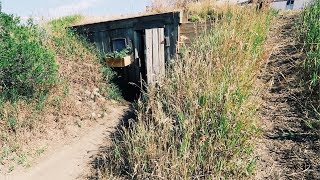
Okay, no, this is a— this is a dugout.
You would live in this too?
Yeah, so this is another one.
This is what—
I know, they lived in this in, um, Maple Grove. Is that what it was called?
I think it smells like— I don't know, smells like gas.
Walnut Grove.
Wow, so they lived in this at Walnut Grove.
This is a sod house. Yeah, so this is like what they— so when people would come to the prairies, they either had to build a shanty or they had to build one of these because they had to have a house and there was no woods, so they couldn't build a log cabin.
Victor Justin Rhodes. Hey, how's it going? Big fan. Where are you from? Jasper, Minnesota, right on the South Dakota-Minnesota border. Okay, cool. You gonna take the wagon ride? Sure.
I'd like you to step back in time with me to the year 1881. Enough families had moved into this area that there was a need for a school, and the first building they used was a claim shanty. Somebody's house on their 160 acres that they weren't living in. And that worked for 7 years until the summer of 1888 when the little shanty school burned in a prairie fire.
It's grass, so they didn't have straw, so they filled it with—
they just filled it with grass for the mattress.
Oh wow, this is grass in here. It's not that comfortable. I mean, it's probably comfortable than wood.
Old school irons, old sewing machine. Remember when Pa sold a cow to get Ma this sewing machine? If you don't know who in the world I'm talking about, Laura Ingalls Wilder wrote the books The Little House on the Prairie based on her own life.
This is their bedroom, I guess. More the older child than the younger child. Lily said this is her bed. This is this little square right in there. No, in here. Oh, whoa, this is what it was.
This was the first house.
This is the first.
160 square feet.
140.
140.
And then, and then he built this on, then he built these two bedrooms. He built the two bedrooms.
Ah, and then, oh, and then they live in the luxury. They added on a living room. So how many total square feet?
They had 472 square feet total here. That's it. That's crazy. I will say the breeze is nice coming in.
It doesn't feel that small.
It doesn't. I really like these tomato trellises. I just love gardening.
Then we had a nice dinner together. That was a lot of fun. If you guys like these fun type of vlogs, make sure you check out yesterday's video in South Dakota. You'll see what happens when our— she says North Dakota— when our farm visit fails us and we find something else to do. It's a lot of fun. Check it out.