the 5 Acre Permaculture Homestead - Unbelievable Abundance
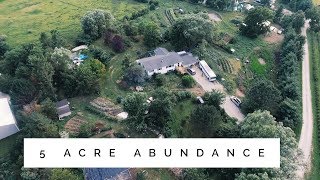
The video is a guided tour of New Earth Farming Goods, a 5‑acre permaculture homestead in Nebraska operated by Jonathan Dawn and his nonprofit KPOS (Greek for garden). The host walks through the property, highlighting a chaotic but productive mix of perennial food forest, terraced hugelkultur beds, low‑cost hoop houses, and extensive animal integration (geese, sheep, chickens, turkeys, guinea hogs, goats). They discuss practical techniques such as using kaolin‑clay powder to deter Japanese beetles, hand‑weeding edges created by terraces, and employing livestock for pest control and soil fertility. The conversation covers challenges like invasive weeds, Japanese beetle infestations, and the labor of maintaining many edges, as well as solutions like grazing, chop‑and‑drop, and manual mulching. The farm sells produce through CSA and restaurant channels and seeks volunteers/partner couples to work on‑site, offering paid positions rather than unpaid internships. The tour ends with a preview of the KPOS gardens and a statement of the nonprofit’s mission to grow food, feed people, and transform hearts.
Chapters
There's a lot going on here. It's only 5 acres, but they're jamming out that 5 acres. Top of the vlog this morning, a special announcement. Happy anniversary to my parents. They've been married for 45 years today. Oh my word, 45 years.
Yes.
We miss you guys and we hope that you have a wonderful day today. Congratulations. Now it's time to move Move on. New state, Nebraska. What's the name of the farm? New Earth Farming Goods. New Earth Farming Goods, here we come. What are you gonna do, water the basil? Okay, it's jamming, guys. 1, 2, 3, 4, 5, a bunch of plants. We're gonna have to thin this soon, honey. We'll take it easy, we'll take it slow.
It's a good day for We have arrived to our destination.
It didn't take me long to see there's a lot going on here. It's only 5 acres, but they're jamming out that 5 acres. Right there we have geese. Right there we have sheep. Hugelkultur bed coming along. Fences everywhere. There is a ton here. I cannot wait to get with Jonathan and see what in all they're doing on this 5 acres. Oh, there he is.
Oh, I'm just over here waiting on you.
What are you doing over here?
Oh, uh, dealing with buried apples. There's, uh, rootstock apples that go all the way down this.
What?
I'm gonna create like a—
and there's stuff like buried rootstock apples right here that we wouldn't even notice. They're just— Jonathan, there's no way we're gonna cover all this, is there? No, no, there's just too much.
I got dressed up for you though.
Oh, you got dressed up? This is dressed up. This is his dressed up outfit. Yeah, bare feet and a clean t-shirt, right, Jonathan? Everybody, this is Jonathan Dawn.
How's it going, everyone? Welcome to the farm.
Thank you, thank you. Is this your gig?
Uh, this is KPOS, which is garden in Koine Greek. Okay, not K-PASA. Yeah, KPOS. Uh, we use food farming education to transform lives.
Okay, cool. Show us, show us what all you can do in 5 acres.
Sure, let's go for a walk. Uh, we've been on this property for 5 and a half years, and we've seen this farm as an experiment to plant a ton of edible perennial and functional plants. I'd say a lot of it's chaos. There's a lot of chaos going on. You know, there's burdock and borage and bachelor button flowers along with your lamb's quarters and all that good stuff. I don't know if we start eating this, be like Grant Schultz.
That's what they would say about Grant Schultz. He just ate everything, including the bugs.
People do call me a goat. I learned a lot of that kind of stuff from him too.
Oh, you did? Just kind of eat everything?
This is one of our main garden spaces over here. Everything is terraced mainly with logs from the forest going down. This is a lot of the spring crop that's now done. You know, you just see leftover kohlrabi and kale plants and some cabbages that are pretty beat up. I'm experimenting with the frost blanket here with carrots. It's really hard to germinate carrots in the summer. It just gets so hot and you can't keep it moist, and I'm hoping that this will help to keep the condensation in and in the ground.
How are the terraces working out for you?
Oh, they're great. They work out. One of the things I find though, man, is the more edges you create, the harder it is to maintain. Just, yeah, every time you create raised corners like this, you're gonna have to hand weed a lot more. It's less mechanized. You know, I look at weeds as a good thing though. I look at weeds as biomass production, and then I'm able to mulch beds that way, so So you cut your weeds and mulch? I do, and then we pull them up too and shake out the dirt. Okay.
What's the white powder? I caught you, you've been spraying. Yeah, permaculturalist that sprays.
I have been spraying. I wouldn't mind eating what's on there though. That's just kaolin clay.
Okay.
It's mineral mined out of, uh, Georgia, I believe.
Okay.
And that's what's using baby powder in a commercial product as surround WP. It doesn't kill anything, it's supposed to trick certain pests into not thinking that there's a plant there that's delicious for them. Trying to control these guys right here.
Japanese. I was gonna say, all you gotta do is eat them.
I mean, I usually eat one entire for effect, but this is a new theme on the farm for you. I'll go ahead and be very—
come on, you're gonna beat out Grant Schultz.
Uh, I usually— coming at you, Grant. I do eat these every day. Do you really?
Why?
Just because I'm always giving people tours, and that's the highlight.
That's what they're gonna remember.
We're taking 5-gallon buckets and we're into soapy water, and then we're taking them to the chickens. I wish I had 200 turkey— juvenile turkeys. That's the best, uh, pest control that I have found because they are just looking for bugs. They're not scratching. No, juvenile stage, I've seen them just pick it right off the plant. It's amazing. They get this high, uh, they'll jump.
Wow.
Uh, the rooster out there, they'll jump in.
Okay. What's the weirdest thing you've eaten on a tour?
Hmm.
Or is Japanese beetle it?
Uh, I don't know.
Do you actually swallow them?
Yeah, they're good, man. They're actually— they taste really good. My mindset in the future moving forward is this is a turkey farm. Okay, the problem is the solution. And, uh, the Japanese beetles as a— is a plague this year, and I see it only getting worse, uh, as we move forward. And I think turning this thing into, you know, we're harvesting the bugs through producing meat.
So if you could turn what's killing most— what's after most— is that powder working?
Not at all.
It's not working. Okay. But I know a turkey's going to eat a Japanese beetle.
Yeah, I mean, I don't want to spray chemicals because we have bee— there's so many beneficials out here and bees and—
yeah. Is this a sheep paddock we're in right now, or do you know?
Uh, I mow this. I did start the sheep out here, but, um, with all the trees, it's— I take that back. I will weave it in. Um, I'd rather just have the geese up here and help them. Just little hazelnuts interplanted. This is kind of chaotic planting up here, maybe like just sporadic. There's not really a pattern to a lot of this stuff, just filling in gaps. But you can see like their cherry trees, the Doggo apples, they're, they're on everything, man.
Oh yeah, you're talking about the Japanese beetle taking it down. What do you think about the Japanese beetle traps?
They're awful. They just— all they do is bring more in.
That's what I've heard.
Yeah, they're probably one of the worst things that someone could do.
How much of your own food could you eat off of this land?
We produce a lot of food. We store a lot of food in the winter. Um, we don't produce everything. I love this hoop house style, man. This little greenhouse here.
Yeah, that's cool. That doesn't look like you spent that much money on this greenhouse. Beautiful greenhouse, man. This is just cattle, cattle panels on a box frame. Yeah, that's it.
We just started all of our plants in here. Okay. You know, so this was just nothing but seed trays and baby plants, and then they got hot, so I threw in tomatoes and peppers. So more Jerusalem artichoke. These are actually in-ground hugelkultur beds I originally did a few years back that have sunken in. Now I've only put things up here that I don't have to manage. In here This is where I just threw a lot. There's like 11 types of edible food in here. Raspberries and blackberries, asparagus, comfrey, rhubarb, um, poison ivy.
How you gonna turn that poison ivy into a solution, buddy?
There is not one, I gotta tell you. This is the nest. We have— that has a little AC, it's got a heater in it, it's a loft, it's got electricity. Oh wow, it's got a fridge. I can't show it to you inside because, um, there's a guy that has his stuff in there right now.
Somebody's staying in there? Okay.
Yeah, but he'll be here for 2 more weeks and then it opens up and we have no one to fill.
So you're telling me this opens up in 2 weeks and somebody could come in here and be a part of this?
We desperately are in need of people to come work with us, okay, primarily on the farm, but if— hiring as well, hiring assistant. Through with K-Paws.
Okay.
And I'm look— I— my ideal situation would be a married couple.
Okay.
Without kids.
All right.
Um, and without pets.
If you're a couple interested in coming and learning and being sort of a partner-ish, so it's not like an internship, there's money, there's going to be— there's some benefit there other than just learning.
Yep. Yeah, we have a big market, so people that want to create products as well and all of our resource base and taking a percentage of the food.
I'll leave a link to your contact down in the description.
This hasn't been mowed in 4 years. This is all animal management and grazing.
So, well, you can tell too. Look, you got clover, you got all kinds of rich grasses coming up through here.
Yep. So this, uh, this is only through animal management, primarily through— we've tried, we've trialed everything, man. We've, we had, uh, Dexter, we had Dexter cows, we've had different types of sheep. We have Icelandics now, uh, doing chickens, doing broilers.
Why'd you go Icelandic?
I think honestly that that's not good for a 5-acre homestead. I think the best sheep would be a Doper, a Katahdin cross, something with hair sheep that can lamb twice a year.
You've managed this with your sheep? Yeah, they don't eat down the—
oh, I don't let them in the comfrey. So, oh, you don't let them off the food forest?
Oh, explain the food forest to us. So yeah, let's walk in.
We'll start at the top. You can see back in the back, that's a black locust, okay, hedge. Uh, there's a few chestnut trees there, and then about 30-foot alleyway, and then about a 10-foot-wide food forest swale that's got— in each food forest, it's every 60 feet going down, um, alternating different combinations of plants.
What is on this row?
Uh, this row has— well, there's hazelnut right here, comfrey, apples, salmonberry, which is just a former raspberry. But, um, you know, honestly, man, we have fought grasses. They always come back. Uh, yeah, they just always take over.
You don't have to manage this area?
I do it by hand.
Okay, so you'll manage this area by hand, but the animals are managing that. You haven't mowed?
That's right. So we just run the electric fence.
And okay, chop and drop, chop and drop, and hand pull.
Um, and we got to do it probably 3 times a year. It's been done once, kind of twice.
So you're due?
It's due.
It looks okay though.
All right, but you know, like all this comfrey needs to be cut back and stuff like that. Okay, so these are only 2 and a half years old, all these locusts. I, you know, just twigs in the ground.
Wow.
And, uh, it's great, man, that animals will graze this.
We can eat the flowers and And, uh, is that a living fence for you, or is that— there is a privacy—
it's privacy. It's a living— it's, it's a living thing, but it's great firewood, man. That's great firewood. It's great building wood. It's fodder for my animals. Multi-function, you know. It's nitrogen upslope. Every time I cut this back, it's going to release from its root tips nitrogen, and it's just going to feed the system going down. This is where— so doing the broilers and then planting behind them. Here you got a few chestnut trees, and you got cucumbers. And yeah, I— you can see the beetles on this too.
A lot of this annuals here is for your CSA. Yeah, fair.
Yep, CSA and restaurants.
You know, your— the beetles even like the corn, huh?
You know what I'm finding though? If you go look at the GMO corn that's growing around here, yeah, there's no single beetle on anything. I find that kind of interesting. They're all on my corn because it tastes good. This stuff is like sugar. I did let the chickens in here for 2 days. I sacrificed some of the squash blossoms and flowers because the beetle problem was so bad. In the morning is the best time to knock these things off. They just fall, and the chickens just— our egg production went way up. That whole back pasture, and then we got some—
who's in the back pasture right now?
Right now, no one should be back there. I see a chicken back there.
But you rotationally graze people?
Yeah, they've moved. Everyone gets around the farm about 2.5 times.
Well, let's go see some of these characters.
Um, I just did this this year to get the chickens moving, and I love it, man. So simple. $1,200 trailer, pallets, you know, a few nesting boxes, and I can take everything out and use it as a trailer again. So it's— everything is removable. So a lot of throw. So a lot of throw. So Um, what's the rest of it? Animals come through, they create disturbance, I throw a seed.
Oh really? How's that working out for you?
It's awesome. Uh, you know, so then we were able to come back behind them and take food as well, like turnips and radishes and squash and okra and beans.
And look what's happening because he's not mowing. Look what gifts he's getting. Walnuts.
Those are walnuts, right?
Walnut trees are popping up. The sheep haven't eaten them.
They don't—
chickens are—
they'll eat some of the leaves. It's one of the last things they'll eat, but they don't kill it. What a gift.
And now you can have walnut trees.
Yeah, I think one of the things I'd really like to fix out here is to bring a lot more flowers in here. Um, I think we've really lacking on that. And, um, one, it's just beautiful, man, to like have all those things flowering around you, to live in that beauty. Um, You know, we do have a lot of birds out here, so it's amazing just waking up in the morning and hearing all the sounds if the neighbors aren't running their engines loud. So yeah, another growing area over here. This is where we had a hoop house. It's torn down right now. I've used recycled materials and I've rebuilt it, but— Neighbor with the pond, nicely manicured grass. Not that, um, do they think you're nuts? Yeah, definitely. Are you nuts?
Yeah, I think so.
Um, but this corn too, I mean, this is the, this is the winter area for the animals, so clean. And then huge visual block from the neighbor there. So, um, we can let the pigs out now.
Where are they going?
Just to the back, back behind the house there.
I don't think this one's moving. Oh, they This one's not moving.
The one in the pond, they made a mud pit.
She's happy where she's at. What do you think? Or will she get up?
No, she'll— uh, he, he will get up.
So is that about as big as these guinea hogs get?
Yeah, she's only 1 year old, but she's already had a litter. Um, so that I usually have the pigs follow the sheep, or I'll even put them together with them. Because those guinea hogs can just eat grasses and forage. All they get this time of year is just food waste, a little bit of corn. We source— we do buy feed, but we buy all local non-GMO, organic, and transitional grains in bulk.
Look at them eating the grass. You vote the guinea hog best homestead pig?
I think so. I think they're a great pig.
What about the Kunekune?
Um, I haven't had a coonie coonie.
Wait a minute, you come out of your wallow? You come out of your wallows, get some grass?
Oh, here it—
right there. When he comes around, good things happen, right? Right, Piggy? When Jonathan comes around, good things happen. So you come running. Look at these little guys. You're little guys. You're little guys. Watch, don't be scared.
Okay, I know this is gross, but this is proof that these are pasture pigs.
How so? Oh gosh, don't eat it, Jonathan. I'm not gonna eat it, don't worry.
But you know, that's just nothing but grasses. Yeah, this is our winter, you know, our sacrifice area for the winter for the birds. So the birds are in this coop. Last year there's two of them, and then they had this whole bottom area, and then we just— we've managed it by putting mulch on it. So instead of worrying about seeding all the time because they're always scratching, I just threw a bunch of mulch down. But now I was such bare soil, I got the birds moving and then just threw seed everywhere. So in a month, this is going to be a forest 10 feet high of food. What in the world? That turkey got in there.
Where's that turkey supposed to be?
Uh, not there. So all the birds are hatched here.
It wouldn't be farming without problems, John.
No, that one must have hatched here. What the heck?
So you have a guard goose in here on these turkeys?
Yeah, there's geese with every— all the— 1, 2, 3, 1, 2, 3, 4, 5, that is 6.
So it is out.
It is out. Somehow it got popped through that door right there.
And then these guys— this goose has grown up with these chickens.
Good catch. Professional chicken catcher. Okay, come here. Hey, how are you? I know this is not what you want, but you gotta eat it. Please eat it. Oh yeah, there you go, there you go.
Gonna leave you in here until you do eat.
Yes, exactly.
Or is that Mrs. Goat?
That's Mrs. Goat.
All right, what you got going on here, buddy?
Great wool. You can milk them. We're not milking them. Uh, the meat's really great. They're pretty small sheep. Um, it's a pretty hot climate, I think, in the summers for them, but they do all right.
We go out right here, Jonathan?
Right here.
Thank you for the great tour. If people want more of you, I'll leave the link down there. Tomorrow we're gonna go see what?
We're gonna go see our KPOS Gardens.
And what's KPOS? This is actually the nonprofit organization. What does the KPOS do?
Uh, well, we grow food, we feed people, and transform hearts.
Okay, can't wait to see these gardens.
That'd be great.
More from Justin






If I had to start my Homestead all over again, it could only pick one animal… 




