the “Back To Eden” Garden - FULL TOUR
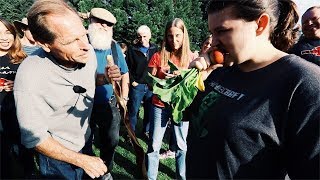
Paul Gautschi tours his half-acre Back-to-Eden garden, showing how thick wood-chip mulch eliminates the need for fertilizer, irrigation, and pesticides. He grafts multiple fruit varieties onto single trees, raw-eats heirloom vegetables to preserve enzymes, and lets chickens eat lawn grass as live food. The system produces abundant harvests without synthetic inputs.
Chapters
A little different kind of video today, long form today. This is Paul Gautschi in the Back to Eden Garden. You're gonna like this video if you want to get into more of how and why this works and his philosophies and all that kind of thing. I'm just gonna drop it in a real raw, long-form video, and you guys enjoy it if that's something that you're into. If you're looking for more of the high-paced, high-energy type stuff, you might want to skip this one. But this one's definitely educationally fueled. I just love observing the effect of wood chips. If you can see my neighbor's cherry trees over here, you can see how the foliage looks on the top of the tree. You can see it's definitely going dormant. If you look at the branches coming this way, you see how much bigger the leaves are? Are you noticing that the leaves are quite a bit bigger? You know why? The roots now are getting in my wood chips. The roots are into my wood chips and they're eating better. And because they're eating better, the trees, the leaves get bigger. It's just, you know, I love paying attention because it's just all of nature is really speaking loudly, showing you how it all works. Over here I have a hydrangea. You know, hydrangea flowers, if you have acid soil the flowers are blue. If you have alkaline soil, they're pink. My hydrangea has both blue and pink flowers at the same time. I think it's awesome. You know why? Because the pH in wood chips is an amazing 7.0. I love the number 7. That's the number of the Creator, and it's perfect balance. At center, everything thrives. I'm going to show you over here that where I have lavender, which is an alkaline-loving plant, growing right next to blueberries. They're touching and they're both thriving because it's 7.0, it's center, and everything, everything's happy. I love nature. You see, we're out there trying to adjust pH for this plant, which never lasts. You're always doing it. Where if you get a natural environment, 7.0, you can grow everything there because it's center. And at center, everybody's happy. It's just— I love nature. It just doesn't have any work involved. It's just, there's no, there's no effort. It's just everything grows because it can't help it. We'll progress over here to the garden. Once you have a plant, you will have free food for the rest of your life because it will always keep creating seed after its own kind. I'm telling you, all of nature is revealing the goodness of the Father. He is really good, very generous and kind. And you can see the whole concept of the genetically modified and hybridized stuff— that makes you a slave. You have to buy from them. They control who has food. What's your annual rainfall here? It varies from 14 to 18 inches. If you didn't hear before, this orchard has not been watered or fertilized for 38 years, ever. No water. And we've had major droughts here, and it's not affected. You know what's interesting? You see my sequoia trees, you see the interior needles are turning brown. You know what I think is so amazing? Again, if you observe nature, just the genius of the Creator. You see, every fall the Creator puts a covering of needles and leaves over the whole planet to return what the plants took out. You follow me? As the plants took out of the ground minerals to create these leaves, every year he returns it. You see these conifers, they're evergreen. They don't naturally drop their needles. So you know how he gets them to do it? He creates a drought. And it's so interesting how they do it. You look at the tips of those, they're bright green. In the interior, they're turning brown. What they're doing is they're getting rid, reducing what they have to hydrate. And they're doing it in a place where it's not visible. And what's amazing to me, after the wind blows, I got like 4 inches on the ground. You look at the trees, they look totally full. They're not lacking anything, but they put back a covering to feed themselves and hold moisture. You know, again, if you observe nature, it's so perfect. I had the most amazing experience when I first planted those trees 19 years ago. 6 to 8, 6-inch starts, like little whips. So they're about this tall and we had this amazing drought here. We're talking like really dry and the whole interior is turning totally brown. And so I'm talking to the creator, says, I gotta water them. He says, no, don't you dare water them. Don't you ever water them. He says, look at the tips. You see, the tips of the tree is indicating its state. That's when the new growth is. You look at the tips, they're all bright green. He says, that's the new growth. If the tips are brown, it's over, your tree's dying. But if the tips are good, it's saying we're getting plenty of nutrition to put on new growth, so just leave it alone. Don't do it. So it's getting worse and worse. We're talking like getting really brown. You sure? I better— don't water, just listen to me. So I'm watching this and it's okay, tips are good, it's all right. So we get this really heavy fall wind and I go out there, look at my trees, and they're totally lush green. And it looked like nothing came out, but look at the ground, there's like 6-inch cover of needles. And what I heard was is your trees are realizing that this is all the water they're going to get. They need to put down a greater cover to hold moisture. Had you watered them and stopped that whole process, they would have been weakened and not prepared for upcoming droughts. And I got that day a revelation that nature needs no help, and if I try to help it, I really hurt it big time. Nature needs no help. And when I'm out there trying to water and do all this stuff to help it, I'm making it weak. Because see, it's in becoming— you overcome by, you know, resistance makes you strong. And as the tree had to overcome this drought issue, it's empowered. And I stopped that by artificially watering. It would have never put that cover down. In coming years, it wouldn't have had that to support itself. So I still get that nature is so right, you know, and it doesn't need me. And if I get in there and mess with it, I mess it up. So I live in a place where you can't grow figs and you can't grow grapes. I want you to notice that really nice fig tree out there at the end of my property, bright green, and I got the most awesome fig crop this year. And as you approach over here, you'll see this mass of green on my fence. Those are grapes. They're not quite ripe yet. If they were, I'd love to have them because they're just so delicious. But if you walk over and you can find some that's just starting to turn yellow, pick one because I want you to see the huge water content. Here's something I'm really, really picking up on, is that the Creator is very orderly. You understand orderly? There's order in nature. You know what the earth is 75% of? You know what your body is 75% of? You know what all my produce is 75% of? And I'm getting it. I'm really seeing it. And you know what's really amazing me is How things have changed in such a short time. When I grew up in Los Angeles, that's where I grew up, Los Angeles is a desert. It's a desert there, and it's 100 degrees a lot all summer long, or more. Back in the '50s when I grew up, there was no such thing as a water bottle. Water bottles did not exist. Some of you older people my age, are you hearing me? You get it? They didn't exist. There was no such thing, and we were out working hard all summer long, 100-degree temperature. We're sweating like crazy. We had no water bottles. You know why? Back then, plants had roots. They took up water from the ground, and we're hydrated with our food. The food we ate hydrated us. Today, farmers are watering just as much as they did in the '50s because the ground is compacted. Depleted, roots can't spread, the water's not going in the plant, and all your produce is totally dehydrated today because there's no water in it. So this is why I want you as much as possible to sample some and just observe how much water content— and this is September after we've come to the end of summer. Now this has not been irrigated, so I just want you to get how powerful a root system is. So as we come up here, there's a green right on the edge. It's called Holland Greens. Snap off at the base because I want you to get the stem, because the stem is going to blow your mind how sweet it is. And just check out the water content. All this stuff is good food, so you're welcome to it. Sweet, you know, not bitter at all. Delicious. How is it, ladies? Very, very tasty. Nice. Actually, it's almost sweet. Yeah, but it definitely has the flavor of a green. Delicious. Yeah. Let me tell you about starts. Those of you who have gone to the store and bought these beautiful, gorgeous starts, bring them home, put them in your ground, and they set back. They sit still and go backwards. You know why? There's a reason. They're growing in an unnatural environment, warm and protected. They were grown in a sterile medium. Peat moss and vermiculite are sterile, and they're fed an IV of basically an ivy of Miracle-Gro, and when they come to the real world, they totally are weak and they just set back. I've told people, buy a start, plant a seed next to it, and watch the seedling pass it up. I'm being real. I, you know, we grow in a place you can't grow tomatoes very well. So over in Sequim, my place, I have fig trees, and when you grow tomatoes, they fall on the ground and they have seeds in them. And next spring, your whole place is covered with little tomato plants. So one was coming up under my fig tree. I didn't notice, under my fig tree, and that thing had ripe tomatoes on it. We're talking it seeded itself in a shady place with no attention and produced fruit in a place they say you can't do it. So I'm so getting that all this stuff I'm told is coming from a broken premise that doesn't work. But when it's nutrient-dense, man, this, this— I have watermelon out here. Watermelon doesn't grow here. I planted these in July because it was such a cold, wet spring, nothing grew. And I got watermelon I'm ready to eat. I'm flipping out, like, you gotta be kidding. But it's saying, yeah, I can do it. This is nutrient-dense. I can grow here. I'm good. So Paul, the thing with crop rotation is really— Oh, this is awesome. Crop rotation. This is so awesome. Thank you so much. Bless you for that question. See, we're told to rotate crops, which is a lot of hard work when you think about it. If you look in nature, there's never ever been any crop rotation. Plants go to seed in the same place every year, decade after decade, century after century, and everything's growing well. And we're going to the effort of moving them? I'm just telling you, if you think about what we do, it's really stupid. Stupid. And we keep doing it. I just, I intentionally, I was raised in a Swiss German culture, and I think that German part of me loves to do things that say you can't. I can't. It just— and so now I'm making an effort to do all the stuff they say you can't. I'm looking for places. Like, I planted asparagus under my, under my apple tree against the barn to knock out all afternoon sun to make it hard to grow. Does anybody know how long they say it takes to get asparagus? I planted asparagus crowns I got from Fedco. They were Purple Passion, amazing variety. I planted crowns in April, and I'm eating asparagus the size of my thumb in June. We're not talking 2 to 3 years, we're talking 2 months. And this year I have a picture, the second year it's been here, of one that was 4 feet tall and hadn't gone into fern yet. A spear, 4 feet tall, man, under my tree in the shade. Justin's kids and I, let's say, over here, and we're harvesting potatoes under my apple tree. In the root ball of the apple tree, we're harvesting potatoes. And the kids are just having fun, they're moving all this stuff away, you know, they're taking all these great potatoes, and I'm planting one back, and it's— I'm realizing that every square inch I have, I can grow food. And so let me just tell you something powerful. You know why we have large farms in the United States? You know why we have large farms? Large corporations? No, there's a reason why they're large. And it's a very sad reason. It's because they're producing so little. They're producing so little they have to be huge. As we walk through my place today, you're going to traverse over less than half an acre. And you're going to see abundance that's going to blow you away. And what I want you to get is when you have nutrient-dense soil, you don't need a lot of space. And you're going to find I'm growing stuff under my trees, and they're actually growing far better under my trees than out in full sun. Thick, heavy-duty. I'm so frustrated. I got these potatoes in amongst my orchard and I want to harvest. I always harvest in September. They're still blooming. I said, would you please back off and shut down? I want to harvest. They don't know how to stop. It's like, give me a break. I want to harvest and they're blooming. It's just this abundance, man, can be a challenge. Can I ask a question? Yes. Your successful Asparagus, did you plant them also under chips? Yeah, what I did, asparagus, they tell you to plant deep and do all this super hard work. Here's, here's a rule of thumb: you always plant— if you're bringing a tree or a sprout, you plant at the same level it came out of the ground. The same level. Just repeat what it lived in. Don't change it. So I planted the same level, I buried wood chips, and I take off. I've had asparagus here for 23 years. And it's thriving. Let me tell you something about asparagus. This is, this is something that I want you to really hear me, and you're going to see this about everything. And this is why everything in nature— this is just something as a foundation. If you look at nature, mammals— that's the category we're in, mammals— mammals in nature are not immunized or vaccinated. They carry no health insurance. They go to no doctors. They have no refrigerator, no stove. Are you hearing me? And they live long, healthy, disease-free lives. They're not sick. They don't get sick. And the answer is very simple. They're eating food fresh, in season, locally. They don't import anything. They don't go to— I'm just, I'm being very real, but I'm just telling you, look at the evidence. It's huge. And so I'm learning that things in season are for a reason. Let me tell you about asparagus because it's really powerful. When does asparagus show up in your garden? Early spring, like April. What did April follow? A winter when you had no greens. And your body is craving greens and saying, I need minerals. And so you're planting your garden because you're hungry for greens. Asparagus pops up and says, got you covered, hold, you're good. When you eat asparagus, And you've all done this when you urinate. Yeah, the odor coming off that asparagus is like potent mineral odor, like nothing else you ever does. There's a reason asparagus sends roots in the ground 14 feet, not inches, 14 feet into the ground, and they're pulling up mineral content that no other produce even approaches. And you know where that shows up in nature? At the time of year you need minerals. Most. Let me give you another example. Tomatoes. Tomatoes is a nightshade. It's not good to eat all year long. And you affluent people, I feel so sorry for you. You live such boring lives. You buy the same garbage at the store every week. The tomatoes don't taste like anything. They're just completely tasteless. You're eating them in January when there's no sun. And you're paying for this. You know when tomatoes show up? Well, let me tell you first of all what tomatoes are. When I was a kid in Los Angeles, I come from a Swiss German culture, I have light skin. Los Angeles is a desert, it gets very hot, and we're out surfing all summer long. My skin peeled constantly all summer, constantly sunburn peeling. Skin cancer in the '50s did not exist. There was no such thing as skin cancer in the '50s. There was no such thing. Didn't happen. Because back in the '50s, everywhere tomatoes were growing outside in full sun. They analyzed the sunlight from tomatoes, what did they find? 300 phytochemicals in the sunlight from tomato. You women, you look at a tomato skin, you wish you had skin looking that good. Track with me, that skin takes direct sunlight blazing on it, 100 degrees in places, all day long, and it's totally smooth, gorgeous, no bumps, no No blisters. There's a phytochemical in the tomato that protects the skin from blistering. And when you eat that tomato in season, you get the same protection. Now when does tomatoes get ripe? August, September, when the sun is the hottest. You think that's an accident, a coincidence. Here's what was scary. They took the same heirloom tomato, grew in a greenhouse, they tested it. What they found? 50 phytochemicals. 250 were lost with light going through glass because it interrupts photosynthesis. Ah, today's skin cancer is rampant all over the world because everyone today eats tomatoes grown in greenhouses. I just want you to connect dots. I want you to pay attention because what's happening to our food is scary. I believe it's evil, and we've got to wake up because it's not safe to eat food from the store. It's totally dead. Eat a live food. Here's a scientific fact which is really scary. In 10 minutes, not 10 hours after fruits and vegetables are picked, they can lose up to 80% of the metabolic properties in 10 minutes. 80%. Yeah. And so the stuff you're buying in the store that's shipped from thousands of miles away, China, and you're eating that, you think you get something out of it? It's dead food. It's totally dead. And if you simply do the math, you can't eat dead food and expect life. I'm just being very real. Dead food will only produce death. You know, if you look at family photographs 30 years ago, we had grandparents and parents and kids and grandkids. Huge crowds in these pictures. There was not one obese person in those pictures. Not one obese person any of them. You look today, these little kids in school, they're grossly obese. And there's a reason for it. Those kids are starving to death on full stomachs. They're eating dead food and the body says, "I'm hungry! I'm creating cells! I'm making bone and tissue and muscles! I need food! That wasn't food! I'm hungry!" And they keep eating because they're hungry. And the body can't get it all through the feces, so it packs it off in fat cells. But they're starving on full stomachs because the food they're getting isn't food. I'm just saying, I mean, it's really huge what's going on, and we need to start waking up because how we're living today— if you look at human history for 6,000 years, the diseases happening on the planet today worldwide has never happened in human history, ever, ever, ever. And it's because we're malnutrition. When you The only reason for sickness is malnutrition. If you're properly nourished, you can't get sick. It's impossible. My graduation class was 641. You look at the class picture and you couldn't find fat people. What's that? Couldn't find people that were overweight. Yeah, you couldn't. Yeah, I'm just telling you. And this has happened, you know what I'm telling you? These events have happened, you know, no water in our food and all this cancer in my lifetime. I'm not that old. It's scary what's coming down. This is so cool though. The whole system in the world could shut down— all the power, all the stores, no gas— and I'm good for life because I get sun and rain, my plants produce seed, and I have far more I could ever eat. I mean, my chickens eat better than most people because I, I have to give them all my food because I can't eat it all, you know. What do you do in the winter? During the winter— I love these questions— and I go back in nature, what do all the mammals in nature— now the bear takes a nap, but all the rest eat all winter. At 40 below zero in Canada, the animals are eating just fine. But they're hibernating, aren't they? Not all of them. The bear. Oh, but all the birds don't hibernate. The deer don't hibernate. Are you hearing me? What are they eating? I don't know. There's plenty of food. What I'm telling you, you're not there, you don't see it, but they're not starving. They're eating well. And all winter long, you know what I love about winter? Winter is my favorite time of year for food because I can stay on top of what I'm growing. This time of year, I'm producing so much food I can't even get to it because it's growing too fast. I give it to my chickens. But in the winter, I'm down to root vegetables, beets, carrots, you know, my parsley, my kale, my cilantro, and my potatoes. I can stay on top of that. I can manage it. But this time of year, man, I can't keep up. So winter is actually a really cool time. I enjoy it because this— and I have— last year we had 20 degrees for several weeks. My kale in the garden did totally awesome, didn't faze it. And what I'm getting— if you look at, if you look at Canada, 40 below zero, you hear me? 40 below zero in the forest, nothing dies. Are you hearing me? Nothing dies. You know why? Because this material is an insulator. It holds heat in the ground. It's— and everybody's farm up in Canada next to nature with all the COVID taken off, everything freezes and dies. You know, if we're paying attention, it's so obvious. It's so like, duh, wake up. You know what I learned about this stuff? I didn't realize how significant this cover was. It's not only insulated, but it's also a filter. I learned this accidentally. When the film came out, I made a statement. I said food grown in a nutrient-dense, you know, soil like this will have more mineral content than those with chemical fertilizers. So some chemical fertilizer got a hold of the girls, really angry, says that's not true, chemical fertilizers has the same nutrient value as anything grown anywhere else, it's really good. This is— we don't know that, do the test, we'll publish it. So they went and got some really nice sandy loam soil, the best, and they tilled it, did all the right stuff, and they planted the stuff and put chemical fertilizers to the max. Now see, chemical fertilizers, if you go over the edge, you'll burn all the plants. There's a fine line. You can only use so much. Organic, no limit. Anyway, so right next to that stuff, they planted the same plants in wood chips, and to their amazement, when they tested them, the stuff in the wood chips did have higher mineral content. And so in the natural mind, I love what they did. They thought, let's put the chemical fertilizers over the wood chips and upgrade those plants. And they did. What they found when they tested them? No change. Absolutely no change. They've got this chemical fertilizer all on there watering like crazy, it's all being dissolved, but the plant's not changing. So the Creator says, you remember that, that's significant. So I get a call from an older woman in Louisiana, who called me off the film. She says, you know, I'm really frustrated. I had an amazing garden. I had fruit trees in my yard for decades, and when Katrina came across and my garden was covered with salt water, everything died. All my trees, everything flat out died. I don't think I can do this again. I'm just, I'm just blown away. And so I had a prompting to ask her, do you have any wooded areas where you live? She says, yes. How are they doing? They're fine. Excuse me, they got covered with salt and they're doing fine? She says yes. I says, well, get it. That material on the ground acted as a filter, and that salt never got to the roots. And so these chemtrails go across my property over here. I just, I just, I just smile. It says that trash, that aluminum barium, will never access my roots because this is a filter. Yay God! I'm just telling you, man, I love it. He's just awesome. And my sense is when he created this awesome, beautiful planet, he knew he had an adversary who tried to mess it up, so he built into it these amazing features of protection. And when you connect to nature, you have them. It's just awesome. I mean, these things are under chemtrails all the time, and they're awesome. They're not affected by it because this is a filter. It's the best. I don't see any wood chips over here. Okay, now this is a good— he says he doesn't see which is— and he doesn't because they're not there now because they're underneath. What this material is here, you just see, I create an awful lot of yard waste in my yard. See, a lot of these plants get too big and I can't eat them. And so the typical thing today is you buy a composting bin and you chop it up and you put it in there and you turn it and you do all this work. Have you ever noticed those compost bins in your yard, if you have them, that the grass underneath is the greenest in the whole place? You know why? All the good compost tea is coming out and going on the ground being wasted. So what I do with all my yard waste, I take to my chickens, which is my soil manufacturing plant. They eat all they want and then they turn it back into that amazing soil you're walking on over there. That gorgeous, beautiful black soil you're eating the stuff out of all comes from my yard waste processed by my chickens. Now I want you to see something amazing about this because I told you living soil cannot be compacted. So you can see that this is, is well traveled on. I want you to go over there in the center where people are walking, and with your feet, pound down as hard as you can. Really try to compact this. You see what the ground's doing under his feet? It's bouncing back. Now bend over with your hand and move it. Go deep. You see how impactful your what the pounding was. And I want you to see that living soil cannot be compacted. And so this is— for those of you who are gardeners, you know how you approach your garden in the spring? You prepare soil because it's hard. This never needs preparation. All I do is a rake, come and grate it up, plant my seeds, I'm done. The only tool in my garden is a rake. I have no use for a shovel or a hoe because there's nothing I need to move. It can't compact. And so you so get that all this stuff we've been doing for thousands of years is insanity because it's unnatural. And we work so hard to fail. It's pathetic, really. We work hard to fail. It's just a bummer. So, Paul, what do you recommend for those of us who don't have chickens? What I recommend for you— you have an orchard? No. You should. And let me tell you about fruit trees you want to plant in your garden where you're growing vegetables, because you're going to see as you walk through my orchard, the stuff growing in my trees is growing far superior to stuff in full sun. And so what you want to do when you have that in place, you have wood chips down, all the garbage out of your house you don't want to eat, you take the rake, you pull back the wood chips, you put it on the ground and put the wood chips back over it, you bury it so you don't see it, the predators won't, and it just lays there and composts. Here's the reality is you want You want to put the compost where it's going to end up. And it doesn't need help. If you notice, everything in nature breaks down on its own. No one's mixing it, no one's turning it, no one's rolling it. Again, if we just look at nature, it does it really well by itself. And so just get it where you want it. If you want to look at it, cover it with wood chips, and just go home and enjoy yourself. And let it break down and feed your plants. You know, again, what I'm loving, this is so simple. Are you getting it? Everything I'm telling you is simple. It's really simple because that's how everything in nature is. It's simple, not hard. And, and all the stuff we do is difficult, really hard and complicated. I came across the most amazing quote. I can't remember the author, but he wrote a book about nature. He's from Germany, and I love this statement he made. He says, most people think that what is hard to understand is profound. This is incorrect. What is hard to understand is what is immature, unclear, and mostly false. I love that. True wisdom is simple and moves from the mind directly to the heart. I love that. True wisdom is simple and moves from the mind into the heart. Ah, it's so cool. It's awesome. Beautiful. Can I ask a novice question? Yeah. So if you have compacted dead Soil that you want to plant, you just put chips on top of it and start planting right away. What you do is, again, this is the thing that's really getting my attention. I want you all to hear me. If you look at nature, the design is so perfect. When do farmers that go to school, that are highly educated in growing your food, fertilize their garden, their farms? Which is stupid if you think about it, because they're planting in spring and it takes time for fertilizer to get to root level. You follow me? And they're doing it in spring. You know when the Creator fertilizes? Every fall. Every fall, all the trees leave needles and leaves. All the plants go dormant and lay on the ground and compost. And then he sends rain and snow all winter to create compost tea to build the soil for next spring's growth. And he uses gravity to do all the work. When you start looking at nature, this thing is genius. This is like, wow, awesome. And you know, today if you pay attention, you know, in the agriculture industry, compost tea is a rage for fertilizer. It's the best there is. And people pay a fortune for it. And they're out watering their gardens with it, you know, because it's the best. The challenge with buying it and watering with it, when you water again, it gets diluted and eventually goes beyond the root system and is out of there. The beauty of a cover on the ground that's in a compost state Every time it rains, every time you water, you get a release of compost tea 24/7, 365 days a year, nonstop. So your plants in this environment are in a constant state of nutrition. There's never a lack, never a shortage. I love it. It's just— and it's all free. It's all free. Yeah, this is what nature does it. So right now on your hard compacted soil put those wood chips down, you come back in spring. Like 6 inches tall? In a garden space, because you got to pull it back to access the soil to plant your seeds, 4 inches. If you have grass and weeds, put down paper. Paper, when it gets wet, lays tight to the ground, will suffocate that material. See this space where you're standing here, this garden was, this was grass all the way to the fence. And so I wanted to plant a cherry tree, and I planted it over here, but I cut it down because it got too big. Here's my challenge. I had a gorgeous cherry tree out there, 17 years old, it was 40 feet tall. 40 feet in 17 years. And I had to cut it down because I couldn't reach the cherries anymore. I cut this one down, this is a young tree. I had one that big over here because it got too big. It was only like, you know, 18 years old. It's just flipping me out how fast they grow. So I asked the Creator, I said, I noticed you don't use shovels. See, my thought was to dig out all the grass. Yeah, didn't you rototill the grass first? No, that's what I'm— this is why I'm asking the Creator, because I noticed he doesn't use rototills or shovels, and he does things really well. He grows amazing gardens with no work. And so I says, now help me, how would you approach this? He says, just cover the grass with wood chips. Oh, I said, that's easy. That takes— how long? Can you imagine the work to dig out all that grass? And who's even sand digging out the grass? I put the wood chips 8 inches over the grass. This is fall. Came back in April to plant my fruit tree. I pulled the wood chips back. All the grass was totally gone and the soil was black full of worms. And here's what I heard: That grass was a living, green, awesome resource that now has composted and fed your soil. You are planning on laboring intensively to remove this incredible asset out of your garden I'm just telling you, man, we work so hard to fail. It's like, did you put it down? I did 8 inches. If you do 8 inches or more, the grass will come through. If you do less than that, it's gonna come through and say, well, thank you for this food, this is great, I'll go find in here. But 8 inches or more— here's the reality: things that are cut off from light and air die. If you have no light and air, death occurs. I had, I had my place over in Sequim. I had this quack grass, which is like impossible to get rid of. I mean, quack grass, I had it the whole place. That's all it was. I'm planting fruit trees, I'm thinking like, man, I'm going to be a slave to this. So what I did, I put the wood chips a foot deep over that whole orchard, and what blew my mind, nothing came through. Nothing. Nothing. The quack grass totally died with a foot of wood chips over because I cut out all light and all air. I'm just telling you, man, it blew me away. Like, wow, this is awesome. So, you know, again, it's just— so in a garden space, 4 inches, because you got to pull it back in the spring to plant. And like I showed you, when you pull it back, this is what's so cool. You see, you take your rake and you pull it back. You see, as I pull this stuff back, you see how below it it's getting really nice, nice soil. So I've created a ridge here. This is what's awesome. That little ridge, when I plant the seeds there, acts as a block to the wind, and the area below is warmer, and the seeds come up quicker. When you start paying attention, you You see, the benefits of wood chips just don't end. It's just awesome. So as your plants come up, you put the wood chips back around them, cover the ground, then you go take a vacation, talk on the phone, go to work, visit your friends, because your garden no longer needs you. It totally takes care of itself. Again, if you look in nature— everybody hear me? In nature, no one shows up to work. You're laughing, but I'm being serious. In nature, with all this beauty all around us, No one shows up to work because the Creator was so genius to design. He designed such a way it was totally sustainable permaculture. It takes care and supports itself. And what I'm getting is I like the idea of not showing up to work, and so I'm learning, I'm paying attention what happens in nature, and it's so awesome how much work I'm not doing. I get these, these, um, what's those farmer people that work on farms, um, Woofers. They come here all the time because they see his work and say, I want to go there, you know. And when they come here, they look around and say, what are we going to do? There's no weeds. You know why organic food costs so much? There's a reason. Because they spend so many hours having to weed. They're spending hours and hours weeding because they can't use, you know, pesticides. And so they have to weed. But you see there's no weeds. And you know why I don't have weeds? There's a very simple reason. In a tilled garden where you have dirt, what are you doing all the time after you plant? Watering. So every weed seed that blows in is hydrated and it germinates. In this space, you can see on top of the ground how dry it is, because I don't water. So I only have weeds in the spring and fall when it rains, all summer long. No, no, no. And you just see how nice it was picking those greens. There was no mud on the foliage. You didn't wash them. By not watering, you have much cleaner food, and it's very accessible. You don't have to wash it. I'm just, I'm just saying, you start paying attention to the benefits of this wood chip thing. It just— yes, when your little seedlings start sprouting and you cover them back up with wood chips, how tall are they? I wait till they're big enough to get the wood chips around them so not burying them. No, but just— but I'm looking at the ground, is naked. Again, here's the most simple thing. If you look at nature, everything in nature has a covering. You know, I share in the film, we have skin, animals have fur, fish have scales, birds have feathers, and the soil is a living organism. And everywhere in nature where man has not been, there is a covering. It was so interesting when the film came out in 2000, 2011, I had all these farmers coming all winter. And the first comment they all said was, how can you have no mud? Because their whole farms are nothing but mud. And I said, if you go in nature, there's no mud. There's no mud in nature. What's up with mud? Who wants mud? Mud's no fun. And it's again, we live in all this negative funky environment we create, never realizing it's not natural. It wasn't made this way, and we keep doing it. It's just, it's crazy. It's really crazy. Paul? Yes? The onions, if you cover them with wood chips, are they gonna stay through the winter? No, I'll eat these long before winter. Okay. And then when you plant garlic? Garlic, I plant in October, and I harvest in August. Okay, and you cover with the wood chips? No, I just plant them in the soil. Plant them in the soil. I plant those, you see my soil here is heavy clay, it's very wet. Over in Sequim, where it's really dry and all rock, that's where I grow it, because garlic has to come out of the ground dry. If it comes out wet, it won't last. So I grow all my garlic there because it's a drier place. This is just too wet here. It's just never— this gets too wet. It's clay ground. I had a lot of people lose all their garlic because the ground never got dry. But over there in Sequim, with all that rock and my wood chips, it holds enough water to feed them. But man, it dries out quickly, and I have— I got beautiful garlic. I I'm telling you, man, I am so provided for. I never go to the store under any circumstance for anything because it's all garbage. I don't like that. It's not even food. And I have an abundance unlimited. I'm being totally cared for, just like everything in nature is. And if you look at 6,000 years of human history, nothing in nature has ever experienced any shortage or lack, ever, for 6,000 years. Lack only shows up where man shows up and does these stupid things of uncovering the ground and destroying the soil. It's so amazing how simple it is. It's so, so simple. It's abundance at all levels, you know. And so when you connect, all you have is abundance. You can't help it. This is awesome. So this garden then is a result of— now this is all— this is a new one. This is only— you see that tree there? That's 18 years old. Okay, so this is the 18-year-old section. So you started with grass and you piled wood chips over it. Wood chips over it. And could you make a guess as to how many feet of wood chips? It was 18 inches up front. 18 inches? No, 8 inches, excuse me, 8 inches. And then you've been using the gift from your chickens. Chickens, because I have so much of it. You know, if you get to my chicken pen, you're gonna find that my fences are getting very short. This principle of abundance is very, very frightening. My garden doesn't need any more soil, it's quite well off, but I gotta get the stuff out because I'm losing my chickens because the fence is getting too short. I'm just telling you, man, it's just at all levels you're just pushed with abundance. It's just, and you can dig down and stuff like 2 feet, it's like gorgeous black amazing stuff like this, unlimited. So that 2 feet down, that's mostly the chickens? It's all compost. And then here's what's interesting, and people say, oh, use chicken manure in your garden. You know, the amount of chicken manure in this is 1 part per 10,000 parts organic live waste. When you get my chicken pen here shortly, you're gonna notice something very interesting. There's absolutely no odor, no odor at all, because the chicken manure is so lost in the mass of organic material you can't even find it, much less smell it. You know, and they're always scratching, always in my and they're just the most amazing soil manufacturing plant in the world. You couldn't do it better. They do it all for free and they enjoy themselves. They're just, they're so awesome to have, you know. Their little feet are just, they take these big old broccoli plants and stuff and just shred them to pieces, you know, eat all the stuff, you know. And then whatever they don't eat, I just pull in a pile and burn because, put the ashes back because ashes are really good mineral content. So they make life so easy for me. And then the eggs are a major bonus. Eggs are great, you know, and this is all— and my chickens eat better than most people because they're eating all this good food. I was just trying to get a picture of the stratigraphy. Yeah, and here's the thing that I'm finding, and I just want to encourage you all: mistakes are a major blessing for you. A what? Mistakes. Doing things wrong, because they teach you. You see, the Word gives us instruction. It says, in everything give thanks. Everything Everything includes making mistakes. And if you have an attitude of thanks, gratitude, you use that mistake as a learning device. Well, I won't do that again. So now you're smart, you know what doesn't work. And so even mistakes are a great advantage. They're really helpful. I made a lot of mistakes. I'm thankful because I get it. I'm not doing that again. And so it taught me the consequence of that poor choice that someone told me to do. So mistakes are beneficial. So don't ever look at them as, oh, I blew it. No, you didn't. You learned. This is made— so just remember it, log it in, and operate from that place of understanding, because now you're smarter. So I'm just telling you, it's so amazing how the owner's manual is so helpful. In everything, give thanks. It's huge. It changes everything in life. It's just— it's powerful. That's true. Can I ask you about that small creatures like moles and gophers? Oh yes, um, I have a cat and she's— and I'll tell you how you get your cats to be very effective is you feed them once a day. If you don't overfeed them, they know how to hunt, they're very capable. And, and my cat really understands how much I appreciate her. When she catches little moles she can't eat, she takes them by my truck and puts them there so I can see she got them. I'm just telling you, they really get how to live and she is amazing. You will watch her just track these fences. I mean, she's out there watching. Something shows up, man, she's on it. And they're really good, you know. And I also use a Victor mole trap because in my sense, this is my home, and I was created to have dominion over this place, and it's my responsibility to care for this. And the mole shows up, he's a trespasser and he's damaging my property, and he's out of here. And my cat doesn't get him, I will. Because he's not welcome here. He's trespassed. And so I eliminate him. I have no use for them. I don't know their purpose, but I just know in my place they have none. They're not welcome here. I have a lot of deer damage because my good dog died, and now I have one that's starting to learn, but she's slow, and she— her tendency is to be more friendly than the other one was. The other one was a chocolate Labrador who's an alpha, and her mentality, this is my home, no one else is welcome here. This one here is everybody's welcome, I like you all. But you know what's interesting? And this is, this is the whole thing of giving thanks. I'm looking at my trees, all my apples being taken off by the deer, all being just hedged back by the deer. My natural inclination would be upset and angry, but I'm giving thanks for it. What I'm getting is that this is for me— this is— no, no, I'm more pruning because they hedging things off. But what I'm getting is that I really didn't appreciate what I had because I had it all the time. Now that I don't, I'm sitting back and like, man, I have been so blessed. I've had so much. And it's been— I'm now thanking God for this deer damage, and I'm praying and asking to teach my dog. And it was so amazing, my dog now, who used to never stay here at night, is on the porch. She's barking at the deer, and she's starting to get it. And I'm realizing that is, I've maintained this attitude of thanks. My father's stepping in and he's training my dog. I'm just telling you, man, you know, from experience, I'm really getting how this works. And I spent my life when I wasn't grateful, always complaining, always whining, and it wasn't fun. But, and it's just so nice, you know, not having, not having issues, just being grateful. Because it's just— and my wife was watching a thing on YouTube with this guy who does work on the human brain. This is his, his he had all these pictures of humans showing how all these deficiencies and stuff, what it looks like. He made a statement, was part of which is gratitude is the most healing and supportive thing to the human brain. Whoa, awesome! Gratitude does major healing and support to the human brain. It's amazing. So many problems with bugs. Well, you know why? Thank you, I love these questions. See, when I first came I had bugs in my apples. I had earwigs. I had, I had all fungal diseases because my trees weren't well. You know why bugs aren't eating my produce? It's so full of water they drowned. Are you hearing me? You see, when a bug bites into produce, they want cellulose and fiber. When they bite into mine, they drown. You all experience the water content. And what I'm getting is, is that you You see underneath, look at this, this is classic. You see this leaf here? See, this is becoming dehydrated right here and right here. You see the bug bites in it? The bugs are going after the dehydrated, unhealthy stuff. They're not going after the new growth that's full of life and water. And see, bugs are created by nature to maintain a healthy environment. They're not accidental. And so you don't kill them. Bugs are telling you your plant's dehydrated. Water, fertilize, get it well, because it's not happy. Bugs only take out stressed, dehydrated, unhealthy plants. You follow me? So you use, to get them healthy again, other than, you know, the dehydration, do you make a compost tea? No, I just put compost on the ground and let water go through it, and that creates its own tea. What I'm getting is that all the steps we do to help nature are one, unnecessary, and usually counterproductive. Damaging to nature. Nature, as you see all around you, needs no help. And so our approach should be go to nature, study how it works, and copy it, because it does it the best. Really, I mean, it's that simple. I had the most interesting experience walking around. I had, I had, um, I grow celery. Anybody plant celery? You know how small the seeds are? They're like tiny, it's like dust, and when you plant them in a row, good luck getting them properly spaced. You drop one, three fall. So they come in too thick. So I had this, I had this awesome row of celery, way too thick. So I'm looking at these beautiful plants, I'm thinking like, I don't want to throw those away, I'm gonna plant my herb garden so I have more to give away. So in my herb garden, I've never seen a slug, they don't go there ever. I took up all this celery, and when I took I bare-rooted it and I planted it in my herb garden. So because it was bare-rooted, it immediately stressed. The next morning I'm feeding the chickens, I walk by and the place is covered with slugs eating my celery. So I always do this, talk to me, to the Creator. He always does this, just watch. He always says that to me when I ask him questions, just watch. I said okay, come back the next day and all the foliage is eaten off the celery, down to the stumps. And I say, you tell me to keep watching? Yeah, keep watching. Come back the third day and the slugs are all gone. The celery grew back and was great. And what I got was, what he showed me was, you notice in your garden the slugs never touch your celery when it's in the garden because it never put out a signal, I'm stressed, dehydrated. When you move those celery, they put out a signal, I'm stressed, I'm dehydrated, take me out. On the third day when that signal stopped, the slugs all left. And what I got that day was this amazing revelation that changed my whole life. Everything in nature except the human race is under the influence of the Father for the support and maintenance of a healthy environment, and they're all in communication one with another. It's only us that's not. And that's why the word says all of nature is groaning and travailing, waiting for the manifestation of the sons of God. It says all of nature, all of nature gets it. They're connected except us. It blew me away. I mean, I saw it. It was so obvious. They put out a signal, and what stopped— they stopped. And so insects aren't bad. God told me they're his police force that he designed to maintain health on the environment. They have a purpose. They have a really good purpose. You don't kill them. So I had these moths flying over my garden all summer long that create the cabbage root maggot, but I had no problem with cabbage because they're not going to go in the wood chips. When I had dirt tilled, they'd go in there and they kill, they kill all my, all my broccoli in the fall. They're not doing that because this is a covering. They don't penetrate it. Again, if you just observe how nature works, it's just those insects are here but they're doing no damage because everything's well, everything's in order. They only go to places that are out of order to stop disorder by killing plants. Think about it realistically. If a plant is weak and grows to maturity and creates seed Eventually it'll become extinct, get weaker and weaker and weaker. So by having bugs taking out weak, unhealthy plants, you maintain plants with only healthy seeds, and that maintains a healthy environment. When you connect the dots, you just see the wisdom. It's a benefit to have unhealthy plants removed. You don't want them declining and becoming extinct, so you get rid of them and only have healthy plants, maintaining a healthy environment. Environment. It's just such wisdom. And here we're out there killing insects. It's crazy. Do you have rabbits? I have rabbits, I have coyotes, I have cougars, I have deer, I have bear and skunk. But I have a dog. And I also have, I also have something here in the spirit. If you guys notice when you came to my property, if you're paying attention right now, you surrounded by an incredible sense of peace. It's all over this place. I'm just telling you, that's presence. And the lady used to bring her sheep in here. These are different sheep here now, but she used to bring her sheep where she lived in Sequim. Coyotes and cougars would kill her sheep on a regular basis. She's had them here for like 10 years, never. There's coyotes, you can hear them at night. Cougars all around here. They never, they never come and hurt my sheep because there's a presence here which is very significant. I just feel so blessed. I mean, what a privilege, you know, to live in that kind of environment where I just— those coyotes could jump this fence easy, no problem. And you could hear— you'll hear them out here at night just going for it. But my sheep are totally safe because I have an awesome presence. Yay, God! Are these strawberries under your Yeah, and if you look at those compared to those over there, they're quite a bit bigger, and they're under my tree. Those are in full sun, and the soil is the same. So that's the crater, because it didn't make sense to me, because I'm told they grow better in full sun. You told me it was powerful. You see that tree there, but in this kind of environment, have roots coming out way out here. It has a very huge root system that's taking in far more mineral content than it can consume, and so it has to disperse displace the excess out through its foliage, and that strawberry underneath is being fed from the ground and the top. So it's getting an input of nutrients that things out in the open don't have. You're going to see me walk in the orchard here, you're going to blow your mind at my squash that are just thriving everywhere with no water because they're getting all the input from the trees. So I'm telling people, the first thing you want to do to the vegetable garden is plant fruit trees. The first thing, because your garden will do so superior having trees around than not. So how do you plant the— I saw how you did the seeds, but what about the fruit trees? You plant the fruit trees. Dwarf trees is what you want to always use. Don't ever use anything else, they get too big. And don't follow their instructions. They tell you, they tell you you can plant them 12 to 10 to 12 feet apart. I'm so glad I asked the Creator. He told me 15 minimum. These trees are 15, and you'll see they're all touching. You see, the people who are telling you how to do this are coming from a broken premise. They've never seen a tree grown in an environment like this that has a root system coming out 30-foot radius from the trunk, you know. So always ask the Creator about spacing and stuff, because what you're told isn't the reality. It's their reality, which is broken. His isn't. And so some get way bigger than you think. Are you How are you planting it in relation to the— you mean you're not putting it in the wood chips? I put it right in dirt. Hard, heavy clay ground. You know, when I planted my trees, I was so bummed out. This place out here where these wood chips are, and Tim, this guy over here, he can tell you, in the wintertime in my grass, they were ponds. We're talking ponds because the clay didn't drain. And when I planted my fruit trees at first, they were in standing water, and I'm flipping out thinking, man, they're gonna root rot, they're not gonna live. Put the wood chips over it, Never saw water again. Here's what's powerful about wood chips. Just down the road here, we have a rainforest, the whole rainforest. You know how much annual water it gets? It gets 14 feet, not inches, 14 feet of annual rainwater. Yeah, in your mind, that's way, you know, way more than that, man. It's like 2 of you standing up and higher. Imagine Just picture in your mind 14 feet of water on the ground, what that looks like. And you saw my film, if you watch Back to Eden, the girls are out walking in there and stuff just like this. It's not soggy, there's no standing water. And here's what I'm getting that blows my mind: wood chips with no brain, they're an inanimate object. When there's too much water, bring it to the surface and evaporate it. And when there's no water, like here all summer, they retain it. I don't know about you, But that rocks my mental boat. An inanimate object, when there's excessive water, displaces it. When there's not enough, retains it. Lets me know this Creator is genius. You know what else is cool about wood chips? Which is heavier, dirt or wood chips? You come in my orchard, you'll notice on the ground you won't see one leaf. And every fall, all those trees drop all their leaves. And I want to keep them. That's good compost. But we live in Jefferson County, and the winter, the wind rips through here 40, 60 miles an hour. All the leaves, they're not even my pasture, out in the woods someplace. I can't even find them. But wood chips, which are lighter, don't move. The dirt, which is heavier, blows away. I don't know, I'm just telling you, man, it's just, it's just awesome. What beets are you growing here? There's golden beets, and there's— and there's this, this is a red beet. Over here is my favorite, it's called Lutz. If you, if you guys have a chance, walk to the back end there and look at the size of them, and then look how close they are together, which is going to totally blow you away because you know that you can't do that. So how do you plant them that they get that close? I plant them that close because that's how they drop out of my hand. Here's, here's what's, here's what's You know what's scary about your intelligent mentality? You're intelligent beings, you all are. And you went and spent money for seed for your garden. You spent money you worked for. And you went and planted them. And you'll go out after you planted carrots and beets and thin out and throw away your investment and spend time to do it. Are you hearing me? Because this stuff is so porous and so soft as they grow, they just push themselves out of each other's way because they can move. And you're going to see over here, my, I had my fall planting, my fall planting, my winter crop of carrots are in tight. We're talking like thick. I'm not going to thin. I'm going to have awesome carrots because they'll move out of the way. And if you notice in nature, no one's thinning. Again, it's just, I mean, these things we do which are so labor-intensive, counterproductive, and expensive, make no sense, and we keep doing it. It's just like— so just for an example, you see that was lots of beets, so you see how beautiful that foliage is? Somebody who likes greens, go over there and sample that foliage. I mean, the greens are delicious. Go down to a stem and just eat it and just see how good it is. It's really delicious. Do you hand water the carrots in the fall? No, I water my seed when I plant after, after April or May when it stops raining. I water till they come up. Once they're up, I stop watering. So like these carrots that you just planted for the winter, I'm not watering. I water to get them up. Once they're up, I'm good. Yeah, because you know why? I'm planting, I'm planting at a quarter inch deep, and on top that dries out. But once they're up, they send a root down and they're good. If you were like in LA still, would you con— in like 100, 105-degree days. Let me tell you my history in LA. I grew up in LA in the '50s, and my parents had an acre property and they grew all of our own food. I was so thankful. And my father was more of a, you know, educated man who followed the rules by what they told you from the American, American, you know, Agricultural Association. My mom was intuitive. My mom would go— their water bill in the '50s was $30 a month, which is like $1,000 today, really. And so my mom was concerned with the cost, so she'd go out every Monday before the trash man would show up and pick up everybody's yard waste, all their grass clippings, all their leaves, and put around all her plants to hold moisture. So you guys, I have some— you can understand where I'm coming from. I got some history here. And remember, we used to work in the yard pulling weeds out of my father's garden where we hand spaded and shoveled was a drag. Pulling weeds out of my mom's garden was a pleasure. They came out easy. The ground's soft underneath, it's damp. And I had this input in me that when I went out to the forest, connected the dots, and I realized, man, my mom got this. She understood how to do it, you know. And it just connected. So covering has such an advantage for water retention, for soil, you know, you know, buildup, and just constantly feeding the plants. It's just, it's just So awesome how it works. Paul, do you ever let your land rest? I'm so glad you asked. That was powerful. I, you know, see, in the owner's manual, the people who are under the fall who are tilling were told to let their ground rest every 7 years. Just every 7 years, give it a break because it needs help because you've been stressing it. So I asked the Creator, how can I do this? I mean, do I go out and pick all my apples off? How do I stop growth to take this break every 7 years. And he just smiled at me, says, if you notice in my garden, it doesn't take a rest every 7 years. It's resting all the time. It's always at rest. That was written to people who are under the fall, who are doing things negatively to the ground. But in my environment, there's no rest. And you know, there's no, no reason to rest because it's always resting. So mine's in a internal state of rest. It's never stressed. There's nothing to let it rest from because there's no, no work. So it's always resting. So is this one going to seed? Yeah, that's what we're looking at. So how close and what would you do? Well, most of this I'm gonna give to my chickens for food because I got so much everywhere else. So it's just, it's all chicken food. See, my chickens, you have— you look in the— you look at the squash when you get out here, you're gonna— my chicken is going to eat really well this winter. I have— I grow so much food for them. It's just, you know, over the top. This is amazing. Are you— are you seeing— look at the— look at all the nice grapes hanging over there. And I live in a place you can't grow grapes. It's just— it's so fun. Ever. Yeah, no water. And you know what's interesting about that grapevine? You see how big it is? I want you all to hear me. 2 years ago, it was this big. And it totally died. I had no reason why, but the thing completely died. We're talking this time of year, everything's brown, totally dehydrated, dead. And so I went with my saw and I cut it off at the ground there at the base 2 years ago. You see what came back from the stump? You cut it off? I cut it off at the base because it was dead, thinking like, this is over. And that's what came back from a stump in 2 years. You see, it's a multiple leader now instead of one. I have like 3. I just had one. And so what I'm getting is this Creator is so awesome, he's all about multiplication and goodness. So when something died, I cut it back to the stump, and from the stump I get a triple return in 2 years. I'm just, I'm just telling you you start paying attention to how nature works, it so reveals the goodness of the Father. He's so generous, he's so good. I love it, man. You try to eradicate blackberries? Um, I don't have them here. I, I have over in Sequim, I have blackberries. They're called Purple Passion, and they're thornless, and I love them. But I don't have them here. But I wouldn't have those kind that grow wild because they take over, so I wouldn't put up with them. But, but I'll tell you what I did have I used to have thistles in my pasture here, tons of them. And I have none now because I dug them all out. It took me 20 years, but I was diligent and I stayed on top of it. And so you can control everything if you just stay with it. So no matter how bad your place is, if you stay on top of it, do a little bit every day, you'll win. I have raspberries over here, yeah. I have raspberries, I have blueberries, I have I have currants, I have loganberry, I got a lot of berries. So if you have— it doesn't matter since your soil, it's acidic and— My soil's balanced, pH 7.0. It's not acid, it's not alkaline, center. And the raspberries do good in it? You're gonna see that everything does well in it. As you travel through here, you're not going to see anything doing bad. I want you to notice as you go through, you're not going to notice anything struggling. Now my cucumbers now at the end of the season look yellow, but you can go in there, eat the cucumbers, and you're going to get wet because they're full of water, you know. So in this environment, everything does well because it can't help it. Did you encourage certain species in the pasture? No, this, this pasture The pasture came with the place when I bought it. It was a pasture and I just started, you know, started. What's interesting about the pasture is it's taught me so much. You see, my property is on a slight slope. When I came here 38 years ago, I could walk through my pasture with grass 4 feet tall with no resistance because it was so thin, it was so depleted. Today, you walk through it, it'll trip you because it's so thick. Let me tell you the power of the overflow. This— there's 11 sheep out here now. A pasture this size, it's an acre and a quarter, will support 6 sheep. Are you hearing me? That's a little support. There's 11 out here now. They, they came late, so they're going to take forever to get this grass down. But a guy brought 54 adult sheep here several years ago. He's a farmer in town who raises sheep, and he had them on 25 acres, and his grass was really depleted because it was chemically fed, and he wanted to restore it, so he wanted to re- I need it. So he says, if I get my sheep off here in about a month, you'll have your grass down, I can get them back and I'll get my pasture back. So he brought them here in June. My grass has never been irrigated, ever. 58 sheep on my pasture he brought in June. He didn't take them out until October and they didn't get the grass down. And he was a good shepherd and he used to come here every few days to check them out because he wanted to pay attention. So he calls me one night and he says, you know what, I gotta call you. He says, "I've been raising sheep for 30 years and I've never seen my sheep ever during the day laying down. They're always moving on the grass and eating. At night they lay down, but during the day they never." He says, "Every time I come to your place, all my sheep are laying down." And so I get this prompting of Psalm 23. He lays them down in green pastures. He says, "Fred, at your place, your sheep were never satisfied because your grass was Grass has no new mineral content. This is nutrient dense and your sheep are satisfied. That's why they're laying down, and that's why they can't get the grass down because it's nutrient dense. It's just, it's so huge when you see the effect. What I love about this is the economics of God. You know, farmers who work hard to grow stuff, you see, you're going to see all this produce in here, all the fruit I'm going, it's all happening in a wood chip environment. It was for free. Are you following me? So they're taking out tons of stuff to feed all that. Here's what's so cool. After all done feeding all these fruit trees and all this produce, the excess, the overflow, feeds my entire pasture. And the bottom line, the cost was nothing. I'm just telling you, the economics, man, are incredible. These farmers are paying a fortune for fertilizers, and they're producing less and less, and they're doing it constantly. Recently, where I do nothing ever and I get this incredible return. And the overflow does the whole pasture. This is the excess, you know, after you're all done, we got plenty to share. So does anybody grow potatoes? Let me just share with you potatoes how crazy that we operate. You see this tree right here? You see that one straight across from the bus? That's the same variety as this. It's a Royal Anne. You know the difference between the two? That one's 38 years old. This is 18 years old. You see the size difference? It's dramatic. This is 20 years younger than that one. Look how much bigger it is. I mean, it's It's huge. The difference is this is growing under cover, that's not. So potatoes, when you do potatoes, you till the ground usually to make it soft, and you plant your potatoes in it. As the potato grows, what do you do? Huh? No, what do you do from what you're always taught? You mound dirt over, you hill dirt. You know why? Because it's expanding and the dirt's falling off and it exposes itself. You don't cover, it turns green. And then you water, right? So under my, under my tree, here you can see where that ground's at. We were yesterday harvesting some potatoes under my tree, right in the root mass of the tree. How I, how I do my potatoes is that I get on my knee with no fork because the ground's not hard. Soon you use a fork to get your potatoes out, you poke holes in them, which is a drag. It messes up your potatoes. So I'm moving with my hands the wood chips. We're taking out these nice clean potatoes because they weren't in dirt, they're not dirty. When I get to the bottom of the hole, I find my biggest potato, put back in the hole and cover it, and I plant and harvest at the same moment in about a 10-15 minute period. And that is the full extent of my potato process for the whole year. I won't need to hill. You know why I don't have to hill? Wood chips are interconnected, and as the potato grows, the wood chips lift. It doesn't fall off, and so you don't have to hill. It holds moisture. We were finding when we were down digging in here, after a summer of no rain, the soil was damp. It wasn't dry. And so it's just so amazing of all the steps steps I save. You know, and again, I tell people, if you pay attention to nature, if you've grown potatoes for years, you've always experienced the principle of volunteers. You follow me? Volunteers, those are the ones you didn't find, you missed, and next spring they're up ahead of everything else, far bigger and nicer than the stuff you planted. Are you hearing me? And you're not getting it. It doesn't need help. You got a whole dug plant. Don't do it in the spring. You got a whole— oh, it'll die in the winter. Well, the volunteers didn't die. They're doing fine. And here's the insanity of what you're taught. When you plant potatoes, what do you plant? Seeds. Small potatoes. Small potatoes, or you cut them in pieces, right? Are you hearing me? If you want to guarantee a small crop, that's what you do. No, really. Guarantee a small crop? The potato. That's its food. So by having a small sliver, you reduce its food. So you're really intentionally trying to minimize your production. Conversely, when you plant a big potato with lots of eyes, with a lot of potato to eat, you get a massive return. You know what I love about the owner's manual? It It talks about all these principles in the owner's manual. The Israelites came to the Promised Land. God told them an interesting fact. He says, "If you give me the first fruits, that's the biggest and best, I'll bless you with abundance." The same truths in nature. You always plant your very best back because it's going to give you a higher return. When I harvest my garlic, I take my biggest garlic and plant that back. When I look for seed, I look for the biggest plant to collect that seed because it's the best. And so you want to invest in your future, not subtract from your future by cutting and reducing. Again, it's just when you think about what we're doing, when you think about it, it's really stupid. And it's amazing how we keep doing it, never getting it. Like, duh, that's dumb. No question about the potatoes. I did your method, about 8 to 10 inches wood chips, the whole potato, and the bugs just came in. And like ate the potatoes up. So when I went to harvest, decent harvest, but there were just bugs. Well, the bugs were there because they were hungry. He was here yesterday when we did the potatoes. Were there any bugs? What I'm finding is that you're starting out with a deficient situation and everything there is hungry because it's not been well fed. When things come into order, there are no issues. And so you're just gonna have to be patient, but in the time, you're gonna overcome that. The bugs— it just seems like the wood chips are a great place for the earwigs and beetles. Well, it's a great place, but once they're well satisfied, which they are in nature, they're not gonna bother you. I'm just— when I came here and I planted my trees, I had earwigs in them, I had powdery mildew, I had scab. Huge. Today I have none of it. So I'm telling you from a place of experience of observation that when soil becomes nutrient-dense, all disease issues leave. Let's talk about your body. When you're well hydrated, you're eating well, you have a good mental attitude, you're getting plenty of sleep, you could be around people sneezing and coughing with the flu, whatever, you're not affected. It's not touching you because your immune system is well supported and it works well. The same true is is in every living thing in nature. When something's being attacked by bugs, it's not well. Really. And so you just have to be patient, you know, stay with it, and you're going to find, like I found, all those issues just— it doesn't happen immediately, but over time just get less and less and eventually are gone. Because that's the result of health. And I want you to really get the significance and power of this soil. And this has never been watered or fertilized and went through this summer where we had 70 days of no rain and it looks like this. It is wild. It's just, I'm telling you, having gardened for 62 years and working so hard to fail, watering, fertilizing, wearing out shovels, using tillers, and seeing this, it just blows me away. Does anybody grow parsnips? Let me show you a parsnip over here that planted itself. You're gonna blow your mind when you see the size of it. And what's hilarious is under my tree, you know, you look, look at this. I mean, it's just, it's just the, the, the, the size of the leaves. Look how it's just growing up in the tree, you know. It's just— what kind of apples are those? This, this one here is a, is, is a, is a, um, Melrose. Melrose. This one, um, is that what this one is too? No, this one, this one here is a Honeycrisp. Don't touch them. That's a Honeycrisp. Honeycrisp is the most amazing keeper on the planet. It's a good Is it a good keeper? It keeps for a whole year, and I don't even touch these until like June next year in my cooler. But these are like the most awesome apple, man. Just like I said, they're just so amazing, so incredible. But they store better than any— I, I've had them last for an entire year. We're talking like the next year ones. I still have ones in my cooler, they're still good. They keep— the best keeper I've ever encountered. I have a walk-in cooler that I run at 28 degrees, 20 to 32. That's below freezing. You know why they don't freeze? Because there's big fans just moving the air. And at that temperature, nothing changes. When you keep something that cold, it doesn't change. And I feel so thankful I'm eating an apple every morning the entire year. I feel, you know, Apple Day keeps it— I think the apple is a king fruit. Remember the old adage, Apple Day keeps the doctor away? I just think it's so awesome to have live apples the entire year. It's just like, I feel so blessed. If you're, if you're storing food like dehydrated food, where I live, the air is damp. It's very damp here. And if you're storing it in a building, they're going to rot. You know how you can keep that from happening? First thing I want to tell you is, if you own a frost-free freezer, refrigerator, you're dehydrating all of your food, and you should never have it. All the food in your freezer in a frost-free is being totally dehydrated. All your meat, all that stuff you like, has no water content because in a frost-free freezer it's sucking all the water out of it. And so what you do— I have a place where I store all my food. I have a freezer with the door off with a timer, and it comes on 3 times a day. And you look outside this little tube, water is dripping all the time because it's pulling water out of the air and getting it out of my building. So a freezer that gets frost, your food is not dehydrated. If it doesn't— doesn't— is it frost-free? Your food is grossly dehydrated because it's pulling all the moisture out of the food. You see, all these things that we do for our conveniences, when you really start looking at them, you realize, man, they're major counterproductive, not good for us. Now look at— look at this this awesome parsnip under here. Look at the size of this thing. And see, this seeded itself. I didn't plant it. But look, look at the base. When you come by here, you can see how big that— how big that base is. Look, you see it's out here. Look, look at, look at, look at, look at, look at how big. And that thing goes down probably a foot. But look, look at the size of that thing. And look at, look at the color of the foliage. Look how And this is under my tree, you know, the place you think nothing would grow. But you, again, you look at this mass, you look over there, all this squash everywhere growing in here. This is spaghetti squash. Look how many is in there, you know. And just everyone, look over here, man, it's just growing up in the tree. This is September and the thing's still blooming. Look at that, flowers. They're acting like we're not going to stop producing because we don't know how. As you walk by my apple trees here I want you to look at the tips and observe all the brand new, totally brand new growth coming off. Look at that, tiny little buds coming out in, in September, at the end of September when they should be going dormant. And this is without water or fertilizer. I'm just telling— I don't know about you, but having done this my whole life, doing all the hard stuff and seeing this, it's just awesome. As you walk by, you see these squash hanging in my tree. Here's the thing about replenishing chips. When you first start, you're going to find, because your ground is hungry, they break down really quickly. You got to replenish constantly. This is 38 years, and what I'm finding, because I have this major foundation built, my soil is very satisfied. I'm adding hardly ever now because I have this amazing condition. And here's what I so love about the Creator, you know, and the owners might He gives you instruction. He says it's good for a man or woman to bear the yoke in their youth. What he's saying up front is if you work hard up front and do it right, as you get older it'll carry you. I want you to— I want you to get this. You see how I get around. I'm moving very slowly. You see the size of this place, and I'm maintaining it because it's not any work, and it's carrying me. This thing is producing far more food than it ever has, and I'm doing 100% less work. It's so awesome, and I love how it's designed that way if you do it right up front. Well, these poor farmers today, you got to imagine how this is affecting their psyche. They're spending more and more each year to produce less and less. That's got to do something to your psyche. Your investment is not increasing increasing, it's decreasing at a constant level. And you're getting older and wanting this thing to carry you, you're realizing it's not because it's not working. Where this blows my mind, man. It's just like every year, like, can I get less please? You know, it's just, it's too much. I prune my trees when it's convenient because I'm learning now that I'm getting older that convenience is really cool. It's a great way to live. So in January, there's no lawn to mow, there's no garden to take care of, and all the leaves are out of my trees and they're very accessible. So that's when I prune. Again, convenience. It's just, it's just, if you just connect dots, it's just— and what I'm loving about that is that when I was young and doing stuff by the date, I come out every April My garden is standing water and I'm tilling and all this mud just fighting it. 7 to 10 days, it's solid green with weeds. I'm back again and I'm just stressed constantly and it's not doing that good. Now when I get around to it, I do it. If I don't, I don't. Who cares? It's fine. And I'm so enjoying living at that level. It's just so much easier on life. Stress is the hardest thing on the human body. It's the hardest thing on the human body, stress. It's incredible what it does to us. And most of us, a lot of us, live at that level, and it's completely unnecessary. Not by design, not intentional. Well, here's what's hilarious. I've never done it before because I was told I couldn't, and some woman came on a tour and said I can because she's doing it over here at Hood Canal Bridge. So she sent me some seed I planted it normally like I do in May. Nothing came up because it's so wet. I planted these watermelon in July. I'm being real. July, thinking like I'm gonna do it because I have the seed, but no way. And I'm having stuff over there getting ready to eat. I'm flipping out, like, you gotta be kidding. July in Western Washington, planting watermelon and getting it. And I'm looking at this sky, and as we may have nice weather through October, this stuff isn't going to end. It's just awesome. So it hasn't ripened yet? Well, I got— I'm not eating it because I want to wait till a frost. You can see when you, you wait for a frost, it's hardened off, and then you're good. So I want to get all the, all the good I can get. So I'm going to wait till I get a freeze, but I'm beyond eating it, man, because it's going to be— I just know the flavor of that is going to be over the top because of the Citric quality. Do you ever save the seed? I save all my seed, and I'll tell you why. The stuff you're buying, even though it's heirloom, is not growing in this environment. And I'll tell you, I, I bought some cucumber seeds from an heirloom company. I'm not going to mention it because I want to badmouth them because they're good. I planted a row, 3 came up. I went and planted my seed, the whole row came up. And I got the reality of nutrient density. They're organic and they're heirloom, but they're not growing in this. The soil they're growing in was deficient, and because of that, the seed was deficient. So it's— so, so I encourage you, once you start growing food, collect your own seed because it's going to be better than what you can buy. And then it's acclimated. This is where it lives. It's not coming from, you know, across the country, so it's more in tune to who we're supposed to be. So always collect your own seed because nature It doesn't import seeds. It just plants right where it is. You know, again, if you go to nature, you know, the answer is so simple. So upfront, you may have to import something, you know, that you don't have, but once you have it, collect your own seed. So we got a tomato that just actually came up on its own this year. Do I just take a tomato and— Yeah, open it up and get the seeds out, you know, let them dry, and you're good. And if you don't do it, if you leave it on the ground, It'll do it by itself. So rotation of plants isn't an issue? Rotation of plants is the most counterproductive thing you can do. Because when you have convenient places to grow stuff, why move? And in nature, nothing's rotated. And I've been growing stuff in the same place for 30 years. And they're doing great. Same space. Because it's a convenient place. They like it here. Why move them? You know, again, it's just, it's so simple and so like, of course. And why do we do this dumb stuff? My grass clippings all go to the chickens. See, all my yard waste, all the waste out of my house, all my ashes, everything goes to the chickens. Ashes are the most mineral-rich substance on the planet. Nothing has more mineral content than ashes. Anybody remember Joel Wallach? He did a talk, Dead Doctors Don't Lie. Anybody remember that? Anyway, he was a very intelligent veterinarian, and the government in the '80s gave him a $30 million grant to study the importance of minerals on human health. Now, $30 million in the '80s was Major huge. We're talking like lots of money. It's a lot now, but a lot more then. So he had money to travel. So he travels the world studying cultures who lived over 100 years, like 120, 130. They— he found they had 3 things in common. The first is they had no electricity. The second is they grew all their own food. The third was very interesting. They all heated themselves with wood, cooked with wood, and put the ashes back in their garden. And he discovered and found that wood ash has the highest mineral content of anything on the planet. And so when I'm reading, I'm hearing this, I get this prompting to bring back memory when my family was in Yellowstone National Park when it caught on fire. We were physically there when that fire started, and they thought it would take Yellowstone like decades to ever grow back and be nice again. In 2 years, it looked like a fire never happened. And what I got in spirit was when wood goes— when fire goes through wood, the ashes are nothing but minerals. Everything else is consumed, but minerals are not, not destroyed by heat or fire. And so ashes are nothing but concentrated minerals. If you've ever seen a place where there's a burn, immediately it comes back totally lush green, just thriving. Well, it's telling you something. And he made a very interesting observation. He says, you know, our food began to be depleted with the discovery of electricity. Before electricity, for 6,000 years recorded human history, everyone heated with wood and cooked with wood and put the ashes back in the garden. Everyone. Lifestyle. When electricity happened, that stopped, and that input no longer was coming back into the garden. It's huge. You should see the soil reports I get here are amazing. You get a soil report I don't ask for them to come and do it because they're curious. You have two columns. One is desired level, the second one is lab results. Desired level of nitrogen is 40, mine's 120. Desired level of phosphorus is 167, mine's 1,154. You know why my food tastes so good? It's called mineral content. Minerals is what give flavor to food. The food indicates— the flavor of the food indicates its nutritional value. If food tastes good, it is good. If it doesn't taste good, it's not. You can, and you can see how we were so lied to in school. They told us in school when they started corrupting our soil with chemical fertilizers, 1948, that now this dead funky food you have, you can use condiments and dressings and sugar to make it taste good. Are you hearing me? Yeah, it's dead funky food. You shouldn't eat it. But you can dress it up, you can make it tolerable with all this trash. And we did it! And do it! And don't get it! If it doesn't taste good, it's not good, don't eat it! Really! I mean, it's just, it's so amazing when you really check in and pay attention to what's happened. And how with the public school system, dumbing us down, teaching us not to think, how they brought all this stuff on us that makes absolutely no sense. And it's totally counterproductive. It's huge. So is anybody paying attention to what's happening in the agricultural world? Because they're using more and more pesticides, and the bee population in the world is declining at a very scary rate. Now if you guys just look out as you walk, look over here, you just see this mass everywhere you look. All these squash, pumpkins, and everything. I'm just, I'm flipping out. This is my chickens, you guys. I don't know if you're gonna be able to handle all this. I mean, there's only so much I can eat. They're thinking like, just the volume, man, it's just like overwhelming. Like, look at it, you know? And this is in a small space, and it's a space that's inhabited by fruit trees. Are you hearing me? I want you to get it. This is, this is the effective nutrient soil. There's no limit to what you can grow. It's just, it's awesome. So what I'm hearing, what I'm getting is that If bees don't happen, you're not going to have food. That's the bottom line. So the Creator has been really helpful to me, and he's been showing me how I can have fruit without bees. It's called grafting. It's so awesome. Grafting fruit without bees. Because when you graft into a tree multiple varieties, because they're so close when the wind blows, they'll cross-pollinate. Let me show you over here how to graft. Anybody done any grafting? If you look at how they tell you to do it, it's really difficult. You got to have this grafting paste, you got to hold stuff together with pins, and it's just a nightmare. So as usual, I'm learning now to ask the Creator how to do stuff, and he told me how, and it was so fun. He says you go to the hardware store and you buy electrical tape. Make sure you get the cheap stuff from Taiwan because the stuff in America is too thick and it won't stretch. So get the cheap stuff from Taiwan, and let me show you how easy it is to graft and how fun. Now, if you see this apple tree you're coming up to, I don't know if you notice, but there's red apples and there's yellow apples all in the same tree. That's because I grafted. This is the Besides being, you know, the effect of cross-pollination, it actually looks cool. The same tree has multiple varieties, so it's attractive. It doesn't look bad. Here's— if you look close, if you follow this branch back with this different color of apples here, you see the black tape right here? Right here, you see that tape? You see that was a graft. And see right over there, you see that black tape on that one straight across? That's another graft. Let me show you how you graft. It's so, it's so cool. The only— I'm sorry, the only live part of a tree, the only live part of the tree is a cambium layer below the bark, the green. The center part is not living, it's there for support. That's why you see trees with cavities, great big openings, it's totally hollow, growing fine because the cambium is still intact. So what you want to do when you graft, you want to make sure that what you're grafting into, what you're grafting with, is the same diameter, so the cambium will line up. So here's what you do. You take your pruning, you saw this off flat, and with your pruning, you cut an opening in the center. So you have an opening. The piece you're going to graft, you cut an angle like this, and you slide into the opening. Now here's what's cool about tape. As you wrap with the tape, you pull everything into alignment so the cambium is intact. Because it's wrapped with the tape, it's not going to flex or move. It stays in position. Because it's wrapped with the tape, it keeps all air out so it doesn't dry out. Because it's black, when the sun hits it, it heals quicker. What time of year do you— I love the time of year because, see, I was told you cut the scion wood that was grafted in the fall, you keep it in the cooler, and in spring when the sap comes back, you graft. And I used to do that, but last year I had the most amazing amazing experience. You see this tree right here? This is a Gravenstein, or the one of the Gravenstein apple. And one of my clients had a Gravenstein she paid too much money for. I couldn't figure out why until I ate one of the apples. I says, wow, man, this is awesome. So I took cuttings and grafted into mine. So last year, as I'm out here, you know, working, pruning, I says, I want to spread this around because this is a good variety. So I didn't want to walk all over my cooler because I'm not walking that well. I says, I'll come back and get them later. It was late in the day, but I didn't come back and get them later. I forgot about them. So I'm out here in the spring doing some weeding, and I come under my tree, which is leafing out, blooming, and the scion wood I put on the ground is as far along in leaves and blooms as the stuff in the tree. And I said, wow, wow. I says, God talked to me. He says it's connected to the wood chips and it's getting life force. And I totally lost it. And I'm realizing, like, I don't have to go put it in a cooler. So now I'm cutting and grafting immediately. Just, I cut off and go graft because I can. And this is the result. And so I'm so loving having all these insane steps I've had to go through just being erased and eliminated, just keeping it easy, because I'm getting it. His yoke is easy, his burden is light at all levels. And all this hard hard stuff isn't him. It's not how you're supposed to do it. And it's so fun. How long after you graft will you begin to get fruit on that? I love that. If you pay attention, if you pay attention to what commercial farmers— they're making a living on growing trees— they graft into a rootstock and they wait 2 to 3 years to have a whip. I grafted this last April, and you can see the amount of apples on I'm telling you, I'm flipping out. I'm thinking, you got to be kidding. I— my pear tree was classic. I grafted into this pear tree and I come back the next year and I'm counting 30 apples on this little piece of stick. And I'm thinking, like, God, talk to me. He says, well, that's normal. He just blows me away. He's just so hilarious. He says, that's normal. And then he told me this that totally blew me away. He says, the abundance you're experiencing will never end. And what I'm getting is that when you connect with the Father and you do things like he does, abundance is the only reality. That's all there could be, because he doesn't subtract, he doesn't do addition, all he does is multiplication. That's how he operates. And when things are in that order, that's all you get. But when you're in an unnatural order, hard compacted soil, doing things, things grow slow. Slowly, they don't produce. I'm flipping out, man. The first year, 30 apples, and commercial growers in the business to try to get a little sell, wait 2 to 3 years for a whip with nothing on it. It's huge. It's amazing. So you could theoretically put 15 different varieties on a single tree. And you know what's so cool about it? You see, I'm done. I had no more space for pineapples, but I can continually increase my apple varieties by grafting. You know what's so cool about grafting? It costs you nothing. You can try it out. If you don't like it, just prune it out, throw it away. If you like it, you can multiply it. Just keep grafting. So these things about the creative, these economics just blow me away. It's all free, all abundant, totally fun, unlimited. It's just so good at every level. Just nothing misses it. You see, if you look behind you here, you see all these watermelons that were planted in July, which shouldn't be growing here because it's too cold. I'm just telling you, man, it's just— I just get rocked every year watching things just like, whoa, I can't believe that, you got to be kidding, you know, because that's the nature of it. So that's why I do this. That's why you're here, because I want you to get this is the reality. This is really how it was made. And all this deprivation, all this lack, and all this struggle we go through is unnatural. It's not by design. Now, does anybody, um, let's see. Oh, does anybody would like an apple? This one here, find one that's— this is a Connie. The Japanese have the finest apples on the planet. Someone pick one, a good ripe one there, and run it by your nose. Yeah, pick it. Just twist it off. Okay, now the one that fell, give it to somebody else. Now run it by your nose, both of you. Is that awesome aroma? You can put that in your house and your house will fill with aroma. It's amazing. It's so good, especially in the bathroom. What's that? Especially in the bathroom. Yeah, anywhere. I hear you, but you know, it's good anyway. The aroma is just pleasant whether in the bathroom or not, but I put it out in the open so I could get it. I wouldn't have to go to the bathroom to find it. I mean, you know, get, get, get, get the full benefit, you know. Now, now here's what's awesome. Everybody come over. Is anybody growing zucchini? Me, I'm trying. You see the size of this plant? You see the size of those leaves? I don't know about you, but man, that's awesome to me. I've grown zucchini, I don't get them like this when I used to till and fertilize. This is growing under my tree, totally neglected, looking like that. I'm just saying, this is awesome. I mean, I didn't do anything. Just stick a seed in the ground and walk off. This has not been watered ever. It won't be because it doesn't need to. You know, again, you know, I have eyes and I've had some experience with growing stuff and I get it, man. This is not normal. This is like, this is awesome. What kind of zucchini is that? This is— I'm glad you asked. Everybody listen to me. This is powerful. Don't you forget this. If you're looking at a seed catalog and the Label says on the seed Italian heirloom, buy it. I'll tell you why. The Italian culture, as a culture, really cares significantly about their food. Food is a big deal to an Italian. I'm being real, it matters. And if it's— they're growing it, it's going to be good. It's going to be good. Now I'm going to have you taste this, you're going to see what I'm talking about. Now this is a raw zucchini. We're not cooking it because we don't cook food because you don't need to. You know why you cook food? Anybody ever question why you cook food? Is that dead food when you cook it? Well, yeah, you kill enzymes. You make it edible because why? It's tough. It's tough and you're trying to make it edible. I want you to notice this. Go ahead and break a piece off and share with the rest of the people and just see how tender and And good it is. Just, just eat it and talk to us. My gosh, this is great. It is so sweet and juicy. Now, would you cook that? No, you wouldn't want to. Are you getting it? You see, when things are grown correctly, sweet, they're tender and sweet. Yeah, yeah, this is normal. No, it's not. This is normal. The stuff you're getting in the in the store is unbelievable. That's not right. It's been slightly steamed already. I know, it's perfect, right? Yeah. And, and here, this is a 10-minute factor. You're getting all the nutrients that it could possibly have. This is how we're supposed to eat— pick and eat. Someday. That's amazing, isn't it? This is a, an Italian heirloom. What would you have to cook it for? That's— I don't— better than apple. I, I I'm just telling you, I don't cook food. I cook potatoes and squash, but everything else I eat raw because it's good. And you got it from— I got this from Fedco, and it was Italian. I think it started with an R, Romanesco or something, but it's labeled Italian heirloom. And now compared to those black ones you buy in the store, are you getting it? This is major difference. This is— it's an Italian heirloom. It makes a difference. You see my dog? You see what she's doing? See, my dog is a vegan. Are you a vegan? No. If I go to— on Passover, I eat lamb. If I go to someone's house, they offer me meat, but I don't buy it. But my dog, if you just look how she gets a little dog food. She like lamb? She— you can give her that if you want. But see, she, she and her leisure walks out here here, picks pears. She'll actually go out in the, in the lawn, eat half of it, come back later and get it. But it's not like once or twice a day with this dead bowl of dog food. She has access to all this food all day long at her leisure. It doesn't look like it's lacking anything. Well, she's not lacking. Look at her. Look at that hair. Look how it shines. Look at her eyes. Check out those eyes. That's a healthy dog. Yeah, she lives on live food. She doesn't and have dog food. Wow. You know what's wow? You know what's wow? Is to think that dog food is normal. Dog food did not happen until the Industrial Revolution when we were all taken off the farm, moved into the cities, and put on concrete. That's when it happened. And if you pay attention to what's happening to dogs today, they're getting cancer like we are. Because they eat the same food we are. Just paying attention. It's stupid. It makes no sense. Now does anybody grow Swiss chard? Oh yeah. How's your Swiss chard compared to this? You see the size of that? And you see where it's growing? It's growing in my orchard in amongst the trees. You see this lacinato kale behind you? You see how nice it looks? It's growing in my trees! Do you thin your apples in the summer at all? No. I have no time for that. It takes a lot of energy. And so I prune my trees open because I'm trying to reduce the amount of fruit I get. You want to see how I'm failing? Everybody look straight across there to that poor little— That is the most amazing variety, it's called Sweet 16, but look at the number of apples. Could I please get less? I mean, really, this is like too much. It's like, come on. Is that a winner? No, but the flavor— I wish it was ripe because the flavor is like completely off the charts. There's no apple that compares to it. This is like— really? It's called Sweet 16 for a reason. It's just like Again, every apple is unique. Well, someone, someone said apple right there on the ground behind you. Pick that up and eat it. Somebody, no, work around the bug bite and then just compare that to any apple you ever had in the past. But is it comparable? Is anything you ever, ever ate taste like that? You see, this is what I'm so loving about everything. No, this one here is another Japanese. I can't pronounce it. Tsugura. That's the water content. Wow. Having never been watered all summer with 70 days of no rain, you see the water coming out of it. I just want you to get— I want you to pay attention to how live the soil is. And because you have a root system that can take up, everything's full of water. Paul, do you ever try Asian pear? I haven't. I like Asian pears, but I still don't have any. If I had more room, I probably should plant some, but haven't got to it yet. What besides the apples and squash do you store over winter? Potatoes. And then in the ground, in the ground, I have living carrots, beets, rutabagas, parsnips, kale, cilantro, parsley all winter long. And are the potatoes stored in the same cooler? I store potatoes in the most amazing space. And when I tell you about it, you're gonna laugh because it's so simple. In my pump house, I have a 125-gallon galvanized tank because my well is lousy, produces half a gallon a minute. That's why the big tank. Water coming out of the ground is 45 degrees year-round. In the summer, that's the cooler. In the winter, when it's freezing, 45 degrees is a heater. And I stack boxes to the ceiling of potatoes, and I never have anything freeze because that water tank maintains a major awesome temperature. Again, if you pay attention, here you got these principles, these things all around you that have tremendous asset you don't even realize or use. I'm just telling you, you know. You don't live here. What's that? You don't live on on this piece of property? This is my home right here. Yeah. All right. Why would I be anywhere else? Didn't you say you had something down in town or something? I have a duplex in town, a rental. Oh, just around a rental. I see. And, and because it's in town and it's warmer, you know, I'm growing apricots and tons of figs and, and, and, and all the stuff you say you can't because it's warmer there, a lot drier. And that's where I get all my wood chips because they dump them there. So for those of you who think you don't like kale, you know how kale is bitter and tough. I want you to go and cut, you know, break it, break a leaf in the center. Come here, come over here. Now start at the base, start at the stem, and eat your way back and talk to us. So anyway, those of you who don't Now, now, usually when you eat stems, they're bitter and tough. Yeah. Have you noticed this is not the case? Yeah, this is totally different than my kale. Yeah. And again, the simple reality is you are what you eat. Everything is. Everything is. You are what you eat. And when you eat nutrient-dense, good soil, you're going to taste like it. You're eating deficient in dead soil, you're gonna taste like it. I mean, again, this is— it's so simple, so obvious. Which kale did you say would be the premier one you would grow? The one— this was— I grow two types, lacinato. And see over here, this Russian kale? Does anybody growing Russian kale? Come look at mine. Look at the size of that. Look at that stuff. And I won't even start eating this until like late October to remember when it starts freezing because it's not good until it gets cold. Yeah, but all winter long, man, you look at the mass, how much is there. I have so much incredible food. It's just amazing. And see, this is, you know, this is part of my chicken. Here's what's— you see over there, that big mass of green with those blue, those purple flowers? That's my potatoes. And it's September, they should be yellow looking like they're done, and these goofy things are bright green blooming. I mean, come on, I want a harvest. Paul, what? This guy right here, I just started working for him at Mission Creek, and he did— he does this, what you taught last year. And the Swiss chard, the leaf alone is as big as my arm and tender. Isn't it awesome? It's amazing. And you're gonna find that next year it's gonna be better because, you see, as this material breaks down— everybody hear me— as the wood chips are breaking down, they're putting into the into the soil far more than the plants can take out. And so every year multiplies, multiplies, non-ending. Paul, do you have a secret technique for managing your woodlot? Woodlots, you know, back in the day when people didn't have stores on farms, you had woodlots because people heated and cooked with wood. So wood was a very necessary part to their lifestyle. And so you should, when you have a farm, grow trees. For one, what do trees produce? Oxygen. Very significant to human culture. You know, when I built my house here— I grew up in Los Angeles and I'm building this house— I'm amazed at how much quicker my brain's working. I'm just thinking better. And so I'm asking the Creator why. He says, when you were in LA, you were oxygen deprived big time. Now you're around all these trees, you're getting far more oxygen. Your brain works a lot better with oxygen. I'm just telling you, man, it's so huge. And I feel so thankful. This property I'm on, you see, I'm south-facing, so I get full sun. And then all of— see, half of my house is open by probably other half all back in the forest. So in the back, I have this amazing forest that's producing all this oxygen, which just gets better all the time, and it's just this incredible gift, you know. Just thinking, like, again, when you think about today where people live, you look at the sky, you're taking this air, if you've got to drink my water, you've eaten my food. I am living at a level, honestly, better than a lot of billionaires live at. Many billionaires are not eating food like this. I mean, I'm being very real. So I feel like I am so provided. I have such a good Father. I'm living at such an amazing quality of life. You know, when you buy apples in the store— everybody hear me? When you buy apples in the store, what do they do to make them attractive to you to buy them? Wax them. Let me show you what the Creator does. These aren't quite ripe yet, but I got to do the demonstration, so I'm going to do it. What kind of apples are they? This one here is Spartan from England. It's a really nice— but wait till you see this. You think it's beautiful? Beautiful. Now look at this, everybody. Check this out. Look, look at that shine. That is the Creator's wax. That's what came with it. I didn't put that there. Is that awesome? Yes. See that? Eat that and enjoy it. Oh, thank you. You're welcome. Does that kind of keep bugs away or something? I don't know what it does, it's just very attractive. You know, it's just cool looking, man. Anyway, while you're here, you see the spinach? Snap off a leaf and sample, just to check out flavor. This is all spinach, so a nice big leaf in the center. And just because I want you to sample food just to see the flavor, because it's different than what you've had in the past. Mmm, that is good. You see that really tall stuff over there, that tall planting? That's cilantro. Everybody go over there. And what I want you to do— you see the stuff at the top is what's going to seed, and you're going to know from experience that that's going to be tough and stringy, not good. I want you to snap off a top and start the stem and see how sweet it is. You'll blow your mind, it's so good. And cilantro is really good food, very, very good for us. It has the highest vitamin seed of anything that grows. It's also a natural chelator that takes heavy metals out of your body. It's really, really good food. That was seeded, um, probably August. And you see right here, there's my— there's cilantro that's gonna— right here next to these beets, that's cilantro that's coming up after that. And this right here is cilantro that's going to finish. See what I do? Here's a rule of thumb, everybody hear me. You know, like lettuce, spinach, cilantro, arugula, Once it's big enough to eat, you plant the next row. So through the whole growing season, you always have tender, delicious, abundant, non-stressed, not going to seed stuff. So always have it coming progressively. Now, are you picking up the odor in the air of the cilantro? I want you to hear me. This is a 10-minute factor. When you buy organic cilantro in the store, there's no odor. Are you hearing me? Here you're not even around it and you can smell it out here because that's that 10 minutes. This is live food. When you buy it from the store, something's not there anymore. Something's lost because it was disconnected. Here, for you men with a grinder, when you unplug, anything disconnected from life dies. It's so powerful. And you can, you can— that odor The odor is vibrant life. And the stuff you buy organic doesn't have an odor because it's not there anymore. It was picked a long time ago. Do you ever start anything in the greenhouse? No, the greenhouse— let's talk about greenhouses. Remember what I told you about tomatoes? Yeah. That greenhouse over there, someone gave to me. And I read that article and I didn't get it. So the Creator, in his kindness, sent a really strong wind the next year and flipped it over, broke 4 panes of glass. And so I'm thinking like, oh, I'll take care of this. I bolted down some railroad ties that would— I'm on the way to the glass shop and I heard, don't put the glass back in the roof. I did that intentionally. Leave the roof open so you get direct sunlight, photosynthesis, and live food. So my greenhouse, I'm growing basil in it because basil won't grow outside, but I have no roof because I'm getting direct sunlight and rain, and my food has nutrient density because it's getting photosynthesis. So if you have a greenhouse, take the roof off. Really, because anything you grow on it has no food value. None. Yeah, see, the sides knock out the wind, so it keeps the heat in, but you're getting direct sunlight, which is giving you a photosynthesis. I want you to notice my carrots here. Remember we talked about density? And I'm not gonna thin. Don't need to because they'll move away. Now, does anybody not like beets? Not like beets? Anybody? Come here. I want you to do an experiment. I can dump that in. See that beet right there? I want you to pull it out. Right here. Pull it out. Bring it out to the grass and wipe it off. On the grass? Yeah, you want it clean because you're going to eat it raw. Because I want you to see that you actually like beets. Because what you had in the past wasn't a bean. So break that off and take a bite. Now listen, listen, I appreciate your willingness to help, and if you don't like it, you just explain to us all the things that are bad about this. It's okay, you'll get over it. Not bad, huh? Take another bite and See if it maybe might be good. Looks like a peach inside. I know, look at that color. Isn't that awesome? It's a golden— pretty sweet. Wow. Now this is, this is a woman who doesn't like beets and she's eating more, and I'm not twisting her arm. I just want you to get it live food is awesome. And the stuff you've had in the past and didn't like wasn't real, because the Creator didn't make anything bad. He made you. He knows how you're made. And he made food to really satisfy and bless you. That's how it's made. It's awesome. Why is it not red? Because, because it's a variety that's not red. I have red ones over there. If you want a red one, you can go have one of those. They're good too. Yeah, right over there, there's red ones. Go get one if you want. That's amazing, Paul. Isn't that awesome? I need to replant. Thin no more. Thin no more. You know, and again, the volume, you know, see, this is going to grow for another month and it gets full size and I have it all winter, you know. That's amazing. I got awesome, awesome carrots here for winter. So this does get sprinkled in the sprinkler? The grass? Yeah, I water the grass because I like green. And then when you mow it, where do you put it? My chickens. Okay, my chickens eat it all. Yeah, if you want, I'm gonna take them to the chickens. Would the chicken survive if you didn't have a lawn, you think? Well, they could survive, you know, they'll eat whatever I give them, but it's just, see, all this is just to me resource. Yeah, wonderful food. And then whatever they don't eat, they make this great, great soil for me. So again, it's just, it's just so, you know, you see that everything in nature is all about recycle. Everything is always being, you know, returned. And where are you, chicken? We're going there. How did you get your grass so nice? The grass came with the place. I mow it. Leave your grass clippings? No. Okay. The mowing is a stimulant. It's a pruning. And because it's not fertilized, it's bright green. No compost from the chickens? No compost. And you can see, if you look at my lawn, you can see over there, you see how uneven it is in all the places? Let me tell you about how brain-dead the human culture is. If you go into the cities where people have beautiful manicured lawns, if you look closely at them, they're a dull black-green. They're not a light bright green like this because chemical fertilizers make it look like that. Now if you look at all the, all the pastures in nature, there's no thatch in the pasture. And for you older people my age, when you were growing up, you never had thatch in your lawns. Thatch is dead grass they have to take out to try to make the grass look better. No lawn when you were a kid had thatch because it's all fed by either the grass or natural fertilizers. When chemical fertilizers were produced in 1948, everybody started feeding lawns with chemical fertilizers. What happened to the environment environment. In under the grass is all the, all the worms left, all the life force left, and there was nothing to break down the dead grass because they either died, killed by the chemicals, or moved away because there was no food. And so now people are spending money to thatch out their lawns, getting rid of all this dead grass, when it's completely necessary. I've come to lawns that are just yellow with thatch, full of moss. I come with chicken manure top dress. In 3 weeks, the people are screaming at me, I gotta mow the lawn twice a week and it's never been so green. What I did, I just established the natural order and everything came back. It's just, it's so part— and look how green this is. August, I mean September, and look how green it is. And you don't do chicken manure? I don't do anything. The grass feeds itself. The sheep never come and do anything? No, because they would tear— they I got plenty out there. This is, this is a place my kids are growing up. Like on the 4th of July, we had 100 people here, you know. We, they just, there's a lot going on here. This is a nice place to play games, volleyball. You don't want a bunch of sheep maneuvering on it, you know. And so again, it's, you know, I did this intentionally to have a nice place for my kids to grow up. So this is a nice lawn, and I mow it with a walk-behind mower because if you do a rider, you see all these dips, these places, I would scalp it. So walk-behind it does a much nicer job. And I'm really into how things— you see, I was raised in a Swiss German culture, Swiss German culture, and in that culture everything has a place and should be in place. It's all about order, and that's how I was raised. And so if you look at this, this has a sense of order because that's my culture, you know. You keep the weeds out of the grass. I keep the weeds out of the grass because by having thick grass. If you have a dense thick grass, how's the weed seed gonna germinate? You see, grass that has weeds in it is really unhealthy, really thin, not looking good. If you look close, there's some weeds in around here, but because it's such a healthy grass, there's no space for the weed seed to germinate because it can't get to the ground. It's too, it's too well covered. And the walk-behind, it'll just leave it in place and you rake it? No, I catch it with a bagger and take it off. You You see, this, this to me is live food for my chickens. See, I buy no chicken food. Jeremy, you know, you know the insanity of chicken food? And I'm saying insanity for a reason. You know what chicken food is? It's dead food. When you crack a grain, it's that— it dies. A grain uncracked is living. Once it's cracked, rolled, or turned into flower, it's dead. So all your chicken food is cracked grain, dead food. So you're spending money to feed your chickens dead food. Again, if you look at nature, let's go back to nature. Ever seen a pheasant in nature? A pheasant, a male pheasant, how beautiful it looks. The feathers are effervescent and they're gorgeous. Who's feeding that animal grain? They get some in the summer when the grass goes to seed, but all winter long they have no grain, and it looked far better than any poor chicken in a chicken pen. And we're out spending money to feed our chickens dead food. It's— I'm telling you, man, it's incredible the stuff we do. And doing it, you know, with a clear conscience and working hard to buy it, thinking it's right, when it's completely absolutely negative, counterproductive. I can take chicken food out there and put in the ground, put kale next to it, the chickens will totally— won't even go to the chicken, the dead chicken food, totally avoid it because they know it's dead food. They got live food here. They're not stupid. In the winter, you see all this kale out here? You see all that squash out there? Bring that to them. I'm just telling you, man, I, I intentionally grow a lot of food because I want to make sure my chickens have food. And the stuff in the store isn't food. And so how you monitor your chicken size is what you could grow for them. You want to make sure you can grow enough. So always— see, I have to have 25. I have to, because I create so much yard waste that if I don't have 25, it gets ahead of them. So I have to maintain, you know, a good number because I make a lot. But I love the eggs, they're really great. And so chickens are awesome. So they're just— you You see, again, it so fits. Everything has a place. Beet soup. Here's a guy eating his red beet and he's saying the same thing. I love the colors. I mean, those colors are really good for us. There's a reason things come in colors, because they're necessary for health. And all these colors, I mean, that's just as aesthetically pleasing to me. That's just bright, saying like, wow, this is good. For those of you who have, I want you to sample a leaf of this and talk to me. What's it called? Arugula. Arugula is peppery, but I want you to check out the integrity and flavor of this arugula. You mean it's hot? Yeah. Yes, it is. Like a radish that gets hot? Yeah. But check— is that amazing compared to arugula you had in the past? Excellent. Yeah. Is that awesome? I'd tell you, man, it's It's so good. Well, do you take all your greens to your chickens, or do you let the chickens come? No, here's— if you remember who I was, I'm Swiss German, and in that culture there's order. If I bring my chickens here, they will destroy my whole garden and make a mess of everything. So for order, I take everything to them, contain them, and they process it for me. I bring it back in a very orderly fashion and spread in my garden. So it's just, it's culture. Because man, they come to my garden, they would just eat everything. I'm telling you, they just destroy it. And so I'm not up to it. Is that cucumber good? And you see all the water. Look at how much water is in it. Yeah, that is delicious. And you can smell it out here. You can smell it, you know, because this is live food. Tell me. And you see, look at hers is dripping. And I'm telling you, you can see the— it's pouring out of there. And I'll sit down and I'll have a couple of these and I'm good for dinner because it's so nutrient-dense. You don't need a lot. And it's sweet. Is there any difference between chips and sawdust? Yes, thank you. The question is, is there any difference between wood chips and sawdust? And I'd include bark. Sawdust and bark have no green and no life force. If you put on the ground sawdust and bark, and you see people use bark all over the place, you gotta fertilize it 'cause there's nothing in it. You see, it's the green material. When you chip a branch, look at a branch out there. The majority of the material is green needles and leaves. When you chip that, that's what's on the ground. Very quickly, the needles and leaves break down, feed the soil, and the wood material lays on top to keep it covered and damp, but the life force quickly breaks down and feeds the soil. Sawdust and bark has no green and nothing grows in it, so you want to make sure you're getting chipped branches, green material. I hope you guys enjoyed that tour. He's lingering. People have some individual questions. We got the most of it. I hope you guys enjoyed that. If you want more Nepal in these types of videos, check out— hey, I'll make a playlist of the 3 videos I've made while here. There it is right there and down in the description.
More from Justin






If I had to start my Homestead all over again, it could only pick one animal… 




