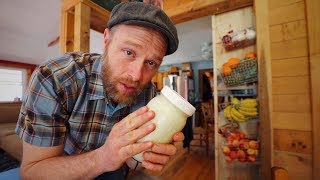
In this instructional cooking video, the host (Speaker A) demonstrates how to make cultured cream, a simple fermented dairy product, using a 1:8 ratio of yogurt starter to cream (½ cup starter per 4 cups cream). The mixture is incubated at about 100 °F for 24 hours in a dehydrator or a warm oven with the light on, then chilled to solidify. The host and co‑host Rebecca discuss various serving ideas—on ham and beets, fried eggs, chicken tikka masala, soups, and even as a frozen dessert blended with honey that tastes like strawberry cheesecake, suitable for the GAPS diet. They also mention other fermented foods they use, such as salsa, fermented juice, and sauerkraut. Throughout, the host promotes a free online crash course (March 11‑15) led by Jill Winger covering fermentation, canning, sourdough, and grass‑fed meat preparation, urging viewers to sign up early. The tone is enthusiastic, conversational, and instructional, emphasizing the health benefits of fermented foods and the ease of making them at home.
Chapters
Here is a food that is so delicious, so easy to make, so healthy— cultured cream. I'm going to show you guys how to do this right now, and I'm going to show you, if you're interested in more fermenting stuff, how to go and find that out, get a crash course on it, like next week from like March 11th through the 15th. Anyway, cultured cream. To make cultured cream, it's super easy. Let's pretend this is cream. Well, Cream that hasn't been cultured yet. This is cream. You put how much? You put yogurt in it to do it like a starter?
Yeah, so it's for in this quart.
Let's say it's a quart.
Um, uh, it's a half a cup of yogurt starter.
So you fill it up to about there. Good. You have to leave room for the half a cup of yogurt.
So what I do is when I cream separate, it's in that jar, it's in the bowl, and I can see how much is it. And then so for every 4 cups I put a half a cup. Of yogurt starter. And so if I had 6 or 7 cups, then I just adjusted according to— for every 4 cups, you get a half a cup of starter.
Okay, so 1 to 8 ratio. We put it into a dehydrator, we cover it up with a towel, we set it to 100 and leave it for 24 hours. That's it. If you don't have a dehydrator, put it in your oven with your light on in the oven. That keeps it just barely warm. That's usually enough. 24 hours, cover it with towels, put it in your oven, 24 hours. Then we put it in the fridge and that helps solidify it. Cultured cream, basically on everything. It's going to go good on the— what is this? This is pork and beets.
Ham.
Ham and beets. And then, uh, fried eggs. Under-fried, I guess. Under easy.
Yep.
And this is the cultured cream. It's absolutely smashing. Would you say?
Yes.
So I would say that would be definitely one use of it. And you also have your fermented, fermented salsa, which is also good.
I love that.
You love cultured cream? Can I put some on your plate then? What is cultured cream, Gideon? Cultured cream. What is it? Yeah.
Eh, coco chocolate?
Do you know what he's saying?
I can't say when I'm eating.
Oh, okay. That's why. All right. So we got cultured cream for breakfast. We've put it on the— anything. Can you think of something it does not go good on? I'm sure. It doesn't go good in yogurt.
No, bananas. Okay.
So we got that fermented packed goodness this morning. Yogurt, cultured cream, and fermented salsa.
We have fermented juice in our broth.
And this stuff is absolutely delicious. I can't believe what we've been missing out on. I can't believe all the applications for it. And you could have it for lunch. Totally. Put it in a soup. There we go. This is a chicken marsala.
Chicken tikka masala.
Tikka masala? It's an Indian dish. She put cultured cream in that sauce.
Yes.
It's so amazing, and that, look, that's a— don't be fooled.
That's cauliflower rice. It tastes so good, y'all. I guess that's what happens when you deprive yourself for 7 weeks.
This is not deprivation anymore. This is amazing. This is—
and then rutabagas, kale, and sauerkraut and broth.
And those rutabagas look so much like a sweet potato. Mm-hmm. Your mind is tricked.
It is.
I'm going to show you by far my most favorite thing to do with a cultured cream. This is cultured cream frozen with about what, Rebecca? Half a teaspoon of honey? And is that it? Is that it? I don't know why, but it tastes like strawberry cheesecake, y'all. So you blend that together, put it in little freezer thing— freezer blocks, let it freeze. Mmm. Now we're progressing on the GAPS diet and can have applesauce. Put some of that in there, it is like you've got ice cream on your applesauce. And this is especially great for somebody on a health diet, like we are on restricted diet, not eating a lot of sugars, not eating any sugars, but a bit of honey Little cinnamon on there. It's like a dessert. It is a dessert. It's wonderful. Now, if you like that, that's something you guys can easily do. You can go to the store and get store-bought cream and use that. You don't have to have your own family milk cow. If you guys want more fermented food— that's like food that has been turned into superfoods, like medicine. If you guys want more of that in your life, there's a crash course my friend Jill Winger is putting on this coming week, March 11th through the 15th.
Only.
It's a free crash course, but you got to get in now, and you got to get in through those dates. And I think you have to sign up for the— by the first day. So you got to get in by the 11th. Go ahead and do that. I think it'll be worth it. And not only is she going to be talking about fermenting, she's going to be talking about canning, making sourdough, working with grass-fed meats. It's going to be amazing. I think it's going to be one of the homesteading events of the year, at least online events of the year. So go and check that out.