The Homestead Tsunami (last call)
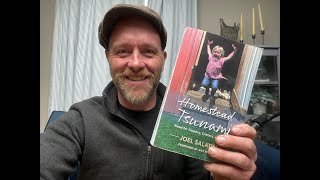
In this live YouTube stream, the host (Victor Justin Rhodes) reviews Joel Salatin’s new book Homestead Tsunami while promoting a limited‑time $39 bundle that includes the book, three PDF how‑to guides (composting, tomato growing, sourdough), and a private two‑hour book‑club webinar with Salatin. He explains how he discovered the book while filming at Polyface, outlines his personal reading strategy, and shares six key takeaways: (1) a reminder of the “why” of homesteading to combat burnout; (2) the joy and humor in Salatin’s writing; (3) insight into Salatin’s mind and decades of experience; (4) a renewed appreciation for composting, illustrated with his own early compost story; (5) concerns about land parceling and inheritance, prompting reflection on legacy planning; and (6) the essential role of family and community in sustainable homesteading. Throughout, he intersperses anecdotes about his own homestead life, engages with live chat participants, and repeatedly urges viewers to act before the Thursday midnight deadline to receive the bonuses and webinar access.
Chapters
Hello, replay viewers. If you're seeing this, we're just waiting for people to get on live. I appreciate y'all. I have to jump to the chase here. I'm going to review, uh, Joel Salatin's newest book, Homestead Tsunami. My first time doing a book review, so that's going to be fun. But I'm also offering this now and through Thursday midnight Eastern along with many bonuses— how to do, how to make compost, how to grow tomato, even how to make sourdough, which is much of what Joel talks about in here being the heart of the homestead. We're going to talk about that in a second. Let's just get people on, make sure everything's working okay. Definitely going to talk to you about the 6 takeaways I got from the book. Hopefully we can have a little chat going on here. I'm happy to interact with you guys some. It's just cool to get on here and get with everybody. Oh, people are starting to roll in. Ada and KG, hello and welcome. Let's give it about— I don't know. Good morning. It's afternoon to me. Where are you calling from, Rosemary? Fosnola Cowbell. Uncle Justin. Hey man, I see you a lot in the, uh, Abundance Plus. Thank you so much for being a member and being in there and interacting. I appreciate that very much. I'm glad to tell you now personally, I see you, I see you in there. Okay, uh, Goshen in the house. Uh, you loved my first book so much. Thank you. Uh, The Rooted Life. That Rooted Life was basically a compilation of, at that time, a dozen years of homesteading experience, plus all the books I had read from Elliot Coleman, from Joel Salatin, from Harvey Ussery, uh, Bill Mollison, and just condensed it down to one. Today we're going to do a book review on Joel's book, Homestead Tsunami. Uh, yay, Habitual Hobbies, first live with me! Oh, you're, you're calling in from Missouri. Missouri is definitely one of the most underrated homestead states for sure. Cowbells says Abundance Plus will help so many people. You keep it up. Yes, thank you. And with folks like you in there interacting with people and posting and answering questions, it definitely makes it better. Butters Plus is like one of those things, it's almost like a social media where the— you want a mass, you want to— there's a critical mass, and like your enjoyment and use of it improves as other people get on. So it naturally makes those who in there want to share it and want to get other people involved, especially now that we have the new community platform that's really smooth. And I appreciate you going in on there. I'm in there every day. We've got Scotty Rains, Southwest Michigan. Boy, I bet it's cold up there. I thought it was cold down here at 18 degrees this morning. How cold are y'all? Maybe that's what y'all should be putting into the chats. How cold is it for everybody right now? All right, we'll get through that. Okay, I've been, I've been on here, uh, we got East Tennessee, Christie. Okay, y'all drop your temps while I get into this. I won't, I won't take you long. I know you guys are busy. I just want to take a few minutes to share and try a book review. I love to read. One of my goals is being 45 years old is to consume one book a week, uh, for the year, and that's difficult And maybe impossible, and it just may be, but I did ask myself, well, how can I? I only get about 1 hour to like actually sit down and read, you know, between the Epsom salt bath at night and the sauna, things I do for my health, I'm reading. Between those, it's about an hour. That's not gonna get you a book read once a week. What is gonna get you a book read? So I said, how am I gonna do this? Because I really don't want to take take any other times. I won't say I don't have it. I'll say I don't want to take away anything else. So how could I do it? Ooh, audiobook blend with text reading. I'll get the audiobook, and when I'm doing dishes or on a drive or doing my training— guys, I've been doing that kettlebell training and just listening to podcasts. And if that's 30 to 40 minutes a day and I do that 5 days a week, That's like 2.5 to 3 hours. So that plus reading 7 days a week, that's 7 hours, plus the 5.5, that's like 13. See what's happening? And that's like over 13 hours a week reading. And then, and that's not counting time doing dishes or if there's time in the car. So anyway, I don't know if Joel's— I don't think his book Homestead Tsunami is on audiobook yet, but I bet, I bet it's coming. Anyway, I discovered this book when I was actually filming with Joe. I'm gonna talk about how I discovered it, why I read it, takeaways, and then I am— I should mention this now for those of you getting on here early. I am offering this through Thursday. I'm able to sell it. I'm privileged to sell it. He actually mentioned me in this book. That's crazy. That's crazy when Joe Salatin mentions you in a book. I've been reading his books for like decade or over, over that. And since I've begun, his book Salad Bar Beef got me started, guys. So to be mentioned was a real honor. So I'm proud, I'm proud of this book. I'm gonna talk about— oh yeah, I'm offering it through Thursday until midnight. And I'm not just offering this, guys, I'm offering a bonus where if you sign up by Thursday at midnight, I secured Joel for a 2-hour book club meeting. It's private. You guys can ask questions, comments, derogatory remarks, and we'll just hang out with Joel in a book club. That'll be at the end of January, so you have plenty of time to read it. That gives you a month to read it. Come on, guys, you can do it. You can do it. It's a fun read. It's a quick read. It's not too technical. It's not a how-to, so it's a quick read. Dang, 32 and feels like 26 in Maine. We're about that right now in North Carolina. Um, so I left a link for that down in the description. We have some bonuses with that. Joel, I'll talk about that more in a minute, about his heart for tomatoes, composting, and sourdough. Those, those three things kept re— keep recurring in this book, and I'm like, oh, this is not a how-to, but what if I created a how-to and made it like PDF bonuses? So I've got those for you: how to compost, Tomatoes and Sourdough. Okay, in the, in the, um, you can find out all more about that link in the description. Okay, let's grab the content. Um, I'm going to talk to— I'm going to give you the takeaways. I had 6. I might think of more as we talk. This is live, we'll see how this goes. Um, and then, yeah, and then I'll, uh, then I got this— I got— I want to then talk about the importance of Growing a tomato, doing compost, and doing sourdough from Joel himself. I've got some quotes from the book. We'll open it up and look at it. Let's grab right in. I discovered this book when I was out filming with Joel. I forget what I was doing. I was at Polyface and I was filming. Uh, I think he had done Polyface Micro, the book, and already, uh, I was— we were thinking about promoting it for him and this and that. And already at the very end of writing his book, like he's now marketing it, he's already, he's already talking to me then about his next book. He's just seen this. He explained how he's seen this wave in homesteading, this tidal wave, and I guess it ends up being called a tsunami. This rush of people, and I saw it too in 2020 and 2021 especially, views on this channel went up 60%, uh, sales surrounding homesteading, you know, uh, McMurray Hatchery was selling out of chicks, uh, Premier One Fencing couldn't keep up with the demand, uh, seeds, guys, seeds were getting all bought up and you were on waitlist. It was hard to get live animals at the time, even like on, on Craigslist. And, um, So that was the explosion. And although that's tapered off a bit, it's still— there's still a rush. There's still a swell. And now, especially this time of year, guys, we have 142 people on here. It's fall. And this is a burnout time of the year. This is a slowdown time of the year. And yet here you are. And, uh, many of you have come to homesteading during that time of when, you know, food shortages and things like that, uh, supply chain issues entered our vernacular for the first time, and you wanted some of your own control. But anyway, Joel was talking about that and, and really passionate about that, and basically he wanted to write a book on the why. You know, he's written a lot of instructionals He wrote a book on more how-to type stuff with Polyface Micro, but now he felt like he really needed to get to wine. I think there's something special to that, and I'm gonna get to that in a minute. So why did I read it? I read it because, well, it's Joel's. I've just about read everything. I haven't read every single thing. He sent this to me. And signed it. What'd he say? To Justin and Rebecca, what would I do with friends like you? Blessings, Joel. Isn't that so nice? So how are you not gonna read that? I'm gonna read this. And at first I thought, you know, it's gonna be a why on homesteading. I'm there. I know why. I've been doing this for 15 years. I went through that 7-year burnout stage. I'm here. I'm set. I have to do this. We have to do this for my health. We cannot buy the kind of food we need. So I'm sold. So we'll see how it goes. I'll just see if it's just gonna be good for you all, right? And so I read it, and then I'm like, wow, I'm so glad. And even though Somebody who's just getting started homesteading will enjoy this book. So will somebody who's seasoned enjoy this book. Here's how, and these are my takeaways. These are my 6 takeaways. It reminded us of the why, and I think that's so important. You know, we had, uh, I'll speak to this in a vlog. Maybe I already spoke to it. Yeah, I spoke to it. Um, someone asked Joel We were in a roundtable and they said, how do we prevent burnout? And you know, I thought, if they were asking me, I would say, well, make sure you rest one day a week. Make sure you take care of yourself each day. So a little micro rest each day and maybe once a year, you know, try to slow down in the winter. If you're overwhelmed, maybe cut some things back, reexamine your goals. Figure out what, what maybe you could take off that's not a powerhouse towards your goals, things like that. Joel didn't say that. He said you got to redefine and rediscover your vision, something like that. And I'm like, wow, okay, leave it to him to go really deep on that. But this book was a reminder of why we do what we do. And it comes at a good time in the fall when we're naturally in a burnout stage in homesteading. There are cycles in homesteading, and fall can definitely be a burnout time. But, uh, it gives you that reminder. If you're just getting into homesteading, well, it can motivate you towards that. But if you're in it and in the throes, it reminds you because you can do all those things I talked about you know, slashing things, you know, cutting back, making sure you get enough rest. But if in the first place you're burnt out, you're not going to be motivated to do that anyway, to continue on, because you're burnt out. So you got to revisit that vision and re-understand why, so that you'll be motivated to put the boundaries in place so that you'll get the rest, you'll get the energy, you'll get the power, whatever it be, to continue. So now I'll say the second— that— so first of all, it was that one. It was that reminder of why. Okay, the second takeaway I got out of it is it was the joy of Joel, I'll call it. And the books are always easy to read. Like, if your goal is to read a book a month, a book a week, whatever it is, you're gonna fly through this one. It's easy and fun to read. There's plenty of jokes, there's plenty of sarcasm, there's plenty of profound truths. Guys, I've underlined lots, lots in here, and I've ear-tagged and made notes all over this place. Okay, so the joy of Joel. Third, the mind of Joel. When you read somebody's book— somebody said earlier they enjoyed my first book, The Rooted Life— when you read that book, when you read the book of an author, when you— when somebody goes and creates text, unlike me creating this live or even the vlog, there tends to be a whole lot of thought going into this. A lot of background thought and experience coming to the plate, but also pinning it, getting it just right, having editors. You know, it's not a quick turnaround. Books can take just the publishing process, but the Rooted Life, I think we started on that like 2 and a half years before it came out. So you have the— the author has this opportunity to say exactly what they want to say. And you have— have you ever read a novel and you can understand exactly what the character is thinking and feeling, and that's special. If you watch the same story on a movie, maybe they turn that novel into a movie, they're very limited as far as getting into the heart and soul of the character because it's not all dialogue. When you're reading a book and it's telling you how somebody feels, nothing's being said. So in a movie, the best an actor can do is make an expression, and we think we get it, and maybe we do, maybe we don't. So there is something very special about somebody's putting their heart, soul, and 100% of their mind into a writing, and y'all get to we get to take that on, observe it. And if Joel's got 60 years of experience homesteading, well then, it probably took— it probably take 3 hours maybe to read this. And I captured that 60 years of experience, his experience and thoughts, into just 3 hours of reading. And now, you know, it's not a how-to book. It's one that makes it easy and pleasurable to read. How-to books are great, we need them, we need that instruction, but we also need that, hey, go take a bath, get in the sauna, just relax and read a book and just get excited about home, just get a new excitement for homesteading. When you read, when you read someone's book You have the privilege of stepping inside their mind, soul, and heart. And when you live your life out after that, whether there's a direct application from the book or not, you can approach life and making your decisions and thoughts and things based on adapting their heart, soul, and mind. So in a way, you get closer to thinking and being and acting like the author. So in this case, Joel Salatin. And also that case, when we're reading something, we want to think about who that author is and do we want to be like them? Is that somewhere I want to be? Is the way they're doing or living what I want for myself? And in the case for Joel, of course it is. You know, he's got a child, a grown man child, still working on the farm. It's a multi-generation. It would be his mom, him, Daniel, and his kids. So 4-generation farm. Yeah. Okay. And he's surrounded by young people and is is able to travel. People are excited to hear his expertise all over the country. Yeah, we'll do that. His— the proof is in the pudding. You go to Polyface, and anybody can at any time and see the homestead around his house and the premier market farm over hundreds and hundreds of acres. So we got to step inside of the mind of Joel. Fourth, I got a renewed appreciation for composting. Now I'm all for it, and in the Rooted Life, I'm like, hey, you guys are just getting started, you know nothing, buy your compost, buy your plant starts, and go. Just go. That gives you a bulletproof method. But listen, also, on the other hand, you know, he said— I think I'll get to this in a minute— but he talked about how composting can be the difference between a homesteader and somebody who's not. And I think what he meant by that is really what happened to us very early on. My dad had, uh, 3 rental houses and we were renting one from— that's the house we currently live in now. And for me to pay rent, I would take the part of my rent would take everybody's trash. And I remember it only took one time to taking everybody's trash, including ours, and dealing with that nasty trash that had that food in there. I wish there was some poetic story of how I got into composting, but that's it. I had to take the trash, and there was food in that trash, and it was nasty. I'll save you the details of the maggots and stuff. I'll save those details. I came home and said, we're not gonna do that. We live in the country. I I don't think we were having a garden or homesteading yet, and we— I, I think I put together a 3-walled pallet bin and just started throwing the food in there. Guys, when we travel, I can't even throw food away to this day. We travel, we usually stay in an Airbnb. There's usually some wood some there. I usually just save the eggshells and the, the banana peels and whatever it is if I can't bag it and take it home. If I'm not going home that soon. I would literally throw it in the woods and feed the forest. So that was probably one of our— definitely one of our very first, if not the very first, acts of homesteading in composting. If that's all you're doing, guys, you can compost anything by putting it in that pallet bin and just leaving it. Just keep putting stuff there, and eventually, guys, it will compost. You'll have some fresh stuff on top because you, you've kept loading it, but eventually you can go rake some of that fresh stuff off and underneath you've got compost. That's all there is to it. But anyway, Joe reignited that joy and reminded me of the importance of composting. And so definitely charged to, you know, turn our deep bedding into compost, have the chickens help us turn it. And so that's how it's applied for me, but being applied for you, you could just keep food out of your trash. Get it out of the garbage disposal. Don't do that. Don't get into the septic tank. If anything, if nothing, throw it in the woods somewhere and feed the forest. But if you want more than that, designate it a pile somewhere. Some cinder blocks around just to contain it. Some 4 pallets stacked together in a cube is perfect. Tie it together with some sort of string or wire and and then just start throwing material in. You can worry about getting ratios better and fine-tuning and all this and that later. Let's just get going. Anyway, the, the fifth thing, takeaway, would be the— I was so fascinated. There was a section on where he talks about how land is getting broken up, you know, people will their land to their children, and inevitably many of the children, or at least some, sell off. And so parcels of land are getting broke down smaller and smaller. There are cultures that he visited— he's told this story in the book— where the firstborn gets everything. And Joel was talking with somebody who was in that situation, and they were the secondborn, and they were like, well, doesn't that bother you? And he's He's like, oh no, well my job is to make sure he keeps it. So, you know, just this fascination of the, you know, of these stories of a well-traveled man and these different perspectives. And maybe you won't go to that extreme when you will your own children something. And you know, this is something Rebecca and I have to wrestle with is we want to— our heart is to create a legacy property. And so then how then do we pass it on to our children's children type of thing. And so we need to think about these things. And so it's good to— we, we know what we know, and, um, of inheritance, whatever that may be. But then it's good to be thrown this whole other idea of it. And then we may not go to that extreme, but we might go somewhere in the middle or discuss— discover something new. So I think I appreciate him for the fascination this brought. The sixth thing would be family and community. So, you know, with homesteading— and I think this is good that Joe put this in print, really, this thought— you know, we want to— we come to it as a— from a sense of independency, from a desire for freedom, really. You know, we might be trying to save money, we might be trying to better our health, but then why are we trying to save money? Why are we trying to be healthy? Ultimately, it's for more freedom. So we come to homesteading with freedom and a lot of times this independency, but then if we're— at some point we have to realize, and, and you do, I think, naturally, if you hang in there, you need other people. And the key to homesteading is community. And actually, the deeper I've gotten to homesteading, as ironic as that is, you know, the more I stay at home and, and, and focus on growing things, the more I've— we've created community around us. When I've walked out of our house to meet somebody who's coming to buy a pig, which that would create community there in and of itself, when I walk out of the house And someone who lives 15 minutes away from me is just taking a stroll in their car, comes driving by, and it ends up being Andrew Rhodes, a long, far-off cousin who ends up being, being our grader, being our contact for hay. Guys, we get local hay now. We used to have to get hay all the way out of Missouri, unsprayed hay. Now we're getting it 15 minutes away. Away. All kinds of things, and all that happened because we're here. We're not off. We traveled some, but not a lot. And we consolidated errands to one big day. We're here, and we're crossing the street, and we're seeing the old-timers come by, the locals come by. And we're making these contacts because we're here. Folks want to find community. One of the best ways to find community is stay put. Don't go— don't— going and finding— when you're lost, when you're separated from somebody, somebody's got to stay put or you're not gonna find each other. If you're both looking, you're not gonna find each other. So ironically enough, the One of the best ways to build community is to stay put. Someone who worked for us a number of years ago, she noticed all the people coming and going on a daily basis. She said, y'all, and us very ever leaving, you know, this was pre-Jonah's injury and we had no, we had no appointments, anything like that. And we literally stay home for a week. She said, y'all are the most socialized homebodies I know. So, you know, I appreciate Joel. Most of the books is this fierce independent mentality, this freedom mentality, just let's learn how to grow things, build things, and repair things attitude. But then wrapping it up with you can't do it all. And it's good to know other people who can grow things, build things, and repair things. It's good to make that connection and say, yes, we came for this fierce independent freedom. And Rebecca's texting me. I think that's it. That was the 6 takeaways. Now, if you haven't gotten this book, I highly suggest it. I've got a deal for you guys now through Thursday, Thursday midnight, 11:59 PM $39. If you get it through us in the link down in the description, you get a private webinar with myself and Joel for 2 hours at the end of January. So plenty of time to get the book, read the book. You'll get this book in time for Christmas. So it's $39 for the book and includes that bonus of the book club meeting with Joel. And then I did a PDF. Okay, I did a how to grow tomatoes PDF. He talks about this a number of times in the book, how important it is to grow tomatoes. Tomatoes are kind of quintessential of the garden, at least, if not homesteading. And, uh, there's— I'm giving you a compost guide. Let me just mention, I choose to give you guys some of these how-to bonuses based on his heart for these things, and then I wanted to give you instructional. So if one object defines a homestead versus just a home, it would have to be a compost pile. Building compost piles, the ultimate momentum indicating that a person understands ecology, cares about stewardship, and enjoys participating in caretaking responsibilities. I mean, that sounds fancy and all, and now I'm even reading that and thinking, well, that's not me, right? Because I was just started composting because I didn't want to handle food in the trash. But in a way it is, because I, I cared. I enjoyed participating in caretaking responsibilities, and it was awful to take trash with food in it. So yeah, I guess it counts. But with a homesteading compost pile, you can do good anytime, every day, without burning an ounce of gasoline or using internet computing energy. On a homestead, compost is the backbone of the garden fertility program. He's never used any fertilizers in all his program, and now the compost, uh, definitely, definitely a motivational— there's so much of that, guys. There's so much underlining. So I'm going to do— I, I've got a little guide from my friend Amy Henderson, helps you decide kind of what kind of compost pile you want to build based on certain answers. It's kind of like one of those books where you decide where you go as you read it. And then lastly, sourdough. At one point he said in here, you know, all was hunky-dory and then COVID came along and then, you know, our freedom was wrapped up in this fierce independence and then COVID came along and we're all humbled and sourdough, because so many people were getting into homesteading, and with homesteading comes sourdough often, if you can eat gluten. I can't eat gluten, but I still love you gluten folks, so I'm gonna get you something on sourdough, and I want you to enjoy one for me. Sourdough, he says, became the gateway to freedom. So next time you are making homemade bread or, or sourdough, or frying eggs, and maybe especially when it's getting mundane or old, sourdough— tell yourself frying eggs becomes the gateway to freedom. So homesteading becomes the gateway to freedom. Guys, yesterday we ran out of cream, we ran out of milk. I, uh, I can't no butter. I think we're out of milk too. I came over here, guys. I'm in the farmhouse right now, so the milk parlor is right over there. And I came over here and I said I got the milk out of the fridge for us. I— there was like 7, um, there was like 4 gallons or something. So I harvested cream and saved a quart of cream for everybody's tea, and then I saved a half a gallon— no, we ended up with half a gallon of cream that I made butter out of. And, you know, during that process, I grabbed some stuff out of the freezer between our bedroom and, and living room for dinner. And that sounds glorious, right? And easy. And it was. And it was convenient, as opposed to having to earn money and then buying it at the store. Because you can't just say, oh, it's easy to go buy it at the store, because no, you had to earn— you had to earn that money. So, uh, but that afternoon I was humbled. This will be a vlog next week. We recorded all this. Cow's water froze. There was a freeze in the main line. It wasn't just one freezer was 4, and I'm hiking up this mountain. It's probably a 300-foot elevation gain. I ended up having to hike this mountain like 5 times. So I ascended and descended, uh, ascended a quarter of a mile vertically, a quarter of a mile, and then descended about the same. Yes, it was quite the good cardio. I kept telling— at one point I told myself, because I was trying to stay positive, okay, this is really good cardio. I definitely don't need a gym membership. Welcome to Earth's Gym. But the point is, it probably would have been easier just to work a job a half a day and just go buy it. Well, the problem is, for me, I can't buy this stuff. Like, this stuff is A2, A2 grass-fed raw milk, which is not available around here. But anyway, the point was, it could be easier. But I was free. I was in the woods. I was really doing what I wanted to do. I was on nobody else's schedule. It was— yeah, I had to push some things back. I had to stay up a little later to get caught up on my business and stuff like that, playing catch-up today. But it was really me who was in charge, and I was breathing the fresh air. And like Cowbell said, I was getting— I was getting my cardio in. I was able to work in a sense. Even though I wasn't earning money, I was saving money, and you can't tax that. So anyway, bonuses on sourdough, compost guide, tomato PDF, and a 2-hour, uh, webinar with Joel. If that's not enough for you guys for $39, I don't know what is. I mean, you're gonna get that value times 10 just from reading the book. So anyway, link down in the description. Thanks guys for coming out and hanging out with me. Out with me. I better get on— get off pretty soon and see what Rebecca is needing. Yes, folks are saying they're gonna check it out. Hopeful Homesteader, Composting is Beautiful, Beauty in the Garden, Green Hearts, Adios Amigo, Aaron. All right, we'll talk to you guys later. Appreciate you. Happy day.
More from Justin






If I had to start my Homestead all over again, it could only pick one animal… 




