The “Not Enough Pasture” Livestock Solution
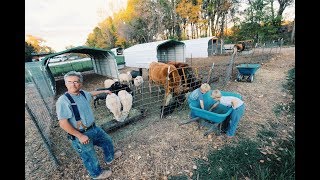
Chris and his New Mexico family built a fully mobile livestock system to farm high-clay, arid land. They move cattle, sheep, and calves every few years using portable fences and structures, rotate cover crops like triticale, and use wood-chip mulch to manage manure. The setup lets them graze without enough permanent pasture.
Chapters
This whole barnyard is actually designed to be moved.
We got it hooked up, ready to go. Looky here, looky here. Arizona to New Mexico today. Going to New Mexico. Let's see what New Mexico has to offer. With the big boys getting fuel. And look what I've calculated here. A lot of folks want to know when they want to know about this bus conversion type of stuff. You know what that means? That 8.07, that's how many miles to the gallon we're getting. I don't think that's too bad for a 1988 Bluebird school bus. Let's see what else we got to do here, guys. We're making good time. 2 hours and a half according to the GPS. Yes. So bus time with lunch, that's probably 3 and a half, 4.
Let's go. Almost there.
I think here come our hosts. Hi, are you Chris? Yeah, sure am. Okay, somebody behind me? Yeah.
Oh, but they're not with you, right?
No. Should I just pull over?
You're fine right there.
Hang on. Hello, Rebecca. He's a little worried we're not going to be able to get this big rig in there. I am too. Let's go see what we got.
Let's put eyes on this.
Hi.
Hello, nice to meet you.
Nice to meet you. All right, is this the only tight part? Yes. Okay.
I mean, there's gonna be— to turn it around in our yard, there's gonna be a few points.
Okay, a turn. What I'm worried about is this tree, but make— actually making this turn, we can try. Let's try pulling it. Okay, if that doesn't work, I'll just back up and then we'll back in.
Think we can make it?
I don't know.
All right, we're good.
We made it. Oh, let's go get our camera. Lily, are you coming or are you staying? Get in. You're gonna go on the tour?
Are you gonna have a fun tonight?
Uh, we're gonna go see if we can find out what we're gonna get into here in New Mexico. Looking pretty beautiful right here. Looking like a mobile plucker. What's that? Anybody want to guess? I'm not going to give it away until tomorrow. See if anybody can guess it in the comments. What is that? Okay, let's go see if we can find Chris. I know he wanted to do some chores. Hey, you guys know where Chris is? Beautiful house. Hey, do you guys know where Chris is? Come on, come on. This is interesting. It's got a wooden pedal here. So that's— this is like for somebody like you. Come on, get in. Come on, get him off the tractor. Come on, buddy. We going? Let's go.
I'm riding your thighs.
Hey Chris!
Hello!
Thank you.
Very nice garden.
What is this?
What do you think that is?
Garden!
Yeah, it's a garden. What are they growing in there?
A bean ranch.
Whatever he said. Whatever he said. I think we got another first here. We're gonna get to ride the orange cart. Did you build this greenhouse yourself?
Yeah, I mean, we got it from— we got it used and set it up and we framed the ends in. You didn't get anything fancy? Probably more labor-intensive than it should be. Unclip the clip and hold on to it. Don't let it go. Hold it from the clip and just let it—
You shutting the greenhouse, Josiah?
Yeah.
Bring it down. Look, he's growing strawberries without any soil. Is this our first aquaponics stop on the tour? Is it your first?
Yeah, it is.
Yeah, yeah, we haven't done aquaponics. Yeah, we had some extra strawberries to transplant, so we threw them in there.
We've tried them before with with— they do better in soil.
Are they going to make it, or is it going to be too, too late in the year?
I think they'll make it. Yeah. And then that's a celery that we've been harvesting on for, uh, quite some time.
I think that celery is going to make it.
So yeah, I don't know if you can see— tomorrow might be a good time to shoot.
Okay.
Uh, the fish, but we can see how it goes.
Okay, no, no fish drama today, Chris.
I think no fish drama.
What we'll do is we'll have fish drama tomorrow.
Okay.
And, uh, we can pick a time where you might be able to film, uh, in— into the water.
Okay.
Yeah, and we can get a ladder set up here, get you at an angle. Yeah, so we can do that.
And you're from the state, right?
I am. Green chili, though, when you talk about New Mexico, you want to make sure you say talk about green chili.
Okay, are we seriously— we're gonna all get in this, huh? You guys get him up there and put him on somebody's lap.
What's it on mine?
What's this field of grass right here?
That's triticale.
Okay, what do you do with that?
Um, it's a cover crop. Oh, so we'll, we'll let it stand tall for the winter. It gets really dry, really windy in the spring, so the more moisture I can hold in the soil— okay, we flood irrigate it. We can spray irrigate it, but I just assume not.
What's up with these big old guys?
Well, they're curious.
You guys are huge.
They're curious.
What are they?
Those are, uh, both steers. Angus, Jersey.
You raise them right here? You raise them right here on this deep mulch?
We, uh, this is a corral system that we've set up for them. They're pastured. We use rotational grazing, and, um, right now, uh, for them to get onto, they'll, they'll—
were they, were they recently flood irrigated? Yeah. So what was the purpose of moving them from one pen to the next?
Um, this calf is still nursing.
Oh, okay.
So we'll, uh, we milk once a day in the morning.
So, uh, so we, so we're gonna split them off, give mom a break so you'll have some milk in the morning.
Get any milk?
Yeah.
Okay, calf sharing.
This whole barnyard is actually designed to be moved, and we usually move it every couple years.
Yeah, I see, it's a T-post.
T-posts, these frame fences, these frame gates, which should have been worth their time that they took to build, and they've lasted pretty well given the New Mexico sun is pretty hard on wood. They just wire onto T-posts and can move around, and then it gives us a structure that the animals really recognize for entry and exit. So if we put one of these out in the larger pastures, they'll key into it and go through it. This area we call the hallway, so it's used as a chute and it's used to move animals between the different—
Cool.
We've done pigs in here too. And then this leads out to the main pasture.
This is alfalfa hay. It is. We're going to feed these cows their hay. Do you get to choose when you flood irrigate or is that somebody else choosing that?
We have some choice. It's a back and forth, but yeah, yeah, we have some choice, but, uh, it depends on the available water for the season. You guys want to throw the hay?
Come on, guys, get in there, get in there. This is your family milking cow?
It is.
How long have you had her?
Since 2006.
So you, you calf share with her, so the calf gets day milk, you get the night milk. How much does she give you in the morning?
It varies a great deal, actually. Um, the quality of the hay goes up and down.
Yeah.
And, uh, so we're looking to a gallon to 2 gallons.
Cool. Is this quality hay?
This is okay. Yeah.
Why is it okay? Because of this? It's a little bit of—
yeah, this, this will, this will go to the sheep. Yeah, just a little bit.
Sheep are less picky than the cow.
And, um, this is pretty good bale actually.
Yeah, that looks pretty good. This is probably just— and that's just here sitting up, sitting down on the bottom. Did, uh The sheep, the sheep will eat the lesser hay.
They do.
Yeah.
Okay, so will the steers.
They're, they're off.
Yeah, they're on a diet. They're, they're about ready to be harvested, aren't they?
They're going to be disappointed with how much they're going to get, but losing weight, feeling great.
So when are they done? They done this season?
Uh, the larger one is. Yeah, we'll butcher him.
And the other one will go another year.
May butcher him in the spring.
Okay, do you do that yourself or you send them off?
And, uh, we do, we do it ourselves. We usually do, um, one every year and a half or so. Okay, let's go do the, the sheep hole. Except I'm feeling sorry for those guys, they need a little more.
Halikai has in this area where he has to keep them for a while because The fields are wet because of flood irrigation. This is really neat that he at least has wood chips down, keep the sanitation level up. See, the manure will come, it'll mix with this wood chips. It doesn't smell, it does not smell here. It'll mix with that, you end up with a great compost material. I imagine you move the whole barnyard and then you plant, don't you?
Yeah, we'll scrape that off. It's more material than it looks like. Oh yeah, it, you know, after 2 years there's quite a bit. Now we, we hand remove as much manure as we can daily.
Yeah, because why?
Because so we don't have to move the barnyard as often. Okay, manure will really accumulate, and then you go and compost it or something, or we'd just have to use more wood chips, which have a price of their own. We are usually able to get them for free. A lot of them come from our farm. And then, but yeah, it's scraped up and piled and composted and, um, killed and ripped and planted, uh, with a cover crop first because you'll have some eutrophic areas in it.
Okay.
So you'll find out what those are.
And, uh, you say that again?
The eutrophic.
What does that mean?
Oh, that's, um, that's nutrient-rich.
Oh, okay, okay. That's a very nice way to say that, isn't it?
I think it's a reasonable way to say it. It's maybe more of a water ecology limnology term, but nutrient-rich place.
We could Google that, which means a lot of manure.
Yeah, so if you know the feeder, we move the feeder constantly. Yeah, and, um, that helps to distribute the, the manure and the urine. But the urine, of course, soaks in and it'll soak down. And yeah, then if we do get rainfall, there'll be some leaching, but it's minimal.
So the COVID crops then absorb that, use it, eat it? Yeah.
So I'll cover with something like, uh, that's a fairly heavy feeder, like milo.
Okay.
And, um, and, uh, and then we'll follow that with, uh, yeah, then you till that in? Yeah.
Okay. Hey, throw them in there, guys. Of course. Come on, Mr. Brown, leave some for Mr. Brown. So what gave you the idea to have a mobile barnyard?
I was always a proponent— once I heard the idea of rotational most everything, um, it seemed like a logical step. We tried a few different things. We tried— if we keep the cows on pasture over winter, they'll— and, and the sheep, the sheep will big for roots. And then we get a dry spell and a lot of wind in the spring, and we see a lot of dust, we see a lot of soil leave the farm. So that's why we went with the mulch beds. Our soil is clay, very high clay content in the soil. So without any bedding, the clay, and when it does rain or snow, it's messy.
You must be building it up. So nice though.
We were growing a dent corn, a Hickory King, I think, and, uh, southern— it's a southern variety.
Okay.
And, uh, it was fabulous.
Oh good.
14, very, very tall.
14 feet?
Very tall. So the, the productivity out of the first couple years is amazing. And, um, like I said, I feel like you're, you're catching that You're catching that resource that you might otherwise lose unless you could keep them on pasture all the time. And we, we can't because of the flood irrigation and soil conditions and predators. The sheep have to come off the fields at night.
For those of you who haven't seen our Arizona show and may not know what flood irrigation is, it's pretty much you have canals I saw them over there. They're over there. And you can ask for that—
you, you—
for your place to be irrigated, right? And you open up your section and this basically floods?
Yes. Is that right?
Yes. Looking at this mobile barnyard, the benefit is with the mulch and whatnot is that you don't get overly saturated with urine and manure. And you're pulling some of the manure out so that you don't have to move this as often, right? Or put in more wood chips because those are limited and take work. Even if they were free, you have to spread it.
We have to spread it.
And then the other keys I would say to this system— correct me if I'm wrong— but our T-bar posts— you call this hog wire or cattle? Cattle.
That's cattle panel.
This is cattle panel. And then you have mobile car sheds. Are there any other secrets? I think I'm seeing everything. Everything in here is mobile.
Yeah, that's, that's it.
I mean, yep, good.
That's about it, uh, besides quite a few hands. Usually when we move it, we have to get it done within a couple days.
Okay.
To not be without our barnyard.
So your wife comes out here and your two children?
Yeah, we get everybody involved. Yep, we've gotten, we've gotten fast at it. We've got some iron wheels that go underneath the the carports. And so we put them on wheels and lift them with the tractor and move them. So they could be moved by hand too.
Did you guys get it all out? Not yet. Okay, this is Scotty. Yeah, Scotty, it's time to move the mobile barnyard, buddy. All right, he said we got to do it before dark. He said he was going to do it for the movie. Okay, he didn't believe me. No, you don't believe me? Is it easy?
Yeah.
Come on, we can't just whip it out.
I mean, if you want to stay here for 3 days.
3 days?
Okay.
Okay, y'all ready?
Yeah.
Well, Scotty's going with us too now. What about this tractor, Mr. Brown? You ain't never seen a tractor like that. How old is this tractor? It's 109. 109 years old. That's a pretty good shape for a 109-year-old tractor. Holy smokes! What did you do with that tractor? What did they do with that tractor in 1908?
Um, this one I think originally was used for— it skidded logs during the summer, and then the fall and winter months they ran a sawmill off of the big belt pulley with it. That one's called a steam traction engine, which means it's basically a tractor powered by steam. You know, it's self-propelled, so it'll drive itself around. This one This is what you'd call a portable steam engine. So it's not self-propelled. It would either be drug around by one of those or by horses. And they'd bring this to wherever they need it, hook it up to either a saw like that. This one was a custom build that we did here.
You guys are gonna crank this up tomorrow?
Take about 2 hours to get it going.
And that's not you working for 2 hours, it's just getting that fire going hot. You guys want to see this running tomorrow? Okay. Okay.
Or at least a whistle.
A whistle.
Okay, you're gonna hear it whistle. It's gonna be cool to see that thing running tomorrow. You guys ready to go back?
Yeah.
Are you tired?
No.
Ready for bed?
No, I, I'm not ready.
You're never gonna admit that, Scotty.
No, I wouldn't. I'm sure I'm ready now though.
Oh yeah, you admit it now as an adult, won't you?
More from Justin






If I had to start my Homestead all over again, it could only pick one animal… 




