The Permaculture Orchard - For Anyone
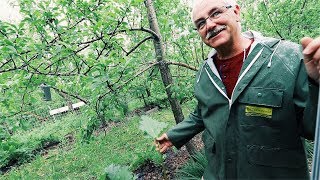
Stefan Šupković walks through his permaculture orchard in Quebec, built on a simple trio system: every third tree fixes nitrogen, surrounded by fruit or nut trees, with shrubs and perennials underneath. Chickens rotate through to graze and add manure. Pest control relies on molasses traps, predatory insects, and biodiversity rather than chemicals.
Chapters
So that's your trio. Trio of trees, then trio of shrubs underneath, and perennials. And that's it. It's pretty simple to lay out. Takes a few plants. I really recommend people start with 2 trios. Just get it started and you'll be amazed how, how well it'll adapt.
Permaculture orchard today. It's raining.
What's up with that?
When we're at Joel Salatin's, it's raining. It's gonna It's supposed to rain tomorrow at JM Forgers. Well, we just make the best of it. Yeah, because it's catch-22. Raining's not good for filming, but it's great for farming. And we film farms, but guess what? The farms come first, and you can't do anything about the weather. So I'm happy for them.
Yeah, we just got through the border.
Here we are in this whole other country. I know. What do you think, guys? We're in Canada. Oh, look, he's flying an American flag too.
Crazy.
Is it crazy? No. It's kind of weird how it doesn't— it didn't really change much. It's pretty much the same. We have arrived! We got the welcoming party, the permaculture orchard. A little stamp hidden in the midst of all that conventional agriculture. Some hope, some chickens working in the orchard. A humble cabin. All kinds of vegetation and plants in between the orchard trees.
As long as she doesn't lick your lens.
Here we go. Humble little cottage here. Stefan himself. Stefan, help us. Say your last name.
Šupković.
Okay. Beautiful place you have here. I cannot wait. Evidently they made us a lunch. What are we gonna be eating?
Omelette with asparagus, chives, garlic chives, and onions. Hope you like the onion family.
Nice. I cannot wait. We're gonna wait out the weather a little bit.
You think it's gonna clear? You know, in an hour or so it'll slow down anyway.
Okay, and then we'll go check out the orchard. What's your name and what in the world are you doing here? And where are you from?
I'm James. I'm from Missoula, Montana, and I'm interning here at Miracle Farms.
How long you been here?
I've been here a month.
Learning anything?
Oh, plenty.
How much longer are you going to be here?
I'll be here another 2 months.
Just you here by yourself? For now, yeah. He's wanting to know, anybody good at cracking eggs? Come on, you get to cook with Stefan.
You know, the Canadian commercial for eggs is get cracking.
I'm in his way here. I'm trying not to get in his way. I'll be in the house.
Oh, look. No, wait, we're very careful. Make sure we don't kill it as we want to keep everyone. They're all queens now. They're their best workers in the orchard.
What is that?
It's a yellow jacket. Okay. So although a lot of people don't like them, but we really, we want to keep them. Okay. So just if the queen comes in, that's the queen. So she mated and she'll go to work in the orchard. She's just looking for a place to nest. That's why she comes in. Wow.
So what's her role in the orchard?
Caterpillar hunter par excellence. I mean, these are, these are the best. So although they can sting you during the season, but I mean, she's, she doesn't have anything to defend or protect. She's just looking. She's on the hunt. She's, she'll be eating, drinking nectar, eating, and basically looking for a place to start a nest.
So there she goes.
Great, great, great wasps to have around. A lot of people don't like them, but they're— they are the best insect in the orchard.
Cool. Come on in and shut the door, buddy.
And when you crack them, you can put the shell right on there. You want to wrap the edge so you hit the middle. Done eggs before, right? You can catch the edge. It's a little easier if you catch the edge right there rather than right on top. Right on the edge there. Hit it right on the sharp part like this. Oh, there, right there. There you go. A little bit of eggshell is good. We don't mind.
Are these from your chickens?
These are from the chickens.
Yeah, these onions from your land? Oh yeah, asparagus from your land? Oh yeah, everything he says. Oh yeah, everything. Oh look, he's grown oranges in Canada.
Yeah, that doesn't— we are in what we call the banana— the banana belt, but not because we're growing grown bananas, but because it is the warmest part of the country. Look at this! What do we have here? Somebody came in on one of the eggs.
What's that guy? It's a little tiny bug.
It looks like— it almost looks like a little, uh, what are they called there?
A praying mantis.
Praying mantis. That's a little tiny baby praying mantis. So that means there's probably in one of the vegetables they were near a nest of praying mantis. So we'll put that one on.
So what's the role of the praying mantis on the permaculture orchard?
General predator. We'll let it go to work in the herbs here. Go on. There he is.
Everybody's like us, they're trying to get out of the rain.
Yeah, thank you.
Just ask them to go give them to the hens. You guys know where the hens are?
Oh.
He's gonna get the yolk out.
Scared of their own eggshells. Did you see the velociraptors out there? No, no, you didn't take— they're not hungry yet.
We saw them eat ground eggs.
That's it, give it a round. You feel the action?
You can really tell Stefan really likes to teach, and in a very hands-on way.
Keep going, keep going, you got it now. Keep going.
Look at that grin. What are you making us, Stefan?
Asparagus omelet.
Nice.
We're lucky, especially in the way of breads. I mean, this is one of the absolute best large-scale bakeries, and they do just an amazing cheese bread. That's a thing here. It's not where I'm from.
I've never heard of cheese bread.
Oh no?
What's cheese bread?
Cheese bread, it's bread with lots of cheese in it.
So that's— oh, it's made with cheese in it.
Oh yeah, it's got cheese right in it.
So, oh wow.
And maple syrup on it. I mean, hey, and butter. Yeah, we're—
nobody's feeling sorry for you, let's just say that.
No. No. You guys want some tea? Getting the mount— the volcano's about to erupt. Do you see that? Look at that. Yeah, that's the sign of a nice omelet when the volcano's gonna blow.
Yeah, so you can't see.
See that? You see it? Mount Vesuvius is starting here. And— or is it Etna? Which one is about to erupt? And then that'll cook up real nice. A little bit of this and a lot of that. You know, who wants to farm in northern New York? Nobody. It's like, why do you want to be up near the Canadian border?
Yeah.
And you cross the border and people go, wow, we're in southern Quebec. We're in the absolute warmest part of the province. And this is about the best farmland you get.
This is your Florida, huh?
This is the best. So people, you see the farms here are big farms, prosperous. And you cross the border and all of a sudden it's like, yeah, nobody's growing much down there.
Even though it's not much of a difference.
And yet the soils and climate are the same. So it's really, I find it's a question of attitude. You start with what's your attitude? Is it, oh, I'm in the best or I'm in the worst? Even if you're in the worst, there are people who are doing really well on cattle in northern New York because they go, hey, land is cheap, nobody wants to be here, let's set up there, it's a great place. The volcano's still erupting in the middle. You see that? Look, it's still erupting. It'll continue to bubble for as long as there's moisture in there. Mom, are there water bubbles? Let's see how that looks. Ooh, that looks pretty good, pretty good. It's not strictly an omelette because I didn't flip it. If I'd flipped it, it would have been a real French omelette, but the cheese is actually joining it back together again. Whose is this one? You're the biggest, right?
Lunchtime from the farm. How is it, guys? You're quite the host, Stefan.
Thank you so much. It's always nice when we get the abundance coming in. Yes, James has been good at getting the eggs, so we've had abundance of eggs. Took the hens a little while to get cranking into their routine. They changed from being indoors all winter to coming out here, so it's kind of taken them a month to shift. Plus they're old hens, they're spent hens. We're just giving them a second, second life.
You're just putting them to work in the orchard.
Putting them into work, that's their main job here, is to work.
Eggs are just a bonus.
Eggs are the bonus round. Exactly.
Yeah, she jokes about that being the trigger because the wind, because the wind whips It almost looked like Alaska. 80 miles per hour, and I'm like, oh! I don't know about all that. Grab a towel and just jump up and fly. Yeah, you would love that. You would love to try to fly. We're done with lunch. I'm gonna hide the camera under this umbrella. It's raining just a little, but I think this is totally doable. Stefan, you ready to give a tour?
Ready, let's take a walk. Okay, so where do we start?
Wherever you want to start, whatever you normally do. If you're closest, then we'll move our way out.
We could take a look where the chickens have just been. We moved them this morning, of how they'll work in the orchard. Yeah. So they, they worked it well. This was an area without the plastic.
There you go.
Okay, without the plastic and with the plastic. So with the plastic, what we want them to do is get all the grass off. That's really the main job for the chickens here, is to clean off the grass off the plastic. Otherwise, the grass will start to grow and basically build up mulch and invade and just cover up the plastic. So we don't want the plastic covered.
What kind of apple trees you got planted here?
I don't know, we got 60 different kinds. This one's Spartan. You don't know Spartans? You don't know the Spartans? It's a very nice apple. This was actually— it was the best apple in the orchard when we bought it in terms of the low disease, the least susceptible to disease, and now it's kind of become the most susceptible to disease. So it's gone from the best best to one of the worst. It's still a great apple, but compared to the new ones which are really disease resistant, it has much more likelihood of having disease than the others. You hear all the birds? So what do you hear?
That one there?
Wait, let him talk. Oh, that's the orchard oriole. And you hear the whistling ones? Psst, psst, psst. You know what those are? Waxwing. Waxwing. So the cedar waxwings, they're eating the flowers right now. They like eating— they like the nectar around the flowers. And that oriole. So the orioles will start making nests soon in the trees. And then we got all the different ones that are actually laying pretty quiet right now. In the nest boxes. We got bluebirds. You guys know bluebirds. We got chickadees. You know that one? Chickadee-dee-dee.
Pretty good.
So there's the waxwing. So we— I've been told that we kind of set this up, or I set it up originally mainly for the birds, and that's not totally wrong. Because my first training is as a biologist, and I definitely, when I was reading John James Audubon and his accounts of how orchards were the absolute best areas for birds, I didn't see that when I looked around orchards. So part of the idea was to see, can we actually have orchards that are productive, commercial, and have a lot of birds? And the answer is absolutely. So one of the biggest Comments is when people— we've had different courses here and PDCs, and people were saying, you know what, one thing that's bad here is you can't sleep in in the morning. There's just way too many birds.
That's a good problem to have.
That's a good problem to have. Yeah.
So tell me, this is not your average orchard. There is stuff planted in between these trees. Can you tell me what this is and why?
Yeah, so we go on a trio system. Them. So our trees are based on trios, so we'll have nitrogen fixing and then two fruit trees, or a nitrogen fixer and two nut, or a nut and a fruit. Here it's all nitrogen and two fruit trees.
So tell the folks what a nitrogen fixer is for those that don't know.
Oh yeah, well, like you'd have in the lawn if you had some clover in with your grass. Well, the same thing exists for the trees, so you have nitrogen fixing trees as well.
What are some examples?
Here we have Honey locust, black locust, Russian olive, sea berry, caragana.
So every third tree is one of those?
Every third tree.
And the other two are fruit-bearing or nut-bearing?
Fruit or nut, yes.
Okay, and what's here on the lower level here?
So that's the second thing. So we have tree trios and then we have vertical trios. So we'll have a tree, then we'll have one or two 2 or 3 shrubs underneath the tree, and then we have perennials, all different kinds of perennials, but the idea being that the perennials should be for edibles.
Okay.
And it really is pretty simple, just a lot of diversity, but keeping it simple. And you can get more complicated in permaculture with more layers, and we just keep it simple, the 3 layers.
So what are these planted here?
These are different daylilies. And they haven't started yet, but they will produce a really nice flower bud, and we sell and eat the buds. So that's a really nice one for flower and edible. Rhubarb is a pretty typical one we'll use. Rhubarb is incredible. We sell the stalks, so we sell it at 50 cents a stalk, and we tell people, you know, you got to plant your own rhubarb. It's so easy to grow. If you have a fruit tree, plant the rhubarb underneath. And they're a spring plant, so you see they're fully grown already at this time of year, and we're only— we've just finished flowering on the fruit trees here. Yep, not same as in North Carolina, but we, we have it just later. And so these are already fully grown, and they're actually going up. We've been taking out the flowering stalk.
Does it have a particular advantage being planted among the trees?
If you don't plant something something will grow. So the advantage is you get the crop rather than getting a weed.
Yep.
And you guys like rhubarb?
Yeah, we just had rhubarb pie, but one of our latest guests— there you go.
No, Lily?
Oh, so you eat it raw if you peel it?
You can, yeah, if you peel it a little, you can eat it if you like. Get the face on that, right? If you If you like sour, some of the kids, when, when they go, you like those sour candies? Oh yeah, try one of these. You know, you get the face like, wow, that was sour! But it's good if you like sour. If you don't like sours—
and it looks like you have it, a row of plastic to suppress the weeds. You have— is this a volunteer bush right here? Did you plant that?
Yeah, that's a— we actually dig them up because they're on their own root, plum trees. Yeah, so our plums come back on their own root.
Is this your only weeding method, is the plastic?
Yep. Okay, we do actually— we do, we do hand weeding about, uh, 5 hours per acre per year. Okay, so that's not too bad. Main weeding we do is to keep out trees because there are volunteer trees that will try to come in.
How do you mow the aisle here?
We just actually— I just mowed this morning over there. We mow on a 6-week rotation. Okay, so we mow half this one. The chickens have been in, so you don't really— can't really see it that well.
So you mow before the chickens?
So there's one, one plant that's actually one of our— one of the plants we planted. That's Mitsuba, a Japanese lettuce kind of plant. Yeah, it was good. It tastes a little bit like celery, and it's a shade-loving perennial. So now these are growing in the grass, so they've reseeded, and now they're off. We don't have to plant these anymore. So the idea is you have an orchard of weeds in the sense that a weed is a plant that you don't have to plant, and it keeps coming back.
What are some other plants you have on here in the underlayer?
Red currant. So you can see that they're still green, but that's the red currant we have. Oh, here's gooseberry. So they're coming around. They're also green. So these will be mid-July, they'll be ready. Gooseberry, black currant. That's a great medicinal It's a fruit, but it's, it's more medicine than fruit, just about. Highly anti-antioxidant packed. So, and then some of our understory plants. This is one that you had in the omelette. It's become— I think it's one of my absolute favorites. It's, it's so easy to grow and it's so good anywhere you're going to use onions. So you see how flat that is? It's a chive. But it's a garlic chive, so it's totally a flat leaf. And anywhere you'd use garlic, you can replace it with garlic chives. And the one negative about the orchard, now that I've had it going for 10 years, is it's starting to be a lot like a forest. And at this time of year in a forest, it's a great habitat for mosquitoes. So you'll get—
What are the mosquitoes? What's the role of mosquitoes in an orchard?
To keep the orchardist out for a time. Here's a neat one. There's one that's just all of a sudden—
Force break. Yeah.
What's that one? That's a tent caterpillar, and that caterpillar is really the reason why I replanted the orchard away from a monoculture. Mainly it drove me nuts and there was nothing I could do other than poisoning them to get rid of them. It was so appropriate for caterpillars. They would defoliate a third of the orchard every 2 or 3 years. Oh, and as long as it was a monoculture apple orchard, which is what I bought originally, there was no way to, to get rid of them other than poisoning them. So that was a good indicator something's got to change.
So this is something This, this, this thing's going to take down your tree and you don't care?
Well, actually, I, I like to see them now. Yeah, as much.
Tell us the magic. So you went from monoculture, which means you were only growing one thing, which is fruit trees, just—
and not just fruit trees, one, just one kind.
Oh my gosh. How then did mixing it up decrease the pressure of those caterpillars?
Just the diversity. So now we get— here's a Here's a spider in there. I mean, we've got so many predators going around, and the main one is if they do start somewhere, they can't go very far. And there's so many birds in here now, birds in the spring and wasps in the summer. So having the wasps in the summertime is essential, and they really take care of them. So we get them. This is a big year actually for these tent caterpillars, so I've seen a few nests. But we still are looking for the damage. Yeah, as opposed to when they would be a third eaten of the orchard. Now we're looking for the branches. This one obviously had a nest in at some point, and there's no sign of any damage of leaves being eaten. So yeah, it's just changing away from a monoculture to a polyculture and having the trios has virtually eliminated that.
And that's Is that because it attracted more predators?
Attracts more predators, creates more diversity in plants so they don't eat everything. The nitrogen fixers they don't like, so they don't even cross it. And so once they start somewhere, they're really left on an island, as opposed to before they would march through the orchard like an army.
What is that?
That's our codling moth traps. Okay, very simple. It's just an oil container in which we put a very secret mixture of— what does that smell like? Does it smell like the cookies you had for dessert? Yeah? What kind of cookies were they, Lily?
I'm gonna guess molasses.
Molasses, yeah. So it's molasses and water, that's all it is. Non-toxic, I mean you can drink it.
You're drinking your bug spray, man.
It's starting to ferment, so that's actually what makes it most effective and most attractive to the bugs. And see a few there?
So they get in there and then can't get out?
They get in and they drown, they can't get out. So it's a very simple trap.
And then you give them to your chickens?
No, actually we just rinse them out when they're done. There's usually so many that it's a solid cake of molasses and insects in it, but it works great. We've had as little as 3% damage, which is totally acceptable even for conventional orcharding.
Really?
And all that without spraying. So that's okay.
So let me get this straight. Your weeding plan with the plastic and a little bit of chickens. Your bug plan with a bit of molasses and an old plastic container. What about water? Are you irrigating?
Yeah, we do irrigate.
Okay.
We're on very, very sandy— our neighbor is a gravel pit and sand, so it's sandy soil. So we do water, we have lines running underneath the plastic, very simple, but it, it works. So there you get your— that's a good example here. You got pear, plum, and the nitrogen fixer. So here's your honey locust. So that's your trio, trio of trees, then trio of shrubs underneath, and perennials. And that's it. It's pretty simple to lay out. It takes a few plants. I really recommend people start with 2 trios. Just get it started and you'll be amazed how well it will adapt.
Yeah. How do they know how close they should plant them?
Ask where you buy the trees. They'll usually tell them.
Okay. Cool. You want to show us the chickens, what their role is in the orchard?
Yeah. These little pears are coming nice. There's actually too many set. We do have a problem in the orchard. It's a good problem most people would love to have. We have too many bees. No. So we've gotten rid of all our honeybees because we have so many native pollinators. I mean, that's not supposed to be that many fruit set in a cluster. That's one flower cluster. Yeah. And pretty well every, every fruit is set. So that would be way too much. The branches would break on this tree. And so by getting rid of honeybees, the idea was to reduce this, but I see that there's still too many native bees. Too many bees is a good problem. There are bad problems and then there are good problems, so that's a good problem. You can see here where the chickens were. Move just—
okay, chickens were right here.
You You can tell they've had a little bit of disturbance.
You don't mind them going on top of the plastic?
No, but you can also tell where they've— they have a roost in their pen, and every line where they roost. So you see, that's a little, a little bonus for the, for the soil and for the trees around.
Yeah, they fertilized here. I imagine that's going to attract lots and lots of worms.
Yep.
Uh, how often do you move them in here?
We move them every second day, but we set up the pens once a week. We set up the fences once a week. Hey, how'd you get out? Uh-oh, how'd you get out?
Rogue!
She got out.
Come on, James, show us your skills, buddy. Oh, you better beat Bo to it.
I like the idea of being able to chase chickens.
Grab that chicken, Lily. Come on, grab the chicken before Bo does.
Okay, she's gonna drop an egg, I think. Yeah, in all that excitement. Okay, maybe she'll chase and chase it all the way to the end, eh? So this is just the new piece we gave her. So what we do is we just mow one half of the row so that it's easier and the fence is not going to be grounded out. We put our Electronet around and we hope that we'll have the panels. We just haven't put them on yet to partition. So we'll put panels to run across because it's a pain to run a net through the trees. So we'll put a plywood partition to break off the basically the 3 paddocks out of one enclosure.
Okay.
And they're off and they're working. So here you see already, actually when we were setting up the fence they came out, but you can already see the impact of where they've been. They know exactly where to go. They've been at the worms and they don't have to usually look very far, so they'll scratch a little bit And— oh, there's one. So they just have to look. They know that as soon as they scratch a bit— they're not scratching much now because they've been out for a couple hours in the new piece and they're full. There's only so many dozen worms they can eat each.
What's planted in here? This is something different.
Yeah, we— this is kind of our collections here where we can keep an eye on the plants. We like to try a plant out for 3 years before we multiply it more. So we'll put out things that we— a lot of people give us plants, they say, hey, you should try this, and we try it, and if it works, it passed our test, then we'll plant it out more.
What are the name of those plants? What's the name of that one right there?
I don't know the common name. It's lamium. It's a ground cover, basically an ornamental plant. Okay, looks nice.
What's the name of this one with the purple?
That's chives. So we got a lot of chives.
Chives. What's that herb right there? Is that lemon balm?
Oh yeah, that's lemon balm. Yeah, that's, that's a really nice one. And you can— you want to smell that? What does that smell like? Not my hand, because my hand's going to smell molasses. Oh yeah.
Stefan, so if, if somebody was going to do this on the homestead level, they work 9 to 5, they just need to do this part-time, what would— how would you suggest they start?
They start with a couple of trios.
So, okay, so when you say a couple of trios, 3 trees, 6 trees, 6 trees, 2 times 3.
Yeah, start with that and get 2 or 3 shrubs, fruiting shrubs per tree, and get some perennials. So I say you could put 10 perennials per tree. Start with that. You don't have to quit your job or anything because once you have the trio set up, then you will actually have all the material you need So you'll be able to take, for example, here's a passcap, or honeyberry as it's known in the US. So it's almost June, we'll soon be able to take these green cuttings and multiply them. So we can actually take cuttings, stick them in, and root them up. So those 2 trios will be enough plants that you could multiply by 10 in a couple of years, how many trees you have. So you go from 6 to 60 and then multiply that 60 to 600.
So when you say 6 trees and then you say 10 companions, is that just 10 individual plants or is that just 10— are you saying 10 varieties?
It would be 10 individual plants. So whatever you start with, you'll multiply. So second time trio, you want to add to the variety of things you put in.
Okay. What would you suggest first for some of the main trees, the nuts and the fruits?
I would suggest whatever grows like a weed in your area. I mean, it sounds funny to say, but look around.
It could be apples in your area.
It could be apples. We don't have any apples wild in this area. It's too sandy and dry. But what we do get growing like a weed here is cherries. So here's a cherry. The cherries, once we started putting them, I mean, they really, although it's getting to be a little shaded for them, but in terms of the first phase, they really grew extremely well and produced really well.
And what would you suggest for some of those 10 companions?
10 companions, if you can grow all the onion families, so your, your chive, which is an onion family, your garlic chive, Egyptian onions, we don't have any right here, there could be some around Those are great. Rhubarb, garlic. Start with the really simple ones. Put in some flowers. Daylily is a good one if you'll grow it in your area.
Do you recommend them experimenting with just anything, or is there a no-no?
Yeah, just start with anything. In your trios, if you put 2 or 3 trios, start with anything, and you'll quickly see which plants will do. You want plants that want to take over the world.
Those are the ones you want to learn how to— learn to love.
Yeah, and you have to like it. If you don't like it, if you don't— if you won't use it to cook with while you're growing it.
Exactly.
So start with things that you like. Try a bunch of things, some of which you'll say, you know what, I don't really like that, so I'm not going to multiply it. But if you happen to not like it and there's a huge market demand, then who knows, maybe your part-time adventure can turn into a venture.
And so I imagine for the first time, they should maybe— you would maybe recommend them just going to the nursery and seeing what grows well there, or would you recommend something else, going online or something?
Nursery is a great place. Just ask a few people locally who are growing something and see what grows so easily here. Most people would be able to help you, even gardeners. Okay, just ask a gardener, what grows like a weed here? Oh well, this grows, just you don't have to do anything, it'll just multiply.
And then just go by the recommended spacing.
Yep.
And the recommended method to planting a tree. Or is there something that people do wrong in planting a tree?
Well, they tend to put a lot of different things in the hole, which is really not recommended. You don't want to— if you want to put anything, put it on top after you've planted. Don't, don't amend the soil in the hole.
So basically you're saying, and if I remember from your movie right, permaculture orchard. You basically dug a hole, you put the fill dirt back in, and then you put amendments on. I don't even think you did compost. Did you do compost? You did do a few inches of compost. And then did you use cardboard for weed suppressant?
Yeah, cardboard and leaves or wood chips on top.
And then you had, you had harvested the sod, and so then you had flipped it upside down. Am I right, or am I getting it mixed up? Yeah, that's okay. Good.
It's pretty simple.
So it sounds easy.
And you know what, this is still a good time of year to do it. So go ahead, go get to your garden center and get out there and get your first tree.
That's what counts.
That's what counts.
Just stop being so scared. I mean, what's going to happen? You're going to kill a little tree and you'll start next year.
That's all. And you'll know what— and even if it doesn't work, it doesn't mean it doesn't work. It just means it didn't work there. Yeah, sometimes that's true. Try it over there and it will work.
That's true.
Or try another kind of it. Yeah, sometimes you're happening to try the type that's maybe most recommended, which really isn't the easiest unless you spray or, or do a lot of different treatments. Start with the— just start. Yes.
So do you recommend they dig a hole first and see if it drains well? Yes, pour some water in there or let it rain and see if it's draining.
Or just dig. If you dig at this time of year, we're still in a wet period, at least around here. If you dig and you see water in your 3, 4 feet, try digging another place. Okay, if you can find a better place.
Okay, so tell me, how did you build this chicken tractor? It doesn't look too fancy, which is actually really—
it's a really nice tractor. I love this design because it's only got— yeah, come on in.
Coming in. Come on in, Josiah. It's on, it's on! Watch out! No, I'm just kidding.
No, it's not. No, it's not. I love to be in charge. I get a charge out of that. It's revolting. Oh, you girls are all in here now.
There he is back.
You're out of the— you're out of the way.
You guys don't like the rain, huh? Oh cool, just Sticks for purchase.
Sticks for purchase. Two skis. So the, the runners— these are really light. Any of your kids can pull this pen easily.
Wow.
Because it actually is a ski. There's nothing to stop it at the front or back.
Okay.
And if it's a design like this where you're actually using an electronet, this is really the way to go.
Cool.
Try pulling that. Give it a little pull. The chickens will have a fun little ride.
Come on, guys!
The chickens are heavy on there.
They'll go with you.
Look at that! Can I try? Sure.
Hey, come on, come on, Mr. Brown! Come on, you can do it! You can do it! Come on, help him, guys! All 4 of you! Come on, Rose kids! There you go! Whoa, good one!
Another one!
Come on, do it again!
Woo! Woo!
That's how easy it is to move this chicken tractor! You got electrical conduit, is that what that is?
Yeah, it's conduit crossbars. But the nicest thing is when we're done with the chicken season, these are actually used as a greenhouse for the production of vegetables.
So smart.
So it's a, it's a four-season pen. We call it the pen house.
So there you go. Oh, this is a 2x4 crossboard holding those bins together under there.
Yeah.
And homemade perches, earth-made perches, unscrews.
So we unscrew— this is silage plastic, really heavy grade, which we pick up for free anywhere a farmer's doing silage.
Nice, it's just their throwout.
And so we just take this all off, take— unscrew the perch support, and then we got a greenhouse with frame, and then we just put 2 or 3 of them in a row, run a plastic over it, and we can do our 4-season harvest vegetables.
And the predators are kept out by the electric fence and by your dog, Beau.
Yep.
Guys, I should mention this mulch here. This has got to be the least amount of work I've ever seen or thought of in an orchard. This makes it so accessible, doesn't it, guys? This mulch, this is not added mulch. This is mulch from the trees. Oh my gosh, Stefan, you're making it too simple. It's got to be more complicated than this. Come on, man.
That's the key, is if simple works. I like simple. I mean, it's easy to, to show somebody, and never more than 3 things. That's how we use trios. Yeah. And so 3, everybody can remember 3, and just keep it keep it absolutely simple. The chickens do most of the work now with having them in here.
Anybody could do this.
And even if you had just 2 hens and you had 6 trees— actually, you couldn't keep them in those 2 trios too long because they'll absolutely—
that's a good point. You do got to keep these dinos moving. They are like dinosaurs.
They are.
They will tear this place up, so you got to move them. Mr. Brown, you about ready to move them? You'd like to move them, wouldn't you? Look at this feeder, guys. Another homemade thing. There's feed under here, out from underneath the rain.
This is a bulk feeder, so we do it cafeteria style. Learned that from Joel Salton, you know, keep it cafeteria. And it actually— it is good because you'll know what they, they like most. So we just gave them a laying mash, cracked corn, and oyster shells.
Okay, and then you see what they need. They know what they need.
This, we filled it 2 weeks weeks ago, and it'll go another 2 or 3 weeks. So get some feed, fill it up once a month or once every month and a half.
Nice. Oh look, they caught one! They caught one! They got one! Good job, guys! James could have used you a minute ago trying to catch that chicken. I already did it.
Oh, there is a weed, an elderberry. A weed, a good weed.
Now wait a minute, you can't really No, no, but it came up. What do you mean by weed? Okay, you didn't—
came up. I didn't plant that.
So that's a volunteer elderberry.
Elderberry.
So you're gonna leave that one?
Oh yeah, and it'll grow up well here along the— along this nitrogen fixer. And that's it. That's, that's what we really want. We're starting to see nuts coming in that we don't have. I don't even know where they are. Like, within a mile, I couldn't tell you that there is one. We got beech nuts starting in here. So birds are bringing them in, squirrels are bringing them in.
Yep. Well, you know what, Stefan, thank you so much for opening up your orchard to us. You're a huge encouragement because you make this accessible to anyone, so we appreciate that. If we've learned anything, guys, let's review. Let's, let's review. Stefan, what would they do if they want to just get started?
Start with a couple of trios this weekend.
A couple of trios, 6 trees. 6 trees, 2 nitrogen fixers, which if they don't know what that is, I guess you could just ask Google. Yeah, nitrogen fixing trees. You could even put in your zone and probably find those.
Exactly, you'll find what grows. If you don't know you're in the warmer zones, you can grow nitrogen fixers that produce fruit. Yeah, yeah. So that's even better.
If you don't even know what growing zone you're in, you can Google that too. What growing zone is Georgia, say? Okay, and then so they get their 6 trees, and what else should they plant with them?
12 shrubs at least. Okay, so 2 per tree. All right, fruit-bearing shrubs.
Okay, cool. Shrubs are like— what's a good example of a popular shrub?
Uh, gooseberries are great. Okay, currants, red currant, black currant.
Again, talk to Google about it, whether some shrubs that grow good in your area that you would be interested in. And then lastly, what else?
Lastly, get 10 perennials per tree. So 60 perennials. That could be herbs, it could be flowers, yeah, it could be—
rhubarb is a popular one.
Rhubarb is a great one. Strawberries, it'll, it'll be good to grow strawberries the first 3 to 5 years.
Yeah. Okay, cool. Thank you very much.
Thanks for coming.
Oh, and if you guys want more of him, I highly recommend this. It's Permaculture Orchard, the movie that he starred in that got— helped me get my start, inspired Permaculture Chickens. It's a beautiful film. You can find out more about your farm, your books, that movie, permaculture, orchard on your website. It's— what is it?
www.miracle.farm.
Okay, and I'll leave a link in the description.
More from Justin






If I had to start my Homestead all over again, it could only pick one animal… 




