The Ultimate Winter Barn Formula (It's Not What You Think)
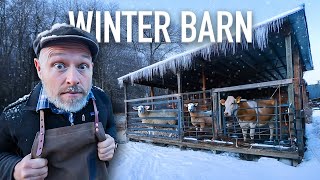
Victor Justin Rhodes builds a three-part winter system for livestock without a traditional barn: deep wood-chip bedding that becomes compost, movable shelters from reclaimed panels and tin, and submersible heaters to keep water unfrozen. He shows real wiring problems, hay-bale insulation tricks, and ends with new lambs born into the finished setup.
Chapters
Happy day! In this video, I'm setting my animals up for the winter, and I'm going to show you my 3-part formula for keeping them happy during the winter months. No traditional barn required— those are overrated. I'll show you a cheaper, easier-to-build setup that taps into Mother Nature and makes compost at the same time. Plus, I'll set up and show you my tried and true way to keep waters unfrozen throughout the winter. We're not going to just talk about it. I'll actually teach this formula as we implement this in real time. The good, bad, and ugly. The reality. Let's go. Happy day. It may be warm out right now, but the cold weather is coming. Pigs, you gotta go. They gotta go to the pig port. We're moving the milk cows into here, the sheep into there. They could be having babies. Any day now. Use this covered barn filled with wood chips to capture their manure and urine. Part 1 of my formula: deep bedding. In this case, wood chips. You see, as my mentor Joel Salatin would say, cows don't wear diapers. I mean, sheep don't wear diapers either. What you doing? Filling up the water? Thank you. So we've got to get them A carbonaceous diaper. This absorbs their urine and manure, else they would just be walking around and that'd just be nasty. So that sanitizes it. Makes chores easier. There is my bedroom. Just come out here, fill up waters, throw some hay, and build giant compost pile. We started out with 4 inches of wood chips on the floor. We got these wood chips from Chip Drop. It's a service where forest workers and whatnot can find a place to dump their chips and and homeowners can find a place for chips. We paid $20 once and we've gotten loads and loads and loads of wood chips. We store the wood chips nearby in a shed. It's south-facing, so sunny side, and it's real near our pole barn. It's ideal to cover your wood chips in a shed-like situation, even just a tin put over it just so it can air out. Frame tent, even better. Just a slapped-together shed over that, even better. But if you have to, you could do a tarp. The tarp will keep it dry, but it also captures the moisture that in the wood chips trying to escape. But still, it's better than just wood chips out in the open. I mean, we have so many wood chips, we're now going to be able to just spread those on the pasture, so we aren't too worried about those. We have enough for our pole barn. The reason you want to keep wood chips dry is because you want them to be able to absorb urine and manure. And if all soaked like a sponge, they won't. Now what comes of that is not only sanitary condition— that's primero uno benefit, numero uno, one— the second is it turns into this. It turns into rich compost, that mix of manure and carbon. So instead of a stinky cow lot You've got a compost sweet-smelling making machine right next to your house. Yeah, there's my, uh, there's my, there's my bedroom. Yeah, that's it. All right, he's getting the, the pole barn ready. Josiah and I will get the pig port ready. What are you gonna do? I hit the bottom. Okay, Henry's playing in a bin of grain because we only have layer chickens. It's a great time to feed layer feed, to feed whole grains. Here's some footage of us setting that up. I hope it'll all fit. Whole grains are more nutritious because as soon as you grind a grain, it starts losing nutrition. So I'm super excited You can't, you can't buy whole grain fed chicken eggs in the store, but you can grow it yourself. Okay, I'll show you how we apply these concepts to the pigs. It's not as entailed. It's been a minute since we've been in here. The pig port, making compost and deep bedding right next to the garden, close enough to the house. We can easy enough run water out here, uh, trough heater for their water. The name of the game is use it up, wear it out, make it do or do without. We're not buying a thing. We're gonna set this up. We got these old horse panels. Lily doesn't need any more. See that tip? You gotta go get the metal tip. Wait, take these back. Get the right thing. Okay, now you have to get— that is the correct thing. Now you have to get a different head though. Gideon, come here. Is this it? Yes. How are we supposed to get it off? It goes in there somehow. I got a question for you. This is the old gate. Can you just weld that? No, you can't weld aluminum. Is that what it is? Yeah. Can you use this for what? For straps? I guess we could cut it like this. All right. We designed this so you could have a 10-foot gate on this and you could open it. I bet this has gotten pushed over. It looks like it has. Yeah, that'll do it. You know what, this chain's got kinked right here. Okay, Jonah found something to keep this, keep this intact. He found some— what'd you do? I guess those were Simpson braces and we just unbent them and we use it as a metal strap. So far we've spent zero money on this. Well, there it is. All we got to do now— it's a lot easier said than done— get those two 500-pound pigs over here. Let's give you a little tour of the pig port. The pig board is on skids, 2x6s stacked together. It's made to be able to move. Every day we're going to be adding wood chips in here, and they're going to manure and urine on it, and that getting mixed together is the combination for compost. So then we move the shed over once they're done, and then we have a place where we can finish the final touches on the compost, turn the compost pile some more. You'll notice I have open Well, I have a gate on this end that's to be able to get animals in and out. And to move this thing, you got to have it open. Temporary, just T-posts, just a gate. And the pig panels is critical. See, you can't get his nose under there and tear up the gate. It's also critical that you don't tin this side. I think that you don't tin the two sides, that way the pigs can see out. They don't have the internet. They're bored to death, uh, in a 10 by 12. I don't know if that's true. Do it in a pinch. I've done it before. It's okay. Do what you need to do. But basically, this is just a shed on skids with some temporary tin siding on two sides and just some temporary whatever you can get, see-through siding on the other two sides. This can be very tricky. Beefcake gets kind of grumpy getting moved. This is easy. Look, Beefcake's running. That was easy. That's too easy. Now one thing I want to point out about this pig port is this little lean-to we built on the side of it. We made it optional. You can put it on any side. And it's just collapsible legs and it covers our wood chips so we can take our wood chips, they stay dry, and throw them in. See any heat, buddy? Maybe you're kind of acting like it. Second part of my formula is keep it covered. And no, you don't need an expensive, inefficient, old-fashioned, outdated barn. That's overkill. Just think pole barn. Open sides, just covered. Just if you're on a budget, just think shed. You want a quick tour of my pole barn? 32 feet across this way, it's the short side, by 48 feet long. For sides, we just have these gates, 16-foot gates. We have 18 inches worth of 2x6 cedar for retaining wall for the material. It gets deeper as the winter goes. 8-foot gates in the front, 8-foot gates to get open and in. In the back, we stack our hay that blocks the northerly sides, the windy sides. And on this side, the south side, look, the sun is low in the winter. It's shining in on the animals. It's keeping them in sunshine. It's keeping them warmer. No walls, no walls. I have it high enough to accommodate the deep bedding, of course, but more or less to accommodate— what, let me show you. I need to accommodate a year's worth of hay, so 1,200 square bales of hay. And if you could somehow spring it, it's worth the investment— concrete floor, because it's easy to scrape it up and get material out. There's no guesswork on where to put your bucket, and it's easy to put material in. Of course, because the deep bedding rises, we have liftable troughs. The troughs and the concept of the pole barn in Joel Salatin's book Polyface Designs. That's right there below, right below this video. Check it out. This pole here in the middle is removable. It's not permanent. It's not gone down or been anchored to the concrete. That's so that we can remove this front. It's semi-permanent and get the materials out, pile it up, get it composted. Manure spread it out into the field. And then that way too, when that's open, we can get wood chips in there. They poop— well, there's a lot of wasted hay, and that works, but we can also haul over wood chips. And you can do this on a small scale with a wheelbarrow and T-posts and cattle panels and a carport or some sort of shed. You don't have to have this— the dream setup, but you can start now just using what you have. Okay, now here we are getting the cows in there. We're ready for cows. Separating the milking cows and the bull. These guys do not like it. Let's go. It's fine if they go in the wrong one. Why'd we open the other one? Welcome to your winter home. Hey, ah, shoot! Okay, I'll keep her in. That's Minty. Oh, Hoke has no idea. He's never been in this thing. He's not, he's not liking it. Hey, there you go, there you go. That guy's the luckiest bull alive. 4 ladies all to himself. And now let's get the sheep in. Poor cows are so confused. Trying to disconnect the other sheep fence so it can be really hot. That was easy. It's good to get them addicted to alfalfa. So you don't have a pole barn yet? No worries. Hay bomb! What you do in a hay bomb situation is grass isn't growing in the winter, so you don't have to worry about moving your animals around. They aren't gonna hurt it because the grass isn't regrowing and they aren't chewing on it while it's growing and not fully mature. You put them in your worst, crappiest pasture ever. In this case, it's our hurricane pasture. Was washed out after the hurricane, and you feed hay in a different spot every day, and this is what it looks like. It's just littered with spent hay, littered with manure. That'll break down into organic matter and feed the soil. Now, it's not quite as good as the deep bedding because, see this manure here? There's no microbial activity. It's too cold. So that will actually— a lot of it will— nutrients will leach out. The beauty of the deep bedding is you can capture that, and that gets to a critical mass and will keep at about 100 degrees. So you you can keep that microbial life around and it's still there come spring when you want to spread it out. But this is definitely a good, extremely frugal alternative. And the third part of my winter happiness formula is water. Critical to keep it unfrozen so they can actually access it during the winter. Now it's tricky because each of my trough heaters you could just get at Amazon They're 15 amps, and each outlet plus each circuit of your house— you might have 3 different outlets on one circuit— is only 20 amps. So that means you can't have 2 on one. So we're gonna have to first of all run electricity to the pole barn, to the pigs way yonder, to the 2 little pigs 500-600 feet that way. We have to run extension cords plus find 1, 2, 3, 4 sheep, 4 different circuits. It's gonna get crazy. There's your little hint. Can you see it? Can you see it? Oh yeah, you can kind of see it right there. Our trough is frozen over. It's not even getting above freezing today. We've got to implement our method for keeping it unfrozen. For the cows and sheep, I use a 50-gallon trough plus a submersible trough heater. Well, the boys installed it It's a trough heater. It doesn't seem to be working. For the pigs, we use a 50-gallon barrel with a pig nipple attached, and we do the same submersible water heater into that. The only problem with those is, well, you got to run electricity to them, and they can take a lot of power when they cycle, so you can't really have them on the same breaker. So we've got to find different outlets for each one, and that means also a lot of extension cords. Before we troubleshoot We've got to get water in that because you don't want to turn that on without water in it or it'll fry itself. Let's figure out why that trough heater isn't working. Well, I think it calls on too much energy power to put it in a splitter to take it off of one breaker. I think it's got to be on its own. Oh my word, I feel like the Griswolds. That is our RV outlet, so maybe it can handle two troughs. Wait a minute, it didn't blow the fuse because the Energizer is still working. Could be that this wasn't working. Let's actually see if it's working now. I just saw poop in that. How are we going to know if that's working? Uh, give it a few minutes and we'll touch it. Test that particular— oh, that is lit up. Okay, turn it off. Is this something to turn it off? Hold on. All right, well, let's go see if this will work. It could be that just some water got on it or something and it just tripped. Yeah, you guys have zero water. It's already dead. At least we know it's not this unit itself not working. It is actually working. It's tripping because there's too much load on it. So we gotta put this in a dedicated outlet. All right, here you go, bud. Hey, why don't I go get out and get us a drop cord? Can you scrape this concrete? Thank you. We're gonna pick up after ourselves. Gosh, looks good, bud. All right, to get the sheep's heat, I'm thinking we're gonna have to get on a whole different circuit. The RV circuit isn't enough to run both. How about we go upstairs? And run a drop cord down. What do you say, Gideon? Yeah, then we can run over side by side. Yeah, or we find a way to run it underneath. We have to. Yeah, you're right, because the side by sides are gonna absolutely tear these cords up over time. So we have to figure out a way to get them protected, but one thing at a time. To test this, I put my voltmeter to squiggly line V, 200. The black in the left neutral side and the red in the right power side. Hey, comments, should I go above the— along the board there, or just lay it down on the concrete. What are you doing? We don't need a ladder and a zip tie. You're gonna have to zip tie the other side because you don't want to pull it through. Let's get this going and see if it even works. Now, now it's— if it doesn't work, it's the, the actual trough heater that's broken. I have a new idea because in the past We've just run cords and we can run them against the wall there, but you dump water, they gets in the outlet here. What if we can go up and over? Is this tall enough for the track loader to get through? You think it's tall enough for the track loader to get under? Try to jump it. Try to get it. Let's see if these are even working. Wouldn't it be hot to my finger? Is it still plugged in? No. Oh, well, that's why. No, it's not working. Dang it. Did I blow the fuse? No, the Energizer is still working. It's on the same thing. We need to test this thing. I would feel better about maybe using a thermometer. So let's do that. A little safer, a little safer. Water temp's about 55. Absolutely no warmer on the hot water heater. Okay, it's not working. Water temperature 44. This one's rapidly going up when I touch the heater, so this is working. I wonder if I— let's take it out of the water so we're not measuring the water all around it. Why? Why? Look at these two sunbathing. It's not frozen. We do it in the pig's barrel even though they're not drinking out of the top. Water temperature 44. That's probably a good sign. Are these not working? There's no way that's working. Big pigs, cows hopefully settled. Hopefully trough heater's working. These guys No trough heater, and their nipple is frozen. It's making me think the trough heater must be working. Beefcake's able to drink out of his, and these guys aren't able to drink out of theirs. That much ice was on the top. Get the water over here. Now, don't— that'll start melting it. Poor guy. Oh wait, maybe it is working. Now how are we going to run electricity all the way over here? Look, pigs are not dumb. They have rooted— they have rooted the wood chips along the edge, therefore blocking the underwind over in that corner. They've made themselves a little nest in the shelter. You've already got it under the house, up over the road. And right there I already got through, and I'm just gonna wove it in through here. Okay, first you haven't started using thin ones yet. Can't use that, that can't get wet. Found another one. Do we need it? Could we trade out the orange one for that one? One orange one? This one for that one. Oh, that's gonna be a Festivus miracle if electricity gets all the way. Do we even have it to here? I cannot believe we had the drop cords for this. Now what are the chances that all 1, 2, 3, 4 trough heaters work tonight? We'll see. Now, you know, I can't quite tell if they're working. Are they supposed to be blazing hot? I don't know for sure. Time will tell. Tonight will tell. We'll see in the morning. It is the next day. It's 20 degrees outside. Things are frozen, but is our— are our waters frozen? The cow's water is unfrozen. How are the sheep? Oh, oh, oh, it feels warm. Even works all the way out here. Oh, the nipple's unfrozen at 20 degrees. That's three. We still got one more to check. Oh, oh, oh, oh. Our waters will be unfrozen for the animals this winter. So crucial. So happy about that. And a little surprise for you guys. Brand new babies. Brand new babies. Told Austin and Ashley, I told Rebecca. Now Austin, I didn't expect you to beat Ashley down here. Why? Where's— what's— baby lambs. Oh, we haven't started running. He's the most excited. Are you the most excited about these lambs? Oh, Mom doesn't care about the sheep babies, she's grabbing the human babies. Hey, hi, Waylon! You want me to get one for you? This is a good time to hold them because they ran. They aren't scared at all. Oh, such a moment! Oh, good job! What do you think, Benson? Oh my gosh, can I hold him? Can I have a turn, Waylon? Mama's holding him. Oh wow, this is really nice. Let me be free.
More from Justin






If I had to start my Homestead all over again, it could only pick one animal… 




