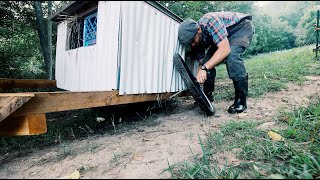
This content was created by Victor Justin Rhodes. This content was uploaded by Victor Justin Rhodes. This is a YouTube video titled "Then the Chicken Coop Wheel Fell off (2X) FIXED" (uploaded July 7, 2020) containing an English farm/family vlog-style recording. The primary speaker (labeled SPEAKER A) documents repairing a chicken-coop wheel/axle (EMT straps, threaded rod, bolts), notes messy chicken droppings, and discusses nearby animals (pigs), while interacting with family members including Rebecca and another speaker (SPEAKER C). The conversation shifts to gardening and farm planning—biochar soil mix, fall/winter planting timing, water-line planning, referencing Joel Salatin and local contacts (Pete Canaris, Casey Ostwich)—and ends with mention of chores, milking, and ordering supplies.
Chapters
Oh no. Oh, it's come off the axle. These EMT straps are loose. They're not tight, and this axle can slide right out. Let's go get some different EMT straps. These are tighter. Somehow Teddy escaped. Teddy, you want to come with? Uh-oh, come on. Get down. This could be quite the disaster. I've got to get under there, I don't know, under 6 chickens and pull those straps out, maybe flatten them out so they'll go on tighter, maybe put on some of these if they're smaller. That is disgusting. Not the dust, not the dust. I'll show you in a minute. Stay with me, guys, stay with me. So This is what those straps look like under there. These are extra, so I think these— what I did is flatten this out and then spread these out so that fits tighter. This is what's disgusting. Look at all the poop that's already dropped. This was dropping while I was under there. There was even some gooey liquidy some running off the bottom board, and I'm like, that's not pee because chickens don't pee. They package it all together. That's diarrhea. And it just missed me. Smooth from here on it, right? Wait, are you serious? How? I think it might be cutting into the wood. That's so heavy, guys. Oh yeah, look, it must be digging into that wood. This is softer cedar than the finished stuff we I had to use rough, and I've noticed it's softer because it's greener. You know what it might be? This might be on so tight. That's it, that was my problem. These bolts have gotten on too tight and it's untwisting this. That explains why this one's not coming off. Yeah, look, look how freely that spins. So what's happening is because this wheel's catching on the nuts and not spinning freely It's turning this, and this is a threaded rod. Okay, good. I wasn't— I was afraid this one wouldn't open up. So this is a pretty easy fix, except we have to do that again. That sight right there makes that trouble worth it. Oh my gosh, there's pigs! Hey, how'd the pigs come down here? Really, guys? Okay, well, at least they come this way. Come on. There. Oh, yeah. 9, 9A. Get none of that.
As long as it's on. You ready to. You want to do some planting, Rebecca, before I got milk? 30 minutes. Yeah. Okay, so the. The boys are going to do the little animal chores.
Okay, These are coming along nice.
Yes, Rebecca. We're going to do 10% biochar.
That's a trick I learned well.
Pete Canaris helped me with Oh yeah, 9, 9.
They didn't get none of that. As long as it's on. You ready to— you want to do some planting, Rebecca, before you get milk? 30 minutes? Yeah. Okay, so the boys are going to do the little animal chores. Okay, these are coming along nice.
Yes.
Rebecca, we're going to do 10% biochar. That's a trick I learned. Well, Pete Canaris helped me with this. This ratio. 10% biochar, uh, 90% just a—
a—
that's a local company for us, Dirt Craft. It's a soil block mix. Oh, did you notice the biochar improves germination, stimulates plant growth, increases water retention? I knew that one. And enhances soil fertility, builds carbon reserves in the soil, and increases soil microbial activity.
I also believe is local to us. This Chard grow.
Yeah, well, we're actually looking at our time to maturity. We might be jumping the gun a bit.
Well, some of this stuff, 3 months.
So it takes 3 months to maturity, so that'll be mid-ish October. And that's if it grows as fast as, you know, ideal.
I'm just thinking that maybe like these other things just don't need to be started yet. No, like Swiss chard.
This is the first time We've jumped the gun on fall gardening. We're always behind on fall and winter gardening.
This one says day— days 58 for summer, more for fall.
But yeah, because it doesn't grow as fast. I don't know if it's the light or what. That's what I was telling you. So it's, it's, it's giving you days is what it would take.
Why don't we wait till this, like, next week?
Okay, let's do next week. We're ready whenever. Whenever it's time, next week or the week after, at least we're on it, right, Beck? All right, back to prioritizing this water line. So working on the water line means planning, measuring. Let me go to here. Let's go 10. All right, I think this is probably good. If we go to right here, that's the end of it. That's the— that's the end of our property right there. All right, I have the list of what we need. We're gonna have to take a break for milking. See right there? Arun's garden. Am I lining— am I pointing to it? Yeah, I did pretty good. Arun's garden. Yeah, yeah, we're gonna make life a little bit easier for us for the winter garden. The winter harvest garden will be right there in our front yard. We may still do low tunnels as extra protection, but the beautiful one is shopping high tunnels which we can walk in. Sure, I'm excited about that for the— sure, I'm excited about that for the These are fall/winter gardening, mainly for the beautiful one. She likes the veggies. You got to remember, I like the animal. Are you brushing her down? Yeah.
Okay, I'll get her a free scoop.
Yeah, sure. I was freshening up on my Joel Salatin, and he talked about putting his chickens in a greenhouse over the winter on deep bedding. And then he moves them out and plants a vegetable. He plants vegetables. We're gonna have some burgers with our brunch this morning. All right, we got him in there. I just may never cook on anything but a smoker again.
Oh, we cannot just eat smoked food.
Why not?
I don't— I think that you should. I think the variety is good.
It's not like a smoked chicken. That was so much better. This is better than grilled, but just a little bit. He's just pinching. Oh, breakfast! Bacon, eggs, burger, broth, beef broth, and chicken. All from land. The only thing not from the land is the salt and the cheese. I'll take it.
Me too.
Into my office work here. Just, hey, that's my guess. Let's figure out when, when our things stop growing. We want our plants to maturity before we are 10 hours or less daylight. That doesn't happen until like Thanksgiving. So that means these 90-day plants— I asked Casey Ostwich, Honey Tree Farm, hey, how much long— you know, the seed packets say 60 days. How much do I need to add for fall/winter growing? 2 weeks. So a 90-day packet, uh, oh no, 2 to 3 weeks. So 90-day packet, let's say 3 weeks, that's like 110 days. That's like August 1st we need to plant by. All right, time to do chores, boys. I want to hurry up and get our afternoon chores done. Maybe we'll have time. I got to finish counting some things so we can make this order. Kind of make this order so that they can start pulling it off the shelf and we can pick it up. But let's get this chores done, Josiah. You know what I just realized? Well, it's bedtime and— cats all over you guys. And, uh, never did go and finish figuring what we need to order. I guess that's tomorrow's project.