These Pigs Thrive on Grass (not Grain) So I Got 2
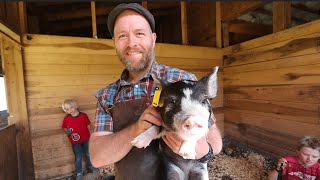
A family drives three hours to Idaho to pick up two pasture-raised pigs bred from Cooney, Old Berkshire, and Duroc lines. The farmers explain the grass-based diet, 9-10 month growth timeline to 425 pounds, and breeding setup: one sow and one boar producing up to 15 piglets per litter, twice yearly. The family sets up electric fencing, deep-bedding stalls, and learns that grass-fed pork develops a red-marbled, beef-like texture.
Chapters
Where's your shoes?
Get it.
Come on. Get it. Meet me out.
That's the Papa.
Alright. We've done our chores this morning. We're trying to get an early start though. It's a 3-hour drive. Yes.
Can I take a briefcase?
Yeah. It's gonna be a big day. What's that?
Tetris and chess.
Okay.
Yeah. Um, are we leaving now?
Sereness.
Yes, I forgot my towel and shoes.
Whatever y'all do, do not step on that green bag.
This?
Yes, don't step on it.
The water— did you bring your boots?
No. Good, good point. Working on some videos. Becca's jamming to music. What are you listening to, Becca?
Judah and the Lion is currently what is on.
Is that one of your favorite—
we are—
YouTube Music playlists?
Yeah.
All right, um, we're what?
1 hour in?
45 minutes, I think, because we are less than 2 hours.
This is what happens when you rarely ever let your kids get on screens. It actually works. Keeps their attention. Lunch break. Got you guys some gluten-free Sammy's bread for a treat.
Yeah, I asked Mom if we could have it.
Peanut butter and honey. You guys are excited about this. You didn't tell them about it, but you knew about it.
He looked in.
We tried to surprise them.
He looked in. They haven't had this in, I think, They've been begging.
I bought some packs of bread just for like emergencies and stuff. And they've been bothering me for months. When can we eat the emergency bread?
Well, here it is.
Hopefully this isn't like—
Whoa!
Where are we? Wake Forest?
We are—
I just saw the college.
We are— In a quarter mile, keep left to continue on US 158 East, US 421 South. Winston-Salem? Winston-Salem, Greensboro something or other.
Somewhere.
I don't think that was Wake Forest.
How was everybody's lunch?
Yucky.
How's lunch on the road? Whatever, you ate so much.
Continue on US 158 East for 3 miles.
Pretty town. Mom's got us there in 17 minutes. How's everybody doing? She does not stop.
I don't like to stop. Get there and eat.
And she's eating on the way.
Get back.
Which is fine with me. Does everybody gotta pee?
No. No? I don't really have to.
Mr. Brown, you gotta pee?
I go a tiny bit.
Okay, good. You guys are good travelers.
Wow, they've been zombied out.
We're there, we think.
How much block are we?
We've gone, we've gone too far. Yeah, we passed it. We're going to turn around and see if we can't find them. There's a loop driveway. Is that too easy?
No driveway.
You'll see when they, when they get full of this, quit eating eating.
Yeah.
So right now they're running with all the rest of them, so it's kind of hard to determine how much they're actually eating.
Yeah.
I put a scoop in in the morning, a scoop in at night, they're not cleaning that up.
Really?
And, uh, so—
oh, here they are.
Once you get them to where they're eating grass— I mean, they'd eat grass now if you had a place to— so yeah, they can't take off where they can eat grass, they will You don't want them to eat a lot of grain. You want them to eat grass. Yeah, that's the purpose of these pigs, is to just—
yeah. Well, we've had guinea hogs. They grew too slow for us. And then we have been doing for 2 years more fast-growing traditional Duroc Hampshire crosses. So this is maybe the middle mark, wouldn't you say?
Yeah.
What would you guys say?
They should be, uh, ready to butcher in about 9 to 10 months.
Okay.
I don't know, we usually He usually does ours between 200 to 225, and we don't hardly grain them at all. I mean, that's just grass.
You're just putting them on grass.
If you want to, if you want to grain them, if you grain these, you're going to have them ready at 6 months. Okay, but that defeats the purpose of these kind of pigs, right?
Okay, what are they a cross of? Because aren't they a cross of—
they're Cooney, um, Old Berkshire, and Duroc.
Okay, and that's what makes an Idaho pasture pig.
Okay, buddy of mine, we sold a 250-acre Black Angus farm and moved here, and my buddy bought the farm and he started telling me about these pigs. And I've had pigs my whole life, all different. I mean, we just raised pigs, but just for us to eat. And, uh, he started telling me about these pigs and I argued with him. I said pigs root no matter what. It's So he's like, well, you and I need to go to Wisconsin and check them out. So him and I flew to Wisconsin and looked at that White Buffalo Ranch that they hold the registration on them. And man, their fields look like they mowed them with a lawnmower.
Nice.
And so we bought some and the meat, it— and when I got out there, they started telling me how great the meat was and they were doing a pig roast that night. And it was okay. It wasn't— I was thinking, man, this isn't any better than anything I've done.
So, right.
Um, but then we bought some burros, and that fall when we killed them, best meat I've ever had. I mean, it's— and I'm not trying to sell you pigs saying that.
Yeah, yeah.
And that this pork, it's not even comparable to pork we've had.
It'll be a red marbled meat, like, um, kind of like almost like beef.
So are you feeding them hay in the winter then? How many sows do you have?
Just one. We just have one.
Oh, one sow and one boar. How many litters a year do you do?
We get two. So one in spring, one late summer.
Where will you put him when you don't need his service?
You just put him in a separate pasture. I'll probably just— usually right where them blocks are. Yeah, I divide that off and leave him down.
Oh cool. And then she'll be here, and they don't— then they behave themselves to stay out of each other's pens.
Yeah, she had 15 this time.
What?
Yeah, it's crazy, isn't it?
So they give a lot. That's not normal for Idaho pasture.
I was shocked. Usually we've gotten 4 litters out of her. She's had 11.
Okay.
And she had 15 this time.
Okay. Is that him and her? Yeah, 2 lovebirds. You, you breed and then he can stay with them? And then when do you have to pull him out?
Um, we usually, um, pull him out probably about a month or so before she's due to have a little one.
Okay.
It all depends too, because sometimes, sometimes the boars can be a little rough, so we might separate them, you know, sooner.
Okay. Look at these guys, here they come. So they'll go out there and graze?
Yep, they'll be out here grazing.
So how much do you think they weigh?
Oh, he probably weighs 425.
Okay.
And how much does he eat a day?
Yeah, that's a good question.
I give them a gallon can of grain a day.
And wow.
And then they eat grass. That's it. And they look like that.
So we're gonna try them as feeders, and then, yeah, you know, we're homestead— we eat a lot of meat. We've got lambs, beef, uh, pigs, and so we are thinking about our own breeding stock. And we want to try these guys first, so we might try these little guys on grass and then, and then move them to the forest.
Yeah, let's move in the forest once the bigger ladies are gone.
So you're raising those for somebody right there? Yeah, look, they've got feed left over. Yeah, you've got something else in here too. You got some horses.
This is Lily. She's a gypsy banner. This is our main carriage horse.
So, so normally when people are out and traveling, you will do carriage rides?
Yeah.
Nice. Yep. Hey, where do you take them on the carriage ride?
Oh, if they do it here, we just take them up the road.
Okay.
There's a—
whoa, that's Jake. Where's his ladies?
I don't have any.
You got one rooster and no, no hens.
This is Bella. She's the beautiful horse of the barn. Just breaking him to drive right now.
How's that going?
Good.
He got a good workout this morning, didn't you? You want that? This is my old quarter horse. That's Trigger. He's 22 years old.
Wow.
This is another Gypsy Banner. She actually came from the Greek— the White Buffalo Farm where these pigs came from.
Hmm.
She, uh, her name's Zoe. She's gonna be 2 in July. We're just starting to train her.
Is that a neck and neck?
Yeah. There you go. There you go.
All right, they are cute at this stage, aren't they? Very manageable, right?
Yeah, maybe I'll be able to lift this one out.
You guys will enjoy them.
Yep. Thank you, guys. Thank you, we appreciate it. All right, we're on our way home. Thanks to your zeal 3:59 it says we're getting back. Yes! 2 and a half hours. Gotta stop for fuel. Or are we gonna pull a Kramer and we're just gonna go for it?
Well, fuel gauge says we have 200 miles left and we only have 162 miles to go. So technically we could still make it home without getting fuel, so.
We got 2 miles to go. How you holding up, babe? What kind of snacks do you have here for the kids? Organic Scouts.
Well, I just found those.
Real food bars. The kids love it.
On Azure Standard. It's the only time my kids are allowed to eat packaged food.
Yeah.
Is when we travel, which isn't that often. Hey buddy!
How are you? How are those pigs doing, Teddy?
His tail is wagging.
Oh, he's a good boy.
That's it!
Good boy.
Those pigs are quiet.
They are.
Not one word.
I think they tooted. There was a smell, but now the smell's gone.
You sure that wasn't the chidlers?
See the mountain.
And look what just happened. Fuel light's on.
The fuel light just came on. So we'll get it on the way home. I think you want to just go home, don't you?
All right, we are almost home, guys. Problem is it's gonna be 4-ish o'clock. You're gonna put supper on, that's easy, just put it in the oven, it's a baking thing. Uh, we gotta do afternoon chores and we gotta put away pigs and we gotta put away a Suburban. Any ideas?
Clean out the car.
Yeah, look back I know, 3:57. We made it home before 4.
We are balling, man. We just like made this happen. Well, it was only 2— it was, it was less than 3 hours.
Home sweet home. I guess we're cleaning up the car now. I said I gotta go change, let's grab something, and it just happened. We just started cleaning it out. Happy to be home, Teddy? You travel well. All right, we got everything. Did bags already get taken up? Okay, we're gonna take these up real quick. We're gonna leave the Suburban aired out for the pigs, and let's get them in. That's our junk pile. Okay, we'll do the junk pile after supper. So only take care of the cold stuff. It's just the only cold stuff. Putting the shepherd's pie in. Yes, very excited.
Premade shepherd's pie.
The oven works while we work.
Win!
Come on, get in, we got a lot to do. First up, bedding. We have a crew coming to chip our wood piles Monday, so we should have mucho wood chips Monday. So I'm thinking that's going to be enough to get us by.
I'll help spread that.
Thank you, buddy. Look at the cucumber growing up from the pig scraps in here. Look, more cucumber. Okay, so this is our deep bedding stall. You want pigs on deep bedding or continually moved? I don't want them in the same spot longer than 5 or 10 days. If you do, you want it on deep bedding. So let's, uh, let's cover any of the old turds. Gideon, you want to help spread it? Okay, come on. You see, we're gonna put them in the stall just to get them used to us, hang out with them a little bit. Get them trained to an electric fence, and we're gonna get them out on grass within a week, easy. Hey buddy, can you get me a scoop? A pound of feed? Uh, let's do one for water. Oh, here we go. But one for water, one for feed. You got me a pound? I think maybe— let's get another pound. Apple cider vinegar, they need a good health boost. You know where our apple cider vinegar jug went? There it is. They're stressed out, they just had to move. Right there. Just put it in. Just put it directly in there. I might normally just do a dash, but let's do a good dash.
I'll stir that.
Okay, well, uh, we're gonna get some, uh, milk— skim milk in it too. How are your plants? They're very dry. I watered them this morning, but it's hot, honey. It's probably, it's probably 85 degrees in here. Your thing says 106, but that's not right.
It's not right.
Oh, we ought to give them some greens. Will you cut some greens with your scythe?
Sure.
All right, water. Oh, move them away from each other so they don't step in them. That's probably good. This would be good for them. After all, they're Idaho pasture pigs and they're supposed to thrive on the grass.
Yeah, are we gonna pick—
just relaxing. Well, relaxing is a strong word, but anyway, let's get them their new home.
Are their feet—
you got that side good?
Yeah.
Oh, look at it. You can look in.
Don't step on the food or water.
We got them green grass.
Come here, come here.
There you go.
They're going to get together.
I hate sudden movement.
Oh, it's been with the grass.
They're already eating, Rebecca. That's a good sign. That means they're not too stressed out. I love that grass. There's grain there with milk in it and they're eating the grass. Are you serious?
They're nice little pigs, aren't they?
Yeah, look at that, they're fighting each other for it.
Look.
Oh look, he's found the grain.
Oh, maybe that's good too.
All right, Jonah, we got one more thing. What? Oh yeah, we should get the cage out and we should put the shavings out. Jonah, let's get the shavings out of that and let's keep the— that box is like perfect for this. Okay, so I'm gonna tilt this. And maybe you shaving towel. Feed, water, clean bedding, you're golden. We're coming for you, sheep and cows. Well, we moved the cows this morning, didn't we? We just have to move the sheep. Let's grab some charcoal, some pieces right there. Oh, there's a good one. Oh, is that a long piece? Oh boy, we burned this brush pile too good. Here's some. There's a big old log. That'll work. This will work. Watch, they're not gonna go for it yet. They're having too much fun at the feed.
You want to time how fast we can do it in?
Yeah, sure. How fast do you think we can do it? It's 4:56.
10 minutes, easy.
10 minutes. Okay, okay. Do we have enough nets over here?
Yep, 2. Add on one more and then build off the feed.
They're doing exactly as I hoped. They're getting in the swamp water. They're actually getting some multiflora rose. Cows wouldn't eat it. They're getting it. We're at 14 minutes. Rebecca, all we got to do is set up the Energizer. We went to test the fence, it was grounding. Well, it was only hitting that one. Just the battery, the Energizer, no fence, only hitting that one. That means probably needs a battery replacement. This is where we were supposed to say, ah, we did it in 15 minutes, let's go in and have shepherd's pie, hip hip hooray. We have an obstacle. All right, hopefully this bat— we got a replacement battery here. I'm thinking it's only one battery that's dead. Hopefully be kind of a quick fix. Let's test it. That did not take too long. Getting pretty good at that, unfortunately. Pretty soon, you know, this is not— we're gonna hook the fence into these lanes once we get a really powerful energizer. Yes, we're gonna plug into the grid because we love the grid. It sounds like it's hitting hard. 13.0. Okay, now let's see if you fixed your fence right. It's hard to get a 13.0 because it's going to ground out on the grass. Oh, 7.2. That's good. The 15 minutes turned into 30, but everybody's healthy. Got to spend a little time out— more time outdoors. Got to get more exercise. We'll try to look at it that way. Shepherd's pie!
More from Justin






If I had to start my Homestead all over again, it could only pick one animal… 




