They Quit the Rat Race to Homestead | 3 Years In
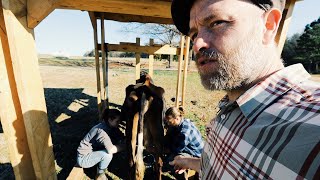
In this segment of the Rooted Life tour, host Victor (Speaker A) visits the Holler Homestead, where Ben and Meg share a three‑year journey from quitting the corporate “rat race” to building a diversified, low‑cost farm. The conversation walks through daily chores and showcases a range of practical homesteading techniques: sourcing and budgeting for compost, improvising an electric fence with repurposed wheelchair wheels, using golf balls as dummy eggs to encourage nesting, coping with an “egg drought,” rotating chickens and cows for polyface grazing, employing heritage guinea hogs and a tame cow for meat, milk, and companionship, and letting pigs rototill and create terraces that foster wild strawberries. They discuss feeding strategies for pigs using kitchen scraps, challenges like rising feed costs, hay shortages, and fly management, and celebrate small victories such as milking routines, making latte, ice cream, and rye bread from farm‑produced milk. Throughout, the hosts highlight frugal ingenuity, community spirit, and the personal fulfillment that comes from living a self‑sufficient, regenerative lifestyle.
Chapters
We are at the Hollers. Ben and Meg, super inspirational. This is part of a Rooted Life tour in celebration of my book. Just, we're gonna look at their rooted life this morning. This is what they've done in just 3 years. It's absolutely insane. So proud of them. We're gonna go on chores with them this morning, not just a tour, chores.
All right, we'll go feed these chickens over here. They're, uh, they're staring in the house glaring because, uh, we're a little bit late.
Where'd you get the compost and how much you have to pay for it?
Uh, that's a local place in town and you don't want to know.
It, uh, was it too expensive?
It was too expensive.
Or was it a steal?
We've bought it every year since we've been here and it's gone up incrementally, and this year it nearly doubled. Ah, so we won't be buying a lot more.
Uh, what will you do instead?
Well, the plan is to just make enough compost, but in this stage where we're putting everything in, we can't make enough right now. Yeah, I'm sure we will eventually.
I get it. No homestead shame coming from me, my man. Oh man, we gotta—
it's kind of janky. This is my, uh— almost got you.
You've got a rod attached to that.
Yeah, it's a work in progress, but, uh, and this is electrified. Yeah. So I've taken to running my electric up where I'm not gonna run it over or snag it with the lawnmower. Yeah, um, it works okay. I— it either needs to go higher. Yeah, or, uh, subterranean.
I like it.
It works. It, um, I've got a great big energizer and keeping everything up. This fence hits so hot, I respect it now because, uh, if you forget and try to step over it and it hits you That's brilliant, man.
Your life flashes before you're a good start, as opposed to like burying in the ground with a coated wire.
We're starting to rotate the cow and the chickens again. Watch out, chickens. I've had them in here. I moved them night before last and they've already taken care of all the cow pies.
Sweet. You're doing a little polyface thing like we do.
Yeah, it, uh, so it has been so nice The way they spread all the cow pies. Oh, it's amazing.
Yeah, I don't even see any cow pies in here. No, there's, there's a little bit destroyed. And they're doing that even though it's not fly season?
Uh, it's warm enough down here.
What?
Yeah.
So you do have flies?
We do have flies.
Oh, okay, okay.
You'll see when we get over there by the cow.
Okay. It's—
I was sad to see flies show up again.
Isn't that crazy? Just 1 hour difference.
Yeah.
And we're not going to see flies for a couple of months. Okay, so this is cool. You've got a hand— you've got a wheelchair wheel on this thing. This— make do, do without.
This represents— I think I spent a whopping maybe, maybe $20 on it. The whole wheelchair was $5 at the restore. Yeah, yeah.
And, and what else have you used those parts of the wheelchair for?
Uh, really just the wheels. I bought the wheelchair just for the wheels.
Nice. What did you just show us? You got eggs?
I got one egg. Nice.
We must have missed it.
Nope.
What the golf ball's for? Tell the people what you're using the golf balls for.
If you, uh, put something in there, you can get fake eggs or you can put a golf ball in there. It basically shows them, hey, that's a nest. Ah, and you can encourage them to lay their eggs in there. We, uh, we keep adding to this flock. We keep hatching eggs and stuff like that. And so The plan was we hatched 3 batches last spring. The first batch would start laying, you know, early fall, and then the next batch a little bit later. And then in theory, we'd have eggs all through winter. Nobody laid a single egg. This was the great egg drought of, uh, 2021.
It happens sometimes.
They're all laying again now, but it was kind of rough there for a minute.
Nice. You've got a little hitch for your Skag, it looks like. It looks like you certainly move this by your hand.
By hand, most of the time that's what I do. I just pick it up and move it. It's not real, real bad, but for like the bigger moves, yeah, I just hook it up.
Hey, you want to speak to this handle? Uh, worth it or not?
They're great when they're new. Uh, after you've carried around a lot of stuff, they start breaking, and then, uh, they'll pinch you and smash your hand when you pick it up. These are our breeders.
Nice.
That don't breed. We, uh, we've had them together pretty much full time. I'll wait till I see them mating and I'll separate them. Some of the things that can happen is if you have a real aggressive boar, they'll basically cause the female to abort. And so I wondered if that was something going on. I've found I really like the heritage breeds that are like the bigger ones, like Hampshire, Berkshire, um old spots, stuff like that. They grow really fast, the meat tastes great, and they have good personalities. These ones, um, I can't get in here with them. I have tried to handle—
really?
Yeah. Um, Bubbles, our boar, uh, if she's in any kind of heat, you do not get in here. He'll bite your leg off.
So they're going to be 100% today on food scraps?
100%. We actually—
nice.
Meg's been doing enough cooking to where So we have a lot of scraps.
How do you know how much to feed them is enough? How do you know it's enough?
Um, generally I go off of how much protein's in here. Ah, and we've got a lot of chicken wings and chicken bones in here.
Okay.
Um, there's also a lot of— looks like beans. Um, half a bucket is not enough for these two pigs.
Full bucket.
Full bucket.
How do you know when it's not been enough? They growl at you? Good.
These are our American guinea hogs. I love guinea hogs. Yeah, they're, uh, they were our starter pigs, and these ones were born here. Uh, all of the rest have moved on to, uh, colder pastures, and these are the two females. We're looking for a boar right now. Ah, um, we're, uh, we're gonna stick with them the way we feel about them. We're always gonna have at least one or two guinea hogs on the property.
And why is that? What's their chief— what's your chief reason they're liking them so much?
They're so gentle. They have great personalities. Honestly, it's like having a couple dogs. Yeah, that's what they feel like— dogs that oink.
And you can totally get in here.
Yeah, these ones, the only way they're gonna bite you is if you lay down.
Have you tried that?
Most time, if there's no food involved, they're pretty gentle. They're about done with this spot.
So what are you doing with this spot? How are you using them in this spot?
For those that don't know, haven't been here before, so this is what was impenetrable forest. Yes, um, you saw—
I remember this.
You saw when we got here, you couldn't walk through here. Um, so like over there, that's what this looked like. That's just a thicket. Yeah, it's, uh, absolutely impossible to walk through and it takes so long to clear it. Well, what I found is if you can clear a perimeter, put a fence in, and park the pigs— as you can see, they're rototilling everything. Yeah, they're eating the greenbrier tubers. Um, if there's any kudzu in here, they love kudzu.
You've got grass sprouting up over there. Yes, from area that they've been in.
Isn't that crazy?
See that? You can see that. And now Eventually your cow will come here, won't she?
Uh, after we thin it out a lot more.
This bucket's sealed. I noticed there's no lid. You just have to keep this off so that you can have suction. Yeah, um, it doesn't create a vacuum. And you just screwed right into that plastic too. You didn't even have to do an adapter.
I've got the bulkhead adapters just in case they rip these out, but these ones are so gentle they haven't, they haven't ruined the water.
I've heard that pigs will hit that nipple and create a wallow, but mine haven't really done that yet. I've been doing it for a few years.
I think the thing I found, um, as long as the pigs have something to do, yeah, they don't tend to, uh, really break their environment.
And look at this brand new— this is ice cream grass right here, man.
Yeah, this is good stuff.
It's brand new green stuff that was not here.
I think what's funny, you can see This little ridge right there, that I had the fence. Yeah, right in here, the pig fence. Yeah, and they rooted up against it. And, uh, what's funny is all in this ridge strawberries come up.
Yeah, they're starting already.
And these strawberries get bigger than any of the other wild strawberries.
That's neat. Yeah, because you— Joel Salatin has spoken about this, using pigs to create a little swell. Or a little, uh, what do you call it when you, when you build a garden into a hill?
A terrace.
Terrace. Yeah, to do some terracing. Hey, we picked up Meg.
Yep.
And Liliana and Henry and Rebecca. It's always nice doing somebody else's chores. Ben and Meg are probably looking around and seeing the to-do list, and I'm, I'm just hearing the birds Seeing the new things, learning stuff. Daisy, are you a big pet?
She is a big pet. She's kind of bossy though. She's like really bossy.
She's kind of bossy.
She, uh, she— I got—
she's out here fussing at us out here.
I got between her and the feed bowl yesterday and she crushed me against the stanchion. It's just like—
look at this, he just leads her in with a halter. There's some good— there's some advantages and disadvantages to a tame cow. Uh, you already spoke to one of the disadvantages. It's kind of like a big— it's like a 1,200-pound pet dog, 100-pound dog that doesn't realize she's 1,200 pounds.
Yeah, when, uh, when she, uh, steps on your foot, you know about it.
That's right.
She doesn't necessarily know about it.
The advantage is though, you just walk her into the stanchion.
She's, uh She's really tame, which has been really nice, but at the same time, she, uh, I don't think she's been raised in like a herd setting. It's been her and her baby. I want to say she has always been artificially inseminated. Um, thank you. Um, so we are her herd. Yeah, we are the, uh, she's like, come and be with me. Yeah, I want you.
She's getting a spa treatment right now. If the aliens come, they'd wonder who's in charge, us or the cow.
Definitely the cow.
So how has that changed things now that your life actually has to revolve around this cow?
Uh, I mean, not a ton has changed, but we don't like up and go to Florida or anything.
No traveling around the 46 states.
No, nothing more. Girl, it's, uh, it's been different. Um, whereas with, you know, all of your other animals, you are responsible. With a cow, she can't wait. Yeah, so, um, that's kind of been interesting. But we're only milking once a day. She keeps the, the calf all day long. If we need a day off, we'll just leave the calf on her. Um, it's been a little bit of adjustment, but it hasn't been that bad.
Have you had any moments like, oh my goodness, what did we do?
No, I think so. No, no, we've, uh—
what's the trick to building up to a cow then?
Talking yourself into it.
Yeah, talking yourself into it. One of the hard things has been running out of grass and realizing, uh-oh, we have to buy hay and all that. Uh, but the grass is starting to grow again, so we're, uh, we're getting back to where we were. It's weird, like all you have to do is give her, you know, shelter and water and milk her. Yeah, and she takes care of the rest.
And just a couple of strands and one strand of electric, some rebar fence posts. Well, Morgan was saying it's so easy once you—
your extension is Like, your shed is so much bigger than Ben and Meg's. Oh, I didn't realize how small yours was.
But you only have a cow. We have—
yeah, that's because we put 4 or 5 cow units under one shed. Yeah, you're talking only one cow unit, maybe a quarter, one and a quarter cow unit.
If it's, uh, rainy, she'll sleep under it. Um, yeah, it's enough as long as we're not getting sideways rain. It keeps us dry. The cows are pacifists. If you, if you do any kind of violence or rapid movements, smash something throw something, they really get upset. Yeah, I thought it was funny. It was like, oh, cows are peaceful.
The couple that milks together stays together.
That's right. Hopefully.
Hopefully.
You guys ever have any arguments out here?
Oh yeah.
Oh yeah. Look at her. Which one is it? He's hanging you out. He's saying, I like it, I'll keep talking to Ben. Okay, tell me more, Ben.
We kind of had an agreement that we would both milk and the boys, you know, we've got teenagers.
Yeah.
So the teenagers watch the baby.
Yeah.
And we're out here for half an hour. Yeah. And this is rapidly becoming— became our like happy little morning ritual.
Yeah.
Um, we come out here, we get to— if we want to have a private conversation, we can.
You might say you're, you're knocking out two birds with one stone here. Yeah, I guess you're getting the work done and milking, and this is a good time to hash things out, have great conversations. Yep. Look at all the fly and gnat activity on these pats, Rebecca. Just 1 hour and you got fly activity in March. Meg likes the big puppy dog.
I do. She gets a hug every morning to let her know that we appreciate her.
They've dropped the one edge of the fence. We're going to get biscuit. I think that's what they call it. The calf.
Are you ready? What is that?
What are you having her do?
Get her to let down.
Are you gonna milk her some more?
Yeah, we get the hind milk.
She's holding it back on you, huh?
Oh yeah, we've been doing this since we got him. Uh, sometimes she'll let down as much as we just milked, so we got probably a gallon and a half. We— not lately, but for a while we could get another gallon and a half, and this stuff will be super creamy.
Thank you. Good sweet boy.
Poor sweet boy.
He is.
He's kissing all of us.
He's your dinner next year, right?
Yep.
So what's that gonna be like, Meg? You're cuddling with them, uh, I think—
I mean, we enjoy our animals and we get connected to our animals, but they do— I mean, that's their ultimate purpose is feeding us.
Yeah.
So we just are happy to give them the best life and then they serve us later.
Yeah.
And you'll do it here on the farm, won't you?
Yeah, we will. Yeah, that's super humane, peaceful.
Yep. Yeah, he won't have to go anywhere. You got a gallon and 3/4?
2 and a quarter almost.
We got 2 and a quarter?
Yeah, almost.
Oh nice. What are you gonna do with all that milk, Ben?
Uh, well, here's an example. I'm gonna make a latte.
Here you come and ask me if I want a latte. I'll take what you're giving me, Ben. What do you make with this, uh, cheese?
A lot of times we'll do ice cream. We'll make ice cream.
Oh yeah, oh yeah, probably more ice cream.
You have a cream separator? We do not. We just skim it all off.
Is that working off? Is that working okay for you?
Yeah, it works fine.
Did you make that bread or buy that bread?
Oh, nice.
Looks good.
It's a rye bread.
The excitement of what I'm about to show you, I don't think is ever going to rub off. They have this amazing library, and then. Look, look. I made the library.
You did? Woo.
How many of these authors do you know as good as me?
I'm gonna say the interlock on the back.
I know.
Jess sour.
Oh, oh, oh, oh. Y. You got me. She got me beat. So how does it feel to know two authors on your bookshelf?
Pretty cool.
Isn't that cool? I feel legit now. That's right. I'm one shelf away from William Shakespeare. Come on now. I'm right next to Wild Garlic, A Cabin Full of Food, The Family Garden Plan. I like it. Oh, The American Boy's Handbook. I really like it. Oh yeah, I'll take that. We crushed this breakfast. What happened? Nobody went for the spinach quiche.
Green stuff.
They went for the potato quiche. Thank you guys for the tour. You've done a fabulous job in just 3 years. We're very proud of you. The people watching this see it. They see it. If you want to go follow their journey, you're back on the— you're back on the train, you're back on the wagon. 5 days a week at the Holler Homestead. If people want to follow you I definitely encourage it because you guys are aspirational. Good job. Thank you.
More from Justin






If I had to start my Homestead all over again, it could only pick one animal… 




