This Will Be EVERYTHING You Need to Know About Electric Poultry Netting
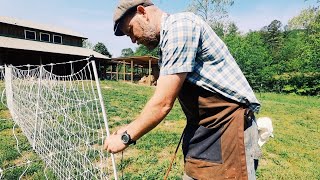
Victor Justin Rhodes walks through electric poultry netting setup and use, from unboxing a Premier One net and FiberTuff posts to grounding, troubleshooting, and pasture rotation. He covers repairs, feeding, watering, and how to keep birds safe on fresh ground.
Chapters
Jason, Sow the Land. What are we doing here? I guess we're, uh, we're going over the notes for the, the one net chicken stead. Really, how to basically do nets. It's a lot. I didn't quite realize how much it was until I started putting it down. Yeah, it's not just putting up a net. It's something I do every day, so I kind of take it for granted, but A lot of people— nets are important, and you can do so much with just even one net. We did. We farmed 10 years with just one net. Yeah. And so we're gonna get the basics here, do a master class for Abundance Plus. We're going through members, people already in Abundance Plus have said, hey, this is my struggle. Some of these I didn't include in my main class, so we're fitting them in, we're adding them. Also Premier One Joe, thank you, from Premier One has put in some tips that we want to make sure that we cover, and that's what we're doing. We're doing the paperwork so that out in the field, maybe it goes a little smoother, easier. Hey, Beck, you got a couple strawberries out here in your green stock. Nice. I came out here because I want you to see what the kids are doing, and we needed a break, didn't we, Jason? That's the hard part, the planning. Yeah. It's all set up. I just want to get out there and just be like, let's show them. All right kids, take us to Wonderland. He's burning out. Look, this is what I looked out the window and saw. Rebecca, those are your sons. They're yours. Well, we got done with the paperwork and we've done, uh, the first lesson. We did an unboxing. That was fun. A brand new net from Premier One, FiberTuff posts. This was fun. We did— we, we unboxed an Energizer. Some new features since I've gotten Energizer is a plug-in option and the grounding rod. That is so cool. It's basically— it mounts to the bottom of this thing. It's removable, so you just— most times if you have soft soil You can just drive it in like that. That was cool. Intellishock 60. Lesson 1 of 12-ish down. Jason, how do you feel? Feeling good. We got that done quick. Okay, good. We want to be quick and to the point with this thing. This is— this does not need to be a 4-hour course. This needs to be like they can consume this in like an hour-ish, like an evening education instead of— yes, entertainment. That's right. So we're gonna go straight to the point. We do have some fun in the videos, but yeah, straight to the point, get you guys out there. All right, let me get you a recycle bag for that. If not, I'll water them. How are you guys?
We're good.
Hey, say hi! One of my favorite outfits. These little vegetable— are you out with Mama? You just along for the ride. You just along for the ride. I am.
He's got to see the baby chicks, and we looked at all the plants.
Did you check to see if your plant starts were watered?
I think they have been.
Rebecca came in— should I say storming in? Say you have less work.
I said you're—
congratulations, your workload just got a lot less this week.
Yeah, because she said what this is the only leaf that didn't die in that frost.
Oh wow, how much bigger it is! Oh, they kind of had to start over.
Yeah, it did.
You made it! She came in because these tomatoes did not look like this. No, they were shriveled. They were kind of shriveled like this lettuce. So some of the lettuce didn't make it back. Well, but how much lettuce do you need?
I'm shocked at how much has made it.
So all these tomatoes came back. So that's my workload the rest of this week, is to get these— these tomatoes planted.
Those marigolds looked terrible.
Yeah, well, everything looks good, uh, so I'm thankful for that. We watered them right away and they came back, but I think what's happening is they're, they're getting big and they only have so much soil, so they're really kind of living on that water. Trying to scout out where we could do a demo of this. How about in the yard? How about the backyard right there? It's already mowed. I think be putting up a net, you'd want to cut this down a little more. So maybe we'll, we'll mow this real quick, get some grass clippings. But first we need to go water our squash. Whoa, hoping that helped. Has not rained in like 2 weeks. That's bad for North Carolina. We have some green plants. Oh, we're gonna get wet. Not too wet, but a lot of these are, are yellow. Even worse, some of these have even gone to flowering. This is field dirt, it was compacted. We knew this was a risk. Hopefully some of them make it because we want them to keep this area. We want to keep the weeds at bay and hopefully get some squash and pumpkins. But it's gonna— it looks like it's gonna take a year or two for this to be a really fertile place. This wood chips will help. Having the cows and the sheep on this in the winter will help. That one's doing good. We just got the area behind me mowed. We're gonna go on our second lesson, Jason. 8:42. I think things would go a little faster than this, but we've got the notes, so I think we should start being able to crank it out. This is the biggest lesson of all— setting up your net. This is a huge pain point for people. Yes, and we're going to solve that because a lot of people were asking, you know, it's too heavy, how do you, how do you actually set it up, all this thing. So that's what we're going to cover now, and This is the key. This is important. That's the secret. That's the hack right there. The rubber mallet. Just wrapped up the morning session. Gotta go in and make lunch. Look at this net. Look how good this looks. We went over setting this up, we went over troubleshooting, we went up setting up corners. There's a little hack right there for you guys right now. Diagonal rebar. This is kind of like paracord, but it comes with Premier One. We kind of hold this off of it. It's best if you get it off this electric part. Let's do right below that. We did come into a problem in our lesson. It was a little— it was good because, you know, you want this to be textbook, everything to go right, but we also wanted to show what do you do when it's grounding out and not working. So we showed troubleshooting, and this was one of the things. We had our little corner support touching that and it was, it was actually conducting electricity through this cord. In our onion patch, I just noticed we've got dill growing up right amongst the onions. I say we keep it. Rebecca likes dill. Interesting, it's coming up through throughout. We actually have somebody helping us come to buddy our sheep. We're gonna castrate— is it castrate when you're banned?
No, it's banding.
We're gonna band him so that he can't breed, and he'll be Nacho's buddy forever. She needs a picture of his balls. That always works better with a camera. Can you go take pictures?
Yeah.
You and Josiah? Can one of you kind of set this up when you get them ready? You guys can kind of vlog it. Okay, thank you. They're back. How was the picture, Beck? It's good. Did it actually work?
It's a good picture.
Oh wow, yeah. All right, you better text that to her. Like, it looked like you might be getting endowed. Good job, guys. All right, let's get back to the fencing master class. All right, I can't believe I'm about to do this, but we're going to do a lesson on how to untangle a fence. That fence is pristine, Jason. I'm really just gonna chuck it into the air and throw it over there, and it's just gonna be all— I'll throw it on here. We'll put our mallet there. We've got that bow and arrow there. Hopefully it'll get tangled. Yeah, put that stick there. Maybe a kid threw it on their, their toy barn. Let's put the toy barn down. Jason was pointing out, you know, if you fall— if you actually pick up the net proper and put it out proper, you're going to save a lot of tangling problems. Mucho. So a lot of it is about just picking it up and putting it up proper, which we just went over in a lesson in that time lapse. But I've at least got to show you this. Tangles to the extreme. You ready? Oh, that's not messy enough, is it? All right. Oh my gosh, did I really just do that? Oh my gosh. So this whole next part is going to be me teaching how to untangle that, huh, for this class, for everyone who gets this class. I, I know it's a pain point because I actually got this, this particular lesson from folks in my member area saying— because I asked everybody, what's your number one, what's your top struggles with these fence tangles? Actually, I'm gonna, you know, we've tangled this thing up I'm going to take my advice in the video. If you have another net, or if you're not pressed for time, take the pressure off yourself, walk away, come back in the evening, uh, come back in a week as Jason has done before after the spouse put pressure. Are you ever gonna get that net up? Yeah. Uh, so our lunch is actually ready, so we're gonna do that. And then go back to it. Lunchtime, guys! This is interesting.
Potatoes.
We're back. Had a good lunch. Well, Jason, how was lunch? It was great. I'm OMAD, but I would— I told Becca, see, it's gonna be the shirtless farmers here. She said, no, you're not gonna take your shirt off for Abundance Plus, right? No, no, of course not. So yeah, okay. Our shirt's got to stay on, Jason. Well, you can take yours off, you're going to be behind camera. You won't know. We're going to get this net untangled. I better put it on time. Let's— hey, let's time this. It's 12:27. Boom! 10 minutes. What do you think? Yeah, learn it. Hot. Are you— I know it's hot. I didn't lose my religion once, did I? No. Patience is key. You, you were here real time, no, no edits. I didn't start swearing and no cursing. We got, uh, but that's because I've had many a tangle and I've learned how to deal with it. Patience is key. Next up is repairing a net. You know, these nets are so tough, it takes a lot to break them. They do break. I mean, we've had a dog— it was off, a dog got caught in it. Not our dog, a neighbor's dog ripped the net. It does happen. They gnaw themselves out, a branch falls, it gets cut. It does happen. This is my original net. This is the original One Net Chickenstead net. It's got a post that's broken. You can actually replace these posts. You can actually order them, and all you do is slip this off and slip another one in. It's all slippable. So I don't know if we have a break, but I feel better about maybe cutting one of these. Oh, is this a break? Nope. Telling you, this is tough stuff. So we'll make a break, Jason, and then fix it. I actually just freshened up on our fence repair. It's been so long. We're actually gonna have to cut it. It's an old net. We'll just cut it and fix it. For the love of you guys, we got our kit ready to do this. It's our last one outside, Jason. Nice. Then we can go inside. All right, we are done with like the— like hook up a wire, set it up. We got some time. It's, uh, 1:45. How about we go inside in the air conditioning? We got some chalkboard lessons, some systems. Like, are people going to do the compost corner with this, or put them out to pasture, or do gardens with this? Yeah, so let's go over that, right? The systems, the exciting stuff. And that stuff's kind of important because you kind of need to know what you're going to do with chickens to have the netting instead of just putting up wherever, right? We're going to give some focus, some planning. Yeah, we just finished the inside session. How'd it go, Jason? I think it went well. A lot of information. I'm gonna tell you, it's a lot of information because we filled up a 32-gigabyte card. We had one shot left, so we had to do two cards. Henry was quiet until now. Little baby Henry, you can interrupt the vlog because then it's good. Everybody would rather see you than the blackboard anyway. Yeah, everybody would. He's really— this is the first time he's seen the camera. Uh-oh. Basically what we were doing in here, I'll give you one example. Is we were showing how to set up different systems. We've got 3 different systems that you can do with the net, and then one of them is pastured system. But inside of that, there's 3 different things you can do. One thing I pointed out is you can put your Energizer right here out in a pasture or a yard, and if you have room, you can set up one net right there, and then the next day— or not, well, if you're moving them every day, you can do that. But say in a week you move your chickens your coop and your chickens over, and you can keep that wall. You can keep that one wall, and you only have to pick up 3 walls. I've done this before. I call it the pasture quad system. And we move them over, and you move your energizer a little just to get it out of the way, and you just go around like that, moving them every week, and you got a month rotation. So it's that kind of stuff that we're teaching in there. Mom's gonna nurse him. Jason, thank you so much for helping. Did you learn anything? I did. What? What? I learned what you just taught right now and, uh, how to roll— come on, what? How to roll up a— okay, a netting. Yeah, because you said you were doing it wrong. You were rolling it by the posts instead of the loose end. Yeah, because I don't like watching videos, right? I just like getting the thing and doing it and then figuring out as I go. So this is helpful. So now you've learned it. Okay, so good for them for watching, uh, the videos, right? Save you a lot of trouble. Yeah, it does. It really does. You guys are probably wondering, well, how do I see these videos? Well, I'm gonna give you— I'm gonna give you guys some of these videos, Lord willing, and the creek don't rise, next week. Hopefully I remember— if you're seeing this later, I remember to just go ahead and link it in the bottom. Second week of June, we're launching Abundance Plus. It's formerly known as Abundance Permaculture, is becoming Abundance Plus. The app's not ready. The app will be ready in the fall. For now, you, you guys will be able to get it in a— it takes time to put— Dan's going to edit these. It takes time, but this is going to be a probably 10-ish parts. It's going to be a master class, and you guys can get that at Abundance Plus. I should fold the milk towels while I finish this. So, you know, Abundance Plus is not just going to be— it's going to be the inspirational stuff rooted. There'll be that level, but it's also going to be the educational stuff, and there's going to be a community element. More on that as we go into the launch. The spring registration— I'll be a little late— middle of June.
The rain is missing us today, but no, Thursday or Friday, really?
Like, what the heck? I actually got a call from our post office. 12:30, our turkeys are here. They're actually not supposed to be here till tomorrow, so they're a day early, but that's good. I mean, that's a good problem. The kids, it looks like they set it up. I'm coming to check to make sure. We kind of need to do a gallon waterer though. That sits up too high for chicks. Got the feed ready. Aroon has gotten to get— gone to get the pullets. And I called them chicks there, but they're pullets. And the feed, our new Country Organic feed order has not come yet, so we had to run to town to get some locally. Let's put this a little closer and maybe a little lower. There's— they're going to be little guys. I am going to opt out of the heat lamp. It's a little late, it's a little warm now, and heat lamps can be so dangerous. Rather not risk it and just do this. Let's get a gallon water. Rain! It's raining! Should do the rain dance. It's been way too long. Gallon warm water, a couple tablespoons of apple cider vinegar. Give them a little magic water. Turkeys, especially poults, are a little more sensitive Uh, when they are brand new. 2 garlic cloves minced. Where's Jason? A little bit of honey, maybe 1/8 cup, and stir it all in. It's warm just so that the honey absorbs. But I guess the chicks probably, or the pulps, would probably prefer it warm anyway. Back, it's continued to rain.
I know, it's so good.
It's coming down. Your yard's looking good from this angle. Barn's looking good over there.
It needs it so bad. Pastures, the gardens, everything. Although, didn't you— you watered that down there this morning, didn't you?
I did, but I am not gonna have that again. You didn't expect rain. I'm not gonna let your plants dry out again. No, you didn't expect rain this morning. That's the first chore now. The first chore. Hopefully I'm gonna get them planted tomorrow. I'm gonna get those tomatoes planted in the greenhouse. I'm gonna start with tomatoes since that's what you love the most. We were approving the vlog. By the way, delivery date for this Kubota, the tentative, tentative delivery date, Kubota tractor and a utility vehicle, June 4th. That's assuming we get everything worked out with the insurance and all the moving pieces. Looks like it stopped raining. How beautiful. Oh, that smell! The plants are gonna love it. You can water plants, but nothing jams plants like natural rain. Aruna's back. Got my waterer. Wait, are these— are there— uh-oh, those are sea monsters.
These are sea monsters.
Those are not turkeys.
Okay, I guess this would make sense because they're 3 weeks from being—
he said it's a chicken. I said no, it's turkey. That does make sense.
Oh shoot, it is chickens.
It's chickens.
Oh boy, so we have chickens.
All right, well, when are the turkeys coming? Tomorrow?
I don't know.
The setup's just the same except we rent— we had Arun go all the way, all the way across town to get feed for turkeys, and we don't really— we don't need chicken feed. Well, you need it anyway. Yeah, we need— because what if they come tomorrow? We got the water. Let's put it in. I'm gonna put it right next to the brooder to the hot bird. So warm out, I think it'll be fine. Yeah. All right, uh, we should probably have two. That's the only thing. We're gonna have so many— there are sea monsters in there. Let's just fill this all the way to the brim if you don't mind. It's a little easier for them to get it. 100 chicks going in. We get our chicks from McMurray Hatchery. Thank you, McMurray Hatchery, for sending these. Maroon's digging in. They're going at it too. What do you think about this, baby Henry? Do you hear those noises? Well, you're born into some family, I'll tell you what. You're born into something else. His eyes were like wide open. Here, look, Hendrick. Look, Hendrick. Yeah, you don't know nothing, but he's really getting excited about that. He's really kicking his legs. Oh, maybe he's getting upset. Yeah, we still have sea monsters out in the field. They've only got 3 weeks left, so these guys will be ready to come out the day the, the big sea monsters graduate to the freezer. On today's episode of Burn It Up Cooking Show, carnivore chips, which is shredded cheese piled into piles. I'm gonna bake it in the oven until they're hard and crispy.
You want to bake them to where they're like All cooked but not dark.
I don't want burnt. Contrary to the name of my show, we don't actually like to burn things. Hey Lily, will you move out of the way please? The show is more about just cooking even if you don't know what you're doing. Bake 350, or is 375— 375 is the new 350. Looks like Need a bit more. Let's set it on 5 minutes. It's not quite up to 275 yet, so maybe 3 minutes. For supper, it's Taco Tuesday. We've got some ground beef from the land. I'm frying up some onions. I'm gonna have some leftover corned beef with that. Lily's got some tortillas going. She's also cutting up the salad. Lily, our timer's going off. She's working on a tortilla. Oh wow, they're starting to bubble. Starting to edge up on the sides. I'm gonna say 3 more minutes. She's really cranking out these tortillas. Can I get in here? Well, I'll peek when the camera is off. It needs— just still needs more time. I just do it every 3 minutes because I don't know how— what's the perfect amount. Let's get that on there before— whoa, we're starting to burn it up! The oil, the olive oil is burning up. The ghee's burning back there with my onions. Let's get some of this corned beef in there. Now, a variety is helping me stay strong in this animal diet. I'm gonna have corned beef. I might heat up some of this pork burger. We're gonna make— I'm gonna make chips. They're gonna be having chips, so I'm gonna try to have chips, but mine are gonna be made out of cheese. Well, it wouldn't be the Burn It Up Cooking Show without the vent on high. We did get that olive oil going. She snuck and put it on high, didn't you? High heat all the time. Oh, this time it won't be like burning up cooking soap. Yep, man, my corned beef is heating up nicely. The cheese chips are heating up nicely. Look at that, I think I got it perfect. Not burnt, but, but, but still. Teddy, why are you barking? The ball's right there. Can you not get it? It's right there. Everything's done. Cheese chip. Crunchy. Nice. The flavor's a hair strong in the chips because it's a cheese chip. It's kind of fun to have something crunchy.
More from Justin






If I had to start my Homestead all over again, it could only pick one animal… 




