Tour Joel Salatin’s Ultimate Mobile Farm Structures
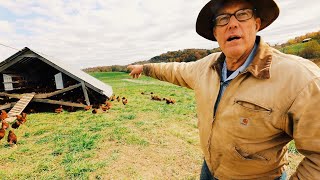
In this YouTube tour, host SPEAKER A, Joel Salatin, and collaborator Chris walk through the mobile farm structures featured in Salatin’s new book Polyface Designs. They demonstrate a portable pastured poultry pen, explaining its lightweight aluminum construction, dimensions (10 × 12 × 2 ft), and the use of a dolly to move 4,500 chickens per hour without machinery. They discuss material choices (aluminum vs. steel), emissivity, and cost‑benefit arguments, framing the design as a “Dave Ramsey” debt‑free solution. The conversation shifts to rabbit “hairpin” shelters that a child can move, highlighting grazing benefits and a rough valuation of $50,000 per acre of grass. They then tour a multi‑species racking house where chickens and rabbits share stacked space, creating on‑site composting and reducing pathogen risk through low density stacking. Next, they present the Millennial FeatherNet – a scissor‑truss A‑frame on skids with electrified netting, designed for wind resistance, predator exclusion, and easy relocation. Economic calculations are provided for both chickens (e.g., 1,000 birds yielding $70,000 annually at 50 % production) and rabbits (e.g., 40 does in a 500 sq ft garage producing $25,000). The hosts discuss scaling the designs down to a 500‑sq‑ft garage, animal density guidelines (1 chicken per 3 sq ft, 1 rabbit per 6 sq ft), and the feasibility of suburban backyard farms. The segment concludes with a promotion of the Polyface Designs book, its detailed construction plans, tool lists, material cut‑lists, and supplemental video content, emphasizing the 50‑60 years of trial‑and‑error behind the designs.
Chapters
Here we are with Chris and Joel talking about their new book, Polyface Designs.
And Chris is the brains of the outfit, just so everybody knows right up front. Chris is the brains of the outfit.
Just clear it out of the way.
If you want to build exactly like Joel Salton, you got to go through Chris.
It is an amazing book. We're going to go around the farm and look at some of the more popular structures. Homestead-friendly, market farm-friendly. Joel is a market farmer. This can be scaled down, this can be scaled up. So this is going to be one of the more popular ones, I think. So can you tell— just kind of give us a tour of one of these pastured poultry pens and maybe give us an idea of inputs and outputs, if you don't mind?
Sure. So the shelter is, is 10 feet by 12 feet. 10 feet wide, 12 feet long, and 2 feet high. The reason it's that dimension is because you can make it smaller, but it's the same effort to move one small as move one big. If you make it bigger, then you start getting into too much weight. So the whole, the whole goal here is to have something that's so portable that it's actually fun to move. The single biggest, whatever, problem that people encounter duplicating this is they make them too heavy. Either by using dimensional lumber that's too big or material instead of aluminum using steel. All this adds weight and then it's not fun. Then you get, it's not fun. So the whole idea is light enough to not blow away predators to dig under, but heavy enough, heavy enough that it won't blow away and light enough that you can move it. That's the idea. And so maybe I should move one just to show how easy this is. And okay, I'll grab the— I'll move this one. Let me grab the dolly up there. Just hang on. Don't underestimate the value of this tool right here. And Chris has done a masterful job in the book of explaining the dimensions, the angles. He even shows how to, how to make a jig, a jig on the ground to get the angles right. But everything about this is really critical for ease of function. But this is the tool, not a, you know, not a tractor, not a garden tractor, none of this stuff. This is the tool. So we come up to it with the dolly and just stick the two shoes under there like that. And then you just, you just, well, yeah, when you're demonstrating, things always go a little bit awry. All right, the point is that that breaks the ground, but not enough for the chickens to get out. Okay, and then we go up here Pull the feeder. The chickens just walk on the ground as we move it forward. And now the chickens have a totally new, they have a totally new salad bar. They have new bedding. So they can, they get away from yesterday's manure, get a new place to lounge, and that took 30 seconds. Yeah, took 30 seconds. So then we just go pull the, pull the dolly out. Okay, then you go to the next one, the next one, the next one. The point is that with this little tool, in 60 minutes, without starting an engine, without owning a tractor, one person can move 4,500 chickens in 60 minutes. In one hour.
And that's canceling your gym membership too.
That's canceling your— that's right, you're canceling your gym membership.
The poultry pen work out.
It's canceling your gym membership. It's canceling your pharmaceuticals, your vet bills. It's canceling most of this. It cancels your predator issues as well because the chickens are completely contained. Weather issues. It makes sure the chickens are on a brand new place every day. And it gives you, it gives you the, all the positives of pasture without the negatives of weather and predation and all that stuff. And you do this without any machinery except this. I mean, that's the thing, you know, folks that are selling these big hoop structures and scooters and all that stuff, I mean, I'm glad that's on the market and I don't want to denigrate anybody, but I can tell you that it makes a big difference whether you have this and a little $300 shelter versus a $7,000 structure plus a tractor to move it. That's a game changer. That's a real— the capitalization is a game changer. So I call this my Dave Ramsey solution. You know, pay as you go, debt-free, and you're up and running. And all you got to do is cancel your Netflix subscription for, you know, for 2 months, and you build one of these. So brand new, all this, the lumber, aluminum, accoutrements, $300.
Brand new.
Brand new. Now that's not your labor, but all you're going to do is not watch TV. So your labor— You bought that somewhere else. So, so, you know, don't worry about the labor. You're going to build it yourself. And, and the Chris, Chris understands the engineering behind this aluminum. The aluminum actually, as a metallic thing, is different than steel. And maybe he should address that.
I believe the mechanical property or material property that we're looking at is emissivity. And the emissivity of aluminum versus steel is about 4 times different, meaning that it will absorb 4 times less heat energy.
Than steel wood.
Okay, so the reflective properties and just the material properties of aluminum, not only does it make it lighter, half the weight of steel, but also you get that heat reflective property. Yeah, so you're not baking your chickens, you're not having baked chicken on a hot summer day.
Did you know that, Joel, going into this, or did you get lucky?
No, I didn't know that. I didn't know that going into this. I just knew I just knew— I want to kind of switch so we can see these and it makes a prettier background. I just knew that all the poultry houses, Tyson, Cargill, Perdue, all use aluminum roofing. I didn't know why. Okay. But we— well, those guys, they're not stupid, you know. And so I used aluminum early on. It was available because we've got a lot of poultry houses in the area. It was available and You know, I figured they weren't stupid. There was a reason to use it.
So, hey, you know what else people are canceling because of this? Their town jobs. Yeah, people are canceling their town jobs.
Absolutely.
So speak to us about the opportunity that's in one of these pens.
Okay. So in one of these shelters, we put 75 birds in and we normally take at least 70 out. I mean, you're going to lose one to something to, you know, anything from pneumonia to a crippled leg to whatever. So let's just assume we take 70 birds out. So our average price is $15 a chicken gross, gross. So 15 times 7 is $1,050. Is that right? Yeah, $1,050 per shelter. And each shelter runs 4 rotations a summer. So it's 6 months. So the birds are in here for 5 weeks. So if you run 4 rotations of 5 weeks, that's 20 weeks. Times $1,050 is $4,200. $4,200 per season through one of these shelters. Just one. Just one.
It's not that much harder to do two.
No, no.
It's not double.
No, it's not double because the cost is in walking out to the field. So if you're going to walk out there, you might as well 2 or 3. Or 50. So these things add up. And then from a land perspective, we run an average of 500 birds per acre. In other words, if you add up the square footage per day, times the 5 weeks, times the chickens, it comes out to 1 acre every 500 birds. So every 500 birds, we're covering an acre. Okay, well, $500 times 15 is $7,500 per acre. So, for a small acreage, yes, does this take labor? Sure it does, but there's no free lunch. The fact is you can't do that with beef cows. You can't do that with sheep. You can't do that with meat goats. You could probably, you might be able to do it with selling first-rate expensive raw milk dairy, let's say. You might be able to do it with raw milk dairy, but there aren't very many things with livestock that you can turn that kind of— I mean, we're approaching, you know, garden-type income. And so for a small acreage to be able to turn an income on a small acreage, you know, the small animal Yes, it takes more labor per acre, but you can quit your town job. So, yeah, so there's a lot to recommend.
Okay, thank you. Thank you so much for sharing about these things. This is an amazing opportunity. Okay, are you on?
Uh, ABC 1, 2.
It's not on. They could be out of a battery.
No, it fell out of my—
oh, did it?
Fell off my back end when I just dropped.
Let's hold it down. There we go.
So these are what we call the hairpins. So these are for the rabbits and, um, So we move these once a day, and these are so light that they don't require a dolly. They just slide. I mean, a, you know, a 10-year-old can move these real easily. The Hairpin and the Millennium FeatherNet are probably the two models that we have here that are the longest evolution. I mean, years, decades in getting to where we are today. I could tell you stories for a long time about all the trial things that we did, but when we finally came to this, it really worked.
Why did you start with rabbits, and why did you insist on putting them on grass?
Well, Daniel— this was Daniel's entrepreneurial project. We're big believers in child entrepreneurship, and so he started with rabbits when he was 8, and he You know, my older brother had had rabbits when we were kids. He saw those rabbit shelters hanging up in the rafters of the barn, you know, I think rabbits would be fun for me. We had some friends that were moving from a country house rental situation to an apartment in the city, and the owner wouldn't let them have animals, so they had to have someplace to take their rabbits. Right when he was 8, and about the time he was starting to get interested, ah, I'll I'll do rabbits. So that's how we started. Of course, everything here is on grass. I mean, that's just that we're, you know, we're a cult on grass. So, you know, from the get-go, the whole idea was, so how do we run these, you know, on grass?
Will they actually mow somebody's lawn?
Well, yeah, you can go up here and see where they've been. So we're moving them, you know, we're moving them downhill and So you can see the squares. So you can see the squares where they've been. 1, 2, 3, 4. Okay, they're not mowing it like a mower mower, but, but, but they're definitely mowing it. You know, you can walk on it. You can walk. Absolutely, you can walk on it. It's not a golf course, and it's not like cow pies. Yeah, you know, rabbit, rabbit pellets are not like cow pies.
It's almost Cute.
Yeah, it is cute.
You heard it, he said it.
It's like, it's like, it's like you spread— it's like you spread breakfast cereal, you know, out here.
Right on it. It's not burning it like— no, like Cornish Cross.
That's right, that's right. Yeah, that's right, that's right. Because the rabbit manure is not— is, uh, not— because rabbits pee.
How much can they eat from the land?
Daniel figures that they're picking up at least 70% of their diet on the land. So we figured up one day, just for fun, and figured up that 1 acre of grass put through rabbits is worth about $50,000.
Yeah. So speaking of dollars, what's your input on this thing? What can one of these pens do by way of cost and by way of—
Yeah, so we We bring them out at 6 weeks, they get weaned, and then we dress them at 12. So they're in here for 6 weeks. And so, you know, each rabbit sells for about $25. They're about $8 a pound times 3 pounds. So for sake of discussion, well, for sake of discussion, we could even just say $20, you know, make it simple. And so each one's big enough for a litter. And so we can put anywhere from, you know, 2 to 8 or even 10 if the litter's real big. We try to put each litter— that's what this is. This is the bunnies. This is the bunnies of number 45. That way we can select for genetics. If we want to keep for breeding stock, we can track the litter all the way through to slaughter. So that's how we identify for genetic selection. So if you figure 6 weeks apiece, and again, this is a deal like 24 weeks they can be out here in the summer. So 24 divided by 6 is 4 rotations. If you say the average is 6 bunnies per rotation, that's 24 bunnies. 24 bunnies at $20 apiece is $480 per one of these.
Wow. This could be in somebody's yard.
Absolutely. We call this nook and cranny farming. This is nook and cranny farming. I mean, this is cool because all the infrastructure is portable. You can move it from yard to yard. Yeah, you could do it in a suburb. Why, you know, with chickens and rabbits, you could hook together, you know, 2, 3-acre suburban backyards and be in the farming business.
I've heard that rooster. I don't even know how far away that rooster is, but I've heard him like 3 times. I haven't heard a thing out of these guys.
No, they're quiet. That's the beauty of rabbits. They're quiet. Very, very quiet.
Culturally, why don't we eat rabbits?
Bambi, Thumper, Peter Rabbit. Yeah, Peter Rabbit. Yeah, yeah. But there are a lot of cultures that do eat rabbit. I mean, the, the British culture certainly does. French. Um, yeah, rabbits are eaten well all over the— all around. But yeah, they are kind of— they're a little bit like lamb. They're a little bit of an ethnic, ethnic kind of thing.
And you got 6 6 rabbits in here?
How many are in here? 1, 2, 3, there's 4. 4 in here, and these were small litters. So a litter can be anywhere from, you know, 3 or 4 all the way up to 10. So, I mean, we've had, we've had 10 in there, and obviously they would mow more. Okay, you know, they would mow more if you had more in there.
Yeah, thank you. And if there were less, they would eat more off the land, more of their own food off the land, and less supplement. Yeah, you have some supplement right there, right? In an automatic feeder under the shed. And then your water. Water. Cool. That's really cool. Thank you. Next up, we are going to go into the racking house.
Racking house.
This is going to be Amazing.
That's rabbit, chicken, two.
Okay, they're working together. Yeah, this is in the book, the Racking House. It's in the book.
It's in the book.
Could somebody scale this down to a garage, or does it need to be in a high tunnel?
Oh no, it can be in a garage. Yeah, yeah, this can be scaled down as small as— okay, as small as you want to make it. Yeah, give us a tour.
Tell us what's going on here.
Well, what's What's going on here is, first of all, you start with deep bedding. I mean deep bedding, okay.
Wow.
It's way— I'm not— I don't know where— it's way down there, okay. But here's what I want you to— if you, if you feel that, that's warm. Oh wow, feel that?
Whoa.
Okay, so that's actually— that's this, this whole thing is actually a very, very gentle composting going on. No, it's not even wet, but that's, that's the, that's the microbial activity that's going on in the bedding. So the idea is that the chickens aerate the bedding under the rabbits. Rabbits urinate, they pee, so that adds moisture, and that actually helps the composting. I mean, it's actually better right under the rabbits. You know, if you go over here See, you can see that there's better. And now feel, now feel that.
Whoa, that's crazy.
Yeah, smell that.
Boy, I really trust you, don't I?
Yeah, I mean, you can put milk on that and eat it for breakfast. It is, I mean, that is fantastic. Yeah, and so, so, um, if you didn't listen If you didn't have the chickens here, in one week it would stink in here.
Okay.
Because the rabbits are pooping and peeing, and if it just sits there, there's no decomposition. So the chickens keep this aerated. This is the best compost we make on the farm right here. It's, it's gentle, gentle warmth, long multi-species. This, this is So how do you—
when do you harvest this?
So what we do here, sometime around Thanksgiving, 1st of December, all of this will move to the hoop houses and pigs will go in here. And that way, the rat— that way all this fragile rabbit and chicken stuff won't freeze. And pigs will go in here, they can take any kind of temperature, and they will do the final heavy, heavy turning. In the spring, we'll clean it all out with a front-end loader, put in a new 18 inches of chips, start the whole thing over.
Oh, so only load it once a year, only empty it once a year?
The permaculture concept of stacking here. Yeah, so you've got two enterprises. You've got chickens on the ground and rabbits up above. You're using cubic footage, not just floor linear footage. And so we can actually produce more volume per linear foot than even a factory farm, but none of the densities is high enough to kick in pathogenicity. So you can have the chickens at, you know, at 70%, the rabbits at 70%, 70% plus 70%, 140%. We can have 140% production but not have the single density of a single species at a density that actually creates issues. So I mean, you notice there's a lot of animals in here, but there's no smell. Zero. I mean, you can eat a sandwich in here. It's fine.
I notice you don't have perches. No. Why?
The chickens just sleep on the floor. You know, look, Half the chickens you have to train. A lot of chickens don't— you have to train them to a perch. I got onto this a long time ago. I asked an old-timer. I said, you know, I built this beautiful perch. The first racking house we had, I built a big perch in there for them. Well, only about 25% of the chickens used it. I went to the neighbor. I said, what is it with the chickens? And he said, well, you have to teach them to be on a perch. I said, well, I got to teach them to be on a perch, and they must not really need it. So they just sleep here and Spread their manure too.
Yes, they're not just pooping under the perch, half their manure load.
That's right, that's right.
So this is nice. So okay, let's, let's scale this, or— okay, a garage, 500 square feet. I mean, maybe it's too much to try to do math in our head there, but how many square feet is this?
Uh, this is, um, I think This is 48 by 30. This is 48 by 30. So it's 1,500 square feet.
So somebody's got a garage 500 square feet.
Yeah.
What can they expect to get in here? How many chickens?
500 square feet, yeah. We try to not put the chickens in more dense than 1 per 3 square feet. So you can easily put, you know, 150 chickens.
Get the car out of the garage.
Yeah, absolutely. Absolutely. And then, and then the rabbits could go in, you know, every, every breeding pair. If you had a 500 square foot thing, garage, you know, you could put— if you have an alley to walk in, you know, assuming— let's say you want to cover half of it with rabbits, 250 square feet divided by 6 would be 40. Yeah, 4 times 6, 240. Yeah, so you could have 40, 40 breeding does in a garage.
40 does, 150 chickens.
And, and if each doe, if each doe gives you, uh, 4 litters a year, 4 litters, an average of 6, well, just, that's 20, let's say 25. Our goal, our goal is 25 bunnies a year per doe. 25 times 40 is 1,000. All right, 1,000 worth $25 apiece is $25,000. And then if you're 150 chickens, just say average 50% production, 50% production, that's 4 dozen eggs a day times 7 days a week. Is 28 dozen a week times 50 weeks in a year is 1,500 dozen of eggs. At $5 a dozen is $7,500. So we've got $25,000 with the rabbits. Now, now, now, that's all— that's only the— we haven't raised the bunnies. So it— well, no, no, no, no, we haven't raised the bunnies. We're assuming the bunnies are out in your yard. Okay, we're assuming your bunnies are in your yard. Okay, so, so we got $25,000 and then we've got $7,500 with the eggs. That's $32,500 in a 500-square-foot garage.
Okay, what are we waiting on? Get the car out. You'll be getting a new car.
Yeah, yeah, this is, this is, this is very, very doable.
Yeah, very, very good. Next up, Millennial FeatherNet. Joe, tell us about it.
Well, this again has a long, long evolution, but when we started with commercial layers, we essentially used the broiler shelters with nest boxes tucked under the, under the back hood with a flip-up door on them and put 50 birds in there, moved them along, and we thought this is pretty cool. And then we got visited by a couple from Australia And this was back when this netting was just starting to come out. They were just, this is, you know, 20, 25, almost 30 years ago. This netting was just starting to be created. And this couple from Australia came and visited and they looked at, you know, what we were doing and they said, obsolete, obsolete. Well, I don't like to be told I'm obsolete. Who wants to be told they're obsolete? And so, you know, I resisted that. They told me about this netting, said you really need to try this netting. Well, I'd invested a lot of emotional and time and energy, and we were on the front page of Acres USA. I mean, you know, you don't just walk away from, you know, emotionally as much as economically. I mean, we had 20 shelters, you know, that's $6,000 worth of infrastructure. So anyway, took me 3 years, and I finally said, you know, I'm gonna try that just to prove that it doesn't work. And so I got, I got a roll of this, the Premier netting from Premier, and, and I set it up around one of the chicken shelters and, and, and then stuck a 5-gallon bucket under the corner to let the chickens out, and I sat there and watched it not work. In 5 minutes, I knew he was right. We were completely obsolete. Michael and Joyce Plain from Gundaroo, Australia is the couple. And I knew we were obsolete. I walked to the house, I said, Theresa, Michael and Joyce were right. We were completely obsolete. And so then we started the multi-year thing of, well, what kind of structure, what kind of shelter do you make? And of course, we started with kind of a hoop house idea. But the problem with the hoop house is that all of the structural integrity is down low because there isn't any in the hoops. Well, when you put all your structural integrity down low, you got all this, you know, angles and stuff down that you trip over, fall over, catch chickens on, all this stuff. So really, this is Daniel's final final idea, and it's just fantastic. It's essentially a scissor truss for an A-frame on skids, and because of the design, all of the structural integrity is up off the ground, so there's nothing on the ground to trip over or catch a chicken when you move it. And because there's, there's nothing, there's nothing going perpendicular to to your flow. And so it's very chicken-friendly, it's very person-friendly, it's very wind-friendly. I mean, the first hoop one we made, we got it all up, pulled up in the field, put chickens in it. We had a windstorm that night. The next morning I went up and the hoop houses were completely destroyed. And then of course we rebuilt them better, and then we kept running over chickens because we had all these little angles and stuff down close to the ground. So This answered all of those things. This structure is now, I don't know, what, 15 years old? We haven't done anything to it. It's taken, you know, 100-mile-an-hour windstorms. It's got a low center of gravity. It's extremely strong. 40 people can stand up inside of it. You can pull it down a gully, through a creek, over a hilltop, turn it in pinwheels. It's just incredibly strong.
Just one regular farm tractor can move it?
Yeah, yeah, just a regular farm tractor can move it. Yeah, yeah. So there we are.
I can hear the people freaking out though. There's no walls. What about the predators?
Well, the netting, the electrified netting keeps the predators out.
And at night, no owls getting somebody on the side?
Well, at night, they might go in here and sleep. They have roosts.
You can see the roosts in there.
So at night they go in and sleep, and, um, it just works.
So how many chickens do you have in there?
A little over 1,000.
Okay. And you keep them out here all winter, or do they go up to the hoop house?
No, come, uh, come Thanksgiving, roughly, uh, 1st of December, they'll go into the hoop house.
And so 1,000 chickens. Is this one paddock that we're standing in one day?
Uh-huh.
Quarter acre. You'll move them all the way— where are you going? Where are they going next?
They're going, they're going up there.
Oh, they're going there.
Set up with the next—
oh, you set up circle up there. So that's the idea, you set up the next paddock and then it's— there's no disaster. They, that— there's no— they still can't get out.
That's right. They still can't. Yeah, you set up, you set up a contiguous circle and then you open it up, you move through, you close this one.
Yeah.
You pick up this one, move it here.
So how do you herd a chicken?
Oh, they learn to come with you.
They're just going to come?
They learn to come with you, yeah.
Okay.
Yeah, they want new, you know, new ground, new bugs, new grass.
Do you have to implement a pig board or anything?
No, no, no, no. They— I mean, initially when you start, you have to kind of work with them or even leave the old one up, just leave it for a few hours until they finally wander in. Um, but no, once they get, once they get used to it, they know very much what's going on. And they're crowded up there, they're ready to, they're ready to go. But isn't it beautiful?
So beautiful. Look at them. And that's a beautiful structure.
Yeah, yeah, it really is a hoop house.
And so 1,000 chickens, probably a little easier for you, half production How many dollar bills is that a year?
Yeah, so, yeah, maybe it's not easier. Yeah, so, you know, if you're getting on a rolling flock average of 50% production, 1,000 birds are going to give you, you know, 40 dozen a day. That's conservative. So 40 dozen a day at $5 is $200 a day, times 7 is $1,400 a week, times 50 is, um, $1,400 times 50 is, uh, $70,000. $70,000. And, and this, this essentially is on a 3-day— we move it every 3 days. So a quarter acre every 3 days means we cover 1 acre every 12. So a 6-acre field gives you a 72-day cycle. So with these, we can touch that 3 times a year, unlike the broilers where it's a lot more intensive. A lot less intensive here. So we can cover one 3-acre— so this is roughly a 6-acre model, a 6-acre model with 1,000 chickens with a 72-day rest. Generating somewhere between 50,000 and 70,000 a year. But remember, for 100 days they're in the hoop houses. So this is not a total year-round, year-round thing.
And people could scale this?
Oh, you can make this much, much smaller. Yeah, the angles— again, in the book, Chris points out the angles so that this can be scaled Smaller if you want to scale it smaller.
Do you know of anybody that's scaled it smaller?
Yes.
Okay.
Yes. Yeah, there have been.
Uh-huh.
Yeah.
Thank you, guys.
Yeah. That's it. All right, they're here. They're here. Let's go!
Jason just saw the logistics truck go by. Oh my word.
Did it go by here? Yeah, it went. I missed it.
Does that mean they're here?
They're here.
Yeah, that's the book truck. Hurry, get in, he's going to leave us. Man, your first book, my first forward.
Oh yeah, there he is.
Nice picture. Oh, Christmas morning in here with two little boys.
That's nice. I mean, it sits open.
Uh-huh.
Yeah, so it's in— it's in what this is called, um, landscape format. So it's, it's longer than it is high. Which means when you open it up, it'll, you know, it'll naturally sit open so you can take it out. You can take it to your shop, you know, and you can lay it out.
So nice. Chris did the plans, you did the commentary.
Yes.
Like, just to show you guys, we'll walk you through the Eggmobile here. We start out with an intro for Joel kind of explaining history, giving you a lot of the ins and outs and why the design is the way it is. Then we move into kind of your basic tools so you have an idea of what you need for the project. You could also put this in a printer easy enough the way it lays out, and we kind of wanted it to be like checkbox format, like you just go through and mentally check off everything you need. Then you got your hardware. So you try to break it down— nails, screws, other hardware, nuts, bolts.
Is that 1-to-1 ratio?
Uh, not everything like this, but maybe that. We tried to get things as close to 1-to-1 as we could.
Yeah.
Um, extraneous materials. And then we got the cut list here. We tell you like 2x6x10 foot, you need 16 of them. And out of those you cut 16 at a 104, and then your waste is in red here.
I dare say if Joel was going to build another one, he's probably going to look at this book. Oops, even Joel. How many of those 2x4s again?
It would give you plywood, your metal cut list.
That's cool.
With an egg mobile, the beauty of it is building with the materials you've got available and being creative with it too. So we don't want to pigeonhole you to doing it exactly our way. If you're one of those innovative types, we wanted to give you the freedom.
Yeah, there.
So Joel went through and he explained all of the most important aspects of like ventilation, the importance of slatted floors. Square footage, how many birds per square foot, nest boxes, how many birds per nest box.
So I mean, even if you weren't building this particular infrastructure, as I start seeing what Chris, what Chris had in mind, I realized this is valuable just for, for basic principles of construction for any do-it-yourself, any self- Alliance, uh, project, project that you— maybe you're making a trellis, maybe you're— I mean, whatever it is. But these are basic, um, you know, uh, build principles.
Even a way to learn some terminology.
Yeah, yeah, yeah.
And show them this tool. That's, that's really the gate. Really?
Is this a pick gate? This, this is just how to make a gate, a wooden gate, like for a corral or a Sorting pin or whatever. Again, you know, you can go down to the store and, and, you know, spend $120 on a gate, but if you've got access to some lumber, you can build your— you know, you can build your own gates. And this is the basic, you know, design of a build-your-own gate. So there's, there's all sorts of notches. There's the simple metal strap, there's a board notch to have a gate latch. There's a gravity latch, and we have these all over. So basically, a gravity latch is where you want something real fast, like in a catch pen. This is a homemade headgate. I mean, those things, you can spend $1,000 on a headgate, and we've had ours for 50 years, and I just made it based on Teresa's grandfather's model. And you can make your, you know, you can make your own, make your own simple headgate. And he's got how to make the notches and the angles. And yeah, I just slap stuff together. Chris makes it real pretty, right?
These hay racks, we're going to need to be doing that before the winter.
You got it in your book.
I know, man.
We talk about, uh, winter hay, like winter hay feeding, hay storage, how to calculate how much hay you need.
Wow.
For a given winter.
Yeah, we go and how much space then, how much cubic footage you need to store that much hay.
I like it.
This is how pigs move and flow. So you've got diagrams on, you know, how pigs move and flow.
I like it.
Pig handling.
I need this chapter. I need this chapter on my way home. I need that ramp into the—
yeah, there you go.
Trailer. It's not just a building.
No, no, it's not management in here. It is, it is.
It's a lifetime of lessons.
Yeah, yeah, it's, it's truly, it's truly capturing all of our practical experience in a, in one, in one book. Here's the rabbit.
You're giving people such a shortcut because how many years is this in the development? 50, 60?
Yeah, 50, 60 years. Yeah, yeah.
The art too. The art.
Oh yeah, yeah, very much art and a skill.
Yeah, nice. That's cool.
But you know, a first-time homesteaders, they've never done this, you know. And then your wagon falls off and bale falls on your child, and you know, this is—
so, yeah, you guys thought of everything.
Well, we didn't think— I mean, there are a few things we didn't put it— we just, we just ran out of—
yeah, you can't, can't go over— you can't—
no, you can't make it everything. But this is a breakdown how the plaston waterers work. So you get a you know, was—
oh, nice. Congratulations, guys.
Thank you.
60 years of work. And then how long y'all been working on this? 2,000 hours. 2,000 hours. Nice.
That's just you.
This is me.
That's just you.
Wow.
All Joel's time and Jennifer's time.
Yeah. Well, may you be blessed with—
and all the years of trial and error to get this.
Yeah.
You'll be blessed with clearing this out for another run soon.
Yes.
Windy!
Windy! Oh my gosh, let me put on my glasses. Shut up! Shut up!
That's what I was expecting from him. You had the better reaction right there.
Oh my gosh! Shut up! Can you believe that it's here? Don't you want to sleep with it?
And just rock it and cuddle it. Sounds like she's put some work in too.
I have not put any work in here right now. But I have worked about this baby for so long.
I feel like I have.
Oh, I just want to put it in a little baby carrier and just carry it around. It's beautiful.
It is, it really is.
Oh my gosh, Daniel's in the office.
Look!
Shut up, it's here! We can stop hearing about it. Just kidding, just kidding.
Sorry for not jumping for joy. Bad back, you know. That's pretty fancy. Nice, all color-coded with the idiot-proof tabs. Very fancy. We need a Wendy reaction.
Tell them to shut up.
She got to tell them to shut up.
Come on.
Daniel wants to know if it fits. Oh, please tell me it fits.
That's why you get the specs of the book before you have to order all this other stuff.
It's going to squeeze in there. It's tight. It's tight. Who's packing them?
Not me. I'm out.
Daniel's Joel's son. He's so practic— he's already making Making sure it fits in the package. He's ready for it to get off the boat.
The only reason is because his wife's about to get here.
If it doesn't fit in the package, it doesn't ship anywhere. There's going to be a nuclear reaction.
We need to get new mailers by the time she gets here.
Look, he's like, bye, see ya.
She's like, he's like, it fit.
It did, it fit.
Oh, it did? It fit. That's good.
It was tight.
It's a big book. It's a big book.
Big, but I'm getting my autograph copy right now. And for those of you who are watching this, the first 1,000 that order through us—
first autograph right here.
Yep. So how long is it going to take you to sign 1,000?
We're thrilled to get this information out there. We think it's just going to be, um, a game changer for hopefully thousands, thousands of people.
It's worth 10 times, 100 times what Cover price.
Chris, appreciate it, buddy.
Congratulations, buddy. Thank you for making me a part.
Okay, then this will be my copy. Sign mine.
All right, cool. Well, Jason, how'd it go? That was good, man. It went so good. Yeah, perfect weather, and they locked down the info. This book is amazing. Yeah, you gonna get one? Yeah. Okay. Man, that was an amazing moment. It's absolutely incredible that we were here. We wrapped up our tour. The books came at that moment. This is like crazy, like pinch yourself. We got to see Joel Salatin receive one of his books, see his books for the first time, and then got to meet Chris. Guys, that book is worth its weight in gold. Absolutely. I'm honored that I am been asked by Joel to help sell that thing. So this is like before Amazon, guys. It's not going to Amazon until 2020. These things are ready to ship. I've got all kind— I said, Joel, I said, we're gonna do this. Let's do this big. Let's give folks bonuses. Let's put in tiers, guys. I'm giving you a free surprise motivational sticker. It's done. It's coming. It's, it's going inside the book. We're going to do a live webinar with Joel Salatin himself after the sale, guys. You have until Sunday. What is that? I don't know. I'll flash the date up on this. What else? Oh, I'm giving you a bonus video. We also went around these structures and Chris and Joelsum talked about some building ideas, some building tips, some things to think about when you build it. It would be a great companion for this book because pictures and words are amazing and it's really all you need, but that video would just be a little bit of icing on top to help you build these things. Those are some of the bonuses. I think there's— is there more?
I don't know.
There's some tiers if you want to go— if you just want more of Joel. Anyway, check that out. Link is in the description.
More from Justin






If I had to start my Homestead all over again, it could only pick one animal… 




