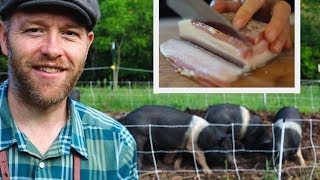
In this YouTube video, Victor Justin Rhodes (Speaker A) and Rebecca document their first year of raising pigs on a small permaculture homestead. They begin by explaining the motivation: high cost and scarcity of quality pork led them to consider raising their own pigs, building on their experience with chickens and gardens. They debunk common myths that pigs are smelly, need lots of space, and are hard to manage, showing that two piglets can thrive in a 1,200 sq ft garden with bi‑weekly rotational moves. The video walks through their low‑tech, mobile system: electric fencing, portable shelters, and a simple composting setup that mixes manure with carbon (wood chips, leaves, hay) to produce hot, pathogen‑free compost. They also present a micro‑scale “carport compost corner” for growers with as little as ~240 sq ft. By September the pigs are ready for harvest, yielding about 200 lb of meat from roughly 200 lb of feed, illustrating a near‑neutral feed‑to‑meat ratio. Recognizing audience interest and fear, Rhodes announces two new educational products: an edutainment documentary and an online course called “Permaculture Pigs,” featuring contributions from experts such as Joel Salatin, John Arbuckle, Cliff Davis, and Al of Popular Homestead. A Kickstarter runs May 20‑26, offering early‑bird pricing, exclusive bonuses, and staggered product delivery. The overall message is that raising pork on a modest homestead is easy, inexpensive, and environmentally beneficial.
Chapters
Bacon. This is the very first bacon we ever grew. You know that, right, Rebecca?
That's right.
I wish we had taste division right now because this is like, you just can't buy this.
Yes.
It's hot, but I don't care. Mmm. Oh my gosh.
Okay. Nothing?
You don't want to touch that, it's hot. Okay. You can have the black one. There's yours.
I don't like the black one. I like it like that. Oh, okay. Is that why you're grabbing it at it?
Okay, well then you can have that.
Oh, why is this on?
We found out very early on as we started to be more health conscious and trying to source good quality pork, that it was very hard to come by. And then if we could come by it, it was very expensive. So what our family did, and what many families does unfortunately, is they just go without pork. And that's too bad because pork is so healthy. It's such a healthy, delicious source of protein and fat. We knew there had to be a better way, and essentially we looked around, we saw what we were already doing with chickens and gardens, and thought, we're getting pretty good at this. So it seemed like a natural progression— why not step it up to pigs? Okay guys, I think we're ready.
We have feed pans, potential waterers, we have our soaked feed, we have our stall ready.
So despite popular rumors that pigs stink tear up the place and need a lot of room, we went ahead with our first 2 piglets.
There they are.
And we quickly found out that pigs are a lot easier than we thought.
Come on, pigs. They're the easiest animal to move.
Sure, they can tear up the ground if left there too long.
We are overdue for a move.
Hey, why not use that to prepare the garden.
This right next door looked like this 2 weeks ago. So that's going to take them 2 weeks. In 2 weeks we've got this. This is where they were. We had these low tunnels on because it's winter. We're protecting them from frost. Here's a patch that was planted in cover crop.
Isn't that beautiful? Isn't that beautiful? Now for the best part, the surprise. What's under these tunnels?
Unbelievable abundance.
After we got our first pigs, it didn't take long to realize they really don't need that much room. We're talking about moving them around every 2 weeks onto a 1,200 square foot garden area. We could have kept them in that one area the entire time on deep mulch.
This is a super amazing system. Maybe for somebody who's got a little bit of outdoor space, maybe 1,000 square feet, you just get this Premier one Electric fence, electric energizer. So easy, so quick to set up, so effective. You get a load of carbon. For us, we were able to get free wood chips. Maybe folks get leaves, maybe folks get spent hay, anything like that. I piled it up here, and when it— they tend to poop on this, so I come in to keep it clean and I scoop up the poop with a little bit of the carbon, and from there just right there to a compost pile real nearby. It gets all that material— look, see it steaming? See it steaming early in the morning? It's heated up, it's killing any bacteria in the manure, and we're turning it into precious compost.
After having them for a while, it didn't take long to realize pigs could really stay in a very small area.
What if somebody only had 240-ish square feet. Enter the carport compost corner system. A small pen inside here, 10 by 12.
How about a compost area?
You have to have a source of carbon, like I said, wood chips or spent hay or something like that. We're going to fill this up a foot inside of this pen.
By the end of the season, by September, these guys are ready to harvest.
We're going to grow it up to right you know, might be leveled up to right here. The pigs will be composting. The pigs are sheltered. They only need this one spot.
We'll give them their water.
They're nice and shaded. And at the end, we come in here, harvest the pigs, move them out, and we have compost in place.
After documenting my first year of raising pigs on my YouTube channel, I quickly realized that my audience was wanting to get into pigs, but they didn't know how, and they feared some of the fears that I feared early on— that they stink, that there's not enough space. I want to help them out.
What's critical is, of course, pigs, chickens— about 30 chickens, about 2 pigs, American guinea hog—
mobile electric fence, mobile pig shelter, And after my wonderful experience, I mean, I went away from the first season saying, why didn't we do this years ago? I love you guys. Here, I want to show people just how easy and inexpensive it can be to grow your own pork. Those two pigs, guys, at first I moved them around every two weeks onto new gardens. They were eating grass. We fed them our food scraps. We fed them some products from our farm, like the skim milk from the cows. Guys, I probably gave them 4 bags total, like 200 pounds total, and we got like between those two at least 200 pounds of meat in our freezer. So to help folks like you out, I'm creating two things. One is edutainment documentary. It's educational, it's entertaining, it's immersion learning. Anybody's going to like it whether you want to grow pork or not because it's a classic food growing story. It's our story of getting started having a goal, overcoming obstacles, and, and achieving them in this case. And the second part of this project is for those who want to do this themselves. I'm going to create a course called Permaculture Pigs. I'm going to teach you everything you need to know for raising pigs from the piglet to the plate. I don't know everything. I've only been— this is only— I've been doing this for 2 years, and where I lack knowledge, I've brought in experts. Like Joel Salatin of Polyface Farm, John Arbuckle of RoamSticks, Cliff Davis of Spiral Ridge Permaculture, and lastly but not leastly, Al, Popular Homestead Channel, coming in to teach us about winter management and show us his small raising system that works. Now, for a limited time, I'm excited to say that I'm kickstarting this May 20th, Monday night, at 8 PM from Monday night, May 20th, only through May 26th. And the exciting thing about the Kickstarter is that, one, you're getting this product at almost 50%— well, some of them at 50% off of future retail. You're also going to get the product as we drip it out throughout the summer. That won't be available to those after the Kickstarter until we launch this thing in like October, like late fall, early winter. Another thing is there's Kickstarter exclusive bonuses that are going to be available right away. Like right now you can get permaculture chickens with this as soon as the Kickstarter is over. And there's also some pig informational videos that I'm giving that will go out. I guess that's my special thank you for those of you who jump in with me to help make this project happen. You're basically pre-ordering to help finance this thing and make it happen. It's so fun because it's not just me doing it. It's you guys jumping in and doing it and making the world a better place for you and everybody else. So check it out while you can. Open May 20th, 8 PM through May 26th, closing at— I like to say midnight, but technically that'd be May 27th. So May 26th, 11:59 PM.