We Built a Homestead in 100 Days - All 100 Days
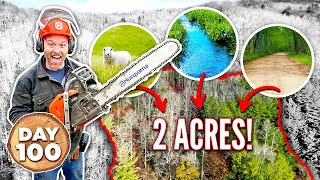
The video chronicles the final stage of Victor Rhodes' family homestead build, marking day 100 of a 100‑day challenge to transform raw acreage into a functional, self‑sustaining property. Building on earlier work of surveying, site selection, underbrush management, and budgeting, the family installs a gravity‑fed Everflow water system, routing a 125‑gallon tank and extensive hose network to supply a new pig paddock, while troubleshooting pressure regulation and overflow issues. The arrival of a new track loader (Mini X) enables efficient stump removal and earthworks, accelerating the creation of a permanent paddock and preparing the land for future permaculture design. A safety incident— a falling limb that injured Victor— prompts a reflective discussion on protective gear and safe work practices. The family also clears an old logging road to Grandma’s, envisioning a hiking trail and improved access. Financially, they secure a modest equity line and plan for additional financing to support further development. Throughout, the narrative blends instructional detail, family dynamics, and reflective insights, highlighting the challenges, successes, and future vision for the homestead.
Chapters
This is the story of how in 2022 my family from scratch tackled a raw 10-acre piece of land and began to turn it into a homestead, set the foundation so that it could be homesteaded. That meant clear 2 acres of pasture, establish a water source. We now have a full pipe of water flowing —and get some access going. The priority: find and establish a house site. Potential house site right here. Why are we gonna do this? Well, we eat copious amounts of meat. Ooh, goin' brown! We need to raise more food. Food for our growing family. So we need more pasture to raise those animals. And if you look around, big properties all around us for expansion, not for sale. And if they were, they would be very expensive. So we have to take advantage of every nook and cranny of what we've already got. Before the 100 days began, we had the acreage surveyed and marked around the perimeter. I think that's very important. Here's an aerial view to include our farm, 75 acres in total. This is the parcel we're going to be focusing on. This is where we currently live. We've currently cultivated this entire 6 acres plus this 6-ish acres over here. We're going to start by going counterclockwise around the perimeter. We had the surveyors mark it off so you can stand at one ribbon and see the next. What you want to look for on new land— you want to explore the perimeter. We want to look for water. We want to look for slope 30 degrees or less, which is about right there. That's not too steep, it's the neighbors. This is too steep, it's us. And then I began to explore, and this was a very exciting time because I was discovering things I never knew were there. I was going around the perimeter and then sort of zigzagging back and forth, looking for potential pastures, looking for interesting things, you know, water features, or, or, oh, I found an old chimney on the property. These kinds of things. There you go, nook and cranny pasture right there. Well, Grandma's house is really close to this property line. How do the surveys know? Great question. I have no idea. We need to ask them when they get back. 3 things of interest right here to sum up what we're looking for. 1, looks like there's an old logging road. 2, looks like there's signs of water. There certainly is water down in that ditch. Is there water in that ditch? Yeah. No. 3, it's pasture over here. And 4, they have a cave. So that's just something of interest. Oh my word, there's a creek under there. Definitely signs of water over here. You want to get in? No, I don't want to get in.
I can, I can stick the camera phone for light.
You guys actually going in? Yeah.
Wait, there's no light on there.
There is, it's not bright.
Okay, well, you got a creek? Yeah, yeah, you can't really see it, but there's a little— there used to be a little bit of water down there, and then, and then there's up here, it's like a little like home or something, like an animal.
This particular area that we were developing was rather unfamiliar, and it's new to our family. It's been in it for 30 years as opposed to 90, so it was extra exciting. We are officially entering land I've never walked on because I didn't know where the line was. We've gone about halfway on this side of the 18 acres. Do we have a nook pasture here? Wow, we have a hideaway pasture, that's for sure. Steep bank there, steep bank right over there. Holy— I like it. Levels off nicely into some mature forest here. Nice. We might be getting close to having something here. I can't believe how much work we had ahead of ourselves. This is the moment of overwhelm. Usable, not us. Unusable, us. Wow, look at this! Any of this would be another possible house site. Look through those branches. Oh boy, another possible site quite a bit lower down. South-facing. I'm wondering if we're getting a little too close to that ridge over there. I hear the generator. Generator runs at noon at our house. Any surprises today exploring? You feel like we found any surprises? Yeah, road. I would say the fact that there are two logging roads that go across our property back there, several dry spring dry beds, there's some wet ones. I don't think I found any more pasture than I thought we had. There may be even a hair less, but I go over With this impression, there's a lot of work to do. I was very hopeful in the beginning, figured we could probably clear 10 acres. We started up by Grandma's house, but pretty soon we figured out it's really hard to get to this stuff because of all the underbrush. The classic permaculture principles of why do the work if you can have an animal do the work for you. We're using sheep to underbrush it so that then we can get in there. A lot of that can just be mowed, but stuff like that we're gonna have to get in and work up. That's very workable. That's because the sheep have been in there underbrushing. This just right next door is not very workable. You could get in there to come saw this stuff out. You're gonna have to contend with all this annoying underbrush, or we can give the sheep something to eat and then it looks like that, and it's a lot easier to get at. So we need to put them to work where we need them. What do you say we can capture this and then all this past that big brush pile? Give them a huge paddock. That's fine. So soon, maybe today, we start coming in after the sheep have cleared and start working stuff up. Sheep, sheep, sheep, sheep! Go on. The name of the game is harvest the small stuff first, small to large.
The reason I go against that is because you'll just say, I'll get through it, I'll get to it, and then 100 days has come and it's not done.
This is, this is true.
So I think we should do it every time a sheep moves.
We take the clear the whole thing. Yeah, like we try to— we move the sheep out, Rebecca, that could just be our first paddock to do, which is great, but we need to get the little stuff first, which means the mower and then the loppers and then the chainsaw. They're going at it. Oak leaves, popular leaves, making it workable. Wow, though, just to mow. Yeah. Oh my gosh, I'm so excited. Are you excited? We're doing this. Yeah. You could start lopping and I could start chainsawing. Good job! I'm excited. You excited?
Yeah. Want me to be doing— I don't even know.
Lopping everything you can. Josiah, you can come in and pile this brush she's getting. 30 minutes. You want to see what we can get with the chainsaw? How about this strip right here? What do you think? Yeah. Here's before, and then I'll do an after. This root is super tricky because it expands out like this. It's not straight up and down. It's hard to cut in there. That's going to be a tricky one. Other than that, it went pretty smooth. We were able to get down real low on these. They will sprout back, but the sheep will keep eating them and we'll keep mowing. And as long as we can get the mower in here— see, this will sprout back, sheep will eat it. And we can get— I cut this down low enough to where the mower could get through. Eventually it will die and rot in its place. These bigger ones I cut down up top, I fell them, and then there's not nearly as much weight and pressure on this as I then work up the stump. Yes, I cut it twice, but it's a lot easier. Here's before, and this is after. They've done it, they've done it! We can easily get in there, Birdo. Look, they're crushing it. The cool thing is we'll go inside, they'll still be out here working. We ran both chainsaws out of fuel. We didn't bring fuel. Gosh, guys, we got to bring fuel next time because we could go another 10-20 minutes. We got twice as much brush as we did yesterday. So you've got 6 trees. Funny, funny guy. The stump we shortened up earlier though, that was a big— that was a big accomplishment. That was a third of our fuel right there, probably. Look at that thing. I just can't quit looking at this. We did that, guys. We did that, and you guys worked hard. The sheep were a fantastic tool for clearing land, but we moved from one problem to the next, and our next problem was, what are we going to do with these stumps? We're going to try this tree grubber. Huh, this is interesting looking. All right, Jonah finished putting it together. Thank you so much, Jonah. Okay, there we go. So The mower would get this, yes, but this would get it by the roots. That's some root. Okay, so it'll get little trees. No sponsors so that we can give it a bad review if we need to. Yeah, this is— I mean, what are we doing? You could have just pulled that out. There you go. I mean, yeah, see, it's just stripping that. Nope, I'm calling it. Nope, nope, it slips. It wouldn't pull the bigger stuff. It's slipping on the little stuff. It seems like you have to get it just right, and it's not really that fun to operate. So they do make another kind that you hook to a tractor that has good reviews. This one kind of had mixed reviews. On Amazon. So I see you've been opening my packages. Give me a leg. Look how heavy duty. You hook this to the tractor, the chain, and then that's—
you open it as you pull.
Yeah, you open that, put that around the tree, and then as this pulls, it just makes it tighter and tighter on the tree. Yeah, this one, unlike the stick one, has good, good, uh, ratings. Yeah. How about this? Tomorrow we try to pull some of these trees out by the roots. We've got this tree pulling tool we're gonna try today. You put this on the tree, hook this to the chain, hook to the tractor, pull it up. Start with this tree. Yeah, that's probably smack. Let's come in here. You saw down the trees and then you hook that up and try to pull it out. So let's do this patch of smaller trees. Okay, that'll be the goal. We are trucking now. Yesterday I was wondering, should we really be doing this? Like, I could hire a machine, they'd do this in 15 minutes. But then I saw those guys working so hard and I thought, we're doing this together, we're building this together, and that, that, that's just priceless. What we're going to try is to pull these up with the tractor. I kind of doubt that thing will get this big old root out. If it doesn't, we have to saw it down. Saw it to the bottom and it just sprouts back. That's the problem. So we have to keep it mowed, we have to keep the animals in it for sure, and eventually it will die. So it's not a huge problem. It mines minerals from deep below and brings them up to their leaves, and then when the animals eat that, they get mineralized. So it's not terrible. My hunch is it'll probably pull up the size of that one. Where you go right for the big one, huh? You think it'll pull that one up? Look at that root system. We can always try. I think there's no way, but certainly we can try. But now we have a big hole. I think it could be easily raked over. Look, look at what this thing pulled out. I was surprised. I'm learning I need to pull up and out and it breaks off the roots. Like that. That's a much better pull, doesn't uproot the ground so much. It's a nice seed disturbance anyway too. And now that they can get sun, this will grow a patch of grass. It just broke off the mountain laurels, so we're gonna have to saw them down. It broke the chain and the back wheels of the Kubota were getting lift up. What the heck?
Why don't we just get an excavator? 10 times easier.
Yeah, let's go. Well, then we're not building a legacy together, are we? Oh really? Big Daddy had a chain. Yeah, we'll pull the tractor over before we break that chain, won't we? Uh-oh, these are not stronger than our other chain. I'm pretty sure these clips Did we just destroy that? Yeah, I'm not impressed with that. Why aren't we just wrapping a chain around it like we used to do when I was a kid? Totally destroyed these links. Look at that link all warped. Maybe what we should do with this 20 minutes is go find our big chain. It bent this thing. This thing was heavy duty. Well, here's what you do with the chain. You wrap it around a couple of times. And it does catch. It does catch. We maybe not— we maybe not saw it so low to the ground. We may have it a little longer, but once, once you pull on this, it don't catch. Watch, we could do this. We could do this right now. We are not gonna pull. Roots up like that. I'm gonna show you guys why in a second. I do not like this result at all. Here's what I don't like about it. Although it does get the roots out and this tree is not going to grow back, look how much soil on that. Look how much organic matter is there. And that's the best stuff. That's topsoil. That's the black stuff. See, black Not black clay. You can see the layer of topsoil here. That's the soil that the forest has built, and we've just pulled it up. Now we can rake this over and smooth this out. Then we have the disturbance from the tractor. Another root job there, digging down into the clay. So you know what I'm going to do? I'm going to work with nature. That stump does not want to be pulled up. And I've cut it so close to the ground a mower could get over that. So if it sprouts and the animals don't eat it, we're mowing behind the animals and we knock it down. And you, you cut that off a number of times and it does eventually kill it, and then it rots. I've already started to do it here. We could bevel the edges so that it doesn't get caught in them on the mower decking or anything like that. This guy maybe 2 inches up right here, surface over there. So yeah, you just take our saw and bevel it. It's gonna be a lot easier than pulling it up. Yeah, I just don't like the looks of that, just tore it up. We want to work with nature, not against. Sometimes it's tempting because we have the machines to do so, and there's a time for it. There's certainly a time for it, but not in this case. May change my mind tomorrow, but not in this case today. You guys want me to show you what happens to a stump? See all these sprouts coming out of it? Yeah, that's what happens. This is a case in point. So this stump has been cut, it's coppiced, and you can see the leaves up here. That's where the sheep haven't been able to reach. But the sheep eating these leaves, it's actually a good thing because these roots are deep down and they're bringing up the minerals. They're mining minerals. And so when the sheep eat this, this leaf, they're getting mineralized. So I think keeping the stumps in is actually could be part of our mineral program. There's just something very satisfying. Sure, I could get a machine, but there's something very satisfying about us working this land and now us looking at our, our finished artwork. Then I had this idea. What if what if we built our house from wood from the land? And then I don't know where I got this idea from, but what if we did it with a horse logger? So, so I contacted this guy in North Carolina, ended up being a forestry consultant, and had him out to look at our forests. Well, he's not bringing us horses, but he's coming tomorrow. We're going to talk about it. His shtick is to harvest wood off the farm to build the homestead house. We have our designer coming tomorrow too, and we're going to meet, we're going to look at lumber, and we're going to see if this is a thing. Because wouldn't that be cool to do a lot of this clearing with draft horses? It's possible house site here. Do you want to walk up that way, or we can walk up this way, or both? Okay. My job is to take stock of your forest resources. Okay. And to see how those can inform, you know, a sustainable ecological building project. Nice. So, you know, without sacrificing— it's only ecological if it doesn't sacrifice a quality forest. The silvicultural standpoint, um, and silviculture meaning the art and science of growing a forest as opposed to agriculture. Not opposed, but distinct from agriculture. With silviculture, you're trying to keep a forest. Yeah. You're trying to, in some form, right? The idea is that they're still growing trees and trees that are regenerating. In my opinion, there's also value in kind of keeping it more or less like it is, save maybe putting in a home site or, you know, some more woodland type, you know, activities, say like cultivating shiitake mushrooms. In terms of things you want to like, so that we could saw up and build with, based on the map and based on what I see here, it might be that we would get some wood here for certain things, but as far as framing something up, probably need to find some pine on the other side. We'll go outside. We exhausted our search on the new side across the creek, found a lot of cabinet, a lot of flooring, not so much timber framing. So we're over here on the, the old side. Looking for pine. You've got a similar forest really, except it's a little more, a little more open, a little less roaded in, but there's still some. Obviously the thing I didn't see across the creek that you have here, um, is a yellow pine component. And this yellow pine right behind you, yeah, that's something I would encourage you to keep actually and not cut. Can your horse pull out a big old log like that? Yes, sir. Really? Dang. How wide was that? How wide is that? You measured it? It's about 20 inches. What's your horse's max, both of them together? It just depends on the grade, depends on the species, what time of year it is, whether or not they're feeling good or not. But I mean, you know, they can pull a 16-foot log out of that tree. Wow. It's a gigantic tree. It's gonna be heavy. It's cool to have Ian here because he, you know, he would look for white pine, but he's saying you have not— we don't have a lot of white pine, but we do have a lot of tulip maple, tulip poplar. So we would use that instead, which is super cool because he's, he's looking at the land and what we have and our needs and marrying those. That consultation was worth its weight in gold. Here's what we learned. Our future house site might not even be on the same side of creek or a plot that we had initially thought. Well, this could be a hole in our plot. When we were back at that pond, they started eyeing that slope, which is on the side we're currently on. Actually, it's on the other side of the road. They're thinking, well, that's your, that's your house site on the plot. We're trying to develop this side for the 100 Days of Building a Homestead. So if we're going over there, we'd be shifting our focus in a different direction. Of course, it'd be the same concept— raw land, clearing ourselves. So It's not that much different. At first I want to get frustrated about the changes, but actually it's actually good. I mean, we're— what does permaculture teach us? Work with nature rather than against. So we're looking at slopes, we're looking at access. A lot easier to access that place over there, you know. It's not so steep to get some of— to some of those more ideal places.
It's interesting. It's, it's changed our plans a little bit, maybe.
Yeah. Maybe a different house? Not in a bad way. Maybe. We decided on a timber frame home. Our hearts sang when we discovered it. Ian introduced us to that. So how did he change the plans for you?
Well, it's, well, it's a different type of house, which I'm totally okay with.
Okay, so it's timber frame. Dan, can you pull up a timber frame shot? Because I don't understand. It's big beams. It's beautiful. It's so— so they harvest the wood from the farm for the timber frame. Uh, there'll be accents with it inside the house, right? And it's perfect for passive solar because you can do things with insulation with it because they're like 6-8 inches thick. And we learned that disappointingly horse logging wasn't going to happen during the 100 days. He doesn't cut the wood till February. I know, which is the sap and stuff, and then it'll be ready to be built by June. Which puts us on top, but it'll be after the 100 days. I was hoping to get these horses during this 100 days, but we need content after the 100 days too.
So more track loaders and excavators.
Uh, that's what he's voting for. This caused me to feel uncertain now if this could be our possible house site across the creek in a whole different spot. Am I wasting time clearing over here around Grandma's? Are we building over there on that side of the street, or are we building over there on that side of the creek? Another permaculture principle is to cultivate around your house, zone zero. Where we're cultivating and clearing, that the house isn't going to be over there, we're misdirected. Not that it would be a bad, a terrible thing, it's just that you would want to develop closer to the house and expand from there. It's actually why you want to get experts like Ian involved. You plow on ahead and you think, oh, I know everything, and you don't invest in some expertise, you could do something stupid like put a homestead house in the wrong— total unideal place. You know, I'm like, do I continue clearing pasture up there. Yes, I think I do. I had this realization that, well, we have sheep up there to keep away from, uh, Nacho, and we could do that with heifers too. So it's kind of handy to have a, you know, our pasture down here, and no matter where the house ends up, but it's also handy to have pasture up there. A distance away to keep certain animals separated from each other. That's making me feel better about the work today, even though we're more uncertain than we were yesterday about where our house is going. I think we were introduced to timber framing yesterday. I think we knew about it. I feel like I knew about it.
There's a house that I showed you. Timber frame?
Yeah, but I really wasn't making the connection. I didn't realize. Oh, look there, there's a That's a good one. Pull that one up so people can see the frame.
Well, it doesn't have to be so ornate, and I don't know if I necessarily want it so ornate. Like, it's very— like, I like the pegs and all that, but like this little finial, like, I don't know if I need that and these, all these extra finial. That would be more— I mean, maybe not exactly like that, but—
I know what you mean. Yeah, see, that's nice. We had our eyes on a homestead across the creek, and that's where we're clearing. Came over here with Ian, and we're like, oh wait, this is nice over here.
Well, we were coming over here to look for different types of wood. Yeah, for the house. Yeah. And he's like, maybe you should build over here. We are. I am okay with— are you?
Yeah. Are you? And the reason— well, the house is the most important thing when you think, because everything then revolves around it. This pond though We are clearing it up and cleaning it up. Yes, so that we can make more use of it. One thing Ian was saying is we're going to get old and we're going to want access. This is pretty accessed. Here's our farm, here's a pond. We have this guy coming November 2nd. Do I need to focus my energies on clearing at possible house sites? That's probably what I need to be doing, not, not yet clearing pasture but clearing possible house sites. Kind of feel like we should shift our homestead build focus onto this side. That's why it's so important to me to figure out where we're going to build a house, because I want to build out from there, not be clearing way up in Timbuktu. The, the idea is to cultivate what's in front of your yard, what's— and expand out. That's why it seems so important to have a good idea where the house is going to be. And what's neat about doing over here is we have so much cultivated over here already, it's a more direct expansion. Although we need across the creek too for the breeding program and for additional pasture, but it would only make sense to develop what would be outside your door first. Right here. Be able to see the pond, be able to see pasture. You can see the, the pole barn blocks the road. We could keep this forest from here over. And look over here, that's the creek where we've been looking. It's already dark. We find the sun and we center ourselves to it, and everything else expands from there. Sun's still setting over there on that. That's where the house would be, about right there. We are across the creek. We keep going back and forth. I don't think that's incompetence. I think that's just being diligent. It's not like, oh, we decided over there. No, we haven't decided yet. Big Daddy's house. This is like the original spot over there and down lower. We came there with Austin But let me show you, their line is closer than we thought. Rebecca, see the ribbon right there? You get to a spot, you observe the corners. The line is like right here. You have to be off the line a certain amount of feet. And could they potentially develop that in 50 years? I don't know. The neighbor— since the graders already happen to be coming we had already lined them up a long time ago to come and do work on our pond over where this other potential house site was. I just began to shift our focus over there. We got the unsexy pile of brush out of the way. Barely doing any cutting down, certainly didn't cut down a tree. Now we're going to start having some fun. Just keep the saw blade in front of you, never saw towards your foot. Always be aware of who's around. They do— that you have protective gear on, they don't. So just kind of be away from us. We're progressing well. Josiah's going at it. Oh, look at that view already! But what's it going to look like from up here? Let's get some more before and after. I'm going to stand right here. Before. After. I'll come back here in a minute and I'll do that before and after sequence and we'll have a view. All right, let's clean around the pond too so that we can actually see the pond directly. Let's do it before and after here. Before. After. Hey, the blue barrel floating around is a nice addition. Before. After seeing the possibilities. Yep, look at that.
This could be our, uh, our backyard one day.
Still got more to clear this way, but can you see it? Can you see a glimpse at the glory? It's gonna be real nice. Wow, look how deep those go. He puts his branches in the pond so that he can actually get out there in it. That's smart. He doesn't get stuck. Holy smokes! We got so much done with that piece of equipment right over there. It's absolutely incredible. We've dug this pond probably 12 feet down in the middle. Mucked the branch— like, it looks like a totally different place, doesn't it? We had to say goodbye to Cubby, our beloved tractor. That was a Kubota deal that had come to an end. It left us in a bit of a pickle because it left us without a quality machine and did start opening up a discussion for what is the future of machines on the Holler Homestead. We're about to be without a critical machine today. It's leaving. The implement's already all gone. We got to do one last thing on old, uh, Cubby here. Well, that was the last ride on old Cubby. Now we're in a bit of an acute bind. We need a big machine to be able to lift 2,000 pounds of feed. A big tractor. Will move 2,000 pounds. A tractor will also hay, which we hope is in our future. But let me share with you my idea. This is Lucky. You guys remember Lucky? My dad's tractor he bought brand new like 30-something years ago. Hence name, because Lucky only started half the time. Battery's gone. I texted Mark, our mechanic, and asked, what do you think it would take to get Lucky going? It turns out it wasn't that much, so I said let's do it. Problem is we were using these attachments to the bucket to move and unload feed. Lucky couldn't do 2,000 pounds though, so we ordered it in a 1,000-pound tote. But the companies kept stacking those totes on top of each other and it gets super sketchy putting weight way out there on the end of a bucket. And I don't think this has an option. I'm pretty sure it doesn't to put forks on it like Cubby did. Then I asked Mark, could Lucky do hay equipment? And I knew Lucky would in a pinch move the milk sled, although we want to make the milk sled lighter and not even need a tractor in the first place. So we'll have the tractor for rolling over pasture and having the PTO for hay equipment. What if we got an extremely multi-purpose machine that isn't even a tractor? We'll use Lucky for our tractor things, and then we get a track loader for lifting the 2,000 pounds. Wouldn't the track loader help us in a very significant way in this 100 days of building a homestead and get us caught up? I don't know, makes me nervous because it would be our biggest farm purchase ever. We calculated it up, the graders are about $6,000 an acre to clear. To do 10 acres, which we won't have 10 acres to clear in that 10 acres, but over time we've probably got 10, 15 acres. Well, 10 acres would be $60,000. In the end, I have 15 to 20 acres to clear over time. Well, golly, that's $120,000. Brand new track loader, $70,000. So you almost pays for itself just with the 10-acre homestead project. And the cool thing about is if we get a machine and do it ourselves, we have something at the end of the clearing of those acres. If you pay somebody else to do it, it's done and it's good, but that's it. If we did more ourselves and save some money and having not pay someone, and we get a machine at the end, that's a win-win, even though it's a big investment. After just a couple of weeks building the homestead I was feeling scattered, unorganized, and behind. Plus we had several distractions along the way.
This is the sicker one. She can't even move her head.
Were they in there?
No, I put them in there to get away from the other chickens.
Okay, let's put them out because they're gonna just poop this up like crazy. She can't even barely move. Oh yeah, she's disoriented. It, didn't she? How are these guys doing? They're clearing a lot. We're gonna watch it, okay? If people keep dropping dead, we'll have to do something. Just the transition, just something else going on. That one could have gotten— maybe gotten by the goose. See, everybody else looks all right. I think the biggest challenge to developing this new land is the current land we're on. We have a thriving homestead, which needs a lot of attention. Yeah, we can't be cutting 5 trees a day. We'll never get done in these, these 100 days. My thought is we'll get into a better groove. There'll be less and less going on the farm as the winter approaches. Like, for example, we have an hour now extra after doing business work. We could go clear more. Josiah wants to go clear more. Look at Lily reading under the tree. I don't need to bother that. Hey, when you're done, honey, come garden with us if it's not busyness. You know, we're going into the winter, so we're gonna have other problems. Tomorrow it's gonna be 25 degrees in the morning. Today I'd like to continue working on putting this fall garden to rest, and then we could at least get the gardening behind us. The other thing that's stressing me out is I want to be on this. Well, one, to be clearing our homestead, but two, to get content for you guys. I don't quite have enough time before training to get started, but we could, uh, queue it all up, couldn't we? It's tempting to not show you guys these obstacles because it feels like, oh, if I just want to cut down some trees, I should just show that. But that's beside the point, I think. It's the obstacles that make this, this so special and intriguing, right? And it's what you deal with too. Everybody's got an obstacle of some sort, and everybody's got a goal. It's about overcoming those that make the rewards. If the reward was easy, it wouldn't be a reward, it'd be a gift. And And many times something that we earn is more special and meaningful than something that we're given. This has to be fought for. Kid you not, guys, it's 10:30. I'm ready to go to the next thing, and Lily says the milk has busted in the cooler. I don't know how. That's probably a 20-minute job. Okay, yeah, that's lucky. I'm thinking it's cutting into my sawing time. Maybe I'll do editing now and then straight up saw in the afternoon, but I don't know. We don't have to do that because this might not take us that long. It's supposed to be a 44% chance of rain today. That's partly why I want to get the outside work done. Actually, we have an hour and a half. I wanted to go clear But look at this. I'm not kidding you. Yeah, it happened yesterday. It also happened today. Look at this. This is our milk cooler. It's in the cold room. Look at this. A child must have thrown a jar in there and it busted. Guys, this doesn't happen that often, and I'm asking myself, my stick is— enjoy the process, enjoy the process. How do I try this? Oh, it's probably an hour and a half. It's gonna be so— it's so good. It's a perfect amount of time to like do a chainsaw project. Here are the real obstacles in the way of the goal. This shit. With all those obstacles in the way, I felt like we really need to hunker down, really get focused, aim for our house site, and then to begin work from there. Rebecca and I had identified 3 potential ones. Site number 1, by grandma's. Site number 2, our favorite on the new to our family— 30 years— parcel across the creek. Site number 3, across the road in a whole completely different area above the pond. We brought in a passive solar expert to help us decide and get us on a clear path, decide what what would be the best house site and hopefully would save us a lot of trouble. The passive solar consultant's coming today. Hopefully it's not too late. He's coming like, like 4. Hopefully he could tell us, is that ridge too close? There's a ridge over there, the sun sets there, and I'm pretty sure we need the sun from 10 to 3. With the solar passive expert coming, we decided to clear around these potential sites, all of them, so that he would have a better idea of which one would be best. Potential house site right here across the creek. The advantage is I don't think we'll see the— I don't think you can see the public road. It's an amazing view. All these spots are high enough up out of the valley, 50 feet from the bottom valley, out of the frost pocket.
Are we just gonna cut all these?
I think so. This is so little, this is chainsaw territory. Can we give ourselves a better vision of what this could be by clearing a lot of this? So how much, kids, do you think we can do? I think we get 50 foot down if we just go nuts. Yeah, she's wondering where the brush pile goes. We should probably start down the hill and come up, and then that way she's dragging the brush downhill. I just feel like we have a mission, we have a vision, and I'm feeling so satisfied in our work, and we're doing it ourselves. Look what we did. Let this be the after shot. Dan, roll the before shot. So this is before we started working. Our goal is to the road of Dendron, over to this road, all this from where Josiah is. And this will give us an idea of what kind of silvopasture view we're looking at. Let this be the after shot. So we'll call this spot number 1.
Is that kind of the pasture in front of the—
no, right, Grandma's. I'm gonna tell you, he's gonna like this spot the best if he's already talking about being close to utilities. Well, there's already utilities established there. There's already a well over there, and actually we're downhill from that. We're downhill from those resources too, Rebecca, the well and whatnot. Okay, spot number 1. Oh, this is Beautiful. So this would look over our entire farm. Well, why do you say this is beautiful? Just— well, if you take down these pine trees, where's the property line? Yeah, this is the problem. So that— you see that orange line? I'm gonna try to buy it to there. Yeah, so for passive solar, we can't clear those trees.
So that's— but, but that's one of our options, is that we want to— if you're like, this is the best site out of all of them, then we want to We want to go and talk to her and see if we pay. Yeah, they're ridiculous.
They're made— they're an acre. Yeah, if she'll do that. Yeah, there may be a possibility to get an acre or two right now. Maybe she'll let you— or would she be open to let you taking some of that? Oh, that's true. If she won't let us sell anything, but wouldn't we want—
I mean, because if the line's right here, don't you have to be like so far away from the line and stuff?
There are setbacks, so you just have to find out how does that work. He's already done. Brian's already done.
As long as you can take out the pines, because those pines will kill you.
South? Oh yeah, because they're— they don't drop. Okay, south is this way, Rebecca. Okay, so let's get away with it, right?
But the evergreens, it's gonna be too much shade. The slope is good here. You got plenty of room. I mean, you're kind of on a ridge, no? So you can shed the water both directions.
That's a good insight.
I don't I don't think you could scoot it up high enough to get past this pine shade though.
All right, all right, well, so that's our hiccup here. Let's go to spot number 2. Spot number 2, are we cleared this morning? The reason it appeals to us is it's actually further off the road, a little more this way. It's a little more nooked in here. Yeah, I would think the driveway would meander to our line and then cut down. Yeah, my concern though, and that's why we have you here— I don't— I was thinking it faced more this way for south, but it doesn't. So we're pretty— we're pretty— we're pretty good.
Yeah, and we have control, right? So we can take out what we want.
Yeah, and I don't— you probably wouldn't—
yeah, take out anything. And this would be just stuff. We're taking it out for our pastures, but this would be just a view all the way down. Definitely.
More expensive to develop to get up here. Yeah, building that road up here, the foundation, the driveway, the pad.
We're going to do a basement regardless, but this would be more of a basement, you know, where— what would you do for a basement over at spot number 1? We just dig down? You'd have to dig down a little bit more. Yeah, um, we're here, you know, You just dig into the side of the mountain, retaining walls on the sides, right? As far as solar exposure, you think we're good here at west? Look at west, it's a ridge, pretty close.
It's the hardest part of the business to price. Okay, it's the dirt work. Okay, the road building. Yeah, but I mean, it could be— it depends how good of a job the grader does with the road, how wide you're making it. We're okay. The culverts, right? But, um, we have some pretty great graders that we are—
we work with pretty regularly. And for 2 days, they're what, like $2,000 or $3,000?
I bet it'd be $50,000 more. Wow.
Okay. For the site though, as long as we're seeing the south, we're good. You're not too concerned about the western sun getting gone too soon?
No, you don't want western sun.
Oh, okay. What do you want, eastern?
I mean, you want, you want south and maybe a little south-southeast for your, for yourself.
I was thinking you had— you wanted to heat it up going into the evening. No. Okay, because you'll— well, that's why we have you here. Yeah, I know, because we—
I mean, we've read the books, but it's— there's still like a lack of like application, I guess, is what you could call it.
Yeah, there's a lot of old school knowledge out there too.
Yeah, uh, kind of conflicting with— yeah, so, okay. So you don't have to worry about that.
Yeah, you generally want to avoid western sun. Okay. Put your covered porches over there.
Maybe we'll flop then the house, Austin, because we have the covered porch on the east side. Yeah, yeah.
This situation and put the covered porch on the west side.
It might make sense more from the— for the driveway approach. Yeah. Also, but, uh, I wouldn't— yeah, I wouldn't get too concerned about west, east versus the covered porch. More about how it looks when you're approaching it and if it's jiving with—
well, I mean, if we're, if we're approaching it from this way anyways, it would be better that the garage is on this side.
What about this spot for utilities?
I mean, it's more than, more than twice as expensive as down there, I would think.
Okay, what about going off-grid?
That's what he says, but okay, so when he says off-grid, like, no, no, we're not roughing it. I don't want to rough it. Like, I need my water, I need hot water, I need a dryer to dry my clothes.
But as a passive solar guy, you like to see people go off-grid, or is it overrated? It's really hard.
Um, well, see, and I don't want to do really hard.
I'm not interested. It's really hard and really expensive. You got to cut a house this size.
Yeah, it takes a long time to recoup the— say, to recoup the cost and savings.
And you got to be really miserly, watch every kilowatt hour.
Won't passive solar help us not need so much grid in the first place.
It will, but in the grand scheme of things, you're not gonna get rid of— you're not gonna get off the grid with passive solar.
Yeah, I mean, no, no heat. We are heating with wood, with a wood boiler.
We love our wood boiler. Now that makes— that can make a difference.
In summary, this place is nice and quiet. Yeah, it's doable. The driveway is going to be more expensive, more expensive for driveway, and we're gonna have to run power underneath. Yeah, these would Just because we're further from existing, but we're further. That's another— you're going to talk to a contractor, Seth, about that. Okay. Get up here on slopes and stuff, septic can be more challenging. And that's—
it looks like you got plenty of room to work with though.
Let's just say we do challenge you.
You can take those trees down, you can have a nice wide field. It's really about the area you have for your leach field. Okay. But yeah, they will look at how how good the ground perks too. And just from the initial look, it doesn't look great.
What are you looking for?
How percolatey it is. It kind of looks clayey.
Spongy? Less clay?
Yeah, like if you dug a hole and pour water in it and it holds the water for a long time, that's a problem. Yeah, you want it to drain quick.
Spot number 3. We're a little close to the road, a little close to activities here. We are close to the pond, which is good. Oh, we could— just so you know, Brian, we can— that road, we kind of cut up this way, but it could meander. We can meet. Yeah, and then come this way. It doesn't have—
it's not going to be this.
Not in front, right in front of the house. No, no, straight. It could go behind the house.
Yeah, so this is the rough area of the house.
It's a possible spot anywhere.
Like, it's— what's he got?
Here's the problem over here. Maybe. This is south, Brian. Yep. Now you can go 20 degrees off south, can't you? Is that another one of those, uh, yeah, the problem.
20 is getting to be a lot, but, um, it looks like it wants to be southwest is the problem.
That is— this is southwest. Yeah, it is.
I thought that was southwest.
That is southwest. 20 degrees to the the southeast, then what?
Oh, I had that backwards.
I love it because the pond's here, but at the same time, you can keep that pond sacred and visit it, kind of get away.
If I was building a house here, I'd probably still include the passive solar because I think it'd probably be worth it here. But yeah, it's definitely the worst of the three.
Okay, for exposure, let's go hike up, see if that changes anything. If we go higher up, we also also get more privacy. We have to meander the road a little bit more— well, a lot more. All right then, spot number 4. This is further up, but it's going to be more expensive. Your driveway, more privacy. It continues to give more, more expensive. So then south, probably right here. Yeah, I mean, it's like you basically just gain a little bit elevation to where we're— so our other house sites, Rebecca, they're naturally facing— well, they're facing south, and if you face face this house south, we're not really looking at anything. Yeah, here we'd have to take that out.
Yeah, that big one and all those little ones.
Well, I mean, I think all those pines are coming out anyways because we're going to pasture this. Okay, so we've been kind of clearing in several different areas because we want to pasture as much of our forest as we can, but that means it's gonna be silvo, so we're not taking everything.
And you're saying if we turn it 20 degrees— well, 20 degrees breeze is a lot from south. Yeah, it's starting to face west there.
Yeah, I mean, I don't mind really late day west through that saddle. Well, I mean, in the summertime it's probably starting to go over there more. It is.
Okay, and you're seeing this— is that the sun right there?
I think so. Wow. Okay, good. Infrastructure and logistics, this is getting a little more challenging. It's probably the most challenging lot as far as getting a driveway to mesh with the, with the house pad, I think, just because it's so steep right here on this side. How do you feel about what he's saying?
I think I like spot number 2 because you don't see the road. We don't have to count on the neighbor. I mean, we can still approach the neighbor and see and then probably come down to spot 1 or 2.
Right now, 2's winning. We definitely have to approach her. We would— well, So I don't feel like— unless we actually were able to purchase that land from her, I don't think spot 1 is going to work.
Yeah, and see, that's right there by that house. Spot 2 gives some separation from everything. Maybe you can pull it more over onto this. Yeah, yeah, let's look at this. This is a more gradual slope.
You got more space to do the driveway here. You could maybe do the garage like that in the house this way.
We're not going to be looking at much because we're gonna have to keep a barrier between us and—
but I'm okay with that—
the cabin. Okay.
Yeah, I mean, I don't care either one. It doesn't bother me. Okay, so we just— well, our next idea was to sit down and do pros and cons of everything.
Yeah, that's what we need to do. In my opinion, I, I'm liking number 2 the best. Yeah, at least we know where to focus building this 10-acre, you know, clearing the 10 acres. Now we're on that side. At least we know what 10 acres we're going to be cultivating for this 100 days of building a homestead. We're heading across the creek, y'all. Day 18. We know which side of the creek we're on. Does that surprise you? I'm surprised. I thought he was gonna like that, but I was mistaken on wanting Western fun. Yep, but that makes sense. It just heats it up, makes it hot.
I mean, over there we're gonna clear because we're gonna have a pasture.
Oh yeah, none of it was in vain, but I feel like for this 100-day goal, we now have a 10-acre spot, a more clear to focus on.
And honestly, we're gonna look down on those wood sheds that we have down there and stuff like that. I mean, that's gonna come down.
Yeah, but, um Yeah, we can beautify them and all that kind of stuff.
Yeah, it's gonna be nice.
Today was a huge win. The biggest win so far in the 100 days. Now we're gonna be super focused. We can have a map. We can draw what's been done and what hasn't and see where we're at. Track our progress. It felt so good to get some renewed focus. Now I knew what I wanted to do. Moving forward. But that wasn't enough. I needed some icing on the cake. So I reached out to my mentor, Joel Salatin, for some clearing advice. There's been talk of a mini excavator, track loader. I asked my mentor, Joel Salatin, in an email, "Hey, do you ever clear significant amounts of land and how?" And I remembered that I thought they probably did it with chainsaws, but is that true? The Greatest Farm in America. They would have an insight on how to do that the most cost-effective way. I was kind of thinking I would need both those machines, which would be a significant amount of money. Joel might have just saved me tens of thousands of dollars. Of course the boys are mad at me. They still have to get a tractor later, so they need a I'll show you some of Joel's techniques for clearing land in a minute. It's accessible to all, pretty much. Actually, it's interesting enough, somebody said if you could only have one tool in homesteading, or the first tool that you should get, you know what I said? It would be a chainsaw, because you're likely going to be clearing, and it's one of the most efficient uses of fossil fuel ever. Just yesterday we probably— what was that? A little spooky out here at night. Joe, you ever clear a significant amount of acres? He said, well, depends on what a significant amount is, but we do about 2 acres a year every winter with chainsaws. Something about that really resonated. 2 acres once a year. You know, that's not like all-consuming. That leaves time for other things, for like homesteading, for other activities. And if a market farm like Joel with apprentices and employees, I think that's still quite an ambitious goal for a homesteader, but I think it's quite possible. I don't know, we're gonna find out in this 100 days. Our goal is becoming quite more clear. A goal goal without a plan— let's say a specific plan— is just a wish. And we ain't gonna wish around here. My dad used to say, which he died 3 years ago today, poop in one hand, wish in another, see which one gets filled the fastest. What kind of weird saying is that? But 2 acres more a year is 1 more cow a year. Horse. It's official, the new homestead is across The creek! What are we doing here? We're working it up, my friend. So far, that's our favorite spot, the house spot up there. That means for our 2 acres of clearing, we're gonna start at the house side. And for the— in this case, it's gonna come along the property line right through there. You can see the tape right there. So from here over all the way to where we came in, but we might as well start where the house is going to be and work our way down. I'm trying to find a tree that we could demo for showing how Joel Salatin clears pasture. In lieu of a mini excavator, I could get you a bigger chainsaw. All right, let's clear the way for this tree we're gonna fell. It's gonna chew, so let's get all that junk out of the way. All right, let's have everybody help Lily with the brush. Step 1, we're gonna cut the tree about a foot up off the ground and fell it. Once it's down, we're gonna de-limb them and stack them directionally in a pile to later get them up and run them through a chipper and get some wood chips. The rest we cut up for firewood, and then if there's any long poles, like 16-foot pieces straight, we cut those and we'll set those aside for later sawmilling to lumber. There's nothing straight in that, so we've got nothing— we got nothing for lumber. Everything's firewood. One less thing to do now that the weight's off the tree. We can get the stump up. This chainsaw is terribly dull though, so don't judge me. It's so dull it's smoking. I'm not going to finish that log, but you get the point. Oh, you think I'm out of bar and chain oil?
Yeah, the barn channel is usually what cools that.
Yeah, but we shouldn't be running through it that fast, and it's because the chain's so dull. We've cut it off right there, and then what we would have done is come through with our chainsaw and beveled this so that if we're mowing in here behind the animals, we're pulling the milk sled or the sheepshaw, we don't get hung up on that stump. That's how you do it without an excavator.
I think a track loader could push that over and then get the—
there's that too. Maybe we leave that stump there. In case we can do that. I left that one because the stump's kind of sticking up for that reason. Maybe there's a way to get it up with the track loader. How's everybody feel about clearing, uh, clearing pasture like Joel Salatin? The boys are— was hoping for an excavator and a track loader. A good chainsaw and the chainsaw sharpener is a heck of a lot cheaper. Wow, they're not gonna like Joel when anymore.
Maybe he's okay.
It might save time. I feel like we have a solid plan, have a location. We're going for this. One of the most important things about homesteading is that you have the right tool for the right job. And loppers and string trimmers are great, but when you're wanting to cut little brush like this, even chainsaw, you don't want to bend over and do that. A brush saw I learned is where it's at. I've heard you in the comments, we need a brush cutter for the little sapling type stuff. It's gonna save my back. No, first impression is that looks plenty big. He didn't even install the blade. Any bigger, it's gonna be heavy. We'll see how it cuts. Let's get it going. Jonah said it's got fuel. Let's try it. Crank this up for the first time. Decide, let's start with a little stuff and, and, and work our way up and see if— see what this thing can handle. Right by Sally at Briar Patch. Clear these briars first up. All right, got the briars, no problem. Try that 1-inch press. Nice. Nice. Okay, uh, you want to try this one? This bigger one and a half? Oh, nice. Okay, it kind of works like a saw. You kind of go go slow into it. You don't just do it like a string. That's easy. Let's say that's 2.5 inches. Go. That's a little bit of a struggle. Yeah. Wow, get the speed going first. Oh my, it knocked this big one down. Hang on, we got to, we got to get lower down to the ground though. Well, I'm happy. I would have had to chainsaw that. You got to be able to get lower to the ground. Wow. No, no, you gotta, you gotta keep spinning and go in slow. I know it's a weird coordination. It doesn't like that 3-inch one. It pinches it when it falls, that's all. All right, see if you can My take is probably this or smaller with this machine. The problem is— or one of the problems is, let me show them. Gideon, a tree that might be that big is actually this big at the bottom, and that's a chainsaw job. And look how big this tree would have been. I mean, that's what is 3 inches here, like 5 or 6 inches down there. It's getting pinched when you get through it with some of these bigger ones. So I think the sweet spot is maybe there. See what Lily's on? Don't need to cut that with the saw, just nip it with that. Okay, something that's not heavy. But the brush saw wasn't the only tool on the table, we continue to visit the heavy machinery option. Look what the kids did to my farm. We need, we need mini excavator. We need a mini excavator. Also on the back of the camera, we need a mini excavator, please, from your loving kids. So the next day, we already have an event at Jess and Jeremiah Sowers' Roots and Refuge. So he said let's take time and check out Jeremiah's machine and see which one or both would be best for a homestead. The moment Jonah's been waiting for. I'm gonna see his track loader and mini excavator. Which one, if you could only have one, Jeremiah? Honestly, the track loader. The track loader. Okay, why do you say that? Actually, no, the mini You were looking at the Mini X when you said that, and I was wondering—
because this can do a lot, but I could do a lot of the same jobs with the John Deere tractor, the ag tractor. Uh, it would just take longer. Yeah, so the bucket's like twice the size of a regular ag tractor, and so you can get a lot more material moved. Yeah, and it's a little bit faster, but you could do the same job with a regular tractor, it just takes longer. Longer. Really? Now the Mini X can do things that neither of those things can do, so I'd probably go with the Mini X if I had to pick one. Okay, but I mean, that's very situational.
Rebecca's already jumped on it. So what are these good for as far as work is concerned then?
I mean, they do the job of lots of manual labor. They just can knock out stuff. For example, you can dig a trench by hand with a shovel. I mean, like, yeah, like bare minimum, if you had nothing else, you could dig a trench. It would take you an awful long time with a lot of calories burned, a lot of back.
Would this help you dig a ditch? It will.
So then you can get, then you can get a, a handheld trencher that you walk behind, and that just jostles so that faster, but still a lot of work, a lot of involvement, a lot of time, a lot more time. Or something like this, and I can put a trencher, which is that thing right there with the blade on it, and I can trench from here to my house in about 30 minutes. What? 3 foot down, perfectly width for—
so we could put the water line in like that.
I run— I already had— that's why I have water line running, all the power. I mean, I didn't notice.
Oh, she's changed her tone. She's changed her tone. I told you this. I told you this. It helps you.
Just from that, I priced how to rent a trencher or to have someone trench for you. Every month that I have this equipment, it pays for itself on a job that I would have had to pay someone else to do. Okay, it pays for itself.
So trenching.
What else? I know you don't do a ton of fencing. No, but the auger is still useful for a lot of things. Um, I planted trees. We've done deep, big holes. You can get—
I see you planted a lot of trees.
Yeah, we have a ton of that auger.
Justin, I have like 80 trees.
Oh, I know we got 80 trees coming.
Jeremiah, I'm not gonna say buying a skid steer is worth the 80 trees, but when you compile it with all the other things you can do with it, it makes it worth it.
One month it might be, right? Right. But then next month we have more work.
Yeah, I mean, we, we would use it. Okay, so I know you're—
I know you're prepping the pasture, right? Yeah, we're clearing. So I got a high-flow stump grinder that attaches on the front. You literally drive up to a stump stump, set it down, and use your thumb controls and just grind the stump out completely. 4 inches into the ground, disappears. Move on to the next one. Takes about 20 minutes to grind out. Wow, a massive stump. So if you're prepping pasture, I like stump grinding and mulching because it produces soil. You know, it basically breaks down all that wood, and instead of just piling it up and burning it, you're shredding it down, and then it starts breaking down, especially if you run stuff like pigs behind it.
Is the stump grinding different than forestry mulching? It is. It is. The forestry mulching takes takes down the whole tree.
It can take down the whole tree, but we've actually— we have one of those also, and it doesn't get into stumps real good. It can, you can do it, it just takes a lot longer. So we ended up going with a stump grinder.
Yeah, I like the stump grinding idea because we want to harvest the bigger wood for firewood and then limbs for mulching, for like a deep bedding.
So we want to have like in our pasture that we cleared, it would be nice to stump grind all those stumps.
Yeah, yeah, yeah, right. The stump grinder, it's cheaper than the mulcher, I'm sure. By far. By far. Yeah, the mulcher is a big deal. It is. Okay, okay. You got your trencher. That's trencher. You can rent this equipment too.
You can also rent attachments, right?
You don't have to buy them all. Yeah. And then you have the auger, set of forks for a little capacity, digging for fence posts, set of forks. Yeah. This is a— that's for the excavator. That's excavator.
This is a trenching bucket, so it's got no teeth on the front and it's got a smooth back. So like putting in culverts, diverting water No, it's just for the mini. And then you've got a grappler hook, which is also, I mean, self-explanatory.
Pick up brush, drag it. Grab it mainly for just picking up brush. Can you, can you get roots out of the ground with that?
Not really, not with that.
Okay, okay. No, no, they have— if you want, they have a root puller.
Yes, they have this thing. I've seen lots of different ways to do it, but they have this one attachment that's like this, almost like an arrow, right? And you push it down under the root, under the stump, and then pick up, and it literally he just pulls this. Yeah, no, that's limited on size because at some point there's so much pressure you probably just pick the machine up. Yeah, yeah.
But I mean, something bigger machine, a bigger root.
So is this, is this Mini X or that's a track loader?
Okay, all right. So Jeremiah, you've heard what we're doing, you know, we're unloading feed, we're getting all the— they, they pulled all the silt out of our pond, we need to put in a manure spreader, spread it out, we're cleaning out deep bedding every year, clearing forest.
I'd say you definitely need—
this is the one. Okay. Over the—
between the two, like, and you may end up deciding later, you know, you want to get that, like, yeah, go ahead.
Yeah, if I see—
but if you're just gonna get one, I would go with this first and then get some attachments to go with it, because attachments will go—
we'll get you two. Most of them are pretty reasonable.
The mulcher head was not. All right.
Having a sharp chainsaw can be the difference between pleasure and drudgery. Early on, we had Mark, my mobile mechanic, come over with his electric chainsaw sharpener to show us what's up. You can mark it so you'll know where you started, right? So I know when I get back around. How long does it take you to sharpen a chain? Uh, after I get it off the saw, about, I don't know, maybe 10 minutes. 10 minutes. How do you know how much to do? Well, you could set the depth right here, but I just, I just know how far bigger down. I just go down, you know, right to the bottom of the curve. And then now spin it around. Yeah, angle on both sides, otherwise you're going to cut crooked. Wait, right? Yeah, which is what I was starting to do. We just cut these that this way. Yeah. And now it should fit. For doing the flat file for getting these teeth, you don't have to do it as No, just maybe once. Sometimes you never do them, right? Only if it's sticking up higher than your blade. Now with a fresh sharpened saw, how far can we get on our little pasture here? Hey, do you think a track loader would push this stump? Yeah, and uproot it. Oh yeah, a track loader. Oh yeah, it should. Yeah, the higher you keep them, the more leverage you'll have. So how high would you keep this? Josh is also clearing land on his homestead. I think maybe that's maybe a hair short. Yeah, it's a little short, but it should be thick enough it won't buckle. So maybe one like this, keep it right here. Yep. Even— yeah, yeah, a little higher. It's good to have a filmmaker that is, uh, also experienced clearing pasture. Uh, I've just been cutting these down to the ground, but you could just dig right out, no problem. Yep. Oh, with the— yeah, yeah, you just get some dirt pull up the roots. I didn't think about that. Yeah, anything that small. Maybe I shouldn't even be pushing this, cutting this down to the ground level. I mean, Joe, Joe cuts them down the ground level, then bevels it, and that's it, he's done. Yeah, yeah, you can definitely do that. Of course, then you have to worry, wait for decay, you know, for the root ball. This way you are disturbing more soil, but you're getting it going. That's the drawback of the machine is it would really tear it up. Coming up in here. Yeah, I'd cut it right about here. Yeah, about 4 feet up, about 4 feet up. Get a good bite of it with the front loader and then just push it on over. The root ball should pop right up. If you have to, you could always dig around a little bit on the edges just to free up the soil some and just push it right over. Dang, you got a big one there. Just the small stuff. And I got to be careful not to hit the ground. It's going to dull my saw getting down close to that laurel. Oh yeah, bruh. Dirty. Cut that down to the ground. It's just filthy. It's going to dull my saw. Dull my saw, put a chain around it, pull it up with a bucket, or scoop it up. Time's out. I'm happy. You happy, Josiah? Yeah. Well, you got with it. The $200 is going to be worth it for that electric sharpener. It takes half the time to sharpen a saw and gets it done right. When I do it, the saw ends up being— saw's crooked and just isn't as nice. That was super nice. Yeah, I'm sold on that chainsaw sharpener. It's a game changer. Also ordered the chainsaw sharpener. I think that's gonna be worth its weight in gold. After Mark sharpened my chainsaw yesterday, absolutely a pleasure. That was the difference between chainsaw being fun versus a job. Shall we try it first time? Yeah, sure. Wow. Good? Yeah, you're really doing it. The idea of big machines was starting to make more and more sense, although it's gonna— it's gonna make me a nervous wreck because it's such a big purchase. But it could also open up new business opportunities. Could I start a grading company? So we took a drive to the dealership. Never hurts to find out more information right? Tractor. Maybe that's in your future one day, Henry. You said they had the one Jeremiah had? Yep, 331D. That one's it? I think so. They got the 333, which is probably bigger. A bunch of 333s. That's all they got. 12,000 pounds. I'm thinking a little big for us. This is not it. This is— he's also got a 325, and I think we're interested in that. He doesn't have it. It's available. Actually, all these are sold. Apparently there's supply chain issues big time on this kind of equipment. And then the 333, so ours would be smaller. Ah, there's the 325. I think that's all that we would need. That one's very well used. It's got what you call a high flow option. It's only a couple more thousand dollars more. Just gives you— I reckon that gives you— I'm not sure I completely understand, but I think it gives you more power in the bucket. I could be totally wrong. Turns out John Deere is offering the best financing deal. They go 5 years, and the nearest competitor was on only like 2 years. So that makes it more lucrative because if I'm going to be paying for grading anyway and instead I just make a payment all day long, it makes sense. It's less and then I still have a machine at the end of it. It's just like no-brainer. Right now I'm just feeling better about the, the little one just for farm application overall. I'm not gonna be running mulcher on it, but the amount of acres we're having and our goal being 2 acres a year. I mean, a mulcher can do an acre in a day. I would just hire that out because the mulching attachment is just, uh, expensive for what we're trying to do. The littler one, less intimidating being first time we're driving it, and definitely less expensive, like $20,000 less expensive. We're gonna go in the office now and see about availability. I think this, this chain is like 50 stores wide, and so he might have one somewhere. That's gonna be our problem. I have feed coming. I might be calling New Country and be like, um, can you put that in 2 sacks, 1,000 pounds each? Because Lucky won't lift 2,000 pounds. Just wrapped it up in there. Guess what? Definitely, definitely not unloading feed with our own equipment. These things aren't available till, uh, March 1st, in the beginning of March. If we were to go for the excavator, it'd be the end of March, so it's gonna be a while. Well, the 100 days of building a homestead just got that much more interesting. Track loader definitely going to be in here and on time. It may be a speed bump, but it ain't gonna stop us. Day 25 of 100 days of growing food, 25% in. 2 acres we need to clear. We probably haven't done an eighth, so we are behind. And today we realize we're not gonna have any big machines till this is long over. So today we ask not what I can do with new machines, but what can I do without? In the spirit of entrepreneurship and, and, uh, Jeremiah's idea, hey, I'm— I have these machines, I'm not using them all time. What if I hired an experienced operator, you know, got licensed, did all the things, insurance, and started a small grading business? We were making good progress around what we'll call parcel number 2, our favorite, the Passive Solar Guys' favorite. And then we realized after clearing more and more, we're just getting a clearer view of the neighbor's property. That means the neighbor could potentially develop right up to the property line, and then we built this massive, beautiful dream home, and that's our— God knows what our view would be. So we came up with a new idea to take us in a different direction. We're exploring a very interesting option for this homestead expansion. We looked at various house sites We liked house site 2, but then it's like further examinations, real close to a neighbor. Yeah, we're like— and then the other one is too close. Yeah, we would need to acquire the land neighbor to have this, and then site 3 to have the trees out of the way. I don't really like site 3. So what if we just remodel?
Yeah, we're so exploring tomorrow.
Contract The inspector's coming tomorrow and we're gonna go over it, Lord willing, and the creek don't rise. Literally, it's supposed to deluge tomorrow.
I'm really nervous about this because, I mean, it's not gonna be any more expensive than building a house. In fact, it's gonna be—
it should be a lot, which is one of the appeals. A lot cheaper. A lot cheaper. Yeah. And you can get an equity line on the house a lot easier than— yeah, like a construction loan.
Yeah. Yeah, so let's see what happens.
All right, that's tomorrow. That should be exciting because this lady has big dreams. I'll admit this is a big curveball for this 100 days of building a homestead. However, I think this is really relatable and really important to talk about and show because what you do for a house is going to be The most important thing in a permaculture homestead design because it's where you spend most of the time. A quick tour to make my next point. A— in a white greenhouse. Turn around behind you, we have an ultimate bulletproof brooder. A butterfly can't get in there and bother the chicks. Extension stalls down here if we need them. In a pinch. A shed, a pole barn, walk-in freezer, ice machine, a workshop, a woodshed right outside our house. Incidentally, our living room's right there. It's not a very long commute to work in the winter. Speaking of winter, a wood boiler. Go from the wood boiler out, you've got a high tunnel. Around the corner, we've got a stall set up for the heat bedding if we need it. On-farm diesel fuel. A fruit cellar— it's normally not going to have— be exposed to the elements. Generator. And not just any generator, that's a Cummins diesel, run off the diesel, farm fuel, whole house generator. And how about a jammin' backyard with chickens and raised beds? Oh, and the new the waterproofing we just did and the new deck. There are 3 problems I can think off the top of my head with this place. 1, we're in the valley, so we're in the frost pocket. You don't want to do that. You don't want to be fighting the extra cold if you don't have to. You want to be at least 50, 60 feet off the bottom floor. 2, we are 36-ish, 40 feet, 50 feet from the public road. And 3, my dad built this. That's wonderful. It was his dream, not necessarily ours. It's not necessarily what we would do, and it doesn't necessarily have that— well, we didn't build it together. We came into it. Basically what we're realizing is we have deep, deep, deep roots here. Oh, not just to this— I mean, the land, 90 years in our family, but to this house? Because we have taken it and turned it into something. Could— and, and because we have deep roots here, I say bring on the storms. This of course is not a passive solar house, but are there some things we could do? Could we do a remodel and make this something more? Of what we've created, and we could tap into some passive solar features. And if you're putting up privacy stuff like plants or fences, that's also going to block the, the cold air coming down in the winter and settling in the valley, and that will give us a bit of a microclimate here. All right, Becky, you want to tell them your wild, wild dream? I don't know, I don't know. I mean, I guess we got to figure out how wild we can go.
Yeah, I guess we need to figure out how wild of a budget we have, because we can do anything.
You can do anything. Yeah, now is it worth it? It's gonna cost—
anything can be done with enough money. Yeah, I mean, you can even bulldoze the whole house and start a new one.
I think we need to figure out the style of this roof and if there's any load-bearing anything.
All right, Seth, we're getting to be real close friends. We're letting you in this loft as we, as we get it organized. What are you looking for?
I'm looking for what this is.
She's down, no turning back. Why can't you just staple it back?
So our goal is to determine what's load-bearing and what's not, correct?
So like this, this wall over here, we put that up. Yeah. Okay, because it used to all be this.
You still be open and just put that partition there?
Correct. So I don't know if any of the walls inside of our home are load-bearing. Okay. Because I think that the barn was built and then living in it was an afterthought.
If you don't have a, uh, like an attic space per se, which you don't— we don't have— um, it looked— it looks to me like, you know, if we go out and we can look at this in the skylight.
Yeah, we didn't know if this was load-bearing, so we put a beam in, but we didn't know, and I'm pretty sure it's not.
So y'all, y'all added—
we added that beam when we took— because there used to be a wall here, and there— and then this wall was here, and there's just be a door.
And I'm assuming with a barn there's no blueprints and no drawings. Even if you get an engineer, he's not gonna be able to tell you anything because he can't see it.
So the only way— you have to rip things out for him to see. See what's going on.
Yeah. Okay.
Um, so y'all put that beam in?
Correct. Why did we put a beam in?
Because Randolph didn't know if it was load-bearing or not.
Okay. Is there already a wall?
Yes, there's a wall.
That's that wall. Usually a barn, it's just one big open space.
Yeah, and that's what it was for a long time. And I guess it was used for hay.
Yeah, it was hay, and then it became junk.
Yeah, actually Actually, above this ceiling you could get up there. It was attic.
Yeah, I guess that would be— that would be the closest.
So this wall doesn't— this wall doesn't even go up to the roof.
This is about— yeah, you know, 32 inches down to right here.
Yep, you have your rafters.
Yeah. Okay, that are holding your—
that's right. And they put up boards for insulation.
Yep. And so they framed it down and put— gave you a ceiling.
Yeah, because we were going to remodel this. Yes, this is—
so I would say, you know, you see this bottom cord right here? This, it's not truss per se, it's stick framed, right? Um, this is not load-bearing. This is sitting on that, this, the top of that. So that, that new ceiling is what I suspect protected by looking at the skylight. Okay, the roof's not load-bearing, but the ceiling underneath it doesn't have a lot of load, but it's, it's carrying on the, on that wall. Sounds like you're wanting to be able to have the flexibility to open everything up.
Yeah, I want to completely change the floor plan. Okay, um, this is my wild idea, but we don't have to do that. Like, if it's not cost-prohibitive I'm not like stuck on that. We can still just move the kitchen over here and we'll just make— shift that around to work for us.
Yeah, and sometimes, you know, when you take out a wall, if you're fine, you can always put a beam there.
Right. Okay. Well, I guess we can talk about what we want. So this is the south side. So living room would stay here. I want to— I don't want this kitchen. I want to like rip out pretty much from everything.
Exterior wall to exterior wall.
Yeah, on this side. Also, I had the idea that I would like to possibly use this as like, um, like a sunroom type room where we would— I don't know what the possibilities of putting in like skylights in there, like several skylights.
Yeah, we need to take advantage of the sun.
Yeah, but the other thing was is I would like to open open up these 3 windows to be like one big opening, like a walkthrough, and not have a door.
So basically turning that into expandable living space.
Correct. So like right here, nothing else works that we— like put up, putting like an entryway kind of like right here, and then, you know, the wall, like maybe a closet here, and then that would be opening up that room. Yeah, for bathrooms and a bedroom. Okay, our bedrooms and bathrooms. And like where the cold room is, it has to stay that way.
So what we're getting from you today is, can we take down the wall?
But also, can we—
also puts it in my noggin too, because the kids don't really like the way their bedrooms are, and the bedrooms are kind of funky sizes. They're not really like good sizes. They want their own bathroom type space.
With the plumbing already in place there, you don't have to really move depending on the layout, you don't have to move a whole lot.
Maybe you go to Austin.
Yeah, and give him two different plans, and then we can look at— we can present it to you, and you can kind of be like, give us a ballpark, ballpark estimate, because then we have to go to the bank to do a loan and see where the—
that's where it all breaks down. Exactly, exactly. The equity line. You could save money, you know, by leaving the hardwood And just if you can match it, add to it, and anywhere where you delete walls, you could go through and just smooth it back.
Okay.
Well, yeah, I mean, I would be willing to keep it. If I remember correctly, this is off the land.
Hardwood floor is expensive. Yeah.
What kind of floor is it?
I'm pretty sure it's red oak.
When you're demoing, it's better just to demo everything at once.
And I mean, I would like to probably update our bathroom. It's been 10 years, and I would like to maybe redo some configuration. But like, we have this space in, in here that we use as a sauna, but I would like to actually have a built-in sauna. I don't know how that would— I mean, that's Austin, he's gonna have to come up with all of that. I mean, like, there's some that I would like to do in here, but it's not like— so really not the main focus. Yeah, I mean, I would like for this to be like opened up, like like completely open and maybe even farther down, but I know I realized like with a kitchen I'm gonna have to have like a wall for a fridge and like stuff like that. Like, I'm gonna have to have some wallage. So I don't know. I mean, Austin, that's gonna be Austin's.
A lot of it's gonna be on Austin now. I'm getting excited about this possibility. You guys getting excited about the possibility? See, a huge remodel. How about remodeling and making it as passive solar friendly as possible. Rebecca's idea for a deck out there means more windows on this side. It means living spaces on this side. So far that's good. So keeping it this way, putting the bedrooms behind us on the north side, more skylights opening this up. I kind of like that we've settled in on this hybrid sort of thing where We're using up, wearing it out, making it do or doing it out, so to speak, something we already have. But then we're also building it. I mean, in this case remodeling, but then it just feels more and more our own. Obviously less expensive than a new house, certainly easier to get the money for it because we can do an equity line on this. This a lot easier easier than we could get a new construction loan. And I'd rather not go into that much debt anyway. And the cool thing about working with Seth, a local contractor— guys, he's living in the house that I grew up in, 3 miles from here. He bought it from my dad before that. Uh, he's close and he's really cool, really flexible. Not all contractors will let you work with them. He'll let us work with him, and we're gonna build this house, and that'll save us some money while we move forward with the remodel. Idea, we continued to develop the 2 acres right across the street, the closest clearing of acres possible to the house. But by day 33, we were not anywhere near 1/3 of the way done. So much rain, so many obstacles were getting in our way. Another obstacle: business calls. But this is actually— this is going to be really fun business. I have to approve Mr. Brown, Where Are Your Shoes? Children's book. The artist has gotten back with the final print and work, and I need to approve it before my agent does without me. Are you going to help milk the cows? Mr. Brown's sister Lily called out as she's headed to the barn with his brother. Mr. Brown sighed. I want to, but I can't find my shoes. I'll help you look, Lily said. That book though, that's my first kids book. It's gonna be so cool. Early spring launch, if I'm understanding I'm right. When the sun warmed up the hydrant, I went to turn it on and the water came on but wouldn't turn off. The little rod that goes up and down in the ground to turn the lever off in the bottom had broken. You guys are some men. It is leaking out the bottom of that right here.
I see it.
That's to protect the weep drain, I'm sure. That actually looks legit.
Yeah, I know, that's why people use a bucket, but that looks legit.
So we've turned off the water. That means the water is off to the entire hauler. Uh, let's dig it out and see what we've done. The good news is we found our water line and it's teed off the main water line to this, and I don't think we busted our main water line.
That's a lot of gravel. There it is.
See your, uh, This teep is leaking. I don't think anything's broken. Your weep hole is running. It probably has something to do with us pulling that lever up and it's not all the way off. You just hold it steady there. Guys, we're about to fix this on our own. I got a T-post driven all the way down here. Support this so it doesn't wobble. Now let's put gravel in that hole. We should probably test it before we go burying it. Hold it down here and then, then do it. Interesting. 135. This pump shouldn't have been turned on until it was 170. So I'm going to turn that off. If it's gone up 35 degrees, that means we have a fire in there. Oh yeah, we have a fire. It's warm. That's our propane heater and AC system. That's the more we can do now. Just let it get up to 170, and then we'll turn on the pump and then the thermostat. We're in this 100 Days to Build a Homestead Challenge, and if we're to clear 2 acres, tap a water source, and clear an access road, well, we're gonna have obstacles in that very work. We weren't able to keep the chain on the chainsaw. Uh, we're not able to get bigger machines till this challenge is long over. The real challenge is this, is life on a farm. The reality is we've got a gigantic homestead that still has to be ran. I asked Rebecca the other day because I feel a lot of pressure to to get this done. She said— I said, are we gonna make it?
Maybe you should, um, go clear while we do the chores.
That's a possibility, Lillian. Thank you so much for that idea. Although I feel like— I feel like this is something I want to do together. And I know that's together, even dividing and conquering is together, but together together. Rebecca so candidly replied, I don't think so. And I laughed. She said it's a lot and there's there's a lot of other stuff going on. It would be one thing if we were truly starting over on a homestead and didn't have any animals or gardens or house yet, you know what I mean? Because houses are a lot of maintenance, like the wood-burning thing. But all of you have obstacles. We're all gonna have obstacles. We all have jobs. We all gonna have to live somewhere. Like, if it's— if it's not a house on the property, you're gonna We're gonna have an RV or something like that. We're gonna have appointments like today, a business call at 10. I was chainsawing 3 minutes ago. Okay, 11, physical therapy. A new calf is coming at 12. A heifer, a heifer. We're getting a heifer, a new— it will be a milk cow for us. Wow. There she is. She looks nice. What's her name? Guacamole? Oh, I like that. And at 1, we have Austin coming, our draftsman, to help us come up with house plans for our remodel. But after all the appointments and obstacles, we got to kicking it into high gear in the afternoon. Hey, you having a good birthday? Yeah. What, is that the biggest tree you ever cut down right there? Yeah, nice. How'd it get out from the middle? Okay, I would, I would start on that end cutting everything you can off, and then cut your lines, and then we spin it over and we cut the other side of it. Man, am I not the most fortunate man alive? The most fortunate father alive. My boy wants to saw wood. On his birthday. We got that bank— well, you see how much we've done there. We got that pile, and then we got a pile over there. There's nothing more satisfying than your boys growing up, becoming a teen, becoming teens, and not being a burden but a blessing and working side by side. Thank you. And then she brings a swat for like, really, am I— have I died and gone to heaven? That Super cool working side by side with my boys. It looks like a tree graveyard with tombstones with all the stumps. Let's do some rough calculations. I think we're better off than I might have imagined. This— the rectangle down here is 110 by 100. I don't know how to do triangle in the field. I'll have to go to the internet for that. Just that, 110 times 100 is 11,000 45,000 in an acre. So let's say that's a fourth, that's a quarter of an acre. Well, not counting the triangle, so we're over a quarter of an acre. So we did 2.5% today towards the goal. If you had 100 days, you would definitely do that if you made that success. If we're 32 days into this and we've done a little over a quarter of an acre, we need to be at a third of an acre. So we're maybe a little behind, pretty close though, but we got to keep it up. Can we do that much basically 6 days a week? I don't know. We had a really good day today, and you— and you— if you follow this, you know we've had a lot of obstacles the last few days, but we're back. We're back on track, and there is hope. We're a third of the way through this 100-day challenge, and we've done a lot of clearing, but we haven't yet tapped water. We need to change that. Yes, we have clearing to do in this project. We also have access to do. This old logging road leads all the way across our property, up it all the way to the end, and that's part of what we're gonna do in this 100 days is get that clear and drivable. This area is nice. Oh look, I think they've already been here and cut a tree out from across. Yeah, look, it's good to mix it up. Same pasture one day, clearing road the next. Keeps the kids excited. Excited. The rule is we need to be able to get Sally through here without hitting any branches. Good job, you already saw them big old logs. Look, this is gonna be a nice feature. You'll be able to see this creek and hear it. We got a little creek, and that's handy that we're going to clear this road. Because we'll get to the top of this where this creek is at the top of our property for, for tapping water, which is our other project for the 100 days. We're down to our water. It's a blessing to have water uphill from all that pasture that we're clearing down below. That's a super cool area. Look at that. I'm super happy because we cleared the access road to the edge of our property. That was a bonus. Didn't take long. Jonah, my oldest son, had gotten in a dirt bike accident before the 100-day challenge and hasn't been able to help us all along the way. But day 36, he was cleared to go, and it was a huge game changer. What do you think? Wow, I'm super impressed. We probably got 2,000 square feet just like that. Nice. Big pile, big pile, little pile, another little pile, big pile, little pile. We only lack a few things working up this branch, a couple branches we missed. Every once in a while somebody survived and got missed, but for the most part, I wouldn't say we got all 3,600 feet, let's say, done. Let's say we had a 30— a 3,000 day because we still got some brush right here and a cluster of trees. There's the fence line. The sheep were in here, they helped us clear, we could get in there. It's gonna be so nice. And then when that cluster is gone, see the green pasture behind it? We're gonna have a heck of a view to our farm. Extremely satisfying day. The boys are into it. I just love that. Oh man, I've died and gone to heaven just out here working with my boys. After a lot of thought, I decided to move forward with the Mini X and the track loader. We just had a little timeout. John Deere guy came, I signed on it. Okay, march-ish. Lily wanted to help with chainsawing, but still too young to do that. But I had this idea, the same— somewhat same principles apply to a Sawzall. You're gonna get some training. Yeah, you want to run the chainsaw, you got to learn to run the Sawzall. You could cut that, perhaps. Try it. Now here, let me show you how to do it. Like this? You have to hold this against that, okay? Don't do like this, do like this, and get it sawing, and then do it. This is pretty dull blade, so let's do smaller stuff. Cut little branches off the main branches if you want, because this saw is so dull. There you go. Can you do that? We got to get a new blade for that if you're going to be doing it. Okay, you tell me if you like it, then we'll get you a new blade on it. There you go. Nice. Look at this girl. Massive pile. Good job, Lily. How you like it? Good. Just wait till we get you a sharp blade. Doing great. In order to stay focused and excited, we would sometimes give ourselves daily goals, and sometimes just accomplishing those was just pure motivation enough to go another week. We're trying to think how we can get Sally and equipment up to where we are. We have an old access road into here, but all these logs are blocking it. There's some laying in the way right there. Taking a little bit of a speed bump here. To get us some access, which will speed it up in the end. The goal is 45 minutes, we get Sally on the other side of this. Can we do it? If we don't do it, we'll feel set back again with it tomorrow. Help me clear this over. That's cleared. That's it, Josiah. Well, This is gonna be a little tight. We got up here with Sally. Sometimes there was a tangible reward for meeting goals. We got Jonah a chainsaw for his birthday coming up. What's the reward if we get done? If we get our 1,300 square foot quota today.
I can have my chainsaw early?
How about you can have your chainsaw tomorrow? We get done early today. I'll give it to you today though. You could queue it up and all that stuff. Okay, can we get done? Yeah. Okay, well we gotta hustle, we're behind. You can see our line there. Going safe. I like it. Woo! Time's up! Boy's excited. All right, you get to coddle it. Let's go. Oh, how's that feel? Good. So nice. It is so nice. You can, you can sleep with it tonight in the bed like a teddy bear. What are you gonna do with that thing?
Chop a lot of trees down. See the tape?
Yeah, we can do it. It's the end way up there. What's the reward? I get a chocolate bar. Chocolate bar split for Josiah and Jonah. Run back, run back! The moment you guys been waiting for. You made the quota. Go to town. While we were clearing, we discovered a water feature I didn't even know we had. and I was hopeful that it would be clean and work for us. Jonah, not so much. We found a spring! Somebody has built up rocks right here. You guys, we have that washed out, and I was wondering what that was from, if it's just from washout. We're sitting on a spring! This is awesome! Somebody way back in the day has put some sort of rock here to mark it. You think there's a culvert there? That does kind of look like somebody's built some kind of bridge, but why and where? Maybe there was a trail going up that way and then the other end of it would be right here. Yeah, and it's gotten buried. Why would somebody put a culvert in though? I do see remnants of a creek up above it. Yeah, that might not be a spring. Got a little nook across the creek over here for grazing. You're right, that's probably just an underground creek. I think tomorrow we should continue climbing and exploring this dried up creek. Maybe we'll find a spring at the top of our property. That would be ideal. Higher we can find up a spring, the better, because then we could gravity feed our livestock and us. I decided to bring in a local spring expert, Eric from Base Camp WNC on YouTube, to come in and help us settle the debate if this was going to work for us to provide water for our new 2 acres of clearing. So we're out here clearing yesterday and look at this. So somebody's put a rock wall there. Jonah kind of thinks that's a culvert. Do we have a spring right here, or is that a creek gone under underwater? Well, we got Base Camp WNC here. If anybody can help us figure it out, it's Eric. And I don't know if he's right and it's a culvert that's draining. Yeah, or you're looking for a culvert, then you found a culvert. Is that a rock? I think it's a rock. Parts of me wants it to be a culvert and a little creek underground. Another part of me wants it to be a spring. I'd rather spring be higher up. We could gravity feed the pretty place from here, but that's about it. No culvert, plenty of rocks. So we're gonna hike up a little bit and see if we can't find the source. See, this has had some significant water in it. Yeah, don't you think? To be ravined out 3 feet. But I mean, you're also in the lowest section of this land. Yeah, which would be the natural flow. Okay. Wow. How muddy. He's definitely found water here. Is this a water system flowing down, or is this a number of springs? That you don't know. Sally got us to spot number 2. What's our elevation? 2,450. Okay, the house is 2,300, so if you got 150 foot, you got 75 pounds of pressure in theory going from here to there. You'll tap it here, you'll have your barrel down there, you'd collect off that bottom rock or maybe this middle rock here. Probably collect off of this one. Okay. And put the weir down here. Okay. So it runs down. So we'll get this cleared up for you by the time you get back. We'll clear this out, we'll saw in here. We got to get all this brush out of here, Jesse. This is a 15-gallon drum. Yeah. Cut in half. Okay. Just split right down the middle. Okay. Um, it is then framed with like 2x2s. Yeah. Screwed into it from the inside. There is a— okay. Half-inch piece of hardware cloth on the bottom. Okay. A piece of stainless steel screen door— yeah, wire— and then a piece of half-inch hardware cloth on top just to add strength to it. Yeah, should a stick, rock, something like that. And all this here is really for is to keep salamanders, bugs, crickets, big debris from getting in. Really, the problem with that is it's going to clog up your outlet, really. The outlet comes here. Yeah. And it just kind of keeps all the little spring lizards out, everything, frogs, everything else. Just built it on a slant based on your judgment? Well, this right here will be unscrewed and we can change whatever angle we need when we get up there. Okay, cool. Dealing with homesteads, I deal with survivalist preppers, everything else, water's number one. That's the first thing you got to have, you know. It's kind of kind of hard to have an 800-foot deep well pumping water from 600 feet. If the grid goes down, how you gonna get it out? Ah, look at that. And then I'll adjust the box to kind of fit Water's going over this plastic mold and holes in there. It's going to drop through. We got this outlet pipe here and we're just going to go down the hill to our big tank. Oh look, first visitor! Salamander, uh, crawdad. I guess that's what the screen in that plastic's for, so he don't get inside there. We drilled these holes here. Here, this is where the water is naturally flowing, and just with those holes in there, we now have a full pipe of water flowing out. That's probably not quite it, but 1-inch pipe gravity flow flows 12 gallons a minute. It came out as a 3/4-inch piece of pipe to 1 inch, so the only thing we're really getting is what comes out that 3/4-inch pipe, but that's still a pile of water. Let it roll. Yeah. Is that where it's supposed to go? No, it's got about 10 more foot to go. It's upright now. Don't take much heat. No, you can, you can really warp them if you do too much heat.
Oh, where is the water going to?
Uh, it's going out the end of this 100-foot line. We did it! The water outlet line is in. We're 150 feet down that way. Gotta get more line up here, but I'd say this is a very successful day. A whole lot more to get to the top of that pasture. 200 feet, probably 250, 300. That's a good feeling. That's why we do this, just for this kind of feeling right here. All this hard work just for this noise right here. Sustainability, it's saying. This was one of our biggest accomplishments of the 100 days. Now that we've tapped water from a continual gravity-fed water source, that will reduce our workflow tremendously, saving us lots of time and increasing productivity to these new acres. Our work's not done up. Now that we have the water line, we still have to figure out a way to get the water from the line to the animals in the various paddocks. I'm wanting to do an Everflow water system in the field for the 10 pigs, the 10 market pigs. It's going to involve a trip to the hardware store, and I'm thinking we might do that this morning while it's, uh, cold. I've added a new goal for this end of the 100 days. We're gonna get the market pigs over there on gravity-fed water from that section. There's our tank. I want it to be big. This is 125-gallon tank versus a 50-gallon tank, so when it's full, the pigs don't move it. The trick is it's gonna have to move to a different paddock every 12 days. So they're going to start out in here, and then they're going to move up, and we're gonna have a water line coming down the access road. So say there's a water line here. We got to be able to connect into that water line with some flexibility. The idea is that water will be running into this thing, filling the tank up. Always. The overflow isn't until here, so it'll fill up and it'll overflow, and therefore it'll always be moving. And this end will have a hose that takes it back down to the creek where it was going. That is the water that the pigs don't drink. This has room for several nipples. I'm thinking probably 4. This could be completely revolutionary for getting pigs in the forest or pasture during the winter and would definitely open up possibilities for us, free up the pole barn. If it doesn't work, hauling water out here is going to be very tricky. It's a case to have some hose. I think we have enough line, but you might get some more just in case. There it is. This is the stuff for our 1-inch. We have a piece like this this at home. This goes into the tank, it comes out here. Now we need to get down to garden hose size. We got some stuff. Where are the shutoffs? We need to find the adapters. No ball valves here. I think if we find a ball valve, we can then build our transition from it. Did you find them? Is that it? That is. Where are they at? They're down there. Here's a 1-inch. There's a 3/4-inch. Can you remember, are our valves that big or that big? That's big. And that says 1-inch to 3/4. Okay, they only have 2 of these. Yeah, you have some. You have some of the house. Let's get what they have in 1-inch line. It's gonna go from that. That one works, right? With some heat. Oh, you want to get one of those heat guns? Do not try that at home.
Well, you're not at home. You've got a bunch of those at home too. Do we?
But you can— let's just get some more. You sure? My goal right now here, we're gonna stick this on here somehow or other. We got the right stuff. Connect a water hose to this. I'll do a jig if this happens. Happens. That thing does it fast, doesn't it? This is going to have water out in here. I think you— I think that's gonna freeze. You would probably—
well, why does it matter if it freezes?
It doesn't matter, except it might break something.
Well, I'm sure you could get such something you can screw on.
Yeah, the cap on that. Oh, we're cooking with Grace, we've got gravity-fed water from up to the pond coming down through this hose and coming into our inlet into what will be our pig waterer. 125 gallons. Multiply that, guys. 125 times 8, how much does that weigh? Over 800 pounds. What's 25 times 8? 200,000 pounds. Half a ton. I should not do math in public. Public, but we'll go for it. Half a ton. Beefcake cannot lift that. Okay, Henry, what do you think? You think it's working? I don't know. I shouldn't get giddy yet. It's filled and it's draining. It's draining. We should make sure that's on. Yeah, that's on. Here's the true test though. Is it coming out the drain line into the creek? Theoretically, that could be a pig paddock right there. It's coming out, it's coming out, it's working, it's working. Uh-oh, we got to do a jig. We got to do two jigs, Mr. Henry. In place so it doesn't unroll. You decide to come and help? Yeah, good decision. You hold that steady. One more straightening out, and then we're going to try to haul them up the hill. Now, how to get these long hose hoses dragged all the way up the mountain. I think it'll actually be easier on the four-wheeler. Maybe we can sit on them. I got those over. Let's get the four-wheeler, grab that in, and just pull it into the woods. I say that like that's simple. It could be simple. It could not be simple. We'll see. There it is. See it through the woods. We're at 257. Let's call it 300 feet. Let's go see what our tank's like up there. Water's running. Curious to see what kind of flow we have, if the freezing weather messed with things a little bit. Any tanks right there? We only probably have 100 feet of line down from it and then 300 feet to get to where we were. Let's hope water's still running into this thing. I hear rushing water here. That's good. Look at this, a great flow. We don't even need to fill this tank up. Let's follow this line and let's make sure it drains. I love that. I love that sound. Gravity-fed water off of creek that's already here. Let's go down to the end here and see if we've got water going through our line. Funny, as I'm going down here, I'm always looking for— look at this tree, Lily! Beautiful. Probably 3.5 foot in diameter. That line is way down there. 100 feet feels a lot further when you're walking through the jungle like this. It's flowing out nicely. At that rate, I don't think it's going to overload. If it does, we just slow it down a little bit. We need to put a shutoff on that tank and we can just turn the valve down a little bit. All right, looks like the boys have got 1, 2, 3, 4, 5, 6, 7-ish. I say ish because they're not all complete. This is fast. Give me the other hose. Lily getting our other line, bringing it up. Okay, all you do is pull that off. I can hold you now. I just think for a second Okay, let's keep going down the mountain. That's the only one where we have everything we need. We have enough on this one. Do it a little further away from it. We can turn this off right here, and then the water will be forced to go in here. That can be then where we connect the small hose for, say, the pigs are over here right now. So raise it up here quick, Papa. Got that quick.
Whoa, that one is like a charm! Yeah, it did. All right, we're good.
There you go, that was easy. Oh wait, and put the ring on. All right, let's go down. Let's just walk, putting it to the side of the road, out of the way. I want it to be on the road and not down in the creek the whole way, so it'll be accessible, fixable. Look at this, plenty. It reached. Uh-oh, water's already here. Goodness, it reached plenty. You don't want water to sit on you. All right, Jonah, clamps. You got the clamp? All right, there you go. That's a good clean— that's a good clean cut. Get that out. Good. Oh gosh. Oh no, no, don't push it. No, push it out. There you go. There, I like it. Just rip it. There it is. We got the third one in. Let's hope no leaks. There you go, fill it up. Let's see if we've got any leaks anywhere. That's a good sound right there. Should be coming out soon. Yeah, I hear it going through. All right, we don't need it to come out here. Let's shut that off. Hear it going through. Ah, that's a good sound. Water to the pasture. Now we might have too much pressure down here, and somewhere we're going to need to put on a pressure regulator. This is not leaking. And I hear water going through. The question is, is it going through successfully all the way to the bottom of this new acreage? I hear it going through that one. It's going through this one leak-free. Pull it away from the wall so we can see it. Look at that. Whoa, there it is! It's a big day. Do you guys get it? Yeah, yeah, like we have water throughout all our 2 acres. That was one of our Yay! Water established, check. We've got a logging road cleared all the way to the mount— top of the mountain, check. Now we do have to finish clearing. We've got probably a quarter of an acre, maybe 19 days. And one of the big stretch goals is get pigs over here, start rooting up grass seed for us. This is a big deal. You can pick it up and move it. This is our first paddock. I'm thinking we'll put the edge of our fence right here, and so that's where our water is going to go. Okay, so, so zip this up for us. Shoot right through there and up along the edge of that ravine to where you think a big paddock is. We're working on clearing this. It's a little crooked. Josiah says let's level it. Afraid they're gonna push it over. Now the exciting part. Let's get that— there's the upper one, or I'm gonna feed it from that one. We'll exit with a hose down into the creek. We've got our hose connected. It's gonna be a jump here though. We're going up quite a bit. Pretty sure we have that much pressure. We open up our extended line, water started coming here a little bit, and then we shut this off, and that's the only choice for the water now. I'm pretty sure it'll push it up through there so long as this plumbing holds up and there doesn't become too much pressure and it just pull this apart. Holy smokes, I already hear it Filling up. Wow, so far so good. And the idea is water in this line is always moving. It should not freeze. This line's draining out. And just how you got it running all the way to our creek, uh, it's basically a creek. Not yet. This will fill up. So this will always be full. When it fills up, it'll come out that PVC pipe It'll never be less than this. Let's see if water is going through that Everflow. This is a good sign, although that's not in the creek. It's working. This is our drain line from the Everflow waterer. It needs to go into the creek. There, we got it from the creek up top. So whatever the animals don't use This goes right back to the creek. Let's just double-check to see that the tank is full. No surprise leaks. Oh look, we do have a problem. There's more water coming in than can go out. See, we got, we got an overflow. I think this is an easy fix. Full pressure over into here. What if we let some water by? Not all of it, but some. Is water still coming out here? We got to make sure. Okay, see how forceful that is? Way too much. So if I let more go by, what happens? Yeah, look how— look how that pressure goes down. Oh, but it probably won't climb the hill. I think it'll choose to go this way instead of that way. Let's see if it'll climb the hill. Won't be coming in as fast. I don't need it to be coming in fast. Pigs don't drink that much. There's no water coming through. Really, probably what we need to do is put a shutoff up top the tank and regulate how fast it comes directly out of there. There's fully shut. Okay. Do half shut. That's right. 1 hour later, maybe this will be the happy ending. Please, pretty please. I got with me— you boys woke up. It's still rumbling over there. Please be running up here. I guess if an overflow water like this was this simple, somebody would have already I've already done it. It's not dripping. We're gonna get water to run through it, and then we're gonna back down, back it down. I'm gonna shut this off. Water's gonna go up through there. Papa set you down in the wet. It's coming through. Okay, tell me when it stops coming through. I'll open this up as minimum as I have to. Is it going, coming out just as strong? But it's less than it was. A little bit less. Okay, yeah, that might be slow enough. Okay, well, it's draining. So far, so far so good. All right, let's come back in a little bit and see that that tank is not overflowing. This could be some of the problem. It's winding and it's going over these logs. Let's make the exit so much easier, even especially here at the top. It's different if we get it to momentum. There we go, that's better, right? We've got some water coming out our main line. We have water coming out that. Yep. Yeah, yeah, we do. Bring it up. We're gonna wind it up. See, it doesn't need to go down that hill and then back up. Yeah, perfect. Instead of winding it up We could just take it down the— here, put it down there. I think that's gonna work. I'm pretty confident that's gonna work. We have to wait till tomorrow to find out for sure. Hopefully the pigs are going in here tomorrow. I think there's water in that line. Oh, it's still working! Water coming in, water coming out. Heck yeah! Okay, we gotta Everflow waterer for pigs. You got no water source for 12 days, and then you move this, and then you got no more water. Another 12 days. All right, let's see if we can put the, uh, They're doing their job. Look, they have already tilled. They're tilling this up, bringing up the ancient seed bed, and we can come in behind and plant choice seeds. Y'all are already doing it. They won't let me hug them. Getting the pigs out to pasture and setting up the Everflow water was a huge accomplishment, a great stretch goal. It wasn't necessarily the one we were thinking of, or definitely thinking of from the beginning. Let's get to clearing a road through the forest up to Grandma's.
Henry! Woo!
Came up this way and we got a crossroad. If you go down, that's super cool. This goes straight up behind Grandma's house. That little access was a stretch goal, but what a cool little trail, hiking trail access. Look where we are. Top of Grandma's. We did it. Meanwhile, Rebecca was hard at work designing the remodel. How'd your meeting with Austin go? Really good.
We still haven't figured out this area yet, but he's gonna work on that.
Yeah, he's got some homework, huh?
But what we're gonna do, we're gonna get rid of the walk-in closet over here and we're gonna flip it over here.
Okay.
We're gonna put our bed this way facing this way.
Yeah, that makes sense because then we have more access to the porch up there. Yes, we're still going to do a sunroom right there. She's going to have an arched roof out there, pitched roof like this. You can have a higher— higher—
so we can have a higher ceiling in the inside.
Look like an addition.
It won't, because we're going to— because we're reciting. Okay, so because we're reciting, it won't look like an addition.
I think it makes the house look better.
It's really exciting. Good. What we decided. That makes it real for you, I imagine. It does, because like, it's just gonna be so good.
It's just gonna be so good. You know what? It's gonna make it real for me? The bank. I'm in charge of the dollar bills. That'll set it in motion for sure for me. It is afternoon. We are back from the bank. I believe we have our answer. We have a small equity line on this house already. That we haven't used. I don't think it's enough. We can get a bigger one or more, but it affects— it affects the interest rate. And as you guys know, interest rates are crazy. I think it's one of those things where we're gonna make this work. We're just gonna hustle. We're just gonna earn. We're just gonna use what we have. We've done it before, we'll do it again. By day 89, we were down to our last trees and planning on saving the bigger trees for a later date when the graders could come and safely get them. Just this patch here, it's more than a day's work. I mean, it's more than an hour. I'm pretty sure— you think we could do it today? Yeah. You want to go at that mountain laurel thicket, or do you want to kind of go at this area? They're telling me they have a trick to pull them down without a saw. Hey, I don't even know if we need to clear this part, do we? It's so rugged, there's not going to be any craziness here. Oh my gosh, are you okay? Bad crash. Are you all right? Yes. Come work it up. I know what that craziness is right there. It's a road. I can see the old logging road up there. Sometimes these crazy loggers would go straight up the mountain. It's the only explanation for this craziness, these mounds. There's a logging road right here. Oh wow, look at that view! Now we're gonna be looking at straight stretch goals. Yeah, that's the old logging trail. That may be a stretch goal because I know that comes out just below our spring, although I don't want to use this steepness to get there. Well, it could be a hiking trail. I got 3 left right there. Uh-oh, did you run out of fuel? That's, that's unfortunate. No, we brought it. So way down there. We got those 3 trees, 1 there, and 3 there. We can count how many trees we have left. 7 or 8. That's not in our line. Fuel up, man. Let's do it. Last tree of the 2 acres, which is probably 3 or 4 acres. Back up.
That was it, huh?
Right on the money. 1 minute to quitting time. I wonder if one of our stretch goals ought to be getting up some of these stumps with the machines we already have. Stump graveyard out here. What do y'all want for stretch goals? Pulling up stumps, thinning the steep parts. Jonah just said sit, have a tea. This old logging road right here, we could do that access road up there. We have to get one to where we can come up in here. The graders will help us with that. Hopefully they don't push us back till after the 100 days. Graders are coming and help us with these big trees.
We need to come and mark all the ones with caution tape that we don't want them to cut.
Yeah, good idea. We're in the home stretch, 5 days left, and happy that we didn't have any accidents the whole way. Well, Josiah got a splinter.
You okay? Yeah, I got a splinter into my fingernail.
Oh, that is a splinter. It goes almost all the way through your— crush your entire nail. And I scratched my nose, nicked my nose, some sort of branch. My nose was bleeding and I scratched my nose. Wait, I spoke too soon. We had this area that we had forgotten and we're going strong at clearing that. And then we got a problem here. We got this screw, nailed it, and it came off the stump and just hit right and got caught up in the weed. Jonah says I should notch it at the bottom until it eventually comes down, so let's try that. We're going to have to cut down this tree if that tree come off. Okay, everybody back. What was that? Oh, you all right? I don't know.
Am I? Um, the limb that was holding the tree back, when the tree fell, it made a big reflex and went flying back, and the limb came flying down at you.
I'm glad I had that helmet on. Dang, I'd be laying on the ground right now. That limb fell out of the trees. That tree, I fell out of this one. And what was crazy is the trees were already fall— fell, and then their branch came. We're gonna make sure it is sore. Wow, that's a big branch! Yeah, it got you. It got you pretty good. It bruised you. You know, there's— you're not bleeding. You got a picture? No. I'm gonna keep moving here, or else I'm gonna get really sore. I can tell you that right now. Got you a little on your arm. Too. It looks like down here on your— above your elbow. Making sure I'm not numb with adrenaline. The lesson learned there: if, if, if it gets caught up in a branch, I'm leaving it. I'm leaving it for the machines because the big machines are here and they're far away and they're in a cab. Yeah, that's why— that's why— that's one reason this can be so dangerous. Thankfully it wasn't a break. I've recovered quickly and nobody has gotten seriously injured. Because it can be very dangerous work. I feel like we got one last paddock to conquer on this 100-day challenge. We kind of missed some stuff where the pigs were, but they helped us so that we can actually get in there. My shoulder is much better, much better. I'm shocked. I still don't want to like raise it up over my head or anything. We're gonna go right back to where I got injured and face this beast. Look at this brand branch that hit me yesterday. Huge. It hit you over there. This is our area, basically right through here. I feel like it's— well, it's a stretch goal, right? Well, I guess we kind of forgot this area until we missed this spot. The beautiful thing is, which is a chainsaw, this is gonna become usable pasture today. After we finished tackling that last bit of pasture, we got the biggest surprise you could ever imagine. What's going on? Our tractor is there! What? Our tractor is there! Yeah! When did this happen? Papa kept it a secret! Hey, tractor! Tractor! Wow, that's so cool! Surprise! It was supposed to happen tomorrow. I don't care! Did y'all hear Jonah going nuts?
No, I saw it and I came back.
Jonah's reaction. Reaction though. What was it? He just started screaming, the track loader's here! I saw it! It wasn't supposed to happen till tomorrow. It came early! So early! Brand new track loader. I dare you to find a speck of dirt. Right there on the track. Oh, on the tracks. Of course it's on the track. Take it back, take it back. Did you hear the reaction? The boys just went Well, they didn't think it was coming till March. Yeah, there it is.
My trigger's right here.
So this is to drive it. That's forward, backward, sideways. And this is for your bucket.
That's up. And that's all there is to it.
I just got off the phone with the dealer. The Mini X is coming tomorrow. It was supposed to be March or April. It's gonna come tomorrow. Fun. These boys got up at 5:30 this morning. I couldn't sleep either. Where'd you guys get up?
Because the track loader is here.
Is it because the track loader is here or because the Mini X is coming today? Both. Look what's here! It's here, my boys! We're gonna be pulling up some stumps now. Two buckets. Big one's attached. We're gonna get some serious permaculture design done with this thing. Serious earthworks coming right up. First impression? It's really big. First impression?
It's pretty big, I guess. We're gonna get so much done with these two new machines.
Jonah's turn. Josiah's going at it. Yes, you got it! It is day 100! I am so thrilled to share this moment with you. It's so cool to be at the end of something knowing that we just chipped away and you guys were there with us along the journey. If you missed that, this is part of a playlist. There's 1 through 99 days of coverage inside this playlist. Be sure to catch that. Let's go tour and see and go over the progress. How we've changed. What we've learned. And maybe even most importantly, what's next for this parcel of land. The rain has crippled us the last couple of days. This is the start of it. Perspective. Our house is right through the woods there. This is the nearest acreage that we could clear. There's affection. Beauty for land, and there's love for land. You may appreciate beauty, you may get your breath taken away, your heart may sing over a piece of land, but you don't love it by true definition until you've worked the land. Love being laid down your life for another. This land's got story right here. Not such a good story. A limb fell out and busted my shoulder. Lesson learned, safety precautions put in place. This is my highlight, getting the Everflow water in. Listen to that, just constantly screaming sustainability. Water is coming off the mountain 24/7, coming through here. You hear it always moving, coming in, coming out, and back down to the creek. Not gonna freeze. Water chores once a week on the pigs. That's going to be my big memory of the 100 days. I've seen parts of my land I've never seen before. Josiah ran over a stump and got Sally stuck. We had Shawn, our new friend, come and help us for the first time right over there. We've left these tall stumps. We knew that we were getting machines. We've got a track loader now, so part of what's next is to come in and pull up these roots if we didn't have that, we could saw these down to the ground. But this is ready. You could— sunshine is getting in here now. May not look done. We still have some boughs to burn. These need to dry out before we can burn them. Hopefully by early spring they'll be dried up enough to burn them. This is kind of fun. We're just walking here together, no pressure. I feel like a sigh of relief after this is over. But what I'm saying is sun's can get in here now. This will grow up in grass. We would and could run animals into here, and we will in the spring, even if it's like it is. But we hope to touch it up. We're gonna have grapples for our track loader. We'll pile up these piles. Absolutely not necessary. You could burn these piles in separate piles. You could work them up into wood chips. Coming away from where we just were, this is nook and cranny farming, guys. We're in western North Carolina. We have to take what we can get. Land is not for sale next to us, or very expensive if it was— $27,000 to $50,000 an acre. We got to take what we can get, even if it's 30-degree slope. I remember working this field with my kids and having many a moment of, this is precious, this is what we wanted. You can inherit or come upon or buy a field that's ready to graze. I'm telling you, it's not going to be as precious until you get out there and work it. This field, once we graze it, is going to be so much more precious because we built it together as a family. That's— I'm a big fan of, if you're starting a homestead, to get raw land, build it up exactly how you want. Let it be your vision. Let it be your painting, your blank canvas. It took us so long to clear in the beginning, and there were so many trees, and it looked easy, but it wasn't. We came down and worked through here. I remember working this I remember, uh, Mike Picotti and his precious family came and we worked this huge section down in that area. This is a future struggle, you know. What is this? This is just like a crazy ravine. Cows and sheep can get on it. We can't necessarily get a milk sled in here, or minerals. It's going to be difficult. Look at this ravine. Perhaps culverts throughout and putting bridges throughout and smoothing this out with machines. But I mean, it's ready. Sheep and cows have four-wheel drive. They could, they could get in here. We got some brush to clean up. Technically, we didn't completely clean up after ourselves, typical Rhodes fashion. For, for now, lots of water on this property. Lots of water. It might be a problem down here with this crazy ravine. But we've turned it into solution up at the top where we have tapped it, running water going into a tank that builds up and can gravity feed this entire 2 acres. We found a logging road up there that is going to loop and come down our main logging road. We cleared a logging road up to Grandma's, just discovering hiking possibilities and just appreciating and seeing the land, seeing this view for the first time. Sure, these are— there's these old shacks here, and they will be go. That's part of what's next. But just look at this view. You can see our field way over there that we, that we graze. It's just neat to take something we already had and open it up and make it something it wasn't and make it something very useful. Jonah and Josiah really stepped it up as men and really started to chainsaw over in here. Lily wanted a chainsaw too, and just like with the boys, we trained them first on Sawzall, and she would just get with it. She's putting in the work because she wants a horse, and she knows we need more acreage to be able to feed a horse. And me wanting a cow and us having a united vision and coming together and saying we, we need more pasture, it was just a fresh— a precious thing. It was fun setting up this yellow tape given markers and goals for the day. We weren't able to work on clearing every day, but we tried, and that's the key. Just look at this view. I just love it. And look how we've decorated the landscape with those pigs. They're just coming around and putzing around in that field, and it's just beautiful. There's life over here now that wasn't. Shawn came again and showed us an electric chainsaw and how it worked, and that was fun to maybe see a glimpse of perhaps what the future may be. In this kind of work. If the Everflow is my favorite event, this is my second favorite. We stumbled upon this spring, and somebody in the past has put some sort of feature here to be noticeable. Perhaps maybe it was a— some sort of COVID and this be— but you know, it's fun to see the mysterious stories. What was that? We have this huge mound here that— did somebody mound this up in the past? Well, Now with our machines, we can smooth this out and turn it into something that it's not. You know, I learned you can clear and make a land with machines, and that's hiring it out for about $3,000 an acre. We would clear an acre we had because we could do it for $3,000. We're going to be able to do it for less now that we have our own machines. But if you're an area where we are, where land is exponentially more than that and even not available, that makes sense all day long. We're gonna work up this wood. This is from a different project. I'll be excited to get on some of the other projects on the other part of the farm. This has kind of stole me away from some of my basic duties. I'll never forget going and visiting the Dohertys in Ohio and them opening up my mind to it's okay to graze steep land. You rotationally graze It's good. If you have vegetation there, there's something there that eats it kind of mentality from them. All in all, I learned new skills. I learned how to sharpen a chainsaw with an electric chainsaw sharpener. I got more confident with that. Enjoyed working with our kids. Bonded with them. Had we succeeded or not in the clearing of 2 acres, finding a road, tapping water is beside the point. The point is we were able to work consistently and together, good times and bad, as a family, and we bonded as a family. We fell in love with the land in the most truest sense of the word.
More from Justin






If I had to start my Homestead all over again, it could only pick one animal… 




