We built a PIG TRACTOR (to heal the land)
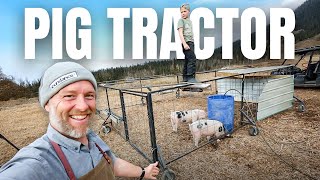
Victor and his crew build a mobile pig pen to shelter two piglets and improve soil health through the animals' manure. The pigs will convert wood-chip mulch into nitrogen-rich fertilizer to restore topsoil damaged by a hurricane. Along the way they repair a cracked water hydrant and improvise solutions with borrowed tools.
Chapters
Happy day! In this video, we're turning our old sheep pen into a mobile pig pen. We're getting the piglets out, we're adding shelter to this pen, and fixing a busted water hydrant, all before the winter freeze. Happy day! We've got to get these two pigs out of here. The cows are coming in very soon for the winter. How are we gonna actually move them to the field? Our primo pasture We lost, I don't know, 2 acres of topsoil because of the hurricane. I can't think of a better place for these pigs than on— we've got these wood chips, we're spreading them around. That's our carbon. The pigs will bring in the nitrogen with their— then we have the, the rain and the air. Pigs do like this naturally, like this, and that gets air, and that's the 4 ingredients for making compost or soil, which we so desperately need here. Pigs are going to need some shelter from wind, rain, snow. We can make our ramp in an all-in-one pig pen. Not sure how we're going to add weather protection to this ramshaw, but we're going to figure it out in this video. Not sure how we're going to get it across there. I think maybe through here. It's going to be interesting. First thing we got to do though is make sure we get them water. It's like old times, me and you working together. Oh, there's a hose. Yeah, got the water lines put in. We need to address a problem at the water source though. Before we address this water problem at the hydrant, I noticed the cows were out of water. So we got him some water real quick out of the creek.
All brains on deck.
Jonah has the idea to weld this. Okay, hang on, let me shut this.
Oh my gosh, that's coming out right.
Hold on, hold on. Oh yeah, see this crack?
I'll do my best, but I don't have the best welding wire for welding— watertight welding.
Yeah, do we just need to get a new hydrant head?
No, I can attempt to.
I bet what happened is this hydrant was left on, it froze in the evening, and the water in it just cracked it. These frost-free water hydrants only work if you turn them off, unhook them, and the water drains to below the frost line. Step 2: figure out how to fix this water line. You guys think—
I'll just weld it.
You can weld it? We've got to figure out how to turn it off. I think we have to turn off water to the whole house.
Why can't you just weld it right there?
You can't weld with water on it, can you? You can dry it off. Won't you get shocked?
Yes!
It's probably cast iron. Can you not weld cast iron?
I don't know.
Let's look it up. Let's look it up.
I'm thinking it's 1.
It's technically possible to weld a crack in a frost-free hydrant, but it's generally not recommended as a reliable or long-term repair, especially if the hydrant is made of galvanized steel. Common for these, or cast iron. First thing we got to do, assess the ramp. It's a sheep pen. It was— it's made for sheep, but I think it will work for pigs. Let's check out the ramp and see what else we might have to get by way of supplies. The tires are good, but the metal has come undone in 3 places. I don't know if that's gonna work, or if we'll get Josiah or Jonah to weld this. My idea is to pin these to right here, 8 feet, 8 feet here, 8 feet there. I just realized, do you think— you think this is going to pull over wood chips? This could be an all-in-one for the pigs. Unlike a net, it will stand up with them pushing wood chips. The danger of a net is them pushing the wood chips right on the net, grounding it out, getting over.
I think we should make sure the pigs can stay in this and not break out before we build all this.
That's a good thought, because what if we go through all this trouble and the pigs break out. Why don't we get it out by hand because it's really close to that container. 2, 1, 2. This will be nice because this would be a good shelter for the sheep. This doesn't have to be a temporary thing. Hey, let's see if we can even get this across the creek. Let's see if we can pull it over wood chips. Let's see if the pigs will stay in it before we build this thing. Let's take a look at this. Okay, it's gonna roll on this. You got no problem rolling, right? The question is, are they gonna get under it? There's a chance they'll more likely plow the wood chips into it, making it deeper. But there is also a chance they dig it out, but they probably won't. Yeah, because they'll be pretty bored in a 16 by 16, won't they, without Christmas movies? Pigs don't get to watch Die Hard this season. Ho ho ho! Now we need to figure out some shelter. If we do a trailer, we need to do a— we have to to do the pig— the ramp. And we need to put sides up to that ramp, which could be those red gates maybe. That's gonna be so loud, and it's gonna take two of us. Are you ready?
I'll help.
And if they dig out and get out, how are we gonna get them back in? Old spots are bad to follow a bucket. Yeah, somebody recently crashed in it. Those are some big pigs. I vote ramp. Look how big they are, bro. And then square them in. Good job backing this up, Josiah. You nailed that.
And I was about to say I'm gonna go get this by myself. Never mind. Okay, let me open that gate. You have to open that gate or it won't be open.
We're pros. No, don't push it. We just be patient. You don't think we could get that? I think we could get the ramp right in there. I'll go get it. I know, we need to get the ramp. That would be how it works. You give up and they get out of the trailer. Yeah, I don't think they're crawling under. What do you think, Bird?
No, besides, it's too small unless they burrow a hole.
We've got to get them shelter, so we could just put that a board over and some tin on it. They'd probably get blown off. We could put their, um, skid housing in here if you think we could pick it up and put it over there.
I think we couldn't pick it up and put it over, but look at that little thing over there, that little shawl.
Oh, you want to put the pig shawl in here?
Yeah. Oh, look, look, you put it in the corner and then you put a board here and a board there and it's strapped in by the thing.
I like the ram shawl idea. If we have our tin snips, we might be able to put the tin sides on before the shelter though. They were already out of their water, so let's get them water. And by the way, if you want to raise your own pigs, I have a free course, Permaculture Pigs. I'm giving it away for free. Link down in the description. Everything you need to know for raising pigs. I had an idea for temporary rain cover for these guys.
The ramshaw.
Lily taking over there. We'll come help you put it in. Gideon says the water's not running hard. That means there's a breach in this line somewhere. Okay, turn it the other way. It's off. What are you doing?
I'm going to see how powerful it is.
All right, do we have a new one of those? There's our problem. Okay, let's put that on our list. Still got some pressure on it. Has it gotten up to them yet? Yes, they're thirsty. You got it. Whoa, that will keep rain off them. It is supposed to rain tomorrow. It will not protect them from wind. Let's go through all our stuff and make sure we have— get a list going. You gotta stay out here. We're gonna make sure these pigs don't break out tonight. Thankfully, it's not going to be too cold, and we'll put on the wind protection tomorrow. It's the next day. That rain is coming. We need to gather our tools to start building the shelter. I've got reports from Gideon, who did the pictures this morning, that the ramshaw is not working out for them, so we're gonna have to check that out in a minute. It's raining. Perfect time to look at how to replace a frost-free hydrant hose. Our friends got this hooked up. This is a new hydrant head from Plumb-Ease. Seems like it's going to be pretty straightforward to take off and pop a new one on. I think we can do it. Josiah dared to go to Lowe's with Gideon and Henry to get the supplies. It's handy when you're— oh yeah, we ain't working in this pouring rain. We didn't get their rain shelter set up. It looks like Can you tell the pigs have knocked a wheel off the sheep shawl? But there's still shelter and they're under it. We should be good. We have to be good. What have y'all done, huh? Huh? What have you done? Oh, what's the point of the pan? Hey, they need water, but let's see if we can't get this fixed today. We'll leave that water empty. What, are we gonna move them today? That's what I was getting at. Let's try to move them. It's maybe been a week. Look at their deposit of manure. I'd say easily a third of it has got holy pig On it. We have extreme weather coming up next week. No more fooling around. We've had some mercy here with some mild weather. Extreme weather's coming, Lily. Let's get this done. Let's frame the roof.
I'm gonna use that shelter right there.
No, I think that shelter— well, first of all, it doesn't have sides. And two, it may be too weak. I mean, maybe Mike could put that wheel back on. It was probably loose, but it doesn't have sides. You want to get some tin while we're at it too? We do have a lot to do. We need a frame and attachment board up to the top to attach our two panels of tin. We need to mark our tin and cut our tin, so let's get a Sharpie too, Lily. Then we need to put a wall of tin right here and here. Seems easy, but it's not quite as easy. It seems like the simpler the build— well, definitely the more thoughtful you have to be about it. See if there's a Sharpie down here. Jonah is about to help me, but also there's about to be some head clashing, and I think I have a valuable lesson to learn again. Well, I recruited help, but we're gonna clash heads, I guess. You're gonna take over instead? This is what I'm gonna do.
Yeah, and then it's gonna bend really bad in the middle.
Oh, there you go. That's so good.
What would make it perfect?
It works. Oh, the only thing is I was going to use it to attach to this notch, but it needs to go right here.
Yeah, just notch it.
But how's it going to attach?
You'll notch it so that it slides in under that board.
We don't want to go under it because I guess we could go under it, but then we have to put a slat on top of this.
No, no, you're not getting what I'm saying.
If you have a board here, you can attach to this board like this because I'm going to cut it out with my Sawzall right here. Just not as good.
Oh yes, it's a very classy way.
Yes it is. That's how you're flattening that out? We're going to do it like I said.
No, on the outside.
No, I want it on this side.
You can't put it on the inside because of this.
I know, I'm going to put it right here and then I have a shim that goes right on top of it. I guess if he's gonna help, he has to take charge. It has to be like this, Jonah.
Yes, I told you.
All right, you see them tabs right there? Yeah. All right.
I'm stupid, you're smart. I was wrong, you were right. You're the best, I'm the worst. Did I not say straps?
I told you. I didn't know they had straps. Do they?
Yeah, this first just flat strap. I'm stupid, you're smart. Hey, this metal is too slippery.
You got any ideas? Well, once we attach tin to it, it won't slide down. The roofing screws go through that metal? Yeah, I think we have some long ones. Hey Jonah, if the screws will go into the metal, we don't even need the boards. That would be nice. Well, let's try. Curious if these 10 screws will just go into this metal. That'll save us a lot of trouble. What's wrong with this drill? Hey Jonah, if we were gonna do this, we were— we would put it flush. I guess you did. And we're not going to put it right there where it is because it can't be at the door.
Why can't it be at the door?
I just— because you don't want to walk in all crouched. You just want to bend over once.
Put it at the door anyway.
I think we're on the same page now. I think Jonah was thinking I was wanting to do that the way I was doing things. It didn't make sense to him, of course. In case you guys are lost, we're going to do this. I think all we need is a pilot. Drill, and we can drill directly into this metal. We'll cut off the extra. It actually goes— we'll have the ends for metal.
See, they got that little thingy on the end.
We don't have a bit for that unless you brought one.
There's a few in here.
Bits. Shoot. Wow, good job, bud. Well, we found a metal screw on farm. Do we have at least one more? Yeah, thanks to Jonah. You've been building Jerry your whole life, huh? Uses it up, wears it out, and makes it do or do's without.
Now we don't have to do any of that.
Framing. How are we gonna pin the metal roofing to the metal?
With these screws, but there's thinner ones that I— we might have to go to the store and buy.
We found some roofing screws that'll go through metal. We need the right size bit. Hopefully Jonas go find it. He probably has more tolerance for that kind of stuff than I do. Oh, that's just not quite long enough. Cut off the extra. Uh, would these work as tin snips? If you could hold that steady up on that side.
God, what are y'all doing?
You find a bit? No. Oh boy. What are you doing? We're marking it.
Go straight with the— with the corner. No, wait, let her mark it like this, and then another piece across like that.
Okay, that's it. Yep. Okay, and then this one's gonna have to go like that. Probably don't like cutting it at the angle.
Shoot, jeez, that ain't cutting.
You want to go get your grinder?
Yeah, the battery was dead.
You got any more?
No.
Okay, let's put that on the list. He got through one, we just lack one more. What happened?
Nothing.
How did we cut it too short? Yes! Wow, no boards needed, right into the metal. A lot of frustration this morning, having some breakthroughs. Yay! That's okay. No, no, I want to go all the way across. Do we go on the inside of this one? No, but let's get the one that goes across.
Oh, see the thing on the other side?
Oh yeah, we can't go much further because of this. And let's say you guys let me go on the inside, but you won't let me. That's because they want it to be smooth like this on the outside. I don't blame them. Can keep the boards going across on the inside.
He wants to go back.
All right, so that's good. Oh, it fit nice! Good job, Jonah. I think what I learned from that is if I'm gonna have Jonah help me I'm gonna have to relinquish most control. So either I do a separate project without him and he does his own project, or we work together. I've got to let him lead. But in the end, that's what I want, because I want him to take over. I want any of these kids to take over. You saw how we built the roof and the walls. Well, just, just in case, I'm also going to show you how this— this is a mobile ramp a— this is a mobile sheep pen, but now it's just a mobile pen because it also works for pigs. You can see how we just, uh, metal roofing screws into a piece of board on the back. You can see the boards over there that just kind of pinch it on these cattle panels. Same up here, we had to use the metal-to-metal roofing screws. We went down into the 1-inch tubing metal On that it worked nicely. Corner wood brace to go from the middle of the pole. See this pole right in the middle of the tent? We went from that pole to that pole. Wait, that one, but over here, here you can see we went from the two middle poles. Two pieces of tent well too, and then a little tiny one. And that's how we built it. You want a tour of the pin to see how we build that? We had a custom welder, Ben Holler, came and helped us with this. We got the idea and concept for this from Greg Judy. The idea is 16 foot across. It's actually a 16 foot square cattle panel height, so it's 52 inches high. These are literal cattle panels here with 1-inch tubing. There's a vertical tubing in the middle for each wheel. There's a wheel in the middle and then there's a wheel on that side, and there's a wheel on that side. We had to do a brace to hold on to this angle here because if we didn't have this brace, this, this wobbled back and forth too much. So this brace came in clutch. These are Northern Tool, I think they're 10-inch. They're non-flat. Sometimes they break right here or whatnot, but they're lasting a good bit and they're not that expensive. Angle brace right there where get in standing. The contraption is about 6 inches off the ground. Sometimes with undulation of the— is that the word for it?— of the ground, sheep might get under it. These pigs are big enough that they're not— they aren't the most athletic. They're more the bodybuilders. At each corner we have hooks welded on, O-hooks, and our strap can be attached any way. We could We could, uh, take it off down there, attach it there, and pull it this way. What else should I show them? What else do I need to show them? Minerals attached, and that's it. You could draw one of these out and take them to your local welder and have one of these built. This is what's tricky, is this wood chips they piled up gonna catch our tin? Just slid right over it. What's beautiful about this, you don't want the pigs in the one spot more 12 days, so they're in their own parasites. We want to spread the manure love. We want them to turn up all these wood chips to help us turn it into soil to repair this land. We move it and everything goes with it. It's their cage now. It's their shelter. I like that. We'll keep that on for the sheep. And we don't see it, but they— they see it. We can unhook it. They see a new and exciting land to explore. They don't have Christmas movies, so they're in tune to everything around them. Now don't leave, we still got one more thing to do. These pigs have shelter, but they're gonna desperately need water, and our hydrant is still broke. Let's get on that. We're draining the water out of it. We have the well pump off. Jonah, did you watch the video? No. I'm a hair nervous because I've never fixed one of these without digging it up. We've watched the video, he did it, I think we can do it. But if we can't and something goes wrong, the whole water is turned off to the whole house, to the whole hauler. Don't, don't do that. Put it back, put it back. We don't want that to break. There we are digging it up.
We used to have a bunch of pipe wrenches, but now we have one for some reason.
You try that. I'm gonna go try to find the pipe wrench. Didn't find the wrench, but found one of Henry's socks. Just call Big Daddy. I hate looking for things. Pipe wrench from Big Daddy. We could buy one, but I'm reading Warren Buffett's book Snowball, the best, which I got for 25 cents at the library. Wow, this works. This is game changer because we've dug up mini a hole just to replace the head. Yeah, there's a rod. You're going to take that rod off of it. Oh my gosh, can you imagine if the water were on?
That's a joke.
Did you guys know who's Warren Buffett? He looks at a dollar and he sees $10 in the future.
Awesome.
So if we were to buy a wrench for $10, is it worth $100? Because we could put $10 in investments instead, and it would earn $100 over the future.
I actually don't know how this is going to work now because there's nothing to grip like anything with.
So all you do— oh, sorry, you get a wrench on this one and a pipe wrench on this one.
I think I got it. But tools have value because absolutely nothing done without tools.
Absolutely. So yeah, I mean, if we couldn't borrow that from Big Daddy, it would be worth $100 to buy the pipe wrench. It would. Because we need water. That means that dirt bike was about $40,000. Is that worth it?
Yes!
Okay, good.
Well, I guess not.
All right, it's worth it. Okay, see, I thought we had to get all this stuff out. Wait, how did you know that's how it got back together? Because— how do you know? You have to keep that loose.
I have a degree in water hygiene.
You have to keep that loose.
No, no, you tighten it up.
No, you don't. You don't tighten it up until it's on.
But you have to tighten it up so you can screw this on.
No, I don't think so. You hold that steady with your pipe wrench. Remember, we had to loosen this to get it off, so that means it has to be loose. That would be— yeah, that's where it goes, right on here. So yeah, okie dokie. How do we know this is all set up right?
We don't.
It is. We walk past, it's not screwing on. But when it's the top of it, you know what usually breaks is that lip though. Something here usually breaks, right?
I'll hold that, just hold that wrench.
Best practice, turn it off when it's gonna freeze. That's tight right there, right? Yeah, but that pins it to the pin.
All right, ready?
Okay, now see if it'll open. Does it feel right?
No, it doesn't. It's because this is too tight.
Okay, good. Now the real test is to turn it on.
If it explodes, leaky.
It's not leaking unless this is a leak. Or is that wet from when we did that? Get our winches out of the way. We did it! Huh? Did we do it or what? Uh-oh, I hooked up our line, went to turn it on, and it's leaking. We're in big trouble. Leaks and it's off, and I think it's leaking and it's off. It's wrong.
Look, do you see that little thing we put in there? When we would turn it on and off from right here, it would— what is that? That's the washer that we broke when we would turn it on and off, and that's why it started leaking.
That's why I didn't leak at first. Washer might be broken already. Don't bang anymore because you're looking at putting out a rubber washer, correct? Is that Mom right there? Yeah. And we think this washer is damaged in this old one. We can't get it out. Can you get that out of the new one?
I'm trying.
All right, we just looked. There are no— these parts are not in the local hardware stores. So we have got to figure something out. We're taking this old handle off so that maybe we can get a screwdriver in there and get that washer out without tearing it up. Did you guys get it?
No.
Okay, you got it off though. So now let's see if we can pry that out. Oh, it's so frittle. See, it's not moving. This is a problem with just not hiring Randolph. He probably wouldn't have made this mistake.
When did you guys get this?
You can't. I already looked it up. That won't work. You can't. I already looked it up. That's a Woodford. This is something else. This head on that wrench— if that head doesn't work, we could probably get the washer off it and hope it's the same size. Hey, you got to do the disconnects.
There's no disconnect stuff.
It's different. Well, that might be why this is not gonna work. It doesn't work like this. Are you gonna be able to put all this stuff back if it doesn't work?
Probably not.
It's gonna be a Festivus miracle if this works. It's straight so far. There you go. There it is. Does it feel good? Yeah, it feels great actually. It's leaking, Jonah. It's not even on.
I know what the problem is.
I don't think it fits. This can't happen. We can't have this running all night. This will freeze.
Oh my gosh, here, one second.
See, I hate this. Okay, this wasn't supposed to be this difficult. We're gonna, we're gonna drain this one more time. It's the third time, right? What's your plan?
So The plug right here isn't getting pushed down far enough, so I just need to loosen up the thread at the top so that it goes down more.
He did something while the camera was off. He says it's fixed.
I lowered the threads so that this— the rod in there like this is lower down. There's about a 10% chance this fixed it.
Well, we kind of need that 10% chance to turn water off.
It ain't leaking.
Oh my gosh, because— nope. Dang. What?
No.
Okay, is this the fourth time we've turned off the water? Yeah. And I don't think just because we stopped getting a leak— I still think— I don't know nothing. I don't know nothing, I admit. But this, this doesn't feel right.
I don't know nothing either, but at least I know a little bit.
And I think because just because it's turned off doesn't That means water's not up in the hydrant.
But look, the little thingy is called the weir.
I know.
This is the weir, see?
Yeah, right here.
So once the little plug goes down to the bottom, it shuts it off down there. The plug shuts it off, it shuts it off, and then all the pipe, all the water in the pipe goes out this little thing. So if it stops leaking at the top, then no water is coming coming up, so that means all the water can drain out. See how this is the thing, and I'm spinning it to make the threads go out more.
See, that just seems jerry. That's not—
but no, I'm doing it at the wrong spot.
No, you need that pole to come to be longer, don't you? Yeah.
Oh gosh, I am dumb.
Why? What does that mean? Is it good now? I bet it could unscrew a lot easier now.
Look, the problem is, is all of the threads are so threaded.
At this point, it's probably just got to get us for a few days till we can get the replacement, the washer for this new one. This doesn't work, we got to put the new one on with the busted washer and it just leak when it's on. We have to get this turned off or it will freeze at night. Okay, we need to wait for the pressure to build up. It stopped. It worked.
That was one turn.
Are our drips getting less or more? Oh, just get that stupid drip pot. Okay, we're gonna get paranoid about drips though. Because that means if it's dripping, that means there's water all up in this.
There's gonna be a little water up here if we just turn it on.
Oh yeah, I'm just saying.
I can't say something.
It will eventually stop dripping if there's no water in there.
Yes, there are this—
you can take a towel and wipe it out if you really want to test it.
All right, turn it on and turn it off, and it better work. Okay, it worked.
Really? Let's go. Look, see?
Yeah, it worked.
I want to say good job. They say it. They say it. That sun right there. I'll say good job when it's an hour lower into the sky. Oh, did I see a drip?
Yes, because there's a little water in there.
Okay, all right, let's check this out. It's not dripping. Good job, boys. Happy day, everyone. Don't forget, free pig course down in the description.
More from Justin






If I had to start my Homestead all over again, it could only pick one animal… 




