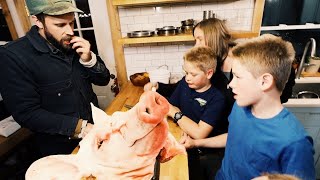
The video documents a hands‑on masterclass titled “Abundance Plus” where host Victor (Speaker A) and guest Brandon Sheard from Farmstead Meat Smith walk through the complete process of raising, slaughtering, processing, curing, and cooking a pig, with a focus on food resilience and non‑freezer preservation. The episode begins with preparations for the day’s shoot, including setting up tools and discussing the importance of having redundancy in meat storage. They demonstrate humane killing techniques, emphasizing a precise brain shot achieved by positioning the pig while it drinks or urinates. Detailed instructions follow for scalding (maintaining water at ~145‑150 °F), scraping, sticking, gutting, and dislocating the skull without a saw. The group then explores salt‑curing using Redmond salt as a freezer‑free method of preservation. Later, they roast the pig’s head in a cabin oven at 325 °F for about six hours, discussing oil choices, seasoning, and the texture of various parts (jowls, ears, tongue). Throughout, they intersperse community moments—feeding a young breeder pig, sharing a beef stew, and celebrating the traditional Christmas pig‑head feast. The video blends instructional content with informal banter, showcasing tools, materials, and the cultural significance of whole‑animal utilization.
Chapters
You're carrying it, aren't you? Oh my gosh, you need some help? Yeah, you want some help?
Just— I'll help you.
You're falling off. This is the climax of our year, the final harvest. The end of this crazy week. Film crew's coming at 8 o'clock. We're doing a master class for Abundance Plus for pig butchery. We're talking about, uh, butchering from start to freezer, really. Uh, killing, scalding, uh, I want to say plucking, but it's not, uh, scraping. And the one I'm most excited about is we're going to learn how to salt cure. We've got a bunch of Redmond salt in here. We're going to cure with that. We're building redundancy in our resiliency. So yes, we love the grid and we love our freezers, but what happens if something happens to that? It'd be nice to know how to cure and store pork without a freezer, wouldn't it? We're out here milking super early, 7 o'clock. Crew's coming at 8. We're pulling the trigger at 9. Brandon Sheard is here from the Farmstead Meat Smith. Best, only the best. These tripod legs end up serving us two purposes. I end up— can use them as a staff. Come on, buddy. Come on, let's go, let's go. These two ladies behind us are in heat. They're too young to be bred. You don't want to leave them. We got the chores done. We almost got this to temp. Brandon Sheard is here, the film crew is here, all is well. It's like 20 minutes till trigger time. This is going to turn into a tool table. We've been, uh, what do you call it, scraping. We've been scraping on this, but Brandon likes to scrape hanging up. I'm so looking forward to learning some tips. On the scraping, because if this doesn't go right, it just sucks. So this goes right, it's a pleasure to do pigs. Got a gambrel, scrapers, tape, uh, cooking twine, a bolt. Hey, what are the bolts for?
They go to my slaughter truck.
Oh, okay.
It regularly sheds bolts.
Okay. We got the yes man. I'm here. What happens when you say yes to things? You learn new things. I thought you were gonna say you end up eating lamb nuts. Or that, or that. Jason said that's what got us through yesterday. We were raring to go after eating those testicles. And yesterday was a bad— took us an hour and a half to scrape this pig. I asked Brandon how long it should take. He said 4 and a half minutes. I don't know, Brandon. We'll see.
So definitely pick her up. Definitely.
This is over. Yes, it definitely comes in there. Maybe when we get their attention down here though, we can teach— you can explain where you're going to shoot them. Yeah, while we're down here.
Oh yeah, and it's only perfect if you hit brain. It is not sufficient just to shoot the pig in the head in a general sense. You need to hit brain.
How big is their brain?
And if you don't get brain, you got nothing. And their brain's about that big. It's a little thing. And the brain— the shot is going to be in the forehead. It's way up here.
It is.
What you do is you go between the ears.
Almost.
Not quite that high. Pigs hold still when they pee. So sometimes when I pull up to a farm to harvest pigs, if I see one in the back and he's peeing I'll run out and get that shot because they just, they hold still. And then the one you can actually control is drinking. So if you can deny them water from the day before or bring a wonderful treat like whey or skim milk that they love and you know they'll drink, then they'll go down into a bowl that you fill and they will hold still while they drink. They don't laugh, they don't move their head while they drink, they hold perfectly still. So that's a good shot opportunity. Scalding and scraping is essential to, to getting the most out of your pig. The temperature has to be very particular. We need it to be 145°F when the pig is in there, which means before the pig goes in, it should be about 150°F, 148°F, because just the thermal mass will displace the temperature a little bit. And so if you're using wood to heat your fire, you get it— you get the water— or if you're getting— using wood to heat the water, you get the water to temp, go shoot your pig, and then bring it back. And from that point on, the key is to avoid the over-scald.
Scalding went well. We learned how to tell when you've overdone it and when you can't, like, re-scald, when it becomes unproductive. This kid, he just wants to get down. You can't, it's cold and wet, buddy. Next up, gutting.
Going to start in the sticking cut. And this is why we picked that line, that way we don't get an excess of gashes and jabs and flaps of meat, uh, from the sticking cut and then the decapitation. And this also lines us up to pop the skull off of the spine just by dislocation. We don't have to get the saw in there and jiggle it all around. So I'm going to start in here and bring my knife just behind the ear, and we will go all the way around the pig. We did scrape off all of this skirt. It's just these little hairs that remain.
On today's episode of Burn It Up Cooking Show, pig head. I cooked this in the gas cabin today because I'm sure we're also cooking chickens for all the normal people. Hopefully it'll fit. Dang. Well, it wouldn't be the Burn It Up Cooking Show without problems. It's gonna fit, just barely. We're not done though. I need to put olive oil on this thing. I need to put some olive oil on this thing. Oh boy, are you serious? This olive oil is empty, totally empty. What are we hanging on to? But we have some avocado oil. I don't see why that wouldn't work. I think we have just enough. Some Ramen. This stuff makes anything better. Pretty much his nose is poking right through that burner right there. I hope the Hopefully that's not a problem. 325 for 6 hours, that's about 6:30 supper.
And the idea is that anything that you can imagine that would taste better being wrapped in a veil of pig fat and then baked in the oven, that's what that is for.
Like a whole chicken or turkey.
Yeah, it's for all the things. Yeah, exactly. Meatloaf, chicken, turkey.
Lunchtime. We catered a beef stew with cornbread. How was it, Meg?
So good.
That beef stew is amazing. I think, I think so. We've destroyed the first one, half into the second one. Thanks, man. We need to get the one live pig that's out in the field. She's a breeder. We're gonna get her with the other breeder. I don't like her being alone. She's a herd animal. Jenny, you think the pig will stay in this the trailer and not jump out? Yeah, good, because we cannot get the livestock trailer and the tractor right now because they're doing the workshop right there. I hope it's not a mess though. I just noticed her buddy over there is in heat and she and Beefcake are trying to get at it, and I don't know how that's going to affect the dynamic with this one, if she's going to be aggressive or not. We'll see. Take that and make it tight, please. Let her get a bite. Well, we made it. You didn't jump out. You're not too stressed either. You're eating and you're ready to mate, aren't you? She is in heat, but she's much too young to be bred, and we want to time it so they get bred in, uh, December, January for March, April babies. All right, now you hold that. This will be that side. That'll be this side. Okay. Whoops, we forgot the ramp. You think she'll get out, Jonah? Yeah, I don't know. Let's check her athleticism. I think it's steep. It's slippery. Whoa, that's some athleticism! That's what we wanted, isn't it? Two females, two females and a male. We're doing it, guys! We're getting close. We've got a rooster, we've got a boar, we've got a bull, we've got a ram. That's sustainability right there. They're curing now.
Um, stainless will work. It's, you know, it's super minimally reactive. Um, plastic works, the bus tubs work. Um, wood is the ideal. Oh really?
Yeah, look at that. It turned out nice, huh?
Yeah, it's beautiful.
6 hours, 325. Forgot to turn it up at the end. It—
I think we got some crispiness. I think it happened.
Is that too crispy?
No, no.
So it's supposed to be hard like that?
Well, yeah, that's, that's what the last little blast would have done is thin it out a little bit. We're just going to open—
not sharp.
We're going to open it.
Okay.
And there's a lot of meat in the jowls, a lot of— it's— there's a lot of meat everywhere.
But I'm ready to eat that ear.
Yeah, you need the ear.
Chip this.
Ooh, this might be—
that's spot on.
That's what I'm talking about.
Yeah, heck yeah.
Yeah, it's hot. That's why we scald and scrape the pig right there.
Wow.
And then, you know, we can just open it up. So all this in here, I'll take them. This is all good stuff. See that long stringy meat?
Yes. You know what I'm saying?
So sometimes, you know, you can—
man, look at that. Yeah, blend that with that meat, that fat with that meat.
Yeah, so this is what the jowls are like. There's just a ton of it in there.
And you can, uh, that's what I tried cutting off.
I just kind of shred it and then, you know, a little bit of salt.
How do we eat this ear? Oh, that's gonna be chewy.
You just go for it.
It's gonna be hard. You're gonna have to gnaw on that for a while.
Yeah, so the ears have— the skin is crispy, but does have a central little collagen that's a little— that can be a little tougher inside.
It's so good.
This is a Christmas feast, the pig's head, traditionally. Is it a Christmas thing? Look up the Boar's Head Carol. So, do you eat a pig head? I'm trying not to sing it right now for you all.
What? Yes, go ahead, sing it, sing it.
We do eat pig heads. We try to do it on Christmas.
Like for Christmas lunch?
Christmas.
Or dinner?
Uh, it's after Mass on Christmas Day.
Oh wow.
Try to have it, yeah.
So do you, would you have like frozen this?
I try to, I try to plan way in advance, you know, get the wieners.
Yeah.
Okay, we're gonna do a class, and then we'll let one go, and then we'll kill it like the week before Christmas, and we'll have the head.
Hey, Big Daddy, I want you to look what's for supper right here. Hey, just pick, pick some meat off of it and fat and skin. Have y'all ever had a pig's head? No, he will tonight. Look at that, it's just empty inside that ear. There's literally nothing in there. Look at that. That's, that's right there. They probably need more like 100. They're kind of thick there. Get right something. You like it? Big Daddy's a good sport.
That does a little bit of fat from the jowl.
That's straight up fat. Straight up fat, huh? Maybe get you some of that jowl meat up in there. Up in here.
There you go.
It's like tender roast beef.
Yeah, yeah, yeah. How do you get under the eye?
There's the tongue. Rub it down the bottom. Very good. Oh, but that ear is crispy too. How you guys like that pig head? It's good, Bruce. How's the pig head? Good, Grandma? Delicious pig head and rice. I got a bit of ear, a bit of cheek. If it's gross, don't say it. Well, I don't want to know. She probably doesn't want to know what this was. No, don't tell me. Blah blah blah.
Eat it quick.
It's the eye. One more bite, Becky. Okay, good. Get it out. Very doable. It's just, it's just chewy.