We Rebuilt Our Farm After Hurricane Helene
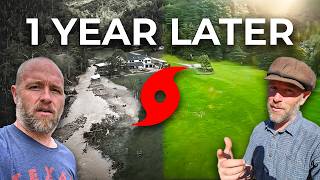
In this documentary‑style vlog, Victor Justin Rhodes (Speaker A) recounts how a devastating flood from Hurricane Helene destroyed nearly every critical element of his Western North Carolina farm – the access road, a pole barn, a high‑tunnel greenhouse, a decades‑old bridge, pasture, and stored hay. Over the course of a year, he and his family, friends, and local volunteers (Arthur, Jonathan, the Hollers, Jonah, Josiah, Henry, Gideon, and others) systematically restore the farm. The video walks through five major projects: (1) rebuilding the access road and driveway using fill dirt and gravel; (2) shoring and stabilizing the pole barn to save thousands of dollars of hay; (3) reconstructing the high‑tunnel with donated materials and community labor; (4) rebuilding the historic bridge from reclaimed logs with zero material cost; and (5) restoring topsoil through permaculture techniques—hay‑bombing, manure spreading, and leaf mulching—to regenerate lost acres. Throughout, the narrator highlights the role of the relief organization CRR, the spirit of mutual aid, and the emotional journey from shock to hope. He ends with reflections on resilience, the “4 S’s” (survive, stabilize, succeed, significance), and an invitation to a preparedness newsletter.
Chapters
One year ago, our farm was completely devastated by Hurricane Helene.
Look at that!
There goes the container! Our whole pond is overflowed! There went the bees!
We need to build some cage cover!
There goes the power pole! 32 inches of rain in just 2 days. But during the storm, we knew we were going to be set back. How many years is this flood going to reset us? In this video, We're attempting to rebuild in 1 year. Is it possible? Well, we aim for the impossible and extraordinary things happen. Let's see. We're talking about our road turned into a river and was completely destroyed. The corner of our pole barn, 25 feet away from the creek, 12 feet up, washed out. The high tunnel, 40 feet away from the creek, gone. Invaluable pasture was washed out. And our very bridge in the middle of our farm, gone. It had been there 30 years! Bye-bye! And that was our way to get up to Grandma and Grandpa! First up, after the smoke cleared, after survival mode, we— our road, this road turned into a river! We need to get out! We need to get out, assess the situation, assess the community, see what's going on! So let's hit it! First things first, we're gonna get some fill dirt and fill in this these massive holes. And then we'll bring in some gravel that washed away and grade this road smooth, and hopefully we'll be getting out of here. We've got to get a path up to where we have some fill dirt from, from an old mountain board course. This is taking so long.
So much dirt.
9:30, taking so much dirt. Our goal is to get out by brunch, so he's got 30 more minutes. I think we're gonna do it. I doubt it. I know, right? I think we got to where we can get out of here with our cars. Gravel, where are we going get gravel right there in the soccer field. I want to first start getting it from there. Finish filling in the potholes. 10 minutes and he's getting rocks from the creek. He was successfully able to get down there. This is going to take a pretty minute. Yes, Austin, we have a driveway! Looks good. Oh boy, he's stuck.
It's a little soft.
We're not stranded anymore! Freedom! Ta-da! Thank God for those machines and those machines on farm. What was a canyon was rebuilt rather quickly. We were able to grab material from on farm that had washed down. What'd you say, buddy? All right, let's see Winnie. Winnie's over there with the, uh, wood chip guys. While the wood chip truck is here, let's go down here and get a shot for later in this video to show our fifth— our fifth project victory. Look, with access established, critical. Next, the next critical thing. We're going there in just one second. We had to save thousands and thousands of dollars worth of hay.
Time out.
I've been beckoned. Nice. He said come film me. Nice. Hey, this is a bit of a tease. This is a bit of a tease.
I'm gonna talk about this.
You get a little glance, a little glance to the glory. And our fourth project, checking up our pole barn, our winter housing for animals. Very important. Thousands of dollars of unsprayed natural hay lost to the waters. It was absolutely crazy, but more is on the line. Two of these posts were washed out. The roof is literally laying on some hay, and if we don't act, we're going to lose it. If we do not stabilize this, this tens of thousands of dollar pole barn is, is going to be extensively damaged. Thank God for my friend Arthur. Coming and helping us. The goal today then is just to get this shored up temporary so nothing— so it doesn't fall anymore.
Don't hit the pole! Do you want to get that other piece of concrete? Wow! That's too heavy.
You got to put your blade down.
That would help. There you go.
All right, we're gonna need another one too after this.
It's gotta go up.
Josiah says this needs to be in the middle. We're just getting to where we can get that back out so that eventually we can build a, uh, we can build a foundation. Corner temporary held up for right now. It fell down! It fell down and we didn't even lose hay. Look at that! All we lack is the middle pole. I feel really good about this.
This is shored up.
This is shored up. We've saved thousands of dollars worth of hay. $10,000 dollars in the barn. Thank you, Arthur. Absolutely, you knew exactly what to do. And then later, our friends the Hollers coming by and Big Daddy just to help us build a new foundation for these posts that were swept away.
He thinks it'd be better to pour it all at once.
The column too. You need to make an E-form, a couple of E-forms. What was your thought behind not doing the column now? Well, you can brace it off of the form that's there probably to keep her from expanding. I mean, it's just a little box basically. Yeah. Did you want to form it up and build it separately? Because we can do that too. That'd be a little bit easier, but it's 2 days of work rather than 1. Oh yeah, we need to do it with 1 day while we have Ben. Now I'm just going to get this thing leveled up. Now we've got stakes in. And once it's level, then we can go from there. Wow. Oh, I think that's a good mix, Rich. It's a perfect slop. Not too wet, not too dry. If we're gonna have enough concrete, we've already used half our concrete. 4, less than an hour, 5 hours, you know, that's pretty good for all this work. We made it, we're done. Everything went off without a hitch. The first part took a lot more concrete than we thought, but that was fine. We had brought some extra concrete that we'd had left over, so we had enough concrete. Um, it went great. Here we are after a whole barn load of, of hay going into the 2026 winter. You would never know, you would never know. And now we made it even better, we have a little access road gradually leading up to here. We buried those posts. Guys, this was washed out. This was washed out to right here, dudes and dudettes. The creek is way over there and way down. Okay, so we're talking about 1,000x, and here we are. It took some of our concrete, and some of our concrete is gone. We had— we have zero— we didn't have a line item for hurricane We don't get hurricanes in North Carolina. After we got our emergencies secured and communication to the outside— we didn't get the internet, we— a neighbor's Starlink for 5 days. We figured out things are pretty rough. As rough as they were here, they were even rougher outside. There was a relief organization, CRR, I got connected with. They needed me as a local, me and the boys, to come in and help them scout for projects, and we did that, and I absolutely could not believe my eyes. A place once popular with tourists is now dirt and debris. Only a few places are still there.
There's a pole.
That's what we like to see. I think we're gonna get to the end of the drivable road right here. That's what we're looking for— inaccessible places. Oh, still here. Stay over on the left. This is a house. What do you want to do, Daniel? Try to get over there and park? Yeah, let's get over to that and try to go down this road. Yeah, don't stop unless he stops us. You got it. This doesn't even look like the original spot. Yeah, I think the original spot was there in that hole. This was a homestead. Look at their gardens. Oh, breaks my heart in a special way to see a homestead destroyed. This was their home. Now it's there. And like a good homesteader, they ain't leaving. They've got a 10x10 living area set up here. Nobody's here. We don't see any water around. We're going to drop a load of water.
Huge truck, like a tow truck.
That's a flatbed.
It looks like the chickens are gone.
So the water must have gotten too terribly high up here. But oh, the poultry net. That's a lunatic homesteader like us. Somebody on this road has goats because somebody dropped feed off— yeah, what was their driveway freezer way up in the middle. Look how high that is, guys. That's 20, 25 feet. That power— how? Well, are Ring cameras battery or powered? Well, I mean, they do have a fan going, so they have power. What happens when you lose land? Like, you don't— you don't get insured for land. My heart goes out to those victims, and, and we were thankful to be a part of some of the relief here. You know, I noticed that everyone was— all the victims, everybody was hurt, but everybody was also helping each other, and we were able to connect CRR with a lot of places, and they've done a lot of good work in there. You know, for example, Arthur, they had their own crises, but they took time to help us. The Hollers too. And sometimes I felt weird leaving here, and there's still piles of trees down in the pasture, uh, just to go see to others. But that was the spirit. That was— that, that's what was going on here. Hurt people helping each other. Let's go to the third project. We're about to lose the high tunnel. This is sad. We're gonna lose the high tunnel. Maybe the 3 pigs. It's so dangerous to get out there. Probably one of the most mind-blowing ones and one of the more damaging. Certainly I would say the most damaging to our food growing. You see, we I see that. You see, we grow nearly 100% of our own food. If we don't do something about this high tunnel, which is a significant portion of our food, I don't know what we're going to do, and I don't have the wherewithal to think about it. People would reach out, how can I help? I don't know. And I've seen, I've seen it said before, when somebody's hurting, don't ask them what you can do to help, because then you're just giving them another chore. They have to think of this. I can see that now. Looking back at us in a crisis. We didn't know. We don't know what you're really willing to do. Jonathan at Farmer's Friend said, you know what, we saw you lost your high tunnel, we're gonna get you another high tunnel. And not only are we gonna do that, we're gonna build it for you. There it goes. You got one whole wall up. We do. Working on the second wall poles. Are we just trying to get it to this green line?
Yeah, so basically the top of this green line is going to be where your baseboard is.
Okay. Jonathan saw what happened to us after her— or during the hurricane and reached out. How'd you know that we lost our high tunnel?
Well, you know, we— I guess we've been working together just a little bit back and forth on affiliate stuff with Abundance Plus. And yeah, so I've— I try to watch one of your videos every once in a while, and I knew the hurricane came through here, so I started watching your hurricane series. And, uh, so yeah, just—
did you see that? Did you see the high tunnel go down? I did.
Yeah, that was, that was sad.
Um, right.
So then I think I just shot you a text and said, hey, we'd love to help you out with a new tunnel.
Yeah, I see. That was the best kind of help. One good thing about this, Rebecca, is you have your trellises. It's, it's trellis ready. It's trellis ready, baby. Jonah came up to me and he said, you are not gonna— by that, you had to mean your mother filled this with tomatoes. Is she the crazy tomato lady? Yeah, she was. Okay, she told me she only needs 2 beds. Only 2? So there's 6 beds in here. So 4 other beds for cucumbers and beans and squash. Should we just all go carnivore? Yes, let it be grass. Oh, y'all don't put it up? When we try this, it's kind of sketchy with us.
Okay.
Oh, you're putting a big long pole up there. He's pushing this 96-foot-long metal pole. It's going down. What's your duty?
I have no idea what this is.
They're getting some plastic up. Whoa, he's climbing! Place to be a thin, healthy guy, young guy. Greenhouse plastic is going up. Look at that!
It's going up. There it is. What?
There we are, beautiful high tunnel, end of season. And now we've got our chickens in there. They're warm. We had a beautiful season with our tomatoes. We got nearly 100 quarts of tomatoes in here. Bushels and bushels of green beans, zucchini, and squash. You walk by this high tunnel and it's as if it never ends. Now we're gonna go see what Henry wants, but we're about to go do the fourth thing, and it's going to be the most everlasting damage. This could take quite literally more than years, but hopefully I'm going to cut that time in half or less given our animal power. Permaculture principles. I can't wait to talk to you guys about that, show you that. But still, we have victory at the end in just one year. Hang on, we gotta see his bridge, then we're gonna go see that. You get across that bridge. All right, Henry, that was also a tease, you know, because you built a bridge.
Gideon did.
You hope Gideon built the bridge? Josiah and Jonah also built the bridge, and this is one of the most mind-blowing things we got because they were only 14 and 16 at the time, and it was going to be thousands of dollars to do my idea, and they did it for zero. Hang on to the fifth point. Come on, let's go show them the fourth project. We're gonna see one more thing. Okay, one more thing, I promise, then we'll go. Suddlers first. What's this? Hold on, hold on. What's this, Henry? Okay, you got a little swimming hole here.
Yeah.
Okay, I think Henry went to find Josiah. Maybe they're gonna dip their feet in the creek. This is probably— I don't know, is it one of the least sexy? It's definitely one of the least quick. We lost probably an acre. I'm gonna show you in just one second. Maybe 2, 2 acres of topsoil. First of all, can that ever be replaced? And if so, how many years? I do have some ideas. We're permaculturalists, so we believe in using animals and plants to do the work of the farm. Let's put every single— well, let's put hay on this and let's put every single animal we've got and their manure going down through here, and let's just see what we can do. Can we redeem this place with a little bit of— you can see it's barren, right? There's There's no grass down in here. All down through there, over here, all gone. We have made a lot of progress. Austin, show the drone footage of the damage again. And now show the drone footage of today's, you know, our progress, showing our progress so far. Today we are building back with 3 things people might call waste. Most wood. First up, manure. Look at all this manure they've dropped. Wait, she's really curious. After the cows, we have the pigs. Where's their squats? And we've added pig manure to the equation. The second thing is hay. We've done and continue to hay bomb wasted hay. They don't eat all the hay. That covers Mother Nature. She's very modest, she likes to be covered. Adds organic matter, and plus we have their nitrogen, and their nitrogen and that carbon mixing together, eventually we're gonna have compost. We're gonna build soil much faster than if we didn't have this system. What sand does is the nutrients are just going to run right through it. The water is just going to run right through But you guys incorporating in some of that hay is going to help retain some of the organic matter and the water. And you're adding your manure, huh? Huh? You want a pat? You want a pat?
You want a pat?
They waste no time. You guys were hungry. This spot, particularly barren. Not a great hay bomb. I mean, you can still see the soil or sand. Looks like we have some leftover hay. Pigs could probably help spread this. Even the sheep will a little bit. We have rolled out more hay. And thirdly, we didn't pay a thing for it. My landscaper friend is looking for a place to throw this away. I'll happily take it. It's free carbon leaves. Jonah's getting to work with some carbon off farm— carbon from the farm, not off farm. Off of the— yeah, carbon off of the farm. Yeah, you're gonna load and you're gonna drop it. We have a landscaper friend who needs to dump his leaves somewhere. Heck yes, we'll take it. I think you can put a lot more in that. What you doing?
What are you doing?
Just setting it so that the— Engaging the wheels. They said, does it need a PTO? It's wheel driven. All right, it's working to throw leaves, huh? Yep.
Okay.
I'm happy this works with the side-by-side. Yeah, it's way more efficient. What's faster, isn't it? Yeah. And now look at it. It washed away our soccer field. You can see, you can see, see, we're not completely healed yet. You can see the line, okay? You can see the greenery. You could see where the water was, but this was all 100% sand. There's now at least— at least we now have brown grass. It's because of its shallow soil. And now we have our soccer field back. We were a year without it. This is a big part of bringing socialization to the homestead. Friends come over, kids get out here and play. We play together as a family. This is a giant— as Joel Salatin would call it, a semicolon on our farm. A little pause to get to have some fun, have some social life on our— couldn't even do deer pasture, mowing it for a soccer field. But it's worth it, and it's back, and we're excited. Our fifth project of this video, the one that blew my mind the most our bridge right down the middle of the farm got swept away. So access to the whole other side of the farm, Grandma and Grandpa, was just gone. And this was a bridge that had been here 30, 30 years, or maybe as long as I've known, so maybe over 45 years. Just a locust post bridge. We looked into things, we looked, you know, it's going to be $3,000 at the least, $6,000, $7,000, $12,000. At the best. Is FEMA gonna come through? They didn't. When they finally did, it wasn't going to touch that. But over time, maybe 6, 7 months, my son Jonah just kept razzing me, 'I'll build the old bridge, I'll build the old bridge.' And you know what, you remember how I said people helping people? We helped the relief organization CRR, and then they organized a team to come and help us clear some of our woods. They ended pulling some of our old bridge out, and we realized our old bridge is there. It's just— I'm not kidding, that's probably 500 feet. It is all the way in that wood line there, guys, in pieces. And they helped us haul that up. We hauled it up by the truckload. Jenna said, let me rebuild the bridge. And I thought, you know what, okay, what's it gonna hurt? We can just take it down. Watch these boys do what they do. Let's just see. Come on, let's just see. I just I'll just let you fail. I won't say nothing. I'll let you do it. Just let you fail. It'd be a great lesson, right? Okay, have at it, boys. Oh boy, wait, no, we're gonna have to pick this end up with the excavator to get the logs mostly level. So that we can put the boards across like that one. You know, it's not— it's not going to be level right there. I know, we're going to have to add a second one to put two here. Hold it there, just set it down. We got to put the big one in first. Set it down. Yeah, that's almost right. I don't know, these logs are warped and bent. That's good. Let me unhook it, and then you got to pull this side this way like 6 inches. That's good. As they got about 3/4 of the way, I'm like, holy crap, they're gonna do this, and this is gonna be super legit. Looks good. Doesn't that look nice when you put the two boards on there? Much higher than it was. It's kind of easy with you guys building this back, huh? Easy. And what do we end, uh, so far? $30 for screws. Hey, they just drove over it with the machine! Hey, you're the first to drive on it! Did you see that? We just drove across the bridge for the first time. Look!
Wow!
No sagging. He didn't think anything of it. He just drove right over it. And several months later, this film— this, this bridge is doing fantastically. We put a fire truck route here in case they don't want to go up through here. But I just can't believe what these boys have done hauling boulders over here. The bridge is higher up than it was. It's probably a foot and a half higher than it was. Embedded— oh wait, look! Victory! Victory! We were having to splash through this creek, cars and all. The side-by-side crossing didn't impress you? Let's see the wood chips go. What'd you say? Yeah, the boys built that bridge. I did not pay him to say that. And that bridge was built zero money. The screws that we had to put into it, zero money. You know, the secret to just being devastated. It's just survive, get stable, uh, get some success and come into significance. Those are the 4 S's from Zig Ziglar. Just one step at a time, even when there's no hope. As they said in the Skeletons of the Sahara adventure story, why lay down to die when you can walk? So with all other hope gone. If you can move, just move. Just gird up your loins and get going. One step, one hand at a time. Do what you can. Speaking of which, that— oh my gosh, this should have been incorporated earlier. But you know where we lost the pole barn? About from there over and then all the way up through here. That's all new. That's all new rocks. I guess it's from right there. All that material was washed away, and that was definitely one of our biggest jobs. Got washed down through here. We had a pile I'm not kidding you, it was probably, it was probably to that other goalpost and 8, 10 feet tall of rock material. And we thought we needed a dump truck. We weren't finding a dump truck. We didn't have the resources to get it. About what we had is we rented a wood chipper for $500 and we were able to chip our wood. Josiah just girded up his loins. We didn't have a dump truck, but we had a track loader skid steer and we just he hauled one bucket load at a time, put the audiobook in his ear, just one bucket load at a time. That's the secret of getting through. The other thing is, I saw an Instagram reel on this the other day. If, if, if you're scrolling and watching the news, you're gonna hate America. But if you want to love America, you travel America. Thank you for traveling here to Western North Carolina with, with me and just Just know that America is good and it's great and its people are helpful and want to come through in a pinch. We got so much help during this time. I saw others— we were able to help others. We saw many other people helping others. It was as bad as it was, it was a beautiful thing to see. Given we were out of power 14 days, 15, something like that, suddenly We still thrived. Milk overflowing, eggs on tap. We thrived. A generator, we offered it to the community folks to come by and get some milk. Got the internet. And living this life of abundance— we aren't necessarily preppers, but living this life of abundance lends itself to a life of preparedness. And I'm going to drop you guys a free video. You join my newsletter It's on being prepared for the worst. Check it out, it's down in the description. Hope you guys have the most happiest day of all.
More from Justin






If I had to start my Homestead all over again, it could only pick one animal… 




