WEED FREE Market Garden (Back to Eden Style)
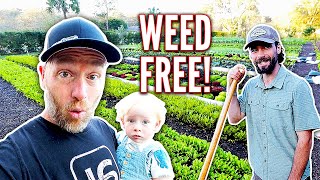
The video follows host Speaker A, Pete, and commentator Speaker C as they tour a 6,500‑sq‑ft market garden near Tampa, Florida, run by Nick, the founder of Growing Back to Eden. Nick explains how he adapts his Back‑to‑Eden, low‑weed, syntropic gardening philosophy to a warm, sandy Florida climate. He describes the garden’s infrastructure (custom walk‑in cooler, silage‑tarped beds, Jang seeder, sand‑bag‑weighted tarps), soil‑building practices (heavy use of compost, wood‑chip mulch, a long‑standing biological compost‑tea recipe, and organic matter additions to counter sandy soils), and his weed‑management system (initial silage tarp, thick compost mulch, monthly hand‑weeding with a collinear hoe and wire‑weeder, and maintaining a dense crop canopy to suppress weeds). The conversation covers crop selection and succession (salad mixes of Salanova lettuce, carrots, radishes, kale, bok choy, tatsoi, turnips, onions, collards, spinach, and winter greens), inter‑planting strategies (lettuce with bunching onions, Napa cabbage between lettuce rows), and the use of a Jang seeder for carrots. Nick shares his record‑keeping of planting schedules, noting that Florida winters act like Washington summers, allowing him to flip the traditional planting calendar. He discusses challenges such as a severe Christmas‑Eve freeze that killed 80 % of the crops, pest pressures from squirrels and root‑knot nematodes, and how a nematophagous fungus in his compost tea helps control nematodes. Business aspects are covered: the garden supplies two weekly markets (with a third approved), the salad mix is the most profitable “cash cow,” and all produce is sold directly. Personal constraints like Lyme disease and physical limits are mentioned, as well as the garden’s layered agroforestry design (ground, shrub, medium‑shrub, tree layers) that creates habitat for beneficial insects but also attracts squirrels. The tone is conversational, instructional, and enthusiastic, with occasional humor.
Chapters
You want to go? Where are we going, Pete?
We're going to see that market garden, man.
Let's do it.
Let's check it out. Should we eat loquats on the way?
Yeah, heck yeah.
We are going to see an epic—
probably the one of the most beautiful gardens you've ever seen. The gardener's name is Nick from Growing Back to Eden, and he claims he has very little, if no, weeding. We got to figure out that secret.
We got some loquats that have been hanging on for, uh, for you guys to get here. This is not the ideal picker. This is more of a citrus, maybe mango picker.
What do you pick loquats with then? What's the main picker?
I normally have a pole that has some pruners on the end because you really want to prune the whole end of the tree.
Pete's always got something growing in his food forest.
Always some kind of food out here.
How do you get the ones way up there?
Well, that's where that ladder and that pruner comes in handy. Oh shit, what the heck?
Well, we pierced it.
We pierced it.
You want to try one?
I think they have a peachy citrusy flavor. A little bit peachy, a little citrus. They have a little sub-acid.
A couple seeds.
We have many different, you know, flavors, varieties.
Okay, he's not having it. Look what— nope. An idea I have for myself, Pete, inspired by you.
These containers, half tiny house, half walk-in, or I should say 25% walk-in cooler. 25% storage.
Yeah, because, uh, what's cool about this— yeah, you could put the walk-in cooler outside, but then it's exposed. Not only did you protect it, you also have storage area. Got some storage area. And this is the Market Gardening storage. I see Nick's signs.
We got Nick's signage over here. You saw it at the market.
I think we just broke a breaker, so the lights are out right now.
Oh nice, look at this.
But this is also—
it's just a custom built. This is custom.
We got the cool bot, 39 degrees.
Heck yeah, pretty big one. Good size. Nick built this? You built this?
We built this.
I built this.
Nice.
He had the most beautiful display at the market.
Nick has a really nice setup. Yeah, it is quite impressive.
I'm driving with Uncle Pete. Not in the morning.
Okay, okay.
He let me grab him yesterday.
He's not— yeah, no, no, he's not.
They told my friend Nick you can't grow a garden in Florida coming from Washington State. It's too hot. It's too sandy. Whatever the reason was, now he's got a decision to make. Does he just blatantly ignore the comments and just plow ahead? Or two, does he tuck his tail in and quit before he's even begun?
This is a seed starting area. Once all the stuff gets started over by the barn, it comes out here. Um, it does— we haven't had a problem with just leaving them out in the open. In the summer when it's downpouring, it could cause a problem, so we might build some kind of like roof structure that the light can through, but we don't really need a greenhouse for the start.
I was gonna say, you don't need a greenhouse because you're warm.
You don't need a shade house either in the summer, maybe, but we're not really growing a ton of vegetables.
So what do you grow in the summer?
Like sweet potatoes, some peppers. I'll do a bunch of peppers in this Intropic system.
Hey Willow, say good morning, Willow. She's the perfect size for you, Henry.
She says good morning.
She says, pet me.
Well, Nick chose a different option. He heard it, but he applied his foundational concepts. He tried anyway. He might have scaled back a little bit, but he went at it anyway.
It's just plastic pallets, something to keep the, the seed trays on, and we just had a bunch of pallets from the nursery, and there was a pallet full of milk crates, so I just slapped this together and it worked.
Perfect. I love it.
It's like the perfect height for the starts. I can easily water everything.
Yeah, and water goes right through, and it's not like wood, it doesn't rot.
The bugs would rather climb wood than plastic, so I don't have a pest problem.
After all, it's a drastically different growing zone, but the core of his principles remain the same. He silage tarped the garden for 2 months.
So you use silage tarp to initiate all this, to kill the grass? Yeah.
Okay, and then I did do an initial till. Okay, um, just because the grass here— can't remember the name of it, but it's got thick rhizomes and just, you couldn't dig in it.
Then he put down the base, a partially broken down bunch of wood chips. He then topped the garden bed with a generous layer of compost.
Considering this is a first-year garden and the soil here— I don't know if we have any molehills somewhere where you can see, but We're growing in a beach, so this nice compost on top is not really what the soil looks like.
And he stayed on top of the weeds like nobody's business.
So why do you hate weeds so much?
They're just a pain. They look ugly, they steal nutrients from the soil typically depending on what the weed is, and they're just competition for the crops.
I do see some weeds. What are you gonna do about those weeds?
Um, just very little. Go grab a tool and I can show you real quick.
Yeah, that'd be cool. Why are there so few weeds in here?
Um, Because I stay on top of it. Okay, like maybe once a month I go through and weed this. It's coming up on weeding day.
Once a month? Yeah, it's been staying on top of it.
It's been about 4 to 5 weeks since I've weeded last.
I thought weeding twice a week would be staying on top of it.
In the beginning, yes. Once you get your weed seed bank down, really, you don't have a weed problem. Ideally, you get a couple inches of compost down or any organic matter to bury your weed seeds initially, and then as long as you don't have something tilling or scratching up those old seeds, you're not going to have that much of a weed problem. So the first season you're gonna spend most of your time, or most of your weeding time in the first season, and then after that it's not gonna be that bad. Okay, it'll be whatever blows in on the surface. So here's the fancy tool that I like. It's made by NeverSink Tools. Oh yeah, this thing is amazing. It's literally one of the only long-handled tools I use in the garden. Most of the time I'll either use this 5-inch wire weeder hoe or this collinear hoe. Yeah, for this size weed, I would use the collinear, or this typical size down there.
This little stirrup wire hose for little weeds.
This is for thread weeds. So I would run this, um, through crops like this where this hoe would slice all of my crops. This one would push them aside and get any seedlings that are in there, but I don't really have seedlings at this stage.
You know, you, you have row crops. Why?
For efficiency.
Yeah, well, it's also beautiful, you know that?
Oh yeah, yeah, I'm an artist, so my garden— I haven't been painting in the last few years, but my gardens have been my, my canvas. You don't have to bend over. I've got Lyme disease too, so bending over a ton is going to be a pain in the back. Um, look at that, but just slicing through the roots of the crop. Yeah, we can find a better one.
Here we go, there's several right here.
So I can stand straight up, good posture, and just slide and it's gone. Ideally do this in the heat of the day. Yeah, and it'll take 10 minutes.
Tell the people why you gotta do it in the heat of the day.
Um, if you do it now or when it's early, the damp soil, um, can allow the weed to get a couple little hair roots in, and that's all it takes for a weed to take over again.
Yeah, it won't kill it. So it's got to be— yeah, because it's, it's still wet there. Yeah, that thing will just start growing again into different spots.
Yep. So ideally when the sun's shining nice and strong long, and in an hour I can do the whole garden. As I flip a bed or crop out of it or whatever, um, I'm just constantly picking any weed seed I see.
This is one of the most beautiful gardens I've seen. It's like straight out of Martha Stewart magazine.
Thanks.
Did you— does this drive you crazy when you have the weeds? A little bit of a— are you OCD?
Extremely. I'm CDO technically.
It's an alphabet order. What's CDO?
OCD in alphabetical order.
Okay, you're real bad. Technically.
Okay, actually, he only changed one thing. Going from Washington State to Florida, he flipped the script. He's flipped the schedule upside down and grew in Florida in the winter.
And guess what?
It worked.
I've been keeping record of every seed that I've planted in the last 8 or 9 years now, and I literally just went from the same planting schedule that I would do in Washington in the summer. Yeah, but here in the winter, because really a winter in Florida is like the summer in Washington, and it worked.
So, but what would have happened if he would listen to everybody? Nothing. Nothing.
Over here we have a curly leaf parsley. A lot from talking to a couple local Florida growers, the curly leaf apparently does better than the flat leaf. So, and I had a bunch of that seed, so I direct seeded all that months ago. Parsley takes forever. Um, this bed was all Salanova.
We have to get him happy. Okay, do you want me to carry you? You want me to carry you? You're gonna have to be happy. Okay. Let's go. I'll carry you, but you got to be happy.
All right, this bed was all Salanova. Crop died out, uh, 2 days ago after the market. Uh, this is arugula direct seeded just after the big freeze, which was on Christmas Eve. Mizuna direct seeded same day. That was just harvested for market, uh, 2 days ago.
So how do you then get rid of all that?
That's actually going to regrow, so I'll get 2 to 3 cuttings of the mizuna, um, before I have to crop out the whole bed. And when I crop it out, I'll literally just take this and slice the crops off and rake them up. Um, but yeah.
All right, Pete's gonna take you home.
Two crops before this bed was kohlrabi.
Oh, is that what that is?
Apparently there was— I did three rows of kohlrabi, and these are in the three rows that used to be there. Yeah, so they must have been seed that never germinated in the cell when they got transplanted and just now decided to come up.
And as the artist, you're gonna let that go, have a little wild in there?
I might. I haven't pulled them yet, so we'll see. We'll see what happens.
Beautiful lettuce.
Yeah, it's all Salanova. That's what I use for my salad mixes. Um, people love that.
Do you sell all this? Every bit of it?
Every bit.
Every bit of this will be sold? Yep. Yep. How many markets you in?
Uh, 2 right now, but I'm approved for 3. I just haven't— like, early on this season, I haven't really had enough to make the 3 work, so 2 right now. Yeah, a weekly Tuesday market and then a once a month Saturday market. So this is a direct seeded bed of radish.
Radish.
And then I went through about a week ago and transplanted Swiss chard, interplanted it. So by the time all the radishes out, the Swiss chard will be really filling up and I don't have to wait.
Ah, that's a good trick.
Yeah, interplanting That's what that's called, interplanting? Yeah.
Okay. This is all—
what's that? White Russian kale. It's a really great kale, super juicy.
There's a bed of spinach.
Spinach. This all made it through the freeze. Spinach is pretty darn hardy. Um, I had lacinato right down the center, lacinato kale, but even that got wiped out in the freeze. Uh, it was just— the freeze was pretty crazy. It was really warm all the way up until the freeze, and then it got to 23 degrees 2 nights in a row for 6 hours a night, and the crops weren't hardened off for those temperatures, so everything just pretty much died. I lost a good 80% of the garden, and this is all regrown since first week of January. All these greens are pretty much winter greens, or I guess fall greens for the north, so they, they grow great all winter long. It's a little slower from like November and December, and then January is fairly slow, but it does start picking up pretty quick.
Okay, radishes. You've grown a lot of radishes.
Well, I've had some problems with direct seeding for some reason. I don't know what the deal is with the radishes. They're just not coming up as thick as I'd like. But so yeah, 2 beds of radishes really equals 1 bed of what it should be.
Hmm.
But they're also planted like— that one's 2 weeks later than this one. I've already harvested most of this out. I also have a biological compost tea recipe that I make, and I've been doing that for the last, I don't know, 6 or 7 years working on the recipe. And that boosts the biology, the fungi, the microbes, everybody in the soil. And that makes your crops, one, healthier, and two, they grow quicker. So when crops grow quicker, they're not as tough, they're not as bitter, they're in a happy environment. So they thrive, they taste better. So I think that helps a lot.
Living in Florida and other places with sand, what's the organic number one key?
Organic matter. So if you can get, whether it's wood chips or compost, any kind of organic matter down, you'll be good.
Okay, good, good to know.
Putting the COVID back on the soil.
Good to know. More lettuce?
Uh, this is actually Napa cabbage.
What's—
oh, it is? Yeah, so they're gonna— they're still pretty young. They'll fill out in probably like another month, month and a half, they'll be ready to harvest.
What's the cash cow out here? What's the big money maker?
Definitely the salad mix.
Yeah, everybody loves the salad mix. So pound for pound, effort and sell, ease of sell, it's the salad mix.
It grows back, I'll get 2 or 3 cuttings out of it.
You don't have a lot of competition in the salad mix?
Not really. When people taste it, they know which one they want.
Okay.
I've got so many customers coming back and they just, they go crazy for it. They love it.
Nice. Okay.
I don't worry about it because I don't come home with salad mix. I can't pick enough, it seems like. So I really like bunching onion with any kind of head lettuce. You can see further down the row how they grow. 3 rows of lettuce will easily give enough space to have 2 rows of bunching onion. And then I'll crop out the lettuce. There's been, I don't even know, I think 3 plantings of lettuce in here. Bunching onion grows really slow this time of year, so I can fit multiple plantings of lettuce in between these rows. And then when I harvest the bunching onion, I just cut them to the ground and let them regrow. I haven't had a problem with customers not wanting that little quarter of an inch stump on the bottom with the roots still attached. With dirt that's a pain in the butt to get out of. I really like this method because instead of getting one harvest of bunching onion, I get two, possibly three. So that's pretty nice.
Even in Florida— where are we near? We're near Tampa. Yeah, you're gonna have to have a low tunnel.
That freeze on Christmas Eve, like I said, took out about 80% of the crops, and I didn't have the row cover that possibly could have helped, but honestly I'm not too sure how much it would have done.
Is this Agribond?
Yeah, it's the really thick—
that's the thick stuff, not my little thin Agribond stuff.
No, that stuff's heavy. It's a pain in the butt. So you would go for the only reason I had the hoops up was because that stuff's so heavy it would have crushed the lettuce. Okay, like it's heavy.
You like the heavy bags too? Let's shoot. Is that the key, not to get the little bags?
Yeah, I mean, yeah, I normally use the sandbags for weighing down the silage tarps when I have to install a new plot. So if a little bit of wind gets under a silage tarp, you can go flying away.
Can you stand growing carrots?
Can I stand growing?
Yeah, I love growing carrots. You love growing carrots? You love a challenge?
Carrots, they're really not a challenge once you get—
then what's the secret?
I mean, it's Florida, they like sandy soil. Oh, so so they just take off.
Um, how do you seed them?
I use a Jang seeder.
Okay. Yeah.
Um, so I can fit— well, typically I do 5 rows in a bed depending on the variety, but I am experimenting. I think I've got 12 or 13 rows in a bed over at the other end of the garden, but we'll see that.
You plant them a little wider apart?
This had terrible germination. I was using old seed for this bed.
Okay.
So the seed—
I thought that might be the The secret to weeding, not having to weed it, or not being hard to weed.
Farther apart?
Yeah. No, no. So normally they would be closer?
Normally they'd be much closer, at least an inch apart.
Oh, okay. Um, you'd have twice as many carrots in here, right?
3 times. What?
Yeah, because that's only 2 carrots and then we had no space for weeds to come up, no sun.
Once the carrot canopy kind of closes over, the weeds don't have enough light to germinate, so by planting your crops fairly close, they'll outcompete the weeds.
Yeah, okay. Bok choy— people start to eat bok choy around here?
Uh, yeah, people really like— that's actually bok choy.
What is it called?
Bok choy. It's like a smaller bok choy. Bok choy can get massive.
Bok choy, neat.
Um, so yeah, people love that. Um, there's only 2 rows of that bok choy, and then this is This is actually tatsoi, which is another Asian green, more of a bitter green. Um, you eat it? I do, yeah.
Admit it, admit it. What out here do you not like to eat?
I hate radishes.
Yes, okay, you missed it. That's proof plants are trying to kill us, right?
Yeah, I would say radishes are trying to kill us. Everybody loves them though. They go everywhere, like, oh, you have the most beautiful radishes. Yeah, I know, I don't eat them.
Go ahead, I'll take your word for it. Okay. And your favorite is the lettuce.
Okay, I really love growing lettuce.
Yeah, it just—
it looks amazing. I like it.
So this is a whole nother row.
This is all, um, what are they? Hakurai turnips. They're good salad turnips, super sweet, super juicy. They take a while to grow, um, at least in this garden. Once the soil is a little more established, like next year, they might be better, but right now they take a little bit. Got another bed of Salanova again with at least one row of bunching onion. Actually, this is another variety. This is a Pompel onion, a specialty onion that gets about the size of a golf ball. It's really good, super sweet. We'll see how it does here. I used to grow them in Washington. People loved them.
How big is this ground?
This is 6,500 square feet.
6,500 square feet. How much can one person handle like you? How much could you do? I can probably do 3 or 4 times this and it'd still be just as nice and pretty.
Yeah.
And one person doing— you said 4 times this, 24,000 square feet? Yeah, of garden. That could make you a living?
I would say so. With a hand, I could probably do twice the amount.
Okay. Yeah. And then 2—
I'm limited to what I can do just because my body holds me back. But like, if it wasn't for the Lyme disease, I'm pretty sure I could do I don't know, double what I just said. Okay, this is collard greens. Oh yeah, Newport Richie does a collard green. What are you saying, oh yeah, for? You're a carnivore.
What's southern? I can still appreciate the southern.
You can appreciate it.
That's good. I can still appreciate my past. That's true.
Yeah, we gotta come from somewhere. Um, the collard greens, they, they did pretty good through the freeze. Um, last week was the first week since the freeze that I was actually able to get a harvest out of them. Um, the plants didn't die. Some of them did, but most of them didn't. But they just got— they got pretty thrashed. But they're still doing good.
And did you sell collards in Washington State?
I did them the first year, and everybody was like, what is this? What do you do with collard greens?
That's why I'm— oh yeah, I love collard greens because I appreciate seeing some collards growing. I appreciate that there's a demand for this here, right?
Yeah, there's actually a collard green festival.
There's a whole collard green festival. There you go, that's what I'm talking about.
Yeah, this is bulb fennel. This actually, believe it or not, a month ago it was just, just the bulbs. I had to cut all of the greens out because the frost killed everything. Have you ever had black, like real black licorice? Try that.
Do you like licorice?
Do I? Like real black licorice? Try it.
You're not gonna like licorice. I remember not liking licorice when I was a kid. Okay, so do people know what this is?
A lot of them do, yeah.
Um, in Washington also?
Yeah, I love using it. You just shred it really fine in a salad or eat the whole plant, grill it. Yeah, you can eat the whole plant.
Sandy.
You can wipe it off more if you want. It won't hurt you though.
Dirt don't hurt.
You eat the dirt?
Not in Florida. It's like just eating sand. I was up north where it's got minerals and stuff in it. It does, but it's crunchy.
There's people that do it.
Adds an extra crunch to it.
It's too crunchy down here in Florida. Yeah. How is the carrot?
Yeah, kind of good.
Kind of good. All right, if that's an early morning rating, that's probably a pretty good rating. Yeah, vegetables in the morning.
Yeah, first thing he's eating this morning, a carrot.
You're doing pretty good, Nick.
Yeah, um, so yeah, there's a whole bed of carrots. That was 5 rows. Uh, I planted them a little thick. That was actually one of the first beds that I started with the Jang here. I'm still learning the Jang. I used to hand seed all of my beds of carrots in Washington. Um, I wasn't doing 50-foot beds, so it was just easier just to go through and hand seed. Um, so yeah, that was planted a little thick, so the carrots are a little smaller, but they sell. People around here really like smaller carrots for some reason.
Ah, it's like, oh, she just got a carrot!
She loves—
she's eating a carrot!
She used to pull them all the time in Washington.
Look at her! I've never seen that dog eat a carrot.
This is Tokyo Bekana. It's an Asian green. Um, some people like to harvest it when it's really small as a baby green. I personally like to space them out and grow them out as a full like head of— I don't know if you'd call it like an Asian cabbage or whatever it would be, but I actually let it mature and go to flower, and then I bunch the flower heads up like you would broccoli or broccolini, and it's super sweet. I love it, customers love it, and nobody else does it.
So this is a bed gonna about be flipped.
Yeah, that was all carrots. You'll just come through with your hoe and rake and weed out that and then reseed it.
When you are to remove the product How do you get it up? You, you hoe it, but then how do you pick it up?
I'll take a rake and just rake the whole bed into a pile and just throw it into a soft rake or bow rake. Soft rake. This is another example of interplanting. So this was an entire bed of Salanova. I've left a couple that I'm gonna throw into a salad mix, um, but I put more of that Napa cabbage in two rows right in between all of the lettuce heads and Once all the lettuce is out, the napa cabbage will really take off and start growing again.
How much compost do you put on it every year?
It's gotten to the point in the season where every other bed flip, I'll go through and take 4 or 5 gallon buckets and just spread them out over one 50-foot bed. And so there's every— basically every other crop, I add a little bit of compost. That way we don't have to spend however long to cover every bed all at once at the end of the season. Or the beginning of the season. Cilantro, spinach, and there's that 13-row bed of carrots.
Are you planting crops in between his bananas?
I am.
Check that out. His orchard. Last time I was here, this was just grass in between.
It was. It was just grass and it drove me nuts. It was a nice type of grass. I think it was mombasa.
Why did it drive you nuts?
It just took so much effort to cut all the grass and rake it into a pile or into the rows, and it wasn't that productive of a system. And so I was getting in his ear saying I need more space, and so we took the grass out of here, put compost. Now these rows are making money. This area is the only area I've had a pest problem. We've got squirrels, and I think they like the COVID of having these permaculture rows. The syntropic rows. Yeah, so they literally just ate that entire bed a couple weeks ago of lettuce, and so I've had to step in.
And yeah, this is neat. Look at the— look at the layers here. I mean, you have your— you have your ground layer, you have your shrub layer, your— your medium shrub layer, and your tree. You have the classic— you could take a picture and have a classic, uh, yeah, we planted that—
those grasses so we can cut them and grow our own mulch in the beds. We don't have to keep putting wood chips down, so we'll see how that goes.
Oh really?
Yeah, instead of having the grass in the alley or whatever, now they're in a row and I can come through and just take a little sickle saw and— Oh really? Cut.
Oh, this is just for mulch?
Yeah.
What about these dead banana leaves? You're gonna use those for mulch?
Yeah, they'll go down this mulch.
Okay, cool. The bananas got froze, they got froze out, but they'll come back next year.
They will.
Yes, see all these holes?
Uh-oh, they go crazy.
Squirrels. Squirrels. You got a squirrel problem? What's wrong, Willow? You've been eating too many carrots? You're not hungry for squirrel?
She hears me talking about squirrels, she wants one. No.
Yeah, she'd rather have that than a carrot.
We put like 4 inches of, uh, horse manure down and then like 3 inches of compost, so it's gonna take some time to finish, like really breaking down and getting to the point where the crops really like it.
So help us here. Look, this is something I've noticed over here that's not on your main market. You're actually getting some mushrooms growing. So that's something to do with it too. That happens a lot in wood chip gardening.
It does. And this is actually a really amazing variety of mushroom. Um, in Florida you battle root-knot nematodes.
Okay.
And my compost tea has ingredients that boost fungal life in the soil. And that is a nematophagous fungi. So all along its mycelium, there's these little rings, and they put out like a pheromone that mimics a plant's root. So the nematodes come squirming around through the soil looking to host on a plant, or for a plant to host, or whatever. And they swim through the little ring on the mycelium, and it constricts, and the um, mycelium injects the nematode with spores and then lets it go and uses the nematode as an incubator to hatch those spores and spread the mushrooms. And so that fungus actually is what helps me not have nematodes.
So it's a good sign.
It's an amazing sign. Good stuff.
Pete, is this not permaculture? This is like a perfect image of a— like, take a picture, put it in the textbook. Like, the ground, the ground level crop The shrub level, the big shrub, the tree?
Well, Nick would tell you the agroforestry row is attracting bugs which are attacking his crops.
So it's creating an environment for the squirrels to feel safe, and so they go through and eat my crops. Ah, he's upset.
Well, we got to turn that squirrel into a solution, Willow. Willow, you got to eat the squirrel.
What are you doing, man?
We've had squirrel tacos around here a couple times.
I love my squirrel tacos. There you go, turn that problem Problem is a solution. Turn that problem around.
Here's the thing we've got to be aware of. Many folks around us especially for succeeding and driving and pushing it are going to hold us back for 2 reasons. Well, one, they might be naturally trying to help us. To try to save us from some harm or shame or failure. But more than likely, they're hiding behind their own excuses. Because if you were to make it work and they couldn't, they no longer have any more excuses. So don't worry about it, just do it.
Thanks, Nick. Where are folks going to follow you at?
Uh, Growing Back to Eden on YouTube, Instagram, Facebook, all the jazz.
Okay, sweet.
Yep.
Good looking garden, buddy. Good job.
Thanks.
More from Justin






If I had to start my Homestead all over again, it could only pick one animal… 




