What 221 Farm Animals Eat in a Day
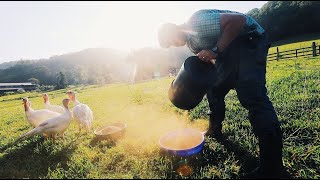
This content was created by Victor Justin Rhodes. This content was uploaded by Victor Justin Rhodes. This is a YouTube farm vlog titled "What 221 Farm Animals Eat in a Day" (recorded 2020-07-19). The excerpt is a first-person narration by a farm host with occasional helpers (named Josiah, Jonah) as they inventory livestock and describe daily care. It details counts and feeding/drinking estimates for chickens, ducks, geese, turkeys, pigs, sheep, and cattle; pasture rotation and movable netting, bedding and water management, feed types (starter crumble, turkey grit, alfalfa), milking routine, and logistics for moving animals and planned breeding/harvest timing. Several animal names (Rosie, Esqueleto, Nacho) and practical farm-management tips are mentioned throughout.
Chapters
Well, that's 30 chickens. One chicken will eat about a third of a pound of food a day, so these guys will probably eat about 10 pounds a day. 1, 2, 3, 4, 5, 6, 7, 8, 9, 10, 11, 12, 13, 14, 15, 16, 17, 18. Oh, and I noticed at least one adult hen in there with the chicks. So we'll add that to the adult count, 32. 18, I don't know, 2-month-old chicks. We don't know how much they're gonna eat, but I'm gonna— well, they went through half a tray yesterday, or maybe a full tray counting both of them. So let's see what that is. I'm gonna say maybe that's a pound-ish, a pound and a half of food. This little crib gives these little guys some privacy if they want to get away from the big girls. They can come in, they can fit right through there, but the big ladies can't. Hey, what do you have there? Yeah, look. Oh, it jumped in the woods. And we can offset that chicken feed bill. I have this Oh, overflow of veggies in the instant chicken garden. So I don't know, this could cut their feed down to 8 pounds a day if I gave them enough green. Ducks, 20 ducks and 4 geese. Kept their food clean last night. Water they eat, I guess it would be drink or splash. A lot more water than chickens, and even food at this point. This is a whole gallon. We're already doing this twice a day. Luckily it's not poopy, it's just backwashed. They like to get water to put down their food. Here, you get their stuff out. We're gonna put down some shavings. You smell smell? Yeah, if you smell smell, definitely time for shavings. Look how they splashed up the bedding. We want to keep the bedding dry, so I think I have an idea. Hey, let's first cover it with dry bedding. Here you go, here's some shavings. Just— I just sprinkle it a little bit everywhere. Thank you. Especially over there, wet water trough. All right, we got them all their shavings. We have this scrap board. I don't know what this was for, but I think I could bury it in there and put their feed and water on that. All right, just— I see you can't bury that in the mulch so that you can get on it. I would build it legs down. Where? Right there is fine. Okay, that's good. Let's try it now. Here you go. Nice. Okay, let's see if that doesn't keep a little bit of water out of the shavings. Ducks and geese, like chickens, like, uh, greens even more so. They they could live even more off of this green. So don't have that gone. Probably we'll probably do that again this afternoon. As for their feed, this is a new country they call Crumble Starter Crumble, and what it's got more of what you call niacin, which is something ducks need a little bit more of than chicks. They're not been messing their food up, so let's just— it can just sit in there. They're having a time this spring. They could care less about the crumble. So there's greens out. Those guys are only about 4 days old, but they're, they're what they eat. And I gave them probably a half a pound of crumble today and a good couple of handfuls of greens. All right, Josiah's gonna get the turkey feed ready and I'm gonna get the Seamaster Chicken feed ready. This is our pasture bird arrangement. 2 male lambs in a 16 by 16. That's roughly— that's a little more than 250 square feet, 256 square feet. I move it twice, so let's say 500 square feet of grass. That's it. Move this so they don't have to hit the same area sooner than 60 days. Let parasites die off. I don't know, about 3/4 of an acre. Oh, that's not 100% fair. We do feed them a little bit more than that. We give them minerals. We have a 16— I don't know, 17, 18— Beauty's in charge of that mineral program. Free choice. These guys drink so little water, it was maybe there, but I like to clean it every day anyway. That hairy one right there, Esqueleto, he's a wither. The clean, smooth one right there, intact, ready to breed, that's Nacho. Nacho is 50% of our breeding program. He's the male that will breed 5 of our females. You'll see them in a little bit. That leads me to a question of the day: when are we gonna put the ram in with the ladies? October. October. And we, guys, we've had these guys almost a year. Talk about the patience game in homesteading. We're gonna then put them in, put the ram in in October, breed them. He'll stay with them until they not calf, lamb. They lamb in the spring, like early March, April. This is where the cows are going. Jonah's about to go set up the fence. Look at how good this grass is, man. That's perfect, dude. That's what I like to call ice cream grass. 6, 8 inches tall, just, just starting to mature. Teenage, teenage grass, as Jill Salton would call it. That's about right. Okay, nice. What, 3-ish blades? Uh, yeah, one not yet gone to seed. Nice. We'll catch up to him in a second, uh, but we still got— what, we got the sea monsters, the turkeys, the fat hens, and the pigs yet. Josiah spreading feed on these chickens. Area. Okay, and every cow patty— the cows were in here. 2, 3, 3. 1, 2, 3, 4, 5, 6, 7, 8, 9, 10, 11, 12, 13 chickens and a goose. Let's just say that's 15 chickens worth for easy math. Count the goose as a couple, we'll round up a little bit. Isn't that like 4.5-ish pounds of food? But They've got all the greens they could want, so knock off 20% for that. Plus they've got all the cow patties to spread, fly larvae to get, so easily probably another 20%. You could really cut that in half in this pasture bird situation. I'd say these guys do just fine on 2 pounds, 2 to 2.5 pounds of feed. How many turkeys we got? Well, we got one out. One— well, that's a goose, but we'll count that. We need to count that in the animals. 1, 2, 3, 4, 5, 6, 7, 8, 9, 10, 11, 12, 13, 14, 15, 16, 17, 18, 19, 20. So 19 turkeys, not bad. We got 20 turkeys, so we've only lost one. I only lost one, and we're just a few weeks away from harvest. So 19 turkeys and a goose. This is a 625 square foot area. It's a 100-foot Premier One net. We move it every day, and turkeys can get as much as 50% off the land for their diet, unlike chickens that get just 20%. So right now these guys are just 2-3-ish weeks away from harvest, and they're probably eating, I don't know, just 15-ish pounds of food a day, I would think. I would say— oh yeah, so this is half a bucket. Josiah, this might not even be— this isn't even 12 pounds, maybe. So never mind, they're eating that. Well, they did eat all their food yesterday, so I'd say 10 to 20 pounds. This was empty. Josiah filled it up to right there. You know how I like to eat copious amounts of butter? Turkeys like to eat copious amounts of grit, what I like to call rooster teeth. They will eat those rocks. I don't know, I probably put 5 pounds in there and they will eat it today. Why? Well, they don't have teeth. So they grab this rock, put it down in their gizzard, and it grinds up the food. It's a muscle that helps them grind up the food, and that's, that's their teeth essentially. And boy, they eat a lot of it. Next up, the sea monsters. 98 of them. I think we've only lost 2 very early on in the transitioning to this stage. 2. So there's 98. They're in a 625 square foot area. They were there yesterday— well, day before yesterday— and we're gonna move them. Let's do that right now. Let's move them right there. I think this is a record amount of chickens towards the end for us. To only lose 2 out of 100, that's like 2%. That's crazy. But anyway, they're drinking a lot more water. They'll drink because there's so many at the end. That's 7 gallons, that's 5. They will drink that. We'll have to top that off in the afternoon. For feeders, we have one Premier One feeder tray. I love it, they love it the most too. They always eat. These are, uh, King feeders with lids. You saw how that fell down. We shake that down in the afternoon too, but sometimes it gets hung up there, and so But it's worked out good because maybe they don't eat as, you know, like totally, totally pick up. But it looks like they can get it. See, they're getting that. A little bit of more work for them, which is probably a good thing. So I like the mix between one tray— the tray will go underneath the shaw, and we'll put these in diagonal corners. So we'll put one king feeder— this is a Premier One king feeder— over here. And then we'll put the other one over there, and the water's diagonally right next to the shelter. It's so hot right now, you don't want these guys have to work too hard to come to their water. You want it to be right there. I'll actually move it closer, probably right here. These sea monsters need rooster teeth also, but as you can see, well, they don't eat it as bad. That's, that's probably only— I don't know, that'll probably last them— well, definitely that'll last them to the end. So that would normally last about a week or two. How much do these guys eat? A lot. Maybe not as a lot as you might imagine. If you think about it like this, it's Saturday. On Wednesday, we're gonna harvest these guys and get over 500 pounds of meat in our freezer. That's crazy. That's crazy. I mean, that's nuts. Did I say that's crazy? That's like 3 and a half pigs. That's like, uh, a steer and a half. That's a lot. And guys, this is a 20-pound bucket. I filled that up. I'll eat that in a day. I only took about half the bucket. There's the other half. And look how much feed they have left over from yesterday in these. So this is unbelievable, guys. Look how much left over there. God, I just fed them 20 pounds. Tomorrow might be— look how big Look how big that guy might be. 5.5, 6 pounds in the freezer. Can you see him? It's gigantic. But tomorrow I might feed, you know, these might go lower. Maybe that we just— boys topped them off yesterday or something. So I'd say 20 to 40 pounds a day, and that's at the end. Oh my, I love you guys. And because we move them every day, we move them every day inside this net, and tomorrow we'll move them we'll move the net so they get fresh grass, they get fresh clover. There's one eating some of it now. Maybe 10%, up to 20% of their diet from that. I'm probably less now that they're bigger and there's less of a space, but when they're younger, certainly closer to that 20% range. Almost forgot, we got to count Rosie the guard goose. You're part of the success, honey. You and this Premier One net keeping these birds alive and free. Free birds! Free birds, thanks to Rosie. So 98 chickens and 1 guard goose here. What are you guys doing? Playing evil witches. Oh my goodness, don't make a mess. Oh my goodness, it's too late, I think. All right, one more animal to do, Josiah, before the cows. Just— are these bad? Uh, they're good. Okay, we better leave them. Scale. Our pigs are 5 months old. Good rule of thumb is a pound a day, or, uh, yeah, for every month they are old. So they're 5 months old, 5 pounds. I don't have much, just some spoiled eggs. So we've got minus 2 pounds for the bucket. We've only got 2 pounds there, and I only count food scraps because it's It's not like perfectly formulated. There's half, so that's— let's say that's only a pound. We need to feed our 2 pigs 10 pounds. I've got about 3 gallons of skim milk just in that bucket. That'd be 24 pounds. Half of that is 12. That skim plus that is, uh, more than what they need today. One mama cow, one bull. One mama cow. How much is that? That's, that's kind of a big paddock. This is not the most productive pasture, and it might be twice as big as some of our lower pastures. We guesstimate based on what we think the quality of the pasture is. Let's measure this. Let's do some fence post math, 122 by 90. If my fence post math— or I guess this is a fence, uh, board post fence board math— almost 11,000 square feet one day. And that, that's mucho for them. They could probably actually do with half of that, but we got the property right now and the grass, so we're running them pretty fast. 30 days, they'll be back here in 30 days. This will be recovered just today. Tomorrow they'll go there, on and on, and then back around up in the upper pasture and then back down into our lower pastures. This is the cow's diet— 100% grass. We do do alfalfa when they're in milk and we're milking them. We'll show you that in a bit at milking time. 2 pigs, 5 months old. 5 months away from harvest. 5 pounds a day each, or 20 pounds a day scraps. It's time to move them. We're actually overdue for a move. You don't want to be anywhere longer than 12 days, and that's what they're at now. They're one day overdue today, so let's move them from here to here. Thankfully, I only fed them a little bit. We still have a lot of food left. We're gonna turn this fence off. I'll go ahead and give them their food right here. Probably not all of it, in case, in case I don't get done by the time they eat it. Doesn't take them long to eat that skim milk, and then that way I can lure them back in. All right, it's 9:30. I gotta milk. I mean, you, you wait too long and you're risking getting in your cow mastitis. She's normally milked about 9. I want to move the sheep so bad, but you never know, it might not go smooth, may take longer than we think. So let's just milk the cow and then move the sheep. Thanks, my man, for setting it up. Good morning, Miss Thang. For cows and milk, we give 5 pounds— 5 pounds of alfalfa, organic alfalfa, while we milk. She also gets a half a cup of apple cider vinegar. This is a health, natural health boost. The alfalfa is a, a nice protein boost, just health boost, just keep her calm and the stanchion boost. And then we got RC Gold, which is a probiotic. I don't know, half a tablespoon, teaspoon. So this is my happy place, my quiet place after the craziness of morning chores. All right, we got it set up for our sheep move. This is our biggest sheep move on the entire farm. Jonah set up the lanes. We've got a little alfalfa to lure them. We're going from way down there, down this lane, up the road, across the street, behind the old farmhouse. Right there, the sheep. We need to get them around and into this lane. What we've accidentally done before is some will get in this lane and others will miss it, and they'll run along this, and they'll just panic, and they'll likely bust through that fence. So we need to herd everybody, even the calves. Where are the calves? We need to herd the calves and the sheep way down there and then get them into this lane. Okay, okay. If we pick up the net from that end, we can actually make a funnel. The funnel— oh, you were thinking that? Okay, let's do it. All right, we pulled up our net, we made them a hair of a funnel here. One's already going. I'll stand right here, Jonah, make sure they don't go back trap. Yeah, start calling them. Look at that, beautiful, beautiful. Come on, let's go with— let's go. They're not as— they're a little more curious. Hey, they're running! Let's run with them to catch up to the sheep. The sheep are walking, they're staying behind Jonah. That's good. The cows, calves will probably scare them by— yeah, Jonah's running. The sheep— oh, they're just— everybody's trotting. Jonah's managing to stay ahead of them. That's good because we want him to show them where to go. Okay, the cows have stopped. Okay, you can walk again. They're walking. Okay, they're gonna make the turn. Yep, they're following Jonah right up the gravel road. Looks like they've kind of stopped up the road. Nope, there they go. Grabbed a little morning glory crossing the street. Moose grabbing a little bit of wild grape there. Crossed nicely. All right, everybody's getting in. That is 2. Uh-oh, are you serious? Don't— not miss. Do not miss. Okay, 2 steers and 5 ewe sheep. Oh, thank you, Jonah. Got sidetracked with the good grass. That's okay, they're gonna have plenty of grass in here. Nice. So we don't normally feed them alfalfa, don't have to. We just thought we'd do that in a move, give them a treat when they get here, pet them a little bit, continue to tame them. Good job, Jonah. So what do the sheep eat every day we move them? This is where the cows were. We just moved the cows out. They come in here and look, they can't— they're just eating what the cows didn't eat. They need no more land. Sheep and cows go perfect together. Uh, cat— sheep will eat and consume, and if they pick up any cow parasites, it dies in their system, and vice versa. So they're vacuum cleaners for each other. The cows have eaten this down really well right there, but the sheep will get some more of this brambly weedy stuff. See, there's plenty in here for sheep and for a steer. They don't need to be as picky eaters as the cows. The cows need to get the ice cream grass because they're making milk, they're making babies. These guys are just making meat. Doesn't take as much quality grass. And that's it. That's everybody. 5 ewes and 2 steers. Mucho animales. Mucho coma. A lot of food? No, comida. Mucho comida. Okay guys, I got it. I looked it up on the internet. Comida. You remember what that is? All right, good job. Comida. Wait, let's see how Mr. Google Pants says it. Comida. Comida. Comida.
More from Justin






If I had to start my Homestead all over again, it could only pick one animal… 




