In this informal farm vlog, two hosts walk viewers through a typical day feeding and caring for a large mixed‑species farm that houses roughly 355 animals. They detail the specific feed types and quantities given to layers, starter chicks, Cornish Cross broilers, pigs, cows, calves, and geese, including organic layer feed, starter feed, alfalfa, probiotic supplements, apple cider vinegar, and kitchen scraps. The vlog shows how garden produce—lettuce, beans, zucchini, tomatoes, and kale—is harvested and incorporated into animal diets, and it highlights natural foraging behaviors such as chickens eating grass, fly larvae, and even cow manure. The hosts discuss milking routines, calf management, composting, and pest monitoring (notably tomato hornworms). Interspersed throughout are family interactions, reflections on the labor‑intensive nature of sustainable farming, and the emotional reward of feeding animals directly from the land they work on. The tone is conversational, enthusiastic, and reflective, offering a vivid snapshot of day‑to‑day farm operations and the philosophy behind feeding a large, diverse herd.
Chapters
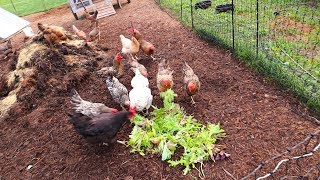
You want to know what it's like to feed 355 farm animals? Let's do this. 1 pound of organic layer feed to the bery hens. Can you open that? 10 pounds of Reedy Fork organic starter to the layers in training. 9 pounds of organic layer feed plus compost pile number 1, compost pile number 2. Probably about 12 pounds of kitchen scraps. Plus, I don't know, gallon and a half of skim milk and a dash apple cider vinegar. Save the other half of it till this afternoon. Start right here and just get this row of lettuce.
It could not wait faster than I, um, than if you did it by your hands.
Yep. Half a wheelbarrow load of spent lettuce. Just give them a couple handfuls. That's enough. Second round of breakfast. Interesting, they left the pickles. Probably putting about, I don't know, 4 or 5 pounds of pretty fork organic starter feed. Put that in there. Bless you. You want the honors letting them out?
Yeah.
Okay. 20% of their diet is going to come from the grass. From— you can see those holes, fly larvae are down there. They're going to scratch and get that fly larva up. Bugs. If you're one of those people that kiss your chickens, you might want to hold your ears for this next one. They eat a bit of that cow manure. Totally different species. Weird, but okay. I guess they're like the pigs. They're getting the undigested stuff that's in it, like 30% of it, and the amino acids that's in it their little digestive system can't produce is good for them. I don't know, that's my guess. It makes me feel a little bit better about them doing that. Two more features, then we're coming at those cows. Those cows, by the way, this little mowed area right here, 2 days, 2 days worth of feed. Probably about 40 pounds of grass a day. Sea Monsters. C for Cornish Cross. Move their coop one link every day. Let's check it out. Fresh grass over here. They love to eat, especially these lamb quarters. Look, some are ahead of us. They're loving this. They're loving this like their height. You loving it? Eating so much grass. Hey, can you get in the water or going? Leave them behind their maneuver. Move our feeders up with them. We're probably feeding about 40 pounds a day. They're almost 8 weeks old. They're probably getting 20% of their diet. Like, like, look, here's what it looked like yesterday right here. Look at all that grass they ate. Holy smokes, you guys are going to be tasty. That is not what you get in the grocery store, guys. Grocery store, 100% on grain. This is going to be absolutely delicious. The goose loves this green grass. That's all she— that's all he needs. That's all you need, isn't it, Donald? He's so shy. You can see the grass moving, but you can't always see the chickens. That's it, Jonah. Let's go see the 3 foresters and then we'll milk. Whoa, take a moment, Jonah. Enjoy the scene. Icelandics, cows, sea monsters. 16-pound organic pig feed. All right, let's go, Jonah. You want to get the cows in? I'll get the milking supplies. Got the milk, but I heard something beautiful. Oh, the beautiful one! That's right, under her cucumber trail. Look how well that came in. Holy moly, you picking, you picking, uh, breakfast?
I skipped— well, no, this is not breakfast, but I skipped yesterday picking. I didn't, I didn't do anything yesterday. I was too tired. Oh my gosh, there's so many beans!
Isn't that weird, like reaching up to harvest beans? It's fun.
I like it. I think that— I think I really like that. This is a hit. So are you gonna do Good Lord, this zucchini bush.
I've not seen a zucchini bush like this.
So the plant that I— the seeds that I got, I reread the package later and it says that this is a very sprawling zucchini.
For sure.
I bought— I planted, I think—
not the best for a raised bed, huh?
No, it isn't. I planted another variety down in that one that is more compact.
Okay.
Which is better?
Now if I'm gonna take a gallon and a half of milk from this gal, I gotta give her something even more than just the 40 pounds of grass every day. Because you're nursing a cow, you're nursing a calf, and giving us milk. All right, you're drooling, you know it's coming. 1, 5 pounds alfalfa. Half a scoop of RC Gold, that's a probiotic, and half a cup apple cider vinegar. You enjoy that. I'm gonna see what you got in there. About 2 gallons of milk right there. It's not free, y'all. Say, these animals are giving us more than half our food supply So understandably, they need a lot of input. And as Zig Ziglar would say, cows don't give milk. You gotta work for every last drop. I think I heard Mom say she's got a hornworm.
Yeah, so here's the damage. There's the poop. There's like— that's what I saw because I'm pruning, because I was like, I'm harvesting here, so I'm moving along.
We have some pruners.
Do we? Okay, okay, I see that. I see more poop. I'm just looking. I don't see a hornworm, but they're so hard to see.
I'm gonna—
I might have to wait until tonight.
Cow number 2, she's laying down. Take a load off, Phyllis. Come on, time to get some milk. This is Greedy Fork Farm alfalfa by the tote, 2,000 pounds. It'll last a while. Well, they do eat together 10 pounds a day. Giving her 5 pounds of alfalfa, apple cider, and RC Gold. Okay. Hey y'all, doing okay? The calves are put up at night so that mama's milk builds up and we can milk in the morning. Then the calves get them all day, but they need feed. They're eating about a quarter of a bale, so maybe 10, 12 pounds of hay. Please keep that hay rack full. Maybe a gallon from— she is drying off though because she's due in August. And actually, we need to dry her off. We need to get Nellie sold. Get some ice cream. That's very kind of you, Lily, feeding the broody hens greens. Before we feed the ice cream to the pigs, let's, uh, let these chicks out. I don't normally have this. I have extra scraps. We just had a Fourth of July party, so the pigs had plenty of scraps today, so the chickens get it. Ready to let the cage fighters out? Let's go! You guys ready for your dessert? This one, he's done. He's done, passed out. Everybody say ooh, ooh! You wallowing in that? You in hog heaven in that? What do you eat every day, Almanzo? A couple scoops of cat feed? You too, Raw? Well, you guys got a hard life. Good cats you are though. You guys are perfect cats. Perfect. Worked hard feeding everybody this morning. Now join us, join us. Let's go have some fun at the lake. It's Saturday. Try to take it a little easier. How's the water, guys?
Okay. Watch this trick.
Watch.
Go, I'm watching. Mama, get that rubber cap game. Where'd he go?
I was waiting for him to come out. You jumping in?
Yeah.
Do you really jump in?
I need to jump in right now.
Does he jump in, Jonah?
I don't know. Jump in.
Really? Well, we got rained out at the lake, so let's go see Papa. Everybody get out. Hey, Pop! Hey, how's it going? Happy Fourth of July weekend.
Now, I don't know if you want this, but I brought you tomatillos. Oh, I'm typically not a tomato guy.
Mine's just blooming right now.
And then Cucumbers.
Oh yeah, we can make good pickles with them. My goodness, you got beans already?
Oh yeah, we've got lots of them, and there's more where that come from. So you eat that up.
Good gracious, I'll tell you, the green beans are so good and those zucchinis are so delicious.
I should have picked— I had a zucchini, I should have picked it before. Oh, they're so good. Hey cutie, hey cutie.
I don't bite you.
Bye, Pawpaw. Bye.
I love everybody. I love you. And my buddy here, boy, he's my farmer. We got your tractor all changed and greased good this afternoon. About to go feed a few more animals. Not too much feeding this in the afternoon, evening, but there are some. Oh my, that's disgusting. Here, wash that off really good. Here, get it away from the pig waterers though. This is the chick feed, probably about 40-ish pounds. You gotta fill it up. During the day though, you can't open it in the morning and then not get out. We got to keep them in the morning. See, supposed to be cracked. Only the chicks can get in and out. Mom is calling me. She's found her tomato hornworm. If mom has an enemy, it's a tomato hornworm.
Yeah, these are their food, is tomatoes. Oh my, I know it's starting! I'm so excited. Oh, all right, I am pruning like Casey taught me, and I pruned these ones. They're already a lot less bushy, which I think is good because one of them I started actually having blossom end rot on the end of my tomatoes, which I've never had. But I think if you because, well, as you can see, I'm moving along and there's some really dense. I was looking at this plant.
Wow, so camo.
I know, and then look at this one over here.
Wow, good eye. How did you see them?
I was just, I'm like looking at the plant, like trying to figure out what I should cut and what I shouldn't. Where's the other one? And I saw poop too. I saw poop, which led me to it. And see, like you can see the damage here.
Can I just take off the branch?
Um, you want me to? Yeah.
Well, I don't want to drop it. Oh yeah, cut it.
We already lost our pruners, so—
wait, wait, where's your pruners?
I don't know.
I thought I saw you with them.
No, this is what I'm pruning.
Oh my— niños! There you train dinos, you vicious animals.
Yummy in my tummy! Ew, in my tummy!
All those pickles were gone. Everything was eaten, you ravenous pigs. Some skim. Let's put it in this sled. I got some weeds. Lily, let's pick some of this kale. I just don't feel like going to get the scythe. So the plan is we're going to harvest this, then harvest a lot of this for the pigs. When I was feeding those pigs those vegetables, I just had this overwhelming feeling like, whoa, I am feeding those pigs from my land, my labor. That's special. I'm sustaining this animal from the work, the direct work I've done. You want to drag that or you want me to? And that made me think even deeper how much more special it is that we as a family are working together to produce something from our land for each other, our us, for our children, them contributing, helping us themselves. It's really an amazing thing. Start right here and just get this row of lettuce. Got the milk, but I heard something beautiful. Oh, the beautiful one.
This is a very sprawling—
For sure.
Bikini.
No, it's like crazy priceless. Yeah, you gotta have this. Okay.