What 371 Animals Eat In A Day
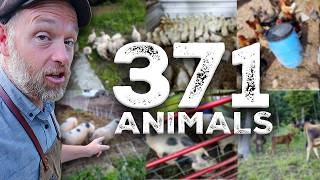
In this on‑farm narrated walkthrough, the host inventories and counts a diverse herd of 371 animals—including turkeys, chickens (brooders, layers, and growers), pigs (feeder, breeder, pregnant, and market), cattle (milking cows, calves, a bull and a steer), sheep, a guard goose, and a cat. For each species the narrator explains daily feeding regimes, feed types (grower, starter, grain, soaked feed), quantities, and the use of equipment such as auto‑feeders, waterers, and compost bins. The video highlights how the animals are integrated into a regenerative system: turkeys fertilize pasture, chickens turn bedding into compost, pigs till and incorporate hay‑bombs, and sheep complement cows by grazing what cows leave. Pasture sizes, netting, water management, and feeding calculations are detailed, illustrating practical strategies for large‑scale, low‑cost animal husbandry and the challenges of managing many lives on a farm.
Chapters
Well, since the T-birds are out, let's start with them. Oh my gosh, what have you guys gotten into? You're so dirty. Thankfully these turkeys didn't go far. It looked like their fence had fallen down. Thankfully turkeys are super easy to herd. Let's count them while we herd them. 1, 2, 3, 4, 5, 6, 7, 8, 9, 10, 11, 12, 13, 14, 15, 16, 17, 18. They mow and fertilize, helping this ground helping this new ground. We graded here. This was all washed away, so we had to bevel this edge. They don't scratch, tearing it up like a chicken. This is a 100-foot net, so that's about 600-ish, 625 square feet. That's 625 square feet of pasture these guys get. I'm feeding them probably about 10 pounds of, of turkey grower. It's higher in protein. I'll probably eat 5 to 8 pounds. They've been in here a day and they've eaten this pretty well. After turkeys, before turkeys. This is a pasture mix we've actually planted ideally for our cows, but we're going to use these turkeys to help fertilize it and establish it. And they'll eat from this, they'll eat from this area. The more we move it, the more they'll eat from it. Fresh girl to be. They've been here one day, uh, this will be their second day. They could move because we have so much going on. I won't, but we will move them tomorrow. They're probably getting about 10% of their food from the land. Let's start the chickens. Oh my gosh, I have 1, 2, 5 posses right now. We order our chicken feed by the 2,000 pounds right now. It's cheaper, it if you buy it by tote, because you're talking about shipping. So we get it on a pallet and it's a lot more reasonable than we would just buy it by bags. When we have growing chicks, everyone including the laying hens gets its New Country Organic Chick Starter. Everybody is out of the chick stage. You see, Chick Starter is just really fine It's ground up for them, so it makes these little chicks easier to get that, easier to digest. 4x6 brooder. We ordered like 125. I'm not gonna count these guys, but, uh, let's say, you know, some have died. Let's say we have 112. Put it up on the screen, Austin. These guys are 2-ish weeks old. We're gonna take— so they're keeping up. They eat a lot of feed already. Somebody jumped in there. Okay, that's the problem. They're gonna poop, and the poop's gonna come down through, and they're gonna have poop in their food. So now nobody can get up there. Well, let's feed them first. We get through 20 pounds of feed. Bucket of feed is about 20 pounds, but these guys are growing. They're gonna start eating and drinking a lot more. We already got a 5-gallon water in here for them. This is a Premier One King Feeder. It's an auto feeder and it's clutch for not having to have to do these chores several times a day. Don't run off. This is my compost posse. Got another 20-pound bucket of feed. They are helping us turn this bedding that was there for the cows and sheep into compost. They're probably getting about maybe 10%. There's microbial life. I don't know what— I don't know what it is, but they see something, they find it. Oh look, one just squatted on the pile, helping break it down. She's finding a little something. She's eating. How many are there though? If you don't know how many chickens you have, you might be a crazy chicken lady. 3, 4, 5, 6, 7, 8, 9, 10, 11, 12, 13, 14, 15, 16, 17, 18, 19. Sometimes it's a traffic jam in here. Nope. 20. I could ration their feed about— you can estimate about a third of a pound per chicken for what it needs, maybe a quarter of a pound per chicken in the summer when there's other life. They're on a compost pile, they're in a pasture, moving around. Oh, this is still full. Somebody must have filled this yesterday. Because we have so much going on, we just put the feed in an auto feeder. And because kids do these chores most of the time, that's also easier than making them set out a rationed amount. Okay, you are good. No new action here. They're eager for food scraps. If you want to feed your chickens food scraps, estimate about a half of a pound— if solely half of a pound per chicken. It's not as perfectly formulated as a commercial mix, and they may not give you as much eggs, but who cares? Your input is so much less. Wait, Austin, we're gonna have a bit of a— have a rogue chicken out right there. That's 21, and there's another chicken right there. 22. This is our nursery. It's gonna be kind of tricky to count all these guys. Let's count the big girls first. This Sorry, it's our front yard garden, so there's going to be less predator pressure. Still, we got them a guard goose. She does a real good job. Let's count the adults. 1, help me keep up, Austin. 1, 2, 3, 4, 5, 6, 7, 8. Okay, there's 8 adults. Let's count all these chicks while we have them. I know there's 4 little chicks born to the broody hen. Call the Enquirer, a chick is born! Okay, we're not counting that adult, we counted them. Okay, count these little guys, these teenagers. 1, 2, 3, 4, 5, 6, 7, 8, 9, 10, 11, 12, 13, 14, 15, 16, 17, 18, 19, 20, 21, 22, 23, 24, 25, 26, 27, 28, 29, 30, 31, 32, 33. That seems about right. We're going with it. Did we count the rooster? I don't know if we counted the rooster or not, but what do a clutch— you call them a clutch— what do a clutch of fat hens, 33 chicks, a rooster, and a goose eat in a day? Maybe not as much as you'd think. I just filled that up, but it's been a couple of days, so probably 10-ish pounds. Reasons we have the chickens next to the garden— well, we can supplement their feed. Weeding has never been so much fun. Not only are you weeding and helping your garden, you're feeding your, your birds. And what they don't eat, they're on deep bedding, gets composted, and the compost from this feeds the garden. Pigs with feathers planted a cover crop here, but it looks like this. I mean, they decimate it, but look at that icing of fertility. This will come back with a bang. I could put these guys through a more lush pasture, but chickens are not the centerpiece of our farm. Meat chickens are not the centerpiece of our farm. They are also here to complement the cows. First thing we got to do is get everything they know as home over. Actually, the first thing we ought to do is get the water spilling up. Some came over for their food. Most are just chilling on their house. I am wondering, because there's not a lot of grass over here, I need to move them more frequent. Especially when it rains. They're getting so muddy. How do they start making their way over? Start the fence. Drop some food. I can't leave it behind. This is like the most expensive part. It's not helping me move them either. Use the Premier One King Feeder. I put it underneath so that it doesn't get rained on and so that it's close close to the shelter so they don't have to go far to eat it. We don't want them burning a lot of calories. We also don't want them getting too hot, so stay under the shelter. We're probably 6 weeks old. They need to go to about 8 weeks. That's probably about 20 pounds a day they're eating right now. I'd say we started with 125. Let's be conservative and say there's 100 here. Last of all our chickens, perhaps the most important The egg layers: 3, 4, 5, 6, 7, 8, 9, 10, 11, 12, 13, 14, 15, 16, 17, 18, 19, 20, 21, 22, 23, 24, 25, 26, 27, 28, 29, 30, 31, 32, 33, 34, 35. Let's say 36. Nope, there's one under there. 36. That's about a little over 10 pounds a day. Their water's good. Huge auto-waterer. You fill it up, it lasts for a very long time. We got nipples in the side. You can hook up a water to it and float valve. Well, the float valve— really never have to do water chores. But even without the water hooked up to it, you only have to fill that up once or twice a week. These guys are also on hurricane relief. There's nothing to speak of to eat in here. They're going behind the pigs who stirred it up dramatically. They kind of smooth it out after. Got our auto feeder, a little over 10 pounds a day probably. And the Three Little Pigs. These guys are at the end of a hurricane relief project. They started way down there and they're, they're tilling and incorporating the, the hay bombs we did over the winter. See, they're incorporating the spent hay into the soil. It's sandy because our topsoil got washed away. They're stirring this up. They find some sort of life in there. They got a bit of pasture. That's kind of neat how This is kind of the end of the damage, but they aren't really rooting up our pasture too bad. Well, partly because it's pretty shallow soil and it's pretty sandy, but that's pretty cool. So they might be getting 5-10% of their food from the land. Hey, you guys know the drill, don't you? Okay, I better stop fooling around. I better get them their 40 pounds of Soaked grain. I spread this on the ground to encourage tilling, to encourage them to incorporate that in. I filled back my buckets with dry feed for tomorrow. This is easier. This is the same buckets I use to take them to feed. This is the easiest, quickest way you can save 15 to 25% on your food bill today. I put a little bit of water in one, I let that soak in a little bit, I start the other one, do that again over here. Otherwise you're just going to get— the water is not going to penetrate all the way down and you're just going to get soaked feed on top. See the bubbles? That's the water going down through there. How do you know how much to feed a, a growing pig? Well, you can feed them all they can eat. I've done that before. Or you can feed however many pounds for however many months they're gonna be. So, uh, if they're 4 pounds— if they're 4 months old, give them 5 pounds. Up to— I kind of, kind of cap it at about 6 to 8 pounds per day. They'll keep growing, maybe not as fast as they might, but grain's expensive. Next up Video bomb. Pig scraps, very important for our breeder pigs who are with us all year round. I take my food scraps, I pour half of it out. I don't know, what is there? Maybe 8 pounds. A lot of broccoli stems though. Short rib ribs, there's still a little flesh and fat on them. Need a little bit of rice, a little tiny bit. These pigs eat about 4 to 6 pounds of grain every day. That's the same. Okay, that's worth a couple of, uh, I'm gonna give them 4 pounds in each bucket. One of these scoops I've weighed it out, so It's good to weigh out your scoop and then you know how, how much, and you don't have to measure every day. And I'll give 4 pounds to this guy. We've got 2 buckets, probably 20 pounds of grain in each bucket, soaked. Makes it go about 25% further. The reason it goes further is because, well, it breaks down the anti-nutrients and it's easier— basically, it's easier to digest. That's gonna be for our 3 little pigs, our feeder pigs that we're raising up to harvest this fall. 2 bigger pigs, a pregnant mama, and a proud papa. We have 2 clean pans, one for each of them. The reason I'm using pans because a lot of times we're feeding liquid like skim milk and we don't want to lose it. Betty, here you go. They're getting starter feed too, uh, swine feed from New Country. They're not growing, but they are getting grower because we have 3 pigs that are growing, and that's more important that they get the high protein. Won't hurt these guys to get the higher protein. We'll go back to the What's it called? I don't know. It's only 12% versus 16% protein when the grower pigs are gone. Last but not least, way up here on the side of the mountain, we got 2 milk calves, a cat, a cat, a nursing calf, a bull, and then who's behind him? Who's beside him, Josiah? Who is that? Oh, a steer for eating. And then we got a new heifer just of age to get bred. And so hopefully she's already bred, and that means we'll have 3 milk cows. Jonah, can we come out here with the brush scythe and mow behind them? This bank is too steep for the mower. It's probably 35 degrees, 40 degrees slope. Okay, bull, steer, cow, milk cow. Nothing will restore this crazy land like a cow though. Nursing calf. And Harriet, the top of that paddock. So how big is this? This is probably 5,000 square feet. Uh, you can actually guess it. It's, um, let me see how many nets this is. This is 4 nets, 450 feet of net. So just do the square footage of that. I don't know how to do that math. Austin, can you do that math? If it's 450 feet in the square, how many square feet is that? Boom, pop that up. But not only those cows eat in here, the sheep now come in and eat. And the sheep will eat this, and they'll get some of this brambly stuff. No grains for them. Boy, they're happy. They don't even come to the call. Okay, look, I can count cows. 3, 4, 5, 6, 7. 7. There's one more over here we don't want to get bred. Is that Minty right there? As best we can. Come on, Jonah. Sheep, sheep, sheep, sheep, sheep. 1, 2, 3, 4, 5, 6, 7, 8, 9, 10, 11, 12, 13, 14, 15, 16, 17, 18, 19, 20, 21, 22, 23. 23 sheep. One's a breeding ram. How many babies we got? 9 or 10. And the rest are breeders. Our goal is to have 12 to harvest each fall so we can have one sheep a month, which is about 30 or 40 pounds a month. Sheep are good complementaries to cows because they eat a lot of what cows don't eat. Dude, Ike, you're looking great. Future milk cow right there. It's a lot of responsibility to feed this many animals, and with that many animals What do you think the chances are that something's gonna go wrong today? I mean, the more lives you have, the more chances are something's gonna go wrong. But it's also very fulfilling to tend this many animals. They depend on us for their survival, for their thrival, and at the end of the day, it's very satisfying to take care of them. And that part, meeting their needs, making them happy, never gets old. Happy day.
More from Justin






If I had to start my Homestead all over again, it could only pick one animal… 




