What does Justin Rhodes Do for A Living?
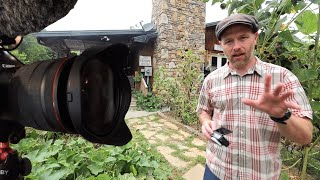
Justin Rhodes makes money as a YouTuber and homesteader through YouTube ads, product sales, and a subscription service called Abundance Plus. He shoots roughly 140 times a day with a Canon M-R5, works with his editor Dan on post-production, and built the business by identifying what his audience needed and selling solutions to them.
Chapters
Just YouTubing. This is what I do for a living. And this— just wrapped up a film shoot for a show Rooted. But how does making YouTube videos that are free to the audience generate income? I'll get to that nitty-gritty in a minute, but let's talk about— let's first talk about the, the what do I do part of of the equation, and then we'll talk about the living income equation. I've switched to the pocket cam, the point-and-shoot, to show you what I do. That's my main rig. This is it. This is a Canon M R5, uh, it's a full frame. This is a fancy wide lens. It has a stabilizer built in, autofocus. Shotgun mic on top is what you call it, and this gigantic tripod. Why do I like this big crazy tripod? Well, you just pull up these levers and it collapses. Get a low-down shot or all in the side by side. But mostly I keep it up here at y'all's height so that you feel like you're out there with me. The first thing I do every morning is find the camera. I usually never leave it in the same spot. I would find a card— that has a card because I'm doing a bit right now, but normally I have to come to my computer and get one of these cards. I put it in here and then I go to menu and I format the card. That means erase all the, all the files from there, and I'm generally ready to go. I should speak about the rig here. This is a Joby GorillaPod here. This is quite the hack. And then this is a This is a quick release for a tripod, which you just come in and put it like that. I've color marked it with white Sharpie. Push it down and then you just hit this clip and it's locked on. It's what you call locked on. But if I don't want it to be locked on and I want to do selfie, unlock it, I can I can even do that with one arthritic hand. And there I go. I've got it. I've got a selfie cam with a little bit of a handle to hold on to. All right, now we're out in the field, uh, and this is field action. I will hit this record button. Let's just show you the point-and-shoot here for, for sakes. I'm back on the big, big Jerry is what I call it, or Bazooka Jerry, uh, is what I call that one. This is a little Jerry. We have to hit— well, we have to turn the camera on. But then we have to hit record and unrecord is what the kids would call it. We could call it stop. About 140 times. Every day. What does that look like? That'd be 280 times because you have to turn it on and turn it off. 1, 2, 3, 4, 5, 6, 7, 8, 9, 10, 11, 12, 13, 14, 15, 16, 17, 18, 19, 20, 21, 22, 23, 24, 25, 26, 27, 28, 29, 30, 31, 32, 33, 34, 35. I'll imagine? I'm going to go on to just hitting it immediately. But every time I've thought intentionally, what am I about to say? How is the next— what shot am I coming from? How do I intro into the next shot? Those guys are cleaning up after our film shoot, Rudy, and we'll get to that in a minute. But, uh, you see the early morning shots where I'm walking out? All you see is this. Yeah, limping out. And then cuts for that walking out the scene door. Well, I was there, I limped over here, I put the camera down, I limped back, walked down the stairs, okay? And then before I go to my next task, I'd— I gotta go and I gotta pick up the camera. Which is a little tricky, and a lot of times I have to do it one-handed. It just collapses like that. It's got a nice little handle on here that I hang on to. If I drag it though, those little red feet come off, so I gotta be careful not to drag it. And then I continue on the day. 140 of those. Back on Bazooka Jerry. I Let's pretend this is Bazooka Jerry. At the end of the day, I've got to get the clip off, file off, put it in, get it to Google Drive, get it to Dan, get him any notes. He's been writing the description and title. I usually go over that. Every day we check the vlog. Don't you, Rebecca? It actually comes into Abundance Plus first. And folks get it there first.
Yeah.
And then we go in and just make sure it's okay for the bigger public. And you check it right there on that TV. You pull it up on the app and you cast it to the TV. Ducks are coming this week. We're gonna need to get our bedding in, guys. So I showed you a little bit there. Of course, is even more. And then you saw a little bit of what these guys are doing with Rooted. So if they come a YouTuber, but now a producer, and then a network coordinator for Abundance Plus. So it's a lot. Let's get into that part, the, the income generation part. How does that actually work? Well, first, a basis of this business structure. This is content creation business. We've been homesteading for a decade before we started creating content around it, but a mentor did hand us The 4-Hour Workweek and we did launch Permaculture Chickens, our first product, as an attempt to get into this business, this online content creation business. It went well. We rode that wave, we're riding that wave, and it's been working. The idea is you create this content, it's free for us, it's mostly through YouTube. Folks get it for free. You nurture your current audience, you also grow new audience, and then As you get to know the audience, I've gotten to know you guys well, you discover pain points and you create solutions for those problems, for those pain points. That's what good business is. Finding a problem, creating a solution, trading with the customer for that. There's a bit of an extra with YouTube content creation because you actually get paid if you monetize it On YouTube, you allow YouTube to put ads in front of your videos. You see ads in front of my videos? Thank you, thank you. We get 60% of that, so we appreciate that very much. It's very fractional. It varies from creator to creator, from video to video. It's so fractional, you really have to get in the millions per month range to start talking about replacing an income. Thankfully, early on, uh, we had an audience through an email list. We could push people to our videos. We caught traction really soon. This was like 5 years ago, wasn't it, Rebecca? 5, 6, 6, uh, it would be 6 years in January. It's like what my friend Jess would say, I've treated this like it was our job from day one because it was our job. We're professional homesteaders, I would— I guess you could say.
We started it because We had created Abundant Permaculture and Permaculture Chickens was a product from that company, and then people wanted more from us of our personal life.
And we kind of phased out of blogging.
Yeah, and we were blogging and I— we didn't love that model.
That's when we discovered vlogging.
We discovered vlogging and it would take Justin like 4 days to write a blog, and then I would take a day to like format it and put it on the internet, and it was never something we could do together, and then this was something we could do together.
That's right, with the kids. Kids were not involved with that. You never smiled. Yeah, when you edited a vlog, I didn't. But what happens now that she's— forever we edited our own vlogs. Yeah, for the 5 years. And then even as you approve them, that's your— that's your part of it. You smile. Yeah, every single one.
I do laugh.
I love it.
I get to see my kids doing things.
Yeah, so that's a good part.
So that's like why we started this, but we did this as our I didn't have that script here, but— This was never something that we didn't do.
We have an outline for this video. Most videos absolutely do not have an outline. This is an outline. Uh, what you see as what we would call vlogs, this is not a vlog. What you would see as a vlog, um, is our day-to-day real-life action as it happens. We try to capture, we put it on the stand, and we try to capture as much as we can of our life. Honey, you're looking so beautiful today. It's the wonderful eggs you're cooking.
I'm making Japanese.
Ooh, she's making Japanese. Okay, you saw it real time there. Okay, so is that a video bomb or is that adding quality? I don't know. Okay, we'll cut her out right now. We'll cut to Jess and heard from Wilder Steel, our new show on Abundance Plus, her bit about how she became to to the mindset to become a professional YouTuber. Roll that, Dan. Dan's my editor. Roll that, Dan.
I had made a handful of videos, picked it back up, made a handful, quit again. I was writing in my journal and it was just all of a sudden this, I guess you could call it vision, whatever you want to go with.
I went to Jeremiah, marched over to him in like resolute determination, and I said, hey, I'm gonna do YouTube channel like it's my job and I'm really gonna pursue it and I really feel like it's going to fund the farm the way that we've envisioned it. I didn't really understand what that meant, but I knew that she would be successful at it, whatever that looked like.
Now, mind you, I had at this point, I think I'd accrued 1,000 subscribers over the 2.5 years that I had like 14 videos on YouTube. And Jeremiah knows me well enough to know there was no argument at that point. The only thing that could be said was, okay, you know, like, you do that. And I did. And for months, nobody watched them. It was real slow going. I was working hard, learning the ropes of editing and uploading and self-discipline because you don't have a boss. But I was like, I'm doing this like it's my job.
That's what you got to do. For those of you wanting to aspire to be pro content creators, you got to treat it like your job. You got to show up. You're going to be an entrepreneur now. You got no boss. You got to show up. We had identified a problem and we were creating what we called the 10-Hour Homestead, and that was going to be our next product after permaculture chicken. And we ended up building our audience through YouTube and launched that to them and did well with it. Well, we weren't even gonna monetize—
yeah, like, we didn't think we were gonna monetize our vlogs.
Like, that was—
yeah, we weren't counting on it, but I was the one who's like, we're monetizing them.
She's already— she's jumping the gun here talking about how we, we create income off YouTube videos. The monetization on YouTube is just a little bit. Little bit, just a little bit. And especially for creators starting out, if you are a creator interested in this, you don't have to count on that. You can have a very small audience and have a lot of effect, have a nice product, have a service that helps people. There's an article called A Thousand True Fans. A thousand seems very attainable for a thousand true fans, and then you give them enough value to then trade for $100. From 1,000 true fans, that's $100,000. But we ended up monetizing because of you guys saying, you know, and you guys are used to skipping ads or whatever, it's just a part of it, and nobody mind, nobody complained. And then we had a viral video putting this fat hen out of her misery. Dan, cut to a real quick clip of putting this fat hen out of her misery. I mean, not the graphic part. What's wrong? What's wrong? Is something wrong with your leg? It looks like she doesn't want to step, step up on that one leg. So let's use Abundance Plus. Oh boy, that's going to be sizzly. That's gonna be sizzly. I was trying to change the angle, mix it up a little bit. You got to think about these things when you do this professionally. Dan and I, my editor, we have this 10-second rule. I try to keep things to 10 seconds, change the angle. He might zoom in. Go ahead and do that, Dan. And that makes it a little more interesting. And then he zooms out. Go ahead and do that, Dan. And then, you know, it just changes things a little bit. He could have zoomed into the zucchini squash. You want to show off for him, Dan? This is Grasshead Homestead, Dan Oman. You can zoom into that, that, uh, that spaghetti squash. That's zucchini. You said zucchini, uh, did I? You got to watch yourself as you talk. You got to not start things with so or, um, you can't say, um, you, you got to get used to hearing your voice hearing your own voice in the, in the camera because it's different. But anyway, let's use an example. Abundance Plus. I'm thinking this is my career hack. This is the biggest pain points identified and solved all in one thing, and we're keeping up with the modern trend. First it was people were getting off networks and creating their own shows on YouTube, but now I think it's going even further and people, including the networks, are creating their own streaming platforms. and we're on top of that with Abundance Plus. So the pain points are you guys don't know everything. I don't know everything. Nobody knows everything. So you need to know stuff. Uh, everybody, all your friends and family think you're nuts, so you need community where people don't think you're nuts. You need to find other crazy chicken ladies. Remember, I'm the ultimate crazy chicken lady. We need to be surrounded by crazy chicken ladies. Inspiration— you need initial inspiration or ongoing inspiration. So we created that in Abundance Plus. We put up shows like my show Rooted. You saw behind this a little bit behind the scenes there. Super inspirational, motivational, high quality. It's like what you would see on Netflix, but it's about homesteading. While They're Still, same story. Our new, our new series, While They're Still, same story. And then Learning Library, 400 videos on anything from permaculture to gardening to chickens to cows, pigs, business, uh, you name it. I have a video in there on how to do the poop dolly. We have a mobile composting toilet, and I call it the poop dolly because you move it around. It's on— it's on a wheel of dolly. It's probably the weirdest video we have in there. Can't think— can I think of a weirder one? Oh, then we created this, our own streaming platform where you can easily consume it on your phone as an app. Or even on an app on TV— Roku, Amazon Fire, Apple TV, and the smartphones. It's crazy. Makes it so much easier to consume. Current members are sharing it, telling others about it, telling them to sign up for Abundance Plus, and it's taken off. It's taken off, guys. And I will wrap it up with this. It's a great— this is a great job because it's amazing to be able to reach millions at this point every month Free. If people don't have any money, they're getting our free content, and that's okay. We get a little ad money from that, and that's good. But then if somebody has some means and they want to invest in themselves and they will put some more skin in the game, they invest in Abundance Plus and they see big changes in their life. They start implementing these things and see gigantic changes. And so That's a full transparency. That's what I do. That's what's going on here. That's what this video is. I gave you content. Hopefully it tickled your fancy. Even if you don't sign up for Abundance Plus, you got something out of it. Behind the scenes, what really goes on, maybe some ideas for creating your own income. But then at the end of this video, you get a pitch, and that's, hey, sign up for Abundance Plus. These are the benefits. I went over that. And then usually link in the description, but abundanceplus.com is so easy. You can ask Mr. Google Buns for Abundance Plus. It comes up, you go and get that. And right now, 10% off if you use offer code Justin. Plus we got a bunch of Wilder Steel bonuses: a sticker, a fall gardening PDF— it's not too late to garden this year, guys— and, uh, access to their podcast, which is about setting up a homestead and that journey. That's it, she's cooking Japanese. Better go because she's calling.
More from Justin






If I had to start my Homestead all over again, it could only pick one animal… 




