What’s Stopping You
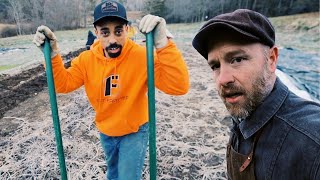
In this YouTube episode Victor Justin Rhodes announces the launch of his new book The Rooted Life and explains how early buyers can receive a signed bookplate, a packet of basil seeds, a PDF chapter, and two master‑class videos as limited‑time bonuses (available through March 7 via therootedlife.com). He walks viewers through the practical steps of rebuilding raised garden beds: measuring corner posts, using a long tape, hammer, broadfork, and twine to lay out straight 42‑inch beds and 12‑inch paths, calculating total lengths (21 ft per row) and ensuring square corners. Rhodes and guest Mike Dixon demonstrate broadforking, describing its soil‑aeration and water‑infiltration benefits and likening the motion to a full‑body workout. The conversation shifts to common reasons people delay buying the book—thinking they already know gardening, cost concerns, or lack of spousal support—and Rhodes counters with testimonials, the value of audio versus print, and the breadth of topics covered in the book (meat chickens, winter harvest, permaculture design). Dixon shares his early‑career hustle, from scrap‑metal collection to odd jobs, to fund a $1,200 culinary course, illustrating the financial resourcefulness needed for market farming. Throughout, the hosts blend promotional messaging, instructional gardening advice, fitness analogies, and personal anecdotes, ending with a light‑hearted polar‑plunge challenge.
Chapters
Uh-oh, Barbara gave me 4 stars because she said the signature is missing. She's talking about my new book, which just officially launched yesterday, so the reviews are starting to come in on Amazon. Yes, we promised out of the 5,000 first orders get a seed packet and get a signature, but there's no signature in this. But how do you get that to people when this is getting shipped from Amazon, from Books-A-Million, from Barnes Noble, etc.? So our best idea is therootedlife.com, where you can go and pre-order the book, step 1. And step 2, you can fill out the pre-order form, whatever you want to call it. You can give us your name, your your email address, your address. And look, now how am I gonna— still, how am I gonna— how am I gonna sign this? Let me show you this. What you do is you get— what we will actually send you these ourselves, my team. This is called a bookplate. I didn't know what this was at first either, but this is just a blank— it's actually a blank white sticker with the Rooted Life on it. Please forgive me, this is my very first time working with a publisher Uh, I reckon we had some mix-ups on who was going to do what for that, and— but this is, this is my best remedy. So where's that sticker? Oh, boom. Okay, so then I've signed however many I need of these up till March 7th. That's going out. What you do is you'll get this in the mail from us and my team along with a packet of basil seeds. You'll know what I'm— why I'm sending basil seeds when you read the book. Uh, it's basically the no excuse, uh, I hope you guys see me in that. I was kind of zoomed in. All right, um, let's take this sticker off and then, well, put it anywhere you want. I mean, one hack would be if you actually don't want a signature on your book, put this sticker wherever you want. But I'd put it on my book, maybe right here, right here. It's up to you. So I'm going to put it down here. And you have a nice— you have a nice bookplate, Justin Rhodes signature, the Rooted Life logo. It's nice, it's nice. We're not actually shipping the books. People are shipping up the books. This is like— these are some copies that apparently the publisher sends authors copies, just, I don't know, for kicks and giggles. So I've already signed like 1,500 of these things. And I'll sign as many as I need to. I haven't signed until, uh, March 7th, up to 5,000. So you early birds, please, please just go to therootedlife.com, put in your order number and your info. It doesn't matter where you order it from, it could be anywhere, and we'll get you to— we'll get you these probably mid-March-ish. Heather is about to explode with baby. She's great with child. Uh, and we're lining up these basil seeds, but the book will ship out right away. The book plates and basil will be a little later, mid-ish, late-ish March. Nice, he's got his warm-up. Ready for this, Fit Farmer?
Here we go. Like to warm up before I do anything.
Mike Dixon, Fit Farmer. We're just gonna— the kids are gonna do the chores. We're gonna hit it hard.
Here we go, let's do it.
Gonna flip these crop garden beds today. We're gonna need a long tape measure, hammer, broad fork, twine. Let's re-establish our corner post. Get on this post right there. We've got to get our corners re-established just so we can have straight rows, get our old rows back. None there.
No, sir.
There's, there's one on the end there and the end here. This is really where we need them, over there or over there. There's none over there in that corner.
One here, that's it.
30-inch garden bed plus 12-inch path is 42, 42 inches. So we need— we've got 1, 2, 3, 4, 5, 6. Actually, there's only 6 in each plot. This must be one of the coasts. I should have this thinking part done before He-Man got here. Well, I can get you on. Speaking of that, grab a, grab a, a broadfork. All right, you can see the rows enough. This broadfork. Here we go. And I'll get this figured out before we actually rebuild beds. This guy is an expert gardener. Let's see him. That's gonna be the bottleneck, isn't it? As deep as you can go without wasting too much time.
Some people like to just jump on there. I've learned the best way is just rock back and forth.
Oh, we're getting broad— we're getting broadforking tips from Fit Farmer. This way.
Back and forth.
42 times 6 equals 252 inches. How many feet is that? Divided by 12, that's 21 feet. So we need to go— you need to be 21 feet. So I'm gonna just lightly— oh shoot, move this. That's probably what happened. It wears out. So I'm going to move this. I'll lightly put it in so I can adjust it after I've measured the other corners. Now let's measure long ways to make sure these two existing stakes are where they should be. Does the post go in here? Here? Here? You don't know what's straight until— I just keep measuring the corners until I get it about right and just moving things. So I'm gonna guesstimate You got any tips for pitching a square line or making a square garden bed?
Just use your lines in a square and just do the best you can. It doesn't have to be perfect. That's one of the things I learned from Curtis Stone. Yeah, everything doesn't have to be perfectly straight.
Okay, good work. Oh look, the help's arrived! The help is on the way. I'm just gonna have to use this long tape line to kind of, you know, do I, do I go more this way? Do I go more that way? That's at 21 feet. We're good there. Josiah, hi! We can get it done now. You want to grab a broad fork? What are you doing, Lacey? Cold, cold exposing? Yeah, I hadn't done it in a week or so. Out here in your t-shirts and sandals. It's always interesting reestablishing these guards. I need to get some more permanent stakes. And I'm trying to build on the old one. You don't want to turn the old one. Soil to establish itself. Yeah, so there's one. Yep, so I started right here at the edge. The cool thing about having two posts in is I can now look and I say, oh, I'm too far that way here, obviously. Oh, I'm too far that way here because it bends. So I want right there. There it is. Hey, put it at my mark. When I was a kid, my dad used to work us really hard hauling firewood, putting in fence posts, heavy stuff. We used to have a furnace that you would load with 6-foot pieces of firewood. The family that works together stays together.
That's right.
So what's the trick of broadforking? For those that don't know, what, what in the world? What's the benefit?
Benefit of it is to get some more air in your soil. Good part of having good soil is to aerate the soil so it's not compacted. You got some— that way the water can get in there. It's really important.
Aeration, hydration. What gym devices does this replace?
Oh man, what are you working out?
Your row.
A lot of people use a row machine at the gym or some dumbbells to do rows, but this is good for your back, your forearms, and your bicep.
What about the abs?
A little bit of abs too. Fitness anywhere.
It's almost a full body workout. Almost.
Yeah, yeah, Earth Gym.
Mom's calling. We're putting a rush on this. I'll tell you why in a minute. That's, that's the start of my story, my dad working us. Henry's got a little cold, so it's been a rough last couple of nights for Rebecca. He freaks out, he can't breathe through his No, she's getting used to having to breathe through his mouth. We're leaving early tomorrow, gonna go to Drew's Shores with the Holler Homestead, gonna go do a feature on Jason Sutherland at his brand new, new used, uh, homestead. Starting from scratch. Back to my story. I would be lying if I told you I didn't fantasize about Arnold Schwarzenegger showing up, like he was hot back then. Uh, Sylvester Stallone, Rocky, he gonna come? Rambo, come on, come help us. We just would wish somebody like that would just come help us with the chores. Mike, tell them what you did before you were a homesteading market farmer.
I was a bodybuilder, personal trainer.
Mike Dixon is my Arnold Schwarzenegger.
That's right, we're here to pop you up.
And we want to pump you up! My childhood dreams come true. What's it like having a Sylvester Stallone on the farm, Lacey? Comes in handy 24/7. Comes in handy to have a strong man on the farm, huh? So it might need to come to right here, and now I'm guessing because I don't have another pole to go off of. I'll make another corner so I can kind of go off what I can see of this old bed. Let's go right there. Mike's gonna draw our line across. I've got all 4 corners established. All right, now wrap it tightly around that more. Uh, that'd be all right. And that, that's going to show us the line of how far we go. With each of these beds. See, now come this way and we'll have our line down through here without having to cut that twine. Same thing, wrap it around this one, and then we'll have our 50-foot line, and then we'll have our— what was it— 44-foot line here. That's 2 big garden plots, 6 beds in each plot, 3 feet row in between those two. So then that's where this goes. Okay, Mike's going down the line. He'll have a line, and now it tells us exactly where to shovel to rebuild our beds. Now he's dug that path, that footpath. We have our, our bale twine this way so that we just keep more square. Yeah, go 42 inches and then let's, let's— yeah, mark it and then move the post. Good deal. Now Mike knows how to do this. We're just doing it the way I do it. Everybody does it different, I imagine, to get the same kind— to end up with the same result. He's gonna do the same thing down there. I've got two shovels now. One shovel for me, one for Muscle Man. We're in launch week of my book, nearing the end. Well, we're midway through it, and I can hear some of you saying, well, I can get the book anytime. That's true, actually. I hope this becomes a timeless classic, but Only now till March 7th can you get bonuses. 2 videos from my masterclass based on the book. One on just plant, just get motivated and just going out there. Dealing with failure means starting small so it's not these epic failures and saying to yourself, it's okay, it happens. Looking at the alternatives and just keep on pushing forward in this adventure. You'll get that video plus, uh, the gardening one. We're out here gardening. Well, I'm going to teach you how to do crop gardens like this. I'm going to teach you how to do raised beds or container gardens like we did yesterday. And then I'm going to teach you how to do a bulletproof garden, a little small, you know, 4x8 foot garden, probably the cheapest bang for your buck type of little garden, great to get started with. Put it in the yard, uh, get going. I measured from our corner 30 inches over, and I put a stake on both sides. Measure 30 inches. Now, how do you stay even here? You, you do a twine— you do a twine line from stake to stake, okay? And then that way you, you're— you can make your rows dig straight across, okay? One row isn't longer, one row isn't shorter. You can see what can happen on the field by how I'm drawing here without a straight edge. So you take, you take another twine and you, you, you draw it or you hook it up 6 inches off the ground so nothing's touching the ground and it's totally straight. If you do a twine from this to here, it will be absolutely straight. That's how you dig ditches. That's, uh, that's how you do fence, fence posts straight. Now You're— what you're doing here is shaping beds. We're not just planting, wow, whatever. We're actually building little tiny raised beds, little 4-inch raised beds. You also saw this morning we're sending book plates out, signed book plates plus basil seeds. And is there anything else? Yes, there's the PDF chapter of our book, so you don't have to wait till the shipment gets here. I mean, shipping pretty fast these days. When you order, just be sure to go through therootedlife.com and you'll see the instructions for ordering and then filling in your info so we can send you these packets and digital goods. What's another reason people might be procrastinating here, not getting the book right away? Sometimes your head—
that's what people do, procrastinate. They want to do things at the last minute, whether it's a homework assignment or whatever. Oh, just get it done right away.
That's true. Mike and I are trying something here. His style is more, uh, tilling, so he really, really upturned the soil. I noticed my style is more just getting the hole in, lifting this ground up a little, trying to keep the soil intact. Uh, and we're just going to have kind of a side-by-side experiment. The— perhaps the advantage to this is less harm to the soil, to the microbes in the soil. But one benefit of this I can see right off the top of my head is look how much it's raising that bed. You know, my beds were flat, and still I don't think it tills it. It's not going to till it like a tiller, so we're— it's still, still better than that.
Another thing that may be to keep in mind as well with broadforking a little more, uh, intensive, it's for those people who aren't able to necessarily have a budget for before buying or getting compost. Ah yes, really good.
You couldn't get compost. Yeah, because that's a good point. I'm gonna add 5 wheelbarrow loads of compost to this. Yeah, but that was almost $1,000 to get a truck here every year. These ladies mulching the garlic. Hey, why do you think people might be putting off buying this book, The Rooted Life? Because maybe they know it all. Ah, okay, because it is a more beginner book.
It is.
Audio, I think, speaks to the heart and books speak to the brain, so it's good to digest things in different ways. Which, by the way, we have the audiobook too. That's a trip, hearing my own voice on Audible. To Rebecca's point, they know you know it all. So Darcy in Florida, experienced gardener, Her review was, and just when I thought I knew it all, I learned throughout the book, and then I got to chapter 9 and 10. You don't know all this, or, or it's going to be a good discussion. It's going into lifestyle, it's working with kids, it's working with a spouse. What if the spouse isn't on board? Those types of things. Even if you think you have that idea defined you might want to just keep an open mind and have a discussion with me. Like Mike and I just discussed, uh, he's learned things from me today and I've learned things from him today. He's told me about a special line that we can use as opposed to this paracord rope type things. Even if you think you know it all, I think you'll be surprised. I, I really do. When you get to the guiding, the guiding chapters, like 6 of them on meat chickens, uh, winter harvest, gardening, um, permaculture design, you're bound to learn something. If you can get a book for $25, right, the info in there, the perspective compared to other books— my books, I would think, a summary of all those books.
Yeah, yeah.
It's like a Cliff Notes. When you were starting out market farming and you wanted Curtis Stone's book so bad—
yeah, that's true—
how did you make it happen? I, I—
oh boy, there was no money. But then I had to change my thinking. I was like, to, to, to be in a better financial situation, I need to learn more. So I need to somehow find— learn to make some extra money so that way I can afford to get Curtis Stone material. And I was so glad that I did because it accelerated my learning curve. I could have spent years making mistakes and still being the same.
How much would that have cost you?
And it would cost me time.
That's a good point. Money. So what are some ideas? What did you do back in the early days to get something you wanted that you could not afford?
Uh, there were things I would do like going around scrap metal and washer dryers.
Okay, I did that. Did that. I mowed grass for— my dad was renting out these houses Exactly right. I would mow grass for my rent and I would haul trash.
Exactly right. We sold stuff on Craigslist.
You went further and you got Curtis Stone's like $1,200 course. That's a lot of scrap metal.
Yes, it was.
How'd you get that $1,200?
Uh, through a lot of that scrap metal, odd jobs, and just doing what I could to make it work.
All right.
Thankfully they did offer some kind of payment plan. I think I even emailed them to ask about it so they could work with me a little bit, but I still paid for the course, and, and, uh, it was totally worth it.
Sweet. Totally worth it.
Invest in yourself.
Well, he invested himself, saved a lot of trouble, and it helped you eventually get out of the financial ruin.
Exactly right, it sure did.
Yeah, guys, if you just do my raised bed from the book, you're gonna grow— you're, you're, you're gonna grow $3,000 worth of vegetables. We did it! We did it, guys! And they've got one covered. We're gonna get way more sandbags on it, guys, because they— it blows off in the wind. Y'all still ready for the polar plunge? Woo! 30 minutes.
I'm ready.
Okay, this looks good. There's something satisfying about building some beds and putting that tarp back over them. That's right, to kill off all the seeds.
There we go.
All the weed seeds we just stirred up. Stirred up. 48 degrees. 48? 47. 47, that's it? Not very cold.
55 is all you need.
Yeah, I know. You just gotta go. Slow does not help. And there's something about getting in down to your neck. Nice! Mike's not so sure.
I am not. I'm frontin' this time. You did it!
You did it, my man! Go ahead, Lily.
You gonna be all right, man?
Yeah, I'll be all right.
It's crazy, the lightest part on me, like, that should be where your pants should come out.
More from Justin






If I had to start my Homestead all over again, it could only pick one animal… 




