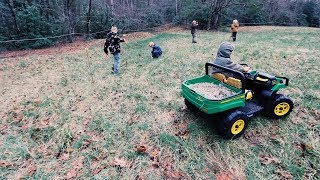
The video follows farmer Mr. Rhoades as he guides a group of boys (Sam, John, Jonah, and others) through a morning of hands‑on farm work on a small diversified farm. The dialogue weaves together practical demonstrations—building and moving fence posts, installing electric fence insulators, using animals as natural mowers, and milking cows—while repeatedly asking the kids why they want to be farmers. Throughout the segment, Mr. Rhoades reflects on the cultural stigma and economic challenges that have caused a decline in farming as a career, noting that many view it as an outdated or unprofitable path. He counters this narrative by highlighting alternative, smaller‑scale models that can be financially viable, citing Yonder Way Farm in Texas and Curtis Stone’s Green City Acres in Canada as examples of successful, humane, and diversified operations. The kids express varied motivations (health, love of animals, lifestyle), and the farmer emphasizes that their enthusiasm offers hope for the future of agriculture. The video blends instructional tone with light‑hearted banter, occasional role‑play (a cow’s “voice”), and a broader message that farming can be a meaningful, sustainable livelihood if approached with creativity, community support, and respect for animal welfare.
Chapters
Unfortunately, it seems farming as a profession is on the decline. Right here.
Oh, over the lake fences.
You gonna move it a little bit, Jonah, or did you already move it?
Uh, I'll move it forward. Hello, my name is John and I am from Texas. And I'm here today with Mr. Rode, and he is teaching, and he is showing us all the different chores you do in the morning on a farm. Is that, isn't that right, Mr. Rode?
That's perfect. Did you look at the camera?
Yes. I'm Sam, I'm from Texas.
Go ahead, Sam gets the honors. Now Sam, put that post, see that post? Put that post in the ground to hold that door open.
I'm gonna make money selling milk and eggs. Do you slide it on like this? Where do you put the other one? Uh, you put it right there in the wheel. Wheelbarrow. My name is Jonah and I'm from North Carolina. You get two of these, you put it on, then you circle this on it and it, um, tightens it onto the post. Right about there. Yeah. I'm just saying, I'm from North Carolina.
What do y'all want to be when you grow up?
Um, John said he wanted to be a farmer once.
You said that once?
Yes, sir.
Is that, is that still true?
Uh, yeah. I want to be a farmer.
It's okay, you don't have to say. You don't have to give the Sunday school answer. You can say the truth.
I wanted to be a soldier, but now I want to be a farmer. You're a soldier.
I'm a soldier. Okay. All right, all right, soldier farmers, let's go. Just like that country song sings, Mama, don't let your boys grow up to be cowboys. They didn't even bother to write the song, don't let your boys grow up to be farmers, because it seems like that's a cultural no-no. But why? Why? Behind the air we breathe and the water we drink, food is the most important thing. John, lug it, buddy. Yeah.
Compost.
Why do you want to be a farmer?
Because it's healthy. I like healthy different kinds of food. What's going on? I found a good breeder. Right here. How do you know it's a good breeder? You'll see. You'll see.
Come on, guys. They're a little less focused than I am, but they also have more fun while working. Okay, we need our dud wheelbarrow. Our poop barrel. No, that's the one for our feed, right? It's the other one.
I like the lifestyle of farming because I just like cows and chickens and doing stuff like that.
We need a bunch of these. All right, boys, we can use a relay here. There's only a couple of insulators, so we're gonna add insulators.
If I had chickens and cows, I would use— I would milk the cows and sell eggs and milk. That's how I would do it. Like this one.
Our cows are on pasture right now, and they have a few more days of pasture, and then they're gonna need to go to an area that is not yet fenced in. That is the theme of our farm, is getting the entire farm fenced so we can graze everything, hopefully before the spring. And the cows The thing about cows is lawnmowers is we gotta implement control, which is this electric fence. We gotta steer them.
We're out.
Okay, there's more in there. So we're, we're working on the steering wheels for these cows right now. Why do you think farming is such a good job?
Well, because Well, I don't really know.
You guys can do that many more and we'll see if that does it. Sure.
Hey, what about right here?
What about it? Oh, now he's using his brain. Nobody has a knife. We got— wait a minute, we got 4 soldier farmers and nobody's— not one's got enough, huh?
Sam had one yesterday. Ah, there we go. He has a swift army knife. So he's got one that's.
I think a lot of it is. Maybe there's a stigma with it now. Not everybody does it like they used to. It's kind of this odd thing. We got it. Who's gonna push it? Okay.
Uh.
Oh. Traffic jam. Everybody.
Honk, honk, honk, honk, honk. There we go. I want to be a friend Because I don't have to go to work.
We farmhouse here. We'll— we jump— we can mow this area. Well, should we mow this bank, Jonah? Should we let the cows mow this bank? The only problem is you have to put the fence down here. I guess that's not too bad. So what do you guys decide?
Here. Here.
Yeah, let's— why mow the bank if we don't have to, right? Like Sam said, let's get the cows as our mowers. Sam knows nothing about permaculture. But it's in his heart that it just makes perfect sense to have the animals do the work of the farm. I think one of the fears is, as parents, we want our kids to be contributing citizens and to make a living for themselves and their family. Well, I don't think anybody would argue that being a farmer would be actual contributing citizen, so that must not be the problem. Maybe it's money. Maybe they don't think there's any money in it. And if you look at the conventional model It seems to be take a lot of debt, take a huge amount of farm to make profit in a conventional way. So look guys, everybody's— hey, now they're all jonesing to get it. Okay, if it won't go in right there, do it in another spot just near. Wait guys, I gotta count them off. I don't like mowing that bank anyway. Sketchy.
They're going, they're going wrong. Oh, they're going like where our sheep That's not bad.
I don't think that's bad. There's no reason to mow such a big yard when we can have it as feed for our— whoa, whoa, whoa! Now let's go across just like we did with the sheep. I have officially lost control. Boys putting fences where the heck— over, over there. Boys putting fences there.
Let's go through with the mower!
Boys bossing each other. No, we need to— we give them some room. Sam, come down here too. 3, 4, 5. I think one puts one in and the other one takes it out.
7, 8, 9, 10. We're in the brush.
Uh-oh, we only have one.
We lack one.
We need one more.
Go find one. We need one more. Papa, why can't we put it more up like the—
you better not, it'll sag too much. Hey, let's just bring one when we come get the cows, Jonah. We'll be walking right there at the lane. Can you remember that, John?
Yeah. Okay.
Oh, oh, oh, all right, hey, let's take it up the hill above the old farmhouse. They got one day there and then they need to come right here, so we need to put a fence up along this access road to keep them off this access road. When I was on the Great American Farm Tour, I saw something different. I saw a professional farmer that could actually make a great living on a smaller piece of land. Yonder Way Farm in Fayetteville, Texas. Population 250. It's tiny. When we moved here, we like increased the population by like 6%. It was actually a significant percentage. It was crazy. You were going broke conventional farming.
Yep.
You knew there had to be a different way. Yeah. Why didn't you just— you didn't just give up cattle. You, you somehow found a different way. Here we go. A beautiful sight. They figured out how to humanely raise 600 birds at one time. Look at this green grass. Look how happy these birds are. Hey, my name is Curtis Stone. I run an urban farm in Kelowna, BC, Canada called Green City Acres. I found Mark through Jeff Larton through the Stun Method. You remember that? Sure do. 3 years ago. Sheer, total, utter neglect. Orchard thriving on that. This is Emma, and Emma wants a belly rub. I think what everybody wants to know is, are you actually making money at this? We actually are. I mean, it's nice to think we could quit our job and do a job with our family, but can you actually make money at this? You can, you can. You know, your life is simple. Definitely a change in pace. It's hard work. It's not for the weak of heart, for sure. But there is money to be made. Yeah. All right, let's get the, uh, let's get the cows in for milking. Milking time!
Yay!
I horned one.
She's good.
Oh, oh, don't go in there. Okay, get her her alfalfa. I'll get it. Some alfalfa pellets as a reward. That's not the bull. That's the mama. Female cows have horns too.
Jonah and Mr. Rhoades are going to milk a bear, a little bear, right? Flossie. They're gonna milk Flossie now. This is John, and we're going to watch Mr. Rhoades milking the cows. Before he milks the cows, he has to wash the udder with a rag so the milk will be clean.
All right, we got Flossie's milk up. Phyllis is here now. John, it's all you, buddy. First time milking a cow.
Ready?
See if this is something you really want to do. Jonah's helping you.
Wait, so Jonah, how do you do this? See this? Yeah, you, you, you first cut off the top, then you squeeze at the bottom.
Oh, okay, you're getting it, John.
Okay, I get it now. This is a harder cow to milk. That one, um, the other one's easier.
So these guys give me hope, and when they say, "I want to be a farmer when I grow up," I want to encourage that. I don't think that's a bad thing. I think they're part of the solution. There is problem there, but I think these guys are part of the solution. And would I be proud of them if they became a farmer? Heck yes. Do I need them to make gobs and gobs of money? Heck no. Will I be happy if they can provide for themselves and for others in a meaningful way and leave the spot they did that with in a better place? Yes.
My name is Bessie and I'm a cow. And I'm a black and I'm a Friesian Jersey mix type of thing. And I live on a farm and my mom in charge is dogs. She hates them. Chill it off. You can't hit everyone below you. I have long ears and long eyelashes. I got big eyelashes. They long. Everybody like me. But I don't like them. Yeah, I run away from them all the time. They try to catch me every night. My mom and my dad, they beller a lot.
Woo! Woo!
This carrot tastes good.
Now that's a calm cow right there.
Yeah. It's comfortable, it's like a blanket. So did you, Mr. Rowe, did you say each, um, each, um, same, each cow, each cow and their udder, they every, every, every time you milk them, they have, uh, 2 gallons of milk? Did you say that?
About 2 gallons, gallon and a half to 2 gallons for each of these cows.
So how do you, or do you milk them in the evening also?
No, it's take a break. We let the calf on them during the day, and the calf can milk her during— throughout the day.
Okay, so I know some, I know some, um, farmers in Iowa and factories, they milk the cows. I've seen them do this 3 times a day, and they live a short lifetime, and they feed them on just, uh, corn, that chopped up corn from the fields, and they milk them 3 times times a day and their lifetime is shorter.
What do you think about that?
I don't think it's good. I think, um, you should, um, you should, we should milk them like you and let the cows have a good share of milk so they are, so they have a lot, the longer living life and they have good grass feed.
What would your parents say if you became a farmer?
I don't know. I bet, I bet they would like it because I would give them, because I would get, um, because I would give them fresh milk and eggs and they can come and see me do it.