Winter Watering Problems SOLVED ~ If this works
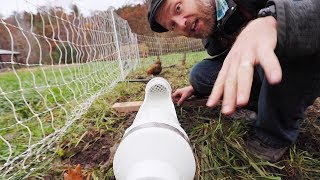
Victor installs an Everflow livestock waterer on his North Carolina homestead, demonstrating how to prime the system and prevent freezing with continuous vacuum-draw. He and Rebecca discuss pig breeds for their farm and upcoming workshops, including a February pig-butchering class.
Chapters
Look, water is always flowing. It's not going to freeze. It's always clean. Well, I've got to build a stand for this Everflow waterer, get it off the ground, get it about like that. I just want to make sure it's going to work good on this. You know, this is, this is a slope. But it's not crazy steep. I've always struggled with getting a good flow, a good draw, this from the trough down from the pond down here. It's no problem. Watch this. No problem. So we have to get a draw from the downward pipe so it sucks the water through. To do that, we need to fill it up. Yesterday I filled it up, but I didn't hook it up right, and there had to be a lot of air in it. This is my situation. Ben did this. I know it can be done. I wasn't watching him because I up at the pond. He's probably yelling at me on the phone right now if he was watching this. Basically, I need a female-to-female connector. Had to take a break for a card for the camera, filled up the memory card, and the boys are calling me. They're getting the chainsaw ready because we're gonna need it to clear some of our perimeter fence way up there. Okay, close them eyes. Open your eyes! Oh my gosh, you queued everything up. Bar and chain oil. Now we should see if this thing will start. Yeah, yeah, that was a fun distraction. Now we need a female to female, and we only have about 15 or 30 minutes. I think that's it right there. This is female to female. Oh, oh, got it! Boy, that's, that's conducive given the time restraint we're on now. I've installed a quick connect so that we don't have to do any twisting. This is legit, so if I ever need to do this, I just need to carry my female to female. Although I don't think that's the same thread. It's not going on real good. Well, there it is. I don't know what's up. Didn't feel like it's going on real good. That one's going on better. Oh yeah, the bottom one's going on fine. Let's see if it works. It's working. Now we're gonna go see if water's coming out the bottom. As soon as water's coming out the bottom, we'll shut it off and the hose should be filled. Unless there's any major leaks, that hose should be filled. By the way, look at our cover crop coming in splendid where the pigs and chickens were. That spattering means there's a lot of pressure since I shut that off. Let's turn this off and then shut this off. Now that should be full of— filled with water. Now to get that off— got it off. Now we got to get this connected back to this. Let's get our female off, our female to female. There we go. Now see, no water's running out of this because I have the shutoff. That's why we did shutoffs on every one of these, is to just get this running here today. And if that works, then we're going to start building the stand. And then glue this, you know, glue the PVC. So I'm going to build a drop into it, maybe like that. Turn this on, shouldn't nothing happen because all the weight's pulling it down. It's shut on that end, and we should open this. It's going to fill that up. It's not going anywhere because it's shut off. And then let's— you know what, let's slam it. All the water we got. Make sure we get all the air out of that line. No more air. Now let's go turn— let's go open the end into the creek, and the water that's in this line will have weight and it'll be pulled out. And it'll— with that getting pulled out, it'll vacuum pull the water that's in the trough. Here we go, let's open it up. It's falling out. What I want to see is that not slow down too much. I mean, it's gonna have a lot of water in it because it had a lot of water in it, but will it keep sucking water in it? It looks like it's a continual flow. It would have stopped by now. I think it's working. If it's working, that's what went wrong yesterday. We just didn't get enough water in our line and we didn't get enough, enough of a vacuum. Okay, it's definitely drawing. Let's see if it's drawing by slowing this down. I'm slowing it down. And what we want to look for— slowed it down drastically. What we want to look for is this to stop overflowing. We want to find that sweet spot where this is pulling as fast as this is coming in. Okay, that's about as slow as I can make it go, and I'm pretty sure it's pulling. And not overfilling. It's working! It's actually draining at this level. Oh my gosh, it's so totally working. It's sort of hard to believe after 6 trips to Lowe's, the struggle we had with the previous one to do this, drain out this end. So much movement there. I'm pretty confident this is not gonna freeze up. Look, water is always flowing. It's not gonna freeze. It's always clean. I'm gonna disturb it a little bit. Pig, pig, chickens come and drink. Happens. Still goes. You know what the true test is? Walk away, go have breakfast, do the stuff we need to do inside, and then come back. It's a nice touch, Rebecca.
The quality of life in our bedroom.
So, Allade, what are you doing? Washing the sheets? We laid there last night and thought About the pigs. I'm scared to death to have an 800-pound boar and a 600-pound sow year-round.
Well, it's expensive too.
Yeah, and when you're only having one sow and one boar, I don't know if you can scale that to profit selling that. I don't know, maybe you can. I just don't know enough.
Yeah, so I think our idea idea is to go ahead and get guinea hogs.
Yeah.
And then maybe get a big feeder pig. Just try it once. Just get one feeder pig and try that and see what that's like.
Yeah.
And then we'll have more experience. I mean, we have experience with the guinea hogs and we feel like it's been a good experience.
Yes. So the Herefords, big Herefords, they have been dewormed I'm sure it's chemical and they're going to do it and they recommend it again if we got them. So that makes me a little nervous because have they been— how long have they been dependent on deworming and how hardy are they going to be? And so makes me a little nervous.
But well, and we just don't want a 600-pound pig.
No, that's what it comes down to.
Cow. 600-pound pig.
I know, you might as well call it a cow. So then I emailed— actually I called the people with the guinea hogs and they got back to me and I asked them why they went into guinea hogs as opposed to commercial breedings. Because they— the girls, their girls, they were young and their experience with commercial breeds were they were skittish and, uh, more unpredictable. So maybe the smaller breed's better for a family homestead. And look, we can do guinea hogs and not and then get out of it and just work ourselves up to bigger pigs.
Did you see Arthur's humongous guinea hog?
Yeah, and see Arthur's—
I'll get up to that size. Yeah.
Arthur's had good luck with guinea pigs.
Did you feel okay about that size? They say it was okay. They had a barn that it lived in and there was a hole so I could just put food down it, but—
But that's like 400 pounds versus 800 pounds.
Yeah, it's like half the size. But they're huge!
They harvest them anywhere from a year to 2 years old? Yes. Okay, they're in Raleigh. They can breed them. These gilts, they're unbred. They're 2 females. They're almost a year old. Okay, in January, end of January, they'll be a year old. They are gonna come bred. You okay, Becky? I'm tired. Okay, I'm sorry.
Because of other things.
We're gonna get you better, honey. You're gonna—
I'm trying.
Don't fight it.
Just a little bit of a relapse.
Yeah. So should we move on with pigs? Should we move on with the farm? Yeah. You're relapsing.
I'm gonna get better.
That's a good attitude. So listen, they're in Raleigh, near Raleigh. It's 4 hours away. A month. They're gonna put them in with the— all we have to do is say yes, we want them, and then they'll take our word for it. We need— I asked for pictures. Of who the dad's gonna be.
And then we have to find a board.
Eventually. Well, I guess pretty soon.
Well, if they come bred—
I want it to be big enough.
If they come bred, then we'll get a litter— 2 litters of piglets.
Yeah.
And then—
But they'll need to be rebred.
I don't know.
How long are they pregnant? Not very long.
3 months. Is that 10 weeks? Is it 3 months, 3 weeks, and 3 days?
Something like that. I need to look it up.
And then, well, but then you need to see, like, do they need to be rebred right away, or do you want to breed them once a year or whatever?
I'll ask them that. But yeah, we'll have to get a guy that's gonna be big and big enough too. Yeah. All right.
We could maybe borrow Arthur's boar.
Yeah. Is he staying in Guinea Hogs?
I think so.
I have no idea.
They haven't told me otherwise. They haven't said they aren't.
Okay, Grandma pulled up and Gideon hid under that. He's hiding under that bucket. What do you think he's gonna do? I have no idea. He saw her coming, he got under that bucket. He's got some trick up his sleeve. He's completely under that bucket. Oh, she's talking to Laurel. She told Laura to lay down. How does she know he's in there? Afternoon chore time. I want so badly to go see if that water is working. Come on, chick-ass, come on. You've been wild and woolly, I see. All right, 3:45. Hour and 15 minutes. You know, when I go up to the mountain, my phone gets lit up. Get cell phone reception up there. Andy from Hanhun Farm, you guys know he's coming to do a butchering workshop on the pigs in February, but I don't know if we left this in the video or not, but our father's farm where we got our cows— the cows aren't coming, by the way, till after our vacation, so it'll be mid-December. But he had some beef, grass-fed beef, live steers he could sell us. And we— I talked back and forth with Andy and ended up being a great deal to get those beef. So those beefs are going to come and then we're going to harvest. They've been grass-fed. It's going to be absolutely amazing. Since we're— since we're keeping Stud Muffin, we need some beef because we're not going to have them. So I'm very excited about that. But we're gonna have a workshop for that. You guys can come here, learn how to process a beef. We're gonna learn how to process a beef with Andy and Doug from Hanhun Farm. And we're gonna do a pig one in February, and then we're gonna do chickens ones next year. And we're thinking about doing gardening workshops too. So I don't know, hopefully I'll get more info on that soon. Let's get down to the overflow. Oh my word. Hey, I'm pretty sure they're eating my cover crop seeds. Are y'all eating my cover crop seeds? All right, I'm gonna have to fence you out of here. It's been hours since I set up this Everflow water. Is it actually working or is it overflowing? Oh my, oh my, guess what? It's working, it's working! It did not overflow. You guys ready to drink out of this? Here in western North Carolina, there's a potential 5 months out of the year for water to freeze. Now that's a problem when you have pigs, chickens, cows, outside animals. Why is that a problem? Not necessarily because they're going to get cold. They're very hardy, they can handle the degrees. It's the water. How are you gonna get them water? Because water freezes at 32 Fahrenheit. There's many, many, many nights that that happens. I'm pretty sure we need to cut this down. Actually, yeah, I'm gonna make a new one of these. Trying to think, do I need that? Yeah, I like that it comes all the way out and doesn't go down until right here. So we need to make a new one of these. This is too long. And then we need to have a support for it. That cut goes from here all the way down to there. In the past, I would just use regular vacuum seal waterers. Well, this is the bottom of one. There's the— there's the top of one over there. Do you see that? Yeah. Um, and I would empty that out at night and then put it up because the animals don't drink at night, and then put it out in the morning. And night is when it's most likely to freeze. And only on really cold days, really cold days, would it freeze during the day, and I had— I just have to switch it out. Let's see if we can't get somebody drinking out of this. You like it, huh? Fill this up. Open this. It's 4:30. We'll be doing great if it works. I also use— don't, no, no, you don't stay. He's biting me. You don't stay too long. You don't sit down too long in here, huh? I'm gonna hold his head here, rub his head so I know where his teeth are. Should be plenty of water in this. Sputtering. That might be all it is because there's not that much going into it. I've also used an electric water heater and that actually, that actually works great. But, uh, the only problem with that is, well, it runs on electricity, so you have to run a cord to it and your electricity has to be working. Oh, that's the first time this has happened with this You're liking this, huh? I'm mesmerized. So what are you gonna do in that situation? You still got to clean it out. Somebody come drink. I started looking at nature. How does nature feed her animals during the winter? Well, she keeps the water moving, and when it's moving, it stays clean, cool, and unfrozen. So I said, we've got to be able to mimic that. And I came up with a crude prototype, and it worked okay. And it worked okay. I think some drawbacks to it was that it was a bowl, and the water is more likely to freeze because there's more still water. And so I thought, let's build a trough. Let's post out till somebody drinks. Let's get rid of this dirty, filthy, freezing thing. I wonder if it's too high for you. And so now I'm happy to say that we finally, after 6 trips to Lowe's, got this Everflow waterer working. Everflow 2.0, still flowing. Who's gonna drink? Come on, anybody, anybody, give us a drink, give us a drink. I'm thinking it might be a hair Hair tall for the pigs. That's a quick, quick fix though. So close. Come on now, who's gonna go drink of it? Aren't you something? Now this will make you want to stick with the guinea hogs, won't it? I tell you what, let's do Let's set this camera up on time-lapse right there. I'll get the drone. I'll show you how we source the water uphill to the pond. We come down, then we go under the road, and then we come into the chickens and pigs, and then we go down a gradual slope all the way to the creek. Wasn't that cool? Nope, nobody drank it. So here's what let's do. I'll start that time lapse again and we'll see. Hopefully somebody will drink of it before dark. Hey, but before we close out this vlog, be sure this weekend, Permaculture Chickens for free, my movie. Tricks— well, this trick is not in there. But there's all kinds of tricks for raising your own chickens for delicious meat, for delicious eggs. I'm giving that away, 2 hours in one evening. You can learn everything you need to know for raising chickens. I hope you make it. You gotta register, link down below. It's from Saturday, November 10th, starts at 8 PM Eastern and goes till Sunday, 10 PM Eastern. So do check it out. I'll be there answering comments, stuff like that. It should be fun. Now somebody please drink out of this.
More from Justin






If I had to start my Homestead all over again, it could only pick one animal… 




