You might Laugh but we're starting a Garden in August
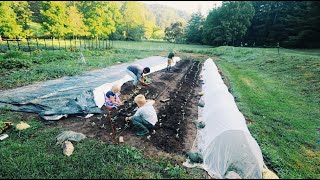
This content was created by Victor Justin Rhodes. This content was uploaded by Victor Justin Rhodes. This is a YouTube farm/garden vlog titled "You might Laugh but we're starting a Garden in August" (created 2020-08-18). The excerpt is an informal on-site recording of a host (an adult narrator) working with family members and helpers — children named Arun, Lily, Josiah, Gideon, Haroon and others referenced (Joel, Mike Boccotti) — describing and performing farm tasks: moving cows and chickens, pasture management and sacrifice paddocks, planting broccoli, collards and Swiss chard, using bug netting, milking, discussing equipment (generator, grounding rod, fuel tanks) and harvest readiness. The tone is instructional/observational and centered on small-scale regenerative farming and family chores.
Chapters
Whoops, looks like we forgot to put our plants back in last night. Seemed to do okay, no torrential rain. It's a race, it's a race. These guys are running out of nutrients, they're starting to get some bug attack. We've covered these. Why aren't these covered? Oh, we're using the other— we're using the other one out there. Let's get these out, let's continue to get these out. Can we do all this today? I think if Arun's helping, we can get some of the kids to help. I think we might be able to. But first, there's a couple of chores I really need to do that I can't really delegate to Jonah and Josiah this morning. Hey, good morning! Good morning. Don't you look pretty? Thank you. You need help with your chores or you got it? I got it. So before I get started on the garden, I need to move the fat hens up behind the cows. I got a special job for them during this sacrifice. Let the pasture grow up a little bit of time. Look who's here! There's the fat hens. You think this is on, Arun? Maybe not. It's on. I don't think so. No. So let's pick this up enough. We'll let the boys get the other fences later. Let's pick up enough so that we can get out down there with these guys. We're going to move these guys. We're going to take that Sally there. Yep. Okay. Yep. But we need to get Sally in down there. I don't want to come up this hill with the— it sure is on. Here's the pasture that the cows and sheep we're going to next that needed a little more. It's, it's booming because we're getting rain, we're getting sun. It is coming along nicely. It's going to be 2 days, it'll be 1 week. What I'm noticing is some clover is coming full on. Look at that clover, that's like 2 feet tall. It's starting to brown. Joel said that was okay because you want— you're going to lose something, you're going to have some brown in order to get some other new ones. To come up and be mature. Okay, but you can also look in here and see where they really like to graze, and it's kind of small, and this really does need rest. They would come here first, I guarantee it. Look at all that grass. It's really going to come up nice. Looks like a perennial rye or something. Wow, this, this makes me feel good. I feel like we did the right thing. Wasn't sure, but as it plays out, at least by the way of grass recovery I feel like we did the right thing. So these chickens are used to following the cows every day, doing a great job spreading the manure. We kept them in here a couple of days. If you leave them here too long, and they will tear it up. Joel was teaching us that back in the day, I guess the wild bison, of course the most neutral nutrient-dense place were the valleys. You know, nutrients run down there, and so that's where animals would naturally be inclined to go. So what would happen is predators— we used to have predators— predators would run the animals out of the valley chasing, and the animals, for safety, would go up to the, to the mountains. So that's how nature nutrientified the entire area, mountains and ridges, and then some of those nutrients get washed down. You guys ready? Look at those nutrients. So during this time of sacrifice, slowing down the pastures, we're gonna just have the cows and sheep in one area that needs nutrients the most. And we're just copying nature, and we're making that sacrifice— that sacrifice area uphill. Check it out, this is a sacrifice area for the cows. We're feeding hay here. There's not enough grass here. Of course, we're taking what would be 2, 3, 2, 3, 4 days of grass, moving them every day, turn it into 1, 2-week paddock that we're feeding hay on different areas at different times. Look at this hay they're leaving behind. That's going to be organic matter, but it's going to be organic matter faster if we shred it. That's where the chickens are going to come in. If we spread it, the nutrients are going to be spread here. Condensed area. This could be spread out. This could be spread out. The chickens will naturally— look, this mucho be spread out. Look at Cricket, they're just gonna love that. They'll naturally spread this out, they'll spread that cow manure, and they'll add nutrients. It's a tight paddock. Maybe we should have made two, two lengths. I think maybe tomorrow we will. But anyway, we need to get an energizer for it and then we can start gardening. The Chickshaw 2.0 charger. Hopefully the grounding rod is in here. I don't see it right offhand. Oh, there. Uh, I'm hoping it's still out there where the last was. Well, this is where it last was, and I don't see it. Tomatoes are jamming. Sweet potatoes are jamming. Pumpkins are jam— well, jammed. Looks like they're done. Cummins generator is jamming. A lot of you are wondering how big's the tank. Question of the day: fuel for this thing. It's a 100-gallon tank. Average use, household use, 2 to 3 days worth of generator. But what about a tank? Well, but what about a refill tank? Well, we have our red tank up there for our furnace, which also runs on off-road diesel. We won't really need our furnace because we're having a wood boiler. So using that tank as a reservoir, but needing an extension pump like you see at the gas station where we can come and pump fuel into there. That's the plan, hopefully coming this week. Hey, you found it! Or you at least found one. This one, you need two. Do you have a smaller one? We can use that one if we need to, maybe not driving it all the way in, but since we're moving it every day We need like a— we don't need such a grounding rod. All right, we'll use that one for now. We're figuring out why this area is not as good. Very shallow. We had a hard time. Look, we couldn't even get our stake in right there. Just a little shallow spike. Okay, that's why we're building this up. Whoa, you got it in right there! Yeah, free the birds! Arun's feeding them. I'm gonna— while he's doing that, I'm gonna move the cows. I noticed the water automatic water fill off the cow's trough. I'll go ahead and move this one up there. Moving this every day, that's parasite pressure. Just move the high traffic areas around at least water, minerals. Haroon, we can start on this. 45 minutes to milking time. If you want to put the broccoli in, this should be maybe 3, maybe 4 trays. It'll say broccoli, I think. It might even— yeah. I'm gonna go get the other niños. We got Lily, but where's everybody else? Hey, what's going on? You're not done, right? What chores? We're done. You do the ducks? No. I didn't do the ducks. Oh, we saw you out there. I did the luchadors. I know, I figured you might. Here, put this in rice. I found your iPod out in the field in the dew. Don't try to turn it on, that could ruin it. Put it in rice. Do you know where my rice is? Papa, it's waterproof. Oh, it is? Yeah. Oh, okay. It looks like it's working. Whose is that? Who left it out in the field? Mine. It's waterproof. All right, let's see. Hey, monkey boy. It works. Monkey man on the counter, you want to go with Come on, we're gonna work hard, plant some plants. Come on, like yesterday, get to dig in the dirt. It works. Will you go change and come? It works. Oh good. Oh good. Yes, we are making something. Come with me. That's fine, but then come with, bring it with. You're gonna go change, bring your tea, we want you to come. Okay, I believe Gideon said wait here. All right. Hey, um, boys, can you guys, after you do the ducks Oh, and what about like the, the hay to the, the cows and sheep? Just do that later when I milk. Yeah, so come help us plant after you do the ducks. Gideon, I'll be down at the garden. Yeah, I've got some tools to gather and stuff like that, so I don't think you'll miss out. Did you find all the broccolis, Arun? Yep. What, 3 trays? Oh yeah. Okay, we're gonna just do one row at a time. So first thing let's do is uncover this next row. Let's take our line and we'll mark our line. And we have— we just— you'll see. Here, you want to unroll that to Arun? Stay in the path. Thank you. Well, that was support you. Look who it is! He brought me some tea. He brought me some tea. Next, we take our gridded— that'll mark our marks. I'll do that and then I'll show you right away how to plant. You can come along behind me. Sound good? Look who's here! We're gonna get it done now. We've got Arun and Lily. Lily, you helping Arun? Yeah, putting in the plants on the grid. 2 rows in this row, Arun, of broccoli. Look at this, all 4 kids on it. Get in wherever the plants are set. Arun's setting them out. Yeah, right where it was set. You can dig a hole. We need that one. Yeah, that's where it was. See, it was right here. Oh, we're in the nutmeg. It was right here. Yeah, then plant right there. All right, well, they're working so nice. I think I'll leave you guys on them in a time-lapse. I gotta go find out what plants we want to plant next and get those. We got our cabbage plant. I got, I got some collards over here for this next row. Half in collards, half in Swiss chard. It's gonna be a lot more intense. Instead of just 2, you can put 3 rows in a row, and calls for 6 inches apart, but our grader is 5, so I'm gonna go for it. I'm gonna go for the tighter fit. Looks like Lily did you a line right down the middle too, Arun. Yeah. Yep. You guys, um, what we should do is cover up these broccolis first with our bug net. Okay, I'll do it. Oh, look, the inspector's here! How are we doing over there, Beck? It looks amazing. We've got 3 rows in. I'm feeling real good about it. And we have a big boy. I know, we did. Ready? Mike Boccotti was here. He told us that you look for this little tendril, and that's dead. So that's as grown as this is going to be. So if it's not ripe, it's just not ripe. It's not going to get any riper, right? It's not getting any more nutrients, I think. So let's, let's get this out and let's put it in a cooler of ice. Let's do it. You agree? You want to be in charge of that, Josiah? Sure. We'll have that tonight. I want to go look at it. He says yeah. Josiah says when he grows up, if his wife's cool with it, he's going to grow only watermelon in his garden. I like it. Grow what's close to your heart, Josiah. Grow what's close to your heart. Watermelon is very close to his heart. This one's almost ready. That tendril's not quite all the way dead. Oh man, I hope that works out for you, buddy. Can I pick it, Papa? Yeah, I'm thinking you can. That's as ready as it's gonna get. This one, this is a good example of not ready. Look at that. Look how green those are, those tendrils. Totally not ready. All right, will you give her some scoops, honey? I'll start washing her. Cow number 2. This is Polly's mama. Polly, our new calf, didn't come down. I told the boys we gotta herd the calf down. That calf's gonna come wild. We gotta get her down there and herd her. I think tonight we'll get her down here and separate her from mom so we get more milk in the morning. I think she's starting to keep up with us. Calf's been on her 24/7. We're done milking, and that's maybe a gallon, maybe. So yeah, that's when you know. I mean, it's been, it's been 10-ish days. When, when you don't get enough milk in the morning, that's when you know to start calf separating. Is that cream separating? Calf? Yeah. So we'll let the calf have her all day, and then we'll just put the calf up here at night, and that milk will build up overnight. Harun is continuing to knock this out. Our tables are starting to look sparse. That's good. That's good. This is kind of neat. It's kind of neat. We're wrapping up gardening for the year. This is our fall and winter crops. The season of rest is coming.
More from Justin






If I had to start my Homestead all over again, it could only pick one animal… 




