Rana el Kaliouby & HBS Professor Karim Lakhani: How AI is impacting productivity at work
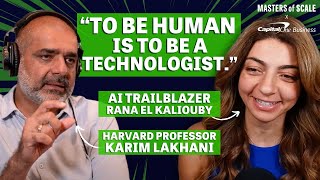
Transcript of a Fireside Chat (YouTube) where Harvard Business School Professor Karim Lakhani and Rana el Kaliouby discuss how AI is changing productivity, business models and organizational design. Lakhani describes research (and his 2020 book) showing AI-centered firms that scale via data (example: Ant Group), explains economies of scale/scope/learning, summarizes lab and field experiments on generative AI (including ChatGPT’s effects on knowledge workers), and gives practical advice for executives, employees and students. He also previews a Harvard course, “Humans Leading with Data and AI.”
Chapters
So now it's time to move on to our next segment for the evening and I'm really excited about this one, Rana. This is where we invite a special guest to sit down with our host for an electric back and forth conversation. There's no immediate problem we're trying to solve. This is just a space for us to lean in and get curious. For this month's Fireside Chat, we're delighted to welcome Professor Karim Lakhani from Harvard Business School. Professor Karim Lakhani is the Dorothy and Michael Hense professor of Business Administration at the Harvard Business School. His research focuses on the intersection of technology innovation, AI and company strategy. He is also the co author of the 2020 book Competing in the Age of AI and he acts as an advisor to senior executives, educating them on AI strategy and technology driven transformation. Welcome, Professor Lakhani.
Thank you very much. It's great to be here with you.
Thank you. I know you two have a lot to get into, so I'm going to hop off and rejoin later.
See you in a bit, Jodine.
Bye. Bye.
Hi, Karim.
Hey, Rana. Good to see you again.
It is great to see you again. Just so the audience knows, we have some history together, so you invited me to join as an executive fellow at the Harvard Business School. School. We've done a little bit of teaching together and you've been supporting a lot of my investments and my fund. So thank you for being here. My first question to you, actually. There's this myth that professors take the summer off and it's. It's. Is that true?
Well, you know, it depends on the professor. So some are diligent at taking breakfast breaks and taking long breaks. My wife tells me that I'm failing a tenure, that I should be calling in at noon and having a scotch every afternoon. That's not my life these days. But I feel so privileged to be a faculty member at Harvard, to have the platform and the infrastructure to do incredible work and to also connect with people. And so I feel it as a responsibility to keep working, especially right now in this. In this age.
Yeah. So I want to start by asking you because basically you've been really looking into how AI is impacting productivity and work. So perhaps we start there. What are some of your findings?
Yeah. So you know, the book that we put out that Marco Iinside and I put out in 2020 was a culmination of about eight years of research and looking at companies and how they were organizing themselves around AI and around data and that research really sort of. And this is Pre chatgpt, right? This is all machine learning models, all the things you had done and so forth. And that book really showed to us that in fact, a new form of an organization was emerging in which data and AI were at the center. And the work that was being done by these organizations was being done by the machines and not by the humans. The humans designed the machines. The humans monitor the machines, the humans updated the machines, but the work itself was being done by the machines. And in our private lives, in our consumer lives, we have this right. When you use Uber, there's no dispatcher you're calling to connect you to it. When you get a recommendation from Netflix, there's no editor saying, rana, these are the movies you should. It's all driven by data and by machines, by AI. And that meant that a new type of an organization was coming, which scaled in a very interesting exponential way. And so the poster child for us in our book was this company out of China called Ant Group, which is a financial services provider. And the thing that stunned me, there were two facts that stunned me about them. One was, you know, they were serving 1.2 billion users with only 15,000 employees.
It's crazy, right?
And that, that, I mean, talk about super productivity. That is a crazy number. And when I talk to, you know, financial institutions here in the U.S. they would say, well, it might take us 2 million employees to serve a billion or maybe 10 million users, not 15,000. And what you can imagine is that every single part of the business was reth with data and AI at the center. And so that's the one fact. The other fact about Ant was like three, one zero. They said three minutes to do anything on their platform, one minute for approval, zero human intervention, right? And so it was like, okay, so they had this crazy metric of 310. And so I'd always joke that, yeah, my bank here in the US also has 3,1 0, but it's like 3 months, 1 month and 0 computers. And then also. But also 310 for me has become this crying call to say, like, what are you going to do, Mr. Executive, Ms. Executive, in your business to achieve what is your 310 equivalent? And how would you sort of rethink your business around these kinds of productivity goals that you might have?
In your book Competing in the Age of AI, you also talk about, we all know about the economies of scale, but you talk about the economies of scope. Can you comment on that? What is that?
Yeah, absolutely. So, in fact, the book sort of lays out this very simple model framework that says a business is defined by two things, the business model and the operating model. And when we think about the business model, there's how you create value. So why are customers coming to you and transacting with you instead of going somewhere else? And how you capture value and you actually want to separate those two dimensions out. There's value creation and there's value capture. And then we think about from the operating model, the thing that actually delivers value to your customers. Then we have three dimensions. There's scale, scope and learning. And what we see AI doing is helping you with scale, as we discussed already. But also scope the data of one customer transaction and what they're doing can help you then imagine new use cases for you to offer to those customers. So the scope expands again, if you think about our consumer lives, all the different services that Google starts to offer us, all the different services that Meta offers us, and so on and so forth, that's the scope and the same interaction that allows you to then think about the next set of things you could offer the customer. So as economies of scope, which I think is interesting.
Sorry to interrupt you, but I think it's really interesting because I, you know, throughout my entire journey founding and growing Affectiva, you always hear like you should focus. You should focus. Absolutely. But now with this data and economies of scope, you should, you can be really, really smart and address like enter adjacent markets.
Right, exactly. And I think of course you want to do it sequentially, but you should be focused in on increasing scope as much as you are going to think about scale. And I think the scope allows you to serve the same customer with more things and scope allows you to serve lots of customers. And then driving both of those is what we call learning. And learning effects, that the data should help you learn continuously about what works and what doesn't work as well. And so that was, so that was.
The part that was pre. That was pre. Exactly. Pre Chat tv. Yeah, exactly.
And so now like chat GPT shows up. And you know, when I first saw it, I was kind of stunned as what it was doing. And the test, I remember I used to be on Twitter a lot and there was a whole academic Twitter, econ, Twitter and a colleague of mine, Kevin Smith in Toronto posted that he had went to ChatGPT and 3.5 and asked it questions that he got asked in his PhD oral exams. And he goes that it answered really well. And so I did the same thing. I put the questions I got. It was a. As you remember, oral exams are horrendous you know, like you get, you get, you get shot by 10 different other professors. They're asking you random questions. I was like, asked, like, how would you advise George Bush on innovation policy? I'm like, I'm studying innovation, but I'm not studying policy. But I had to come up with it anyway. I put all these questions in and again, I was stunned at the responses. I knew something interesting was going on. Immediately I got thinking about, look, what we need to understand is if these superpowers become available to everybody, what happens? The framework, our team at my lab and the postdocs that I work with has been all. And the collaborators I have has been to think about this in terms of what it does to. If you're at a certain skill level now, and now you have ChatGPT available, how does it move your skill level? What does it do for you? And what we imagined it as a very simple imagine, like a normal distribution or Gaussian distribution of skills. There's people at the average, people at the high end, people the low end. And what we imagined was that this would shift everybody to the right. Everybody would get smarter because of this. That was the hypothesis. And then I've been obsessed with doing studies that are very scientific when it comes to innovation. Over the last couple years of, you know, 15 years, I've had built a lab. We run field experiments, like randomized control trials on inhibition settings. And so we thought of chatgpt as a drug. So let's think of as a drug. And if you give, if you give that drug, drug to, to knowledge workers, to professionals, to entrepreneurs, all of us that are listening in, what does it do to us? And so we worked with Boston Consulting Group and we ran this experiment where we had a bunch of people get the drug and a bunch of people not get the drug. And we looked at two different types of work that consultants. One was more creative, problem solving, innovation related work, and one was more analytical work, much more like analyzing numbers and so on and so forth. And what we discovered here was both great news and bad news. The great news was that on the creative task, where the AI is really good at, generative AI is really good at, your performance improved by 40%, which is kind of massive, right? 40% improvement is kind of massive, especially on a sample of elite consultants, right, Graduating from top schools. So that was like a big aha for us. At the same time, we discovered for the tasks that the AI was not good at performance dropped those using AI did worse than those not using AI. And this is where it matters to us to actually have a point of view that says that it's easy for us as humans to fall asleep at the wheel. This is a line from my postdoc Fabrizio Delacqua. Fabizio, as part of his PhD at Columbia came in and sort of looked at what would happen to people when they were given good AI. Would they keep performing as as well? And he discovered that no, that what happens is that people have a sense of like they slack a bit when it comes to with good AI and so then they miss the edge cases that the AI misses. And so that was a big aha for us. And so. But overall what we see is that the priority effects are kind of massive. And we see this not just in our lab. My colleague Ayelet Israeli has a consumer intelligence lab at our institute and she has shown that you could do consumer research with ChatGPT. You can do market research, you can get willingness to pay estimates that match real consumer data, which is quite amazing. My colleague Rem Koning and the Tech4All lab has done a project looking at entrepreneurs in like small and medium sized entrepreneurs in Kenya. They have chicken farms, they have dairy farms, they have small tea shops and so forth. And he finds that again you could. The ChatGPT has a pretty important effect on their productivity as well and their revenues if it's used correctly. So we're seeing this over and over again that for us as knowledge workers this is going to be a, this is already a big boost in our productivity and things we like to do and things we don't like to do as well.
Yeah.
I have so many follow on questions but one in particular with my investor hat on as I'm looking at these AI native or AI first startups, do you think they'll be more capital efficient, they'll get to say profitability? Because it's almost like I'm seeing a dichotomy like some examples are like large language model companies, they're so capital intensive and it's actually not sustainable at all. For, for they're so compute. Intense.
Yeah.
But perhaps some of the vertical AI solution companies, perhaps they can be more capital efficient. I don't know. Do you have a point of view on that?
So, so many thoughts, many thoughts. On the first, the first I could go on forever. So on the first thing is like I think of this moment now as 1908 the Ford model T has been invented. It's coming off the assembly line but you know, it's like the roads have not been invented. We haven't done proper engineering on the engine, on the transmission, you know, there's no seat belts yet. Nothing. Right. Literally. And over 20, 30 years, you know, a whole bunch of infrastructure got built around to make the car safer, cars more affordable and so on and so forth. I think we're at the same stage with generative AI models. It is literally like 1908, it has just come out of the lab. Right. And we're trying to rapidly industrialize it now. Hopefully it doesn't take 50 years for us to invent seat belts. Right. We can do it faster. And of course that's part of the ethical AI work that's going on everywhere, including at our institute. So I expect that we. Hardcore engineering on these models has not been done yet. I think that's going to take some time. But I expect that over time those efficiencies will then mean less power, less data and so forth for us to be able to get what we want out of them. The second thing that I would sort of say is that the laws of innovation can't be ignored. What we know about how innovation processes work is that when a new technology comes through, there is a massive sort of recombinant in a explosion of new ideas and new things that need to be done with this technology. Most of these things fail. Most of these things fail. We saw that in the auto industry, we saw that in, in the tires industry back when the auto. But even if you remember, do you remember all the search engines that came out?
Right, right.
Like Lycos and. And it was. I loved altavista. Exactly, yeah. Excite sgs. There's all this innovation and then there was a shakeout and the shakeout was both technological based, what we call dominant design. Some dominant design shows up. So the Google dominant design of like just, just links and nothing else came through. And then also a business model congeliation, right, which is like okay, like we're going to make the service free but we're going to charge advertisers for access to the eyeballs. Right. Both those things will happen. And so what I imagine is that in this vertical space we're going to still in the super early days of ferment, it'll be hard to bet on the winners yet. Right. But we need to have some theses about what do we imagine dominant designs to look like? What do we imagine the business models to look like and then go invest with those. Right. So for already what we're seeing is like maybe SaaS models don't work as well as consumption models potentially for revenue. Those are all questions that I think we're sort of seeing people ask as these things start to shake out.
Yeah, amazing. Let's shift away from startups for a bit and talk about big companies, Fortune 500 companies that are trying to become AI driven. They're definitely not AI first, but they're trying to embrace AI. What in your experience has been, what does the journey look like? And also, can you comment on culture and the human? I remember in one of your classes you talked about how if your org chart does not represent, kind of it doesn't have data and AI in it, like represented at the top, it's not going to happen. So, yeah, tell us more about that.
So I would say at the moment, every CEO and every board wants to figure out the AI thing, but they all have very different strategies and very different perspectives about this. And I think what's happening is that there is a lack of common frameworks and common perspectives inside of a company around AI and a ton of mythology. And so one of the things I ask, and I've done this now informally in many of my public sessions that I do, and I think my sample size now since last year is about 10,000 people or so. I ask three questions. I go, how many of you use ChatGPT? And everybody raises their hand or some generative AI. Then I say, how many of you think that in the next three years this is going to change your job, your career or whatever? They go, everybody raises their hand. So like 80, 90% say they've used it. 75% to 70% say that it's going to change their, their job, their career, whatever. Then I ask, how many of you use these tools every day in your professional life? 10%. 10% say yes. So what I see is there's a massive knowing doing gap. Right. A lot of people sort of know that's important. No, it's going to be, it's going to change, but nobody's actually doing it. It's kind of like, you know, teenagers and sex. Right? Everybody talks about it, but nobody's actually doing it. Right.
I hope my son's not doing it.
Exactly right. But. But that's the point, right? Like, I think the issue is that a lot of people are talking. There's so much hype, but the number of people doing it is actually very low. And what I'm afraid about is that that's going to create an AI divide amongst companies. We used to talk about digital divides amongst citizens. I think there's going to be an AI divide amongst companies. And what I try to do when I work with executives and when we have people come to our campus or when I'm doing stuff in private is like, throw them into working with ChatGPT so they can actually see what these tools do and how they solve problems, because that's the only way their minds will open up. But so at the moment I would sort of say is that only a few companies get it and only a few companies are investing a ton in making it happen. The rest are still in like, oh, security mode, governance mode, which are all important, which need to be done. But I think it's coming at the expense of not really rethinking your work and your processes to make this happen. And then that connects back to the culture. So there's an observation in computer science and in engineering known as Conway's Law, that the design of your technical architecture mirrors the design of your organizational architecture. So if your technical architecture is siloed, you have silos across your business units. You have silos and data sharing, you have all this overhead in terms of people being able to share knowledge and ideas and so forth, then that's going to reflect your technological architecture and your organizational architecture. And what we know from the development of AI and this notion of AI factories is that they want lots of data. The data has to cut across the entire enterprise and it's just fit across and that you that the siloizations work against what the economies of scale, scope and learning are in an AI factory. And so the biggest challenge we sort of see, you know, we have this rule that says 30, 70, 30% is tech and it's declining and 70% is culture and organizations. And this culture and organizations actually has to be from the top down. Like the executives, the board members, the CEOs have to believe in this. And then it has to then filter all the way down to the frontline workers along the way. And that's the only way we'll sort of see this, this actually take hold. But I am actually worried about this divide between, between Fortune 500, between 1,000.
Companies and then at the individual level.
Which, by the way, that creates opportunity for entrepreneurs.
Absolutely right.
Because if, you know, if you can imagine new ways to do business at a much faster, cheaper way.
Right.
What would the ANT group be for consumer packaged goods? What would the ANT group be for a whole, for a whole range of industries. Right, right. And so I think that's the interesting thing we've seen. We've seen hints of this, like Moderna and, you know, I'm an advisor to them. Moderna as it, as it's done in the pharmaceutical space, Tesla and the automobile industry. Right. You're sort of seeing early examples. And what I imagine is that the next decade is going to create a whole range of entrepreneurial opportunities as well for entrepreneurs to go compete against the big guys and see what they can do.
So if you're not an executive or a CEO at a company and you're not ready to jump on an entrepreneurial journey, what advice would you give our listeners on how to, how to be smart in this human AI collaboration? How to be like, partner smartly with AI?
Yeah, yeah. Well, first, you know, look, you have to sort of respect your company's policies about the use of these tools and so forth. But I would put myself on the bleeding edge inside of your company and take on projects that make sense of this. Raise your hand and say, I'm, you know, pick me, coach. Pick me, coach. I'm ready, I'm ready, I'm ready to dive in. Second thing is start using this. I mean, many companies have come now have generative AI tools available through their various enterprise accounts. Start using them and use it for your work. Become an expert yourself. I've become an expert in this both from like, you know, I've got my, all my degrees and blah, blah, blah, and my knowledge. But my best tutors have been on YouTube, right, on how to prompt but to do things. And I've, you know, I spend more time now watching, you know, YouTube than, you know, Game of Thrones, you know, and so, so, so the, the point being that there's, there's a ton of really great content out there that people have done and people have created and this is an amazing opportunity for you to go, actually go try it and use it. And, you know, the, the analogy I try to use is the one that comes from Steve Jobs, right? He called the computer a bicycle for the mind in the 80s. And the bicycle helped humanity go further and faster. And the question is, I think now with ChatGPT, this bicycle for the mind has truly arrived. This is a cognitive boost for us. We can go further and faster, but we need to learn how to balance the bike. When we learn how to ride the bike, you fell down, you got a concussion, you got scraped knees and bloody elbows and so forth. You had to wear a helmet. And so there is a learning journey which is going to be, which will be difficult but requires investment. You know, my friend Ethan Mollick says you need 10 hours. I think you need about 40 hours. But 40 hours over a month is doable, right? It's five hours on a Saturday, five hours on a Sunday for a month. Do the work and get it going, but apply to your work and then raise your hand in your organization to take on those projects.
I love the raising the hand because a lot of every, I mean even smarteye, the company that acquired my company, Affectiva, like we are an AI company, but we're still having to figure out how much on the bleeding edge do we want to be versus thoughtful and intentional about the risks we're taking. And I think the folks who have raised their hand, whether on the engineering and software side or on the marketing team, the folks who have raised their hand to embrace these technologies are definitely well positioned to keep. Because it's moving so fast too, right?
Exactly, exactly. And you know Mary Erdos, who's on our advisory council, she's the CEO of JP Morgan Wealth Management. She says there's a first mover advantage in adoption. And I truly believe that it's not a winner take all business. These things are first mover advantages because, because this rate is so fast. So the more you wait, the further behind you are. But if you sort of keep up with the wave, right, Then you're keeping up and catch up won't be as hard.
So as we start wrapping up, I know you're about to launch a new course at Harvard. Tell us more about that.
Yeah, yeah. So I'm launching, it's a reboot of a course that we have, a course on data science for managers. And I'm working with our faculty and it's a required course for all 1,000 MBA students. It's called Humans Leading with Data and AI. And the idea is that all MBAs, all business folks, need to have the foundations of how AI work. And starting with statistics and then moving on to algorithms and then moving on to AI factories and what it means for transformation. And that you don't need to be a statistician, you don't need to be AI engineer, but you need to know how these systems work and where they work and where they don't work. And like, kind of like, you know, my Dean Srikanthar is an accountant. Nobody will ever sign up to be to take an accounting course if it was optional. Right. But we teach accounting because it's important for business people to understand how books come together, how these things come together. So same as our view about AI, you don't have to be an AI Technologist to understand the role of AI in your business and what it means for us. And so we're launching this course, we're rebooting this course. We're calling it Humans Leading with Data and AI. But the thing we're doing is that we're actually using generative AI at the core of it. So there's going to be a core spot where all the stuff we teach is going to be available for students. All the statistical analysis that we'll be doing and all the models we'll be building will be on ChatGPT. Because we want to equip our students to be able to enter the world with knowledge and confidence about how these tools work, what their limitations are, what the opportunities are, but also real hands on experience and building, you know, GPTs, building bots and all that kind of stuff to solve business problems as well. So it launches, it launches in the spring of next year. I better go get going and get to work because there's a lot.
It sounds awesome. I have major fomo. Okay, last question. What are you most excited about as it comes to, as it relates to AI?
Look, I am, I am an eternal techno optimist. And there's a false dichotomy going on about technology and humans, which I think is wrong. Humans have always used technology. From fire to the wheel to agriculture, we've always built technology. That's what humans do. To be human is to be a technologist. And this is just another new toolkit in our capability. But now this toolkit is actually giving us cognitive superpowers. And so I feel like we're entering a very new age with these tools and these capabilities. And my hope is that this is not just limited to the elites, but everybody gets access to this and benefits from that. So I'm actually like super excited about how we will use these cognitive tools. Like, you know, when people wear glasses. The example I give is that glasses were invented about 300, 400 years ago. And before that, if you didn't have glasses, you were functionally blind in society and you were knocked out. Glasses change the lives of people that have bad eyes. Same thing with hearing aids, right? Hearing aids are actually really important for elderly, for cognition purposes. If an elderly person is losing their hearing, then they're also going to experience cognitive decline. And you should really insist for your grandparents and so forth or your parents to actually get hearing aids. I'm in that conversation with my mother right now. Mom, put on your hearing aid. Put it right. But so, but it's a cognitive tool. Glasses are cognitive tool. Hearing aids are cognitive tool. These are a cognitive tool as well. But now we can do so much more and that's what I'm like excited about.
Love that we could go on forever. But it was great catching up with you. Thank you for spending time for us. So inspiring as always.
Thank you so much.
Sam.
More from Karim
Ep. 834: Karim Lakhani and Marco Iansiti Interview with Michael Covel on Trend Following Radio

Digital Transformation Strategy: Become an AI Company - with HBS Prof. Karim Lakhani (CXOTalk #768)