Recognizing the PLLs
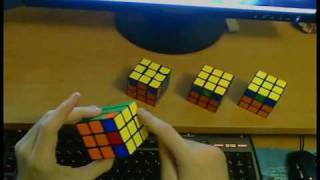
Andrej Karpathy breaks down the 13 PLL cases on a Rubik's Cube using visual patterns like headlights, full bars, and edge-switchers instead of memorized diagrams. He maps each pattern to specific PLL letters and explains how sub-features like edge adjacency narrow down which case you're facing. The E permutation has no distinguishing feature at all.
Chapters
Hello. In this video, I will give out some tips on how you can improve your PLL recognition times. Again, a lot of this is simply just practice, but maybe this video will point you in the correct direction. Okay, so there are roughly 21 PLL cases, but only 13 of these are actually distinct cases. The rest are simply the same case, but usually reflected on the, on the other side, or very slightly modified. Every one of these 13 PLLs is given a name. All of these names are actually just letters that somewhat resemble the astral PLL when you draw it on a diagram. I will refer to all PLLs by their names or letters throughout the video, so try to keep up with it. I will also post a link in the video description to a page where you can see all the names and all the 13 PLLs. Okay, so first we have what I call the headlights feature. Headlights look like this. So you have a face where two corners have the same color here. Like here we have the orange headlights. We've got green headlights here, blue headlights here, and green headlights here. So exactly 4 PLLs contain the headlights feature out of 13. So here we have the— this is the 3-corner cycle, or the A permutation. It also contains a 3-block, a feature that I will talk about later. Here we have the T permutation. It contains the headlights. Here we have the R permutation. It contains the headlights. And finally, we have the G permutation, which contains the headlights, and every G permutation also contains a pair feature, a 2-pair. I will talk more about the 2-pair later as well. Okay, so all 4 of these PLLs contain the headlights feature. That means that whenever you see the headlights in a PLL case that you run into, you can be absolutely certain that you ran into one of these 4 cases. In addition, there is all kinds of useful information around the headlights that can better help you identify the PLL. There are two things you have to be looking for, uh, when you notice the headlights. The first thing is you should always notice the color of the edge in between your headlights. This color can either be the adjacent color to the color of the headlights or an opposite color to the color of the headlights. So on a Rubik's Cube, the opposite color of orange is always red because red is opposite to orange. Green is adjacent to orange. That means that the edge here is adjacent. This edge here is opposite to the headlights color because blue is opposite to green on the Rubik's Cube. This is an adjacent color, red is adjacent to blue, and this is adjacent. So as it turns out, this can help you narrow down which, which of the 4 cases you ran into because you can just look at the edge in the middle. The T permutation will always have an opposite color here. The R permutation and the A permutation will always have an adjacent color of the edge in between the headlights, and the G permutation can be either opposite or adjacent. I will talk about this in a little more detail right after this. The second thing you should be on the lookout for is what I call connectedness. The headlights can be connected on either left or right. So here the T permutation, I call it, I call the headlights on the T permutation connected on both sides because the pattern here continues: red and red, orange and orange. These headlights are connected on both sides, and our permutation is only connected on a single side. Here we have it on the left side, so here it's not connected. Connected on the left. The A permutation is not connected on either side, and the headlights on the G permutation are not connected either. So right away, this can help you narrow down the cases because when you see, when you run into headlights and you see that they are connected somewhere, right away you can, you know it's not an A permutation and you know it's not a G permutation because none of these have connected headlights. It can only be a T or an R permutation and then you can tell these two apart looking at the edge in between here because the T permutation will always have an opposite edge but the R permutation will always have an adjacent edge in between the headlights. I will now say a few more words on the G permutations in particular. I get a lot of questions on how you can identify these G permutations easily. Well, this is how. So every G permutation contains headlights and a 2-pair. So here are the headlights for every G permutation. There's exactly 4 of them. And here is the 2-pair for this particular G permutation. What varies in between all of these permutations is only the location of this 2-pair relative to the headlights. So here it's on the— in the back there. Here we have it on the front here. For this case, we have it here on the right, right up. And for this case, we have it on the right front here. Moreover, the edge in between the headlights can help you distinguish between these G permutations because 2 of them have an adjacent edge and 2 of them will have an opposite edge here in between the headlights. So whenever you suspect that you have a G permutation, the color of this edge can give you a hint on where you should be looking for your pair, because if it's an opposite— if it's an adjacent edge, then you know that your pair must be either on the back face or the front face. If it's an opposite edge, then you know your pair must be located either on the right here, and it only matters if it's on the right there or on the right here. So this can really narrow down things for you as well. Next, we have another feature which I call the full bar. So this is what the full bar looks like here. Full bar. You are lucky whenever you run into a full bar because only 2 out of 13 PLs contain it. They are the J permutation and the F permutation. Of course, the U permutation also has a full bar, but hopefully you can identify that without much trouble. I mean, you can see that all the corners are solved, so we disregard that. Now, it is also very easy to tell these two apart because the J permutation, the bar is connected on one side here. The F permutation does not have a connected bar. Also, just like before with the headlights, we're looking for additional clues from the color of the edge in between the headlights. Here we can do the similar thing because we can look at a color of this edge here, right next to the full bar. Because in an F permutation, this will always be an opposite color from this one here, so green and blue opposite. But for a J permutation, this edge will be an adjacent color. So right away, whenever you see a full bar, you can easily tell these two apart because when you see something connected, it's a J permutation. And if you don't see anything connected, you can just look at this edge, and if it's opposite, it's definitely an F, and if it's adjacent, it's definitely a J. Next, we have a feature that I call a 3-block. This is what it looks like. So you've got 2 edges and a corner in between them, all solved. A 3-block. Only 2 PLLs contain this feature. They are the A permutation, which we've already seen, and the B permutation. In which you have to swap these two and these two. So only two PLLs. It is very easy to tell these apart as well because the A permutation contains headlights here. The B permutation will not contain headlights. So whenever you see both 3-block and headlights, definitely an A perm. If you don't see headlights, it's a B perm. But there is an even better way to tell the difference. That's because if you look at the edges right next to the 3-block For an A permutation, these two colors will always be the same, like here we have red and red. For the V permutation, these two colors will always be different, blue and red. So whenever you see your 3-block, these two colors are different, V-perm, otherwise A-perm. Very easy to tell apart as well. Okay, the last feature that I want to talk about is the 2-pair, and we've already kind of ran into it with the G permutation. It's right here. The 2-pair is also located on the J permutation. Here, here, here. This can also be seen kind of as a 2-pair here. The M permutation, of course, has 4 very distinctly looking 2-pairs everywhere. And the Y permutation also contains 2 2-pairs like this. Now, the 2-pair is not really as strong as a feature as the full bar or the headlights, It doesn't provide you with as much information, but it can still narrow it down to these 4 PLLs, so that's quite useful, I guess, when you see a 2-pair. But try to think more of these 2. That's more distinguishing feature, it provides more information. And the 2-pair, definitely, if you see a structure like this, it's definitely an N. And if you see 2 2-pairs arranged like this with a corner in between unsolved, that always points to Y permutation. So keep that in mind. Ironically, there is one elusive PLL whose only distinguishing feature is that it has no feature. I'm of course talking about the E permutation. The only way to recognize this is to twist the U face enough to realize that there are absolutely no features anywhere, and then just kind of align the edges like so because they can all be solved, and then you just have to figure out which way to swap the corners. So that's the only way to really recognize this one, is by not recognizing anything else. Okay, for completeness, I will very briefly talk about the edge switchers, the U, H, and Z permutations. So it's very easy to basically identify these permutations because you can see that the corners are all solved, always. I mean, you get headlights everywhere. So when you have 4 headlights on every face, it's always an edge switcher. And the H permutation in particular is very easy to identify because for every for every headlight on every face, you always have an opposite edge in between here, so that's always easy to identify. It's sometimes a little bit harder for the Z and the U, but the U permutation of course has a full bar, which the Z permutation does not contain. So that's basically how you can tell them apart. Okay, so I hope this video will help you identify your PLLs more quickly. Again, the most important part is to look at these PLLs as a bunch of features, not as arrows on some diagram. Every single feature can point to a single PLL or to a few PLLs, but it's important to know what those PLLs are so that you can quickly look at the relevant places on the cube and zero in on the PLL that you want to apply. And this is really what gives you the edge. And I think that's all for now. Bye-bye. The last feature that I want to talk about is the 2-pair, and we've already kind of seen it with the J permutation— with the G permutation, The last feature that I want to talk about is the two pair, and we've already kind of seen it with the G permutation. Pause. Okay, so the last feature that I want to talk about is the two pair, and we've already kind of seen it because of the J permutation. Did I just say J again?
More from Andrej

Skill Issue: Andrej Karpathy on Code Agents, AutoResearch, and the Loopy Era of AI










Andrej Karpathy: Tesla AI, Self-Driving, Optimus, Aliens, and AGI | Lex Fridman Podcast #333