Learn 2-look OLL, a simplified method that reduces 57 Rubik's Cube algorithms to nine by splitting the last layer into edge and corner orientation stages. The video covers each pattern with specific algorithms like Sune, Anti-Sune, Headlights, and Chameleon, plus memorization tips for the speed-versus-memory tradeoff.
Chapters
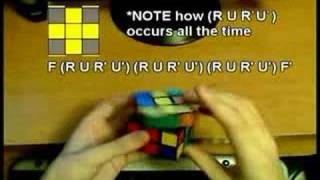
I get a ton of people asking me about the Tuluk OLL all the time, and I don't have a good website that shows it, so I always end up writing up paragraphs of explanation to each person individually. To make sure that I don't go crazy, I wanted to make this quick video on this technique. The Tuluk OLL simply orients the last layer right after you finished your first 2 layers. So it makes the cube go from this to this, where you can see that all the pieces on the last layer are correctly oriented, but their positions are still scrambled. So that's fixed using the permutation step in the Fridrich method, which is the last step. Anyway, so the Tuluk OLL does this in 9 algorithms as opposed to all the 57 algorithms you would have to learn in the Fridrich method. It does it at the expense of speed, so it's a little slower. The way it does it is it first does the edges, it orients the edges, and then it orients the corners, hence the name, the 2-look OLL. Okay, so let's look at edge orientation first. After you finish the first layers, there can only be a few things that happen with the edges. You can have 0 edges correctly oriented, 2 edges correctly oriented, or 4 edges correctly oriented. If you have 4 edges correctly oriented, you are done. If you have 2 edges correctly oriented, then we can have 2 subcases. Either the two edges that need orienting still are opposite to each other, or they are adjacent to each other like here. I will do the last case where you have none of the edges oriented after this. So if you have the two edges that need orienting opposite each other, hold the cube like so, do the following algorithm: F R U R' U' F'. That solves it. If you have this case, do a very similar-looking algorithm, small f, R U R' U' small f', and that solves it. In the last case, you can have none of the edges oriented correctly, and in that case, just do the first algorithm followed by the second algorithm. So the first and the second, and that solves it. After we are done with the edges, we can proceed to the second stage of the 2-look OLL, or the second look, where we do the corners. You can only run into 7 cases in this stage, and these are 2 of those 7 cases. Notice that these 2 cases look very similar on top, but they're slightly different. This one has yellow here, this one doesn't, so the corners are twisted the other way. Anyway, to solve the Anti-Sune, they're called Anti-Sune and Sune by the way, they have names, don't ask me why. To solve the Anti-Sune, I hold it like so and do R' U' R U' R' U2 R. To solve the Sune, I hold it like this and I do R U R' U R U2 R'. And just a quick note on memorization, that's why I reversed that case. To memorize this, it's very easy. Just track this F2L pair around the cube. Notice what happens to it as I do the algorithm. First I take it out, so it's here, then I move it one position over, then I open the slot again and I insert it back. And that's the Sune algorithm. Okay, so here I have another case. This case is very similar to another OLL case, so be careful. This one has like so, the yellows. This one has them here and here, so they're slightly different. I'll do this one in a second. To solve this one, it's very easy. Hold it like so and do F R U R' U' R U R' U' R U R' U' F'. Done. So that should be really easy to remember. Okay, I'll now show you this case that I just talked about seconds ago. So hold the cube like this. There is a fast version of the algorithm and there is a lazy man's version of the algorithm. I will first show you a fast way to do it. It's R U2 R2 U' R2 U'. 'U' prime, 'R2 U2 R'. If it aids you with memorization, notice that the algorithm is actually a palindrome. It's read backwards and forwards the same, which is kind of funny. Anyway, the lazy man's version is to use the two algorithms that I showed you for edge orientation. You do them, the second one and then the first one, in sequence, and that will solve it. So if you do the second one, it's the f R U R' U' f', and then f R U R' U' f', and that solves it too. So decide whichever one you want to use. Okay, there are only 3 algorithms left. This case is called "Headlights," and this case looks very similar to another case, which is called "Chameleon," because it's got eyes on the sides, I suppose. They look similar, but they're not similar again, so be careful. To solve the headlights, hold the cube like so and do R2 D R' U2 R D' R' U2 R'. I cannot think of any easy way to remember this case. You'll just have to learn it. Tough luck. Okay, I will now show you how to solve the chameleon. Hold it like this, do the following algorithm: r U R' U' r' F R F'. That solves it. This algorithm is very easy to remember. The first part is the R U R' U' trigger, which I've used 100 times, even in this video. But the first R is actually small r, and the second part is also a very famous trigger, the R' F R F' trigger, which you may already know, but also the first R' is small r', so that's very easy. I will now show you how to do the last algorithm, which looks like this, the last case. This might be sometimes tough to position because this is a different Wait, we must have a yellow here. Anyway, this will be very easy. Just take the algorithm we just did for Chameleon, move that F' at the end to the beginning. You think that shouldn't work, right? Well, let's see. F' R U R' U' R' F R. We're done. Alright, so using the 2-look OLL technique, there is very little memorization involved and it's pretty fast to solve the entire orientation. I hope it doesn't discourage you from learning all of the OLLs because most of the OLLs are really easy to learn and they're just begging you to learn them because they're very easy. And so anyway, that's it for now. You can use this, it's pretty fast for now, but don't be lazy and learn the OLLs eventually. Huh, bye-bye. If you have 4 edges correctly oriented, then you are done. If you have 2 edges oriented correctly, you can have 2 subcases. This is wrong. Yeah.