Rubik's Cube Cross on bottom: tips and fingertricks
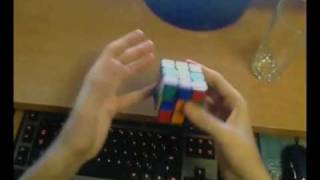
A speedcubing guide on building the Rubik's cube cross on the bottom layer faster. The presenter demonstrates fingertricks like R' F R and double-layer turns to eliminate rotations, explains how to pre-plan during inspection, and notes when a top or front cross is actually quicker.
Chapters
Hi guys, I'm sorry I've been gone for a while. I kind of had a lot of IRL stuff going on. I had exams and I also kind of had a girlfriend, but the exams are now over and the girl dumped me, so I guess I'm back to cubing. So since I need some time to get back into shape, we'll start off easy and I'll give you some more tips on making a cross. Hopefully by now you've seen my first cross video, which by the way received a lot of positive feedback, thank you. Um, that video concentrated more on how you can make the cross in as few moves as possible, and yes, that's important, but as you become much faster, you realize that that's only half the story, because ultimately what counts in the end is the speed, not the number of moves that you take. You've also most likely heard people telling you that you should be doing your cross on the bottom, and there are two main reasons for this. First, it saves you a cube rotation that you would otherwise have to perform at the end of making your cross. And this makes a pretty big difference because not only is it slow, but it also deprives you of valuable inspection time into the F2L. Many people tell me that they take a long time finding the first pair in F2L. Well, this is probably one of the major reasons. You make your cross on the top, you turn the cube around, and then you stare at it and go, "Now what?" You're starting from scratch. And secondly, making the cross on the bottom gives you some nice fingertricks for dealing with edges. While making the cross, and in this video I will basically show you a few examples of that. I'll show you what I mean about the fingertricks. I always show this example, inserting this edge here. You need 3 moves to solve this case, but it takes less than half a second. It's a very quick fingertrick, it's R' F R. So when I pre-plan my cross, I don't only think about what moves I'm going to make, but I try to primarily see how easy or hard they will be to execute, so how many cube rotations I will need and things like that. Here are a couple more examples. I solve the blue edge, forget about the red for now. Here we have the orange and the green. If I just greedily solve orange like this, we are stuck with this kind of problem here where it's really hard to solve this green edge that has to come here because you basically have to do a D2 solve it and do a D2 again to fix the cross at the end. It's a nightmare. There's actually a pretty nice finger trick that I like to use. The trick is that you insert the green first and using, using R' F because that's really quick, and then you are in a position to do a quick R2. So I will show you how that looks like. I will solve the green first and then do an R2. It can take some practice, but you can get very good at it. So that's a pretty nice finger trick. And of course I showed this in my first cross video, so most of you probably know this already. To flip a single edge, you hold it like this, and it's R' U R' U'. So again, very quick, very useful. Here's another example. I solved two edges. And we are left with an orange edge and a green edge to be solved here. So most people, what I think would probably do in this case, is get greedy with the orange and solve it and then worry about the green. The thing is that you should not get greedy with things like this. The optimal way to solve this case, I think, is do an R' and then move this edge above it, and then you do one more R' and F. So again, that R' F thing, that's really quick, so that the whole thing looks like that. So I'm not only using this to flip my incorrectly oriented edge and make it a good edge, I'm also doing it very quickly, and that would be something that I consider in my pre-inspection because I know that this is really quick to solve. Another thing is that double moves are very useful. Like U and U', and I don't think that many people use them. For example, I have the entire cross solved. Imagine you run into this case: incorrectly flipped edge to be inserted here. I think most people, if you ran into it like this, would probably do a cube rotation and then do U' R' F R, like I showed you. But using double moves, you can do this much quicker, and perhaps— I don't know how intuitive this is, but you can do an R U R' U'. And it's really quick to execute, actually. So there are a few tricks like that, and just be aware of that. Of course, don't forget that double moves are useful in general, not just U and U'. For example, inserting this here, you don't have to do a cube rotation and insert it like that, but you can insert it from this angle by doing L U' L'. Double move L. It's also very easy. I have a hard time coming up with these examples because I think there are just too many cases, so I'll just show you one more minor finger trick because I think it's very slick, even though perhaps trivial, but I'll show it anyway. So here we have— imagine the red edge is solved and we are ready to place the orange and the blue very easily, and we have the green here, but forget about that. Let's just place the orange and the blue right now. So one way to do it, I suppose, is just to place the blue, rotate the cube, I guess, place the orange. But there's a pretty neat finger trick that many of you probably already know. You do this orange with an F' with your thumb, and that puts you in a great position to do an R. So the whole thing looks like F' R. Whee! And I set it up intentionally so that this happens. This is an interesting case. Because solving this is— there's basically like 3 ways to do it. One way to do it is do a D2 R D2, which in my opinion takes the most time. Then there is also U2 L U2. That's, I guess, pretty decent. And there's one more thing that you can do. You know how there's a double flick for the U layer? There's also a double flick for the bottom layer, and it's hard for me to show but you can do it with your pinky followed by the ring finger. From here it looks like— and if it's mastered, it can be pretty quick and pretty efficient. So, uh, it's done like pinky, ring finger. So to solve this, it would be double click, solve, double click. So just do whichever one you can do faster. And lastly, I want to make it clear that not every cross is best suitable to be done on the bottom. There are exceptions, and you should not be stubborn about it. Here's a case that sometimes comes up that almost always makes me do the cross on top. It occurs when two edges like this are basically swapped. So to do it on— if you were doing this on the bottom, to swap these edges back, you would have to do something like R D R' D' R. I guess it can be done reasonably fast, but compare it with R' U R U' R'. Okay? So if this is done quickly, then this is much faster, obviously. It's R' U And I want to show another thing. When you make crosses on top, sometimes you can— you don't have to solve this like L and then rotate the entire cube, but there's a trick to do it using double layer turns, consider making something like that in the future. I mean, it's so trivial, but I was still surprised when I found out about it, that it's possible. Maybe it's too obvious, I don't know. Finally, one more location that I sometimes build my cross on is on the front, actually. I only do this when I get cases like this. Let me show you. We have the blue salt, green, red, orange. So usually it happens when you have faces that have a lot of white on them, like a lot of white stickers. You want to make sure that that face is really quick to turn, so you really want it as a U layer because U is so quick to turn. So in this case, to solve it on the bottom, I don't even know how— I guess I would, like, I would solve the red, but then it's hard to place this orange because it's the back face and it's really awkward to manipulate the back face. But to do it here, I would do something like U', place, U', place, U'. And again, those U' would be really quick. So, the things I want you to take away from this video: important thing to consider during the pre-inspection of the cross is how easy it will be to execute. Plan out the fingertricks, see them in your head. Keep in mind that the U and R layers are the layers that you can turn the fastest. Use this to your advantage. Try to position the cube so that most of your edges are in these layers. And don't forget about the double moves. Not only is your U and R quick, But turning the double layers, U mostly and also R, is quite quick as well, so try to incorporate them into your solves. And that's it for now. Happy cubing and bye-bye. Okay, enough of general stuff, I'll give you some examples now. Oh, blah blah. Sigh.
More from Andrej

Skill Issue: Andrej Karpathy on Code Agents, AutoResearch, and the Loopy Era of AI










Andrej Karpathy: Tesla AI, Self-Driving, Optimus, Aliens, and AGI | Lex Fridman Podcast #333